
AS 1428 Handrail Requirements: The 2026 Guide to Australian Compliance
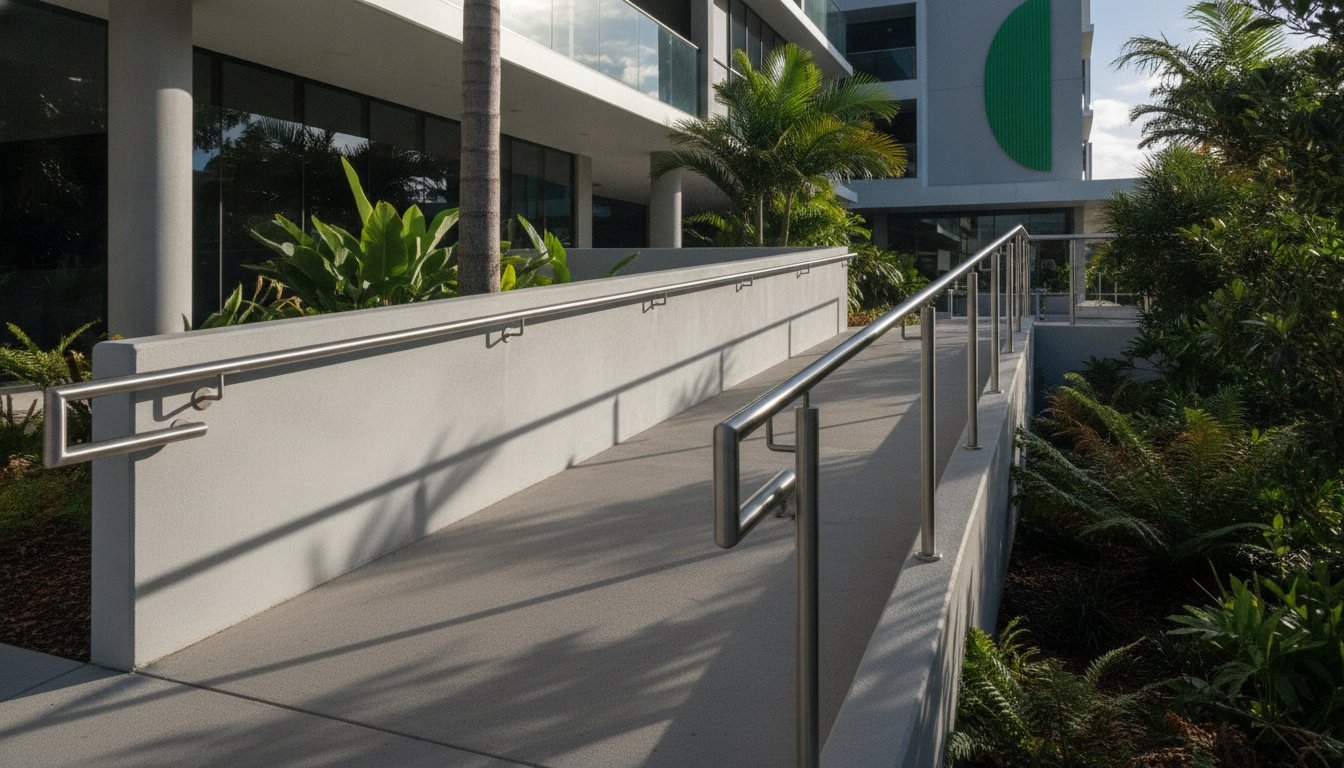
Did you know that over 33% of all disability discrimination complaints in Australia involve the accessibility of goods, services, and facilities? For property owners and developers in Brisbane and the Gold Coast, this statistic highlights a sobering reality. A handrail that is even five millimetres off spec isn’t just a safety hazard; it’s a significant legal liability. Keeping up with the current AS 1428 handrail requirements is often a source of genuine stress, particularly when you’re trying to distinguish between industrial standards like AS 1657 and the rigorous disability access mandates of AS 1428.1-2021.
We understand that you need more than just a list of rules. You need the confidence that your project will pass inspection and withstand the corrosive air of our coastal environment. This 2026 guide is designed to help you master the technical specifications of the latest standards to ensure your installations are compliant, safe, and durable. We will provide a definitive checklist for handrail dimensions, explain your legal obligations under the Disability Discrimination Act, and clarify exactly how the July 2025 updates to the National Construction Code affect your next fabrication project.
Key Takeaways
- Understand how the 2025 updates to the National Construction Code influence AS 1428 handrail requirements and the legal risks associated with non-compliance.
- Identify the exact height and diameter specifications needed to ensure your handrails provide a safe, ergonomic grip for all users.
- Learn to distinguish between disability access standards and industrial maintenance codes to avoid costly installation errors in complex site environments.
- Evaluate the benefits of Grade 316 stainless steel for coastal Queensland properties to ensure your hardware remains free from tea staining and rust.
- Gain insights into why custom fabrication provides the precision and durability necessary to meet the strict tolerances of Australian safety standards.
Understanding AS 1428.1-2021: Why Handrail Compliance Matters in Australia
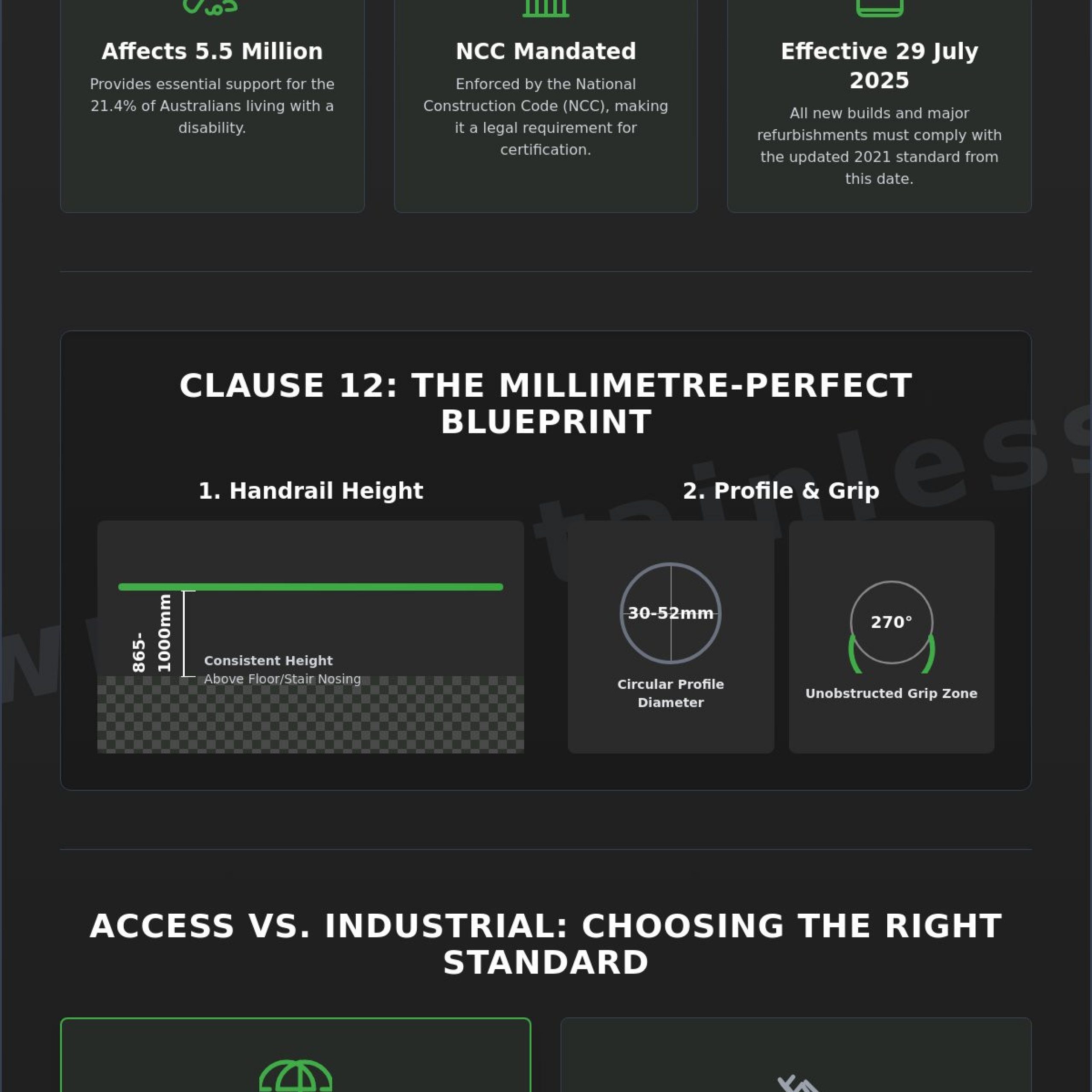
AS 1428.1-2021 is the benchmark for public accessibility in Australia. This technical standard, officially titled “Design for access and mobility,” provides the precise engineering specifications required to make buildings usable by people with disabilities. While older projects may still reference the 2009 edition, the 2021 update became the mandatory standard under the National Construction Code (NCC) 2022 Amendment 2. As of July 29, 2025, all new building works and major refurbishments must align with these updated AS 1428 handrail requirements to achieve certification.
The transition from the previous guidelines to the current 2021 standard reflects a broader national commitment to inclusivity. The NCC acts as the primary enforcement mechanism, ensuring that every ramp, staircase, and landing in a commercial or public setting meets a uniform level of safety. For fabricators and builders, this means there’s no room for guesswork. Precision is the only way to ensure that a project remains on the right side of the law.
The Core Purpose of Access and Mobility Standards
The fundamental goal of these standards is to facilitate a continuous accessible path of travel throughout the built environment. According to the Australian Institute of Health and Welfare, roughly 21.4% of the population lives with a disability. For these 5.5 million Australians, a compliant handrail provides the necessary support to navigate elevation changes safely. These standards are designed to reduce slip and fall risks in high-traffic commercial zones. A handrail that meets the AS 1428 handrail requirements ensures that users with varying levels of physical ability can maintain their balance and independence.
Legal Liability and the Cost of Non-Compliance
Property owners often underestimate the legal weight of these technical specifications. Compliance is a direct safeguard against litigation under the Disability Discrimination Act 1992. This federal legislation makes it unlawful to provide inadequate access to public premises. Data from the Australian Human Rights Commission shows that complaints related to facilities and services accounted for 33% of all disability discrimination claims in the 2023-24 period.
In the fabrication industry, we’ve seen the fallout of “near enough” installations. A handrail that sits just 10mm outside the allowed height range can trigger a mandatory rectification order. The cost of removing non-compliant fixtures, repairing the substrate, and installing new, custom-welded stainless steel is significantly higher than doing the job right the first time. Professional fabrication is an investment in long-term security and risk management.
Key Dimensions and Clearance Requirements under Clause 12
Clause 12 of the standard provides the definitive blueprint for compliant fabrication. Achieving full compliance isn’t a matter of estimation; it requires precise adherence to millimetre-accurate measurements. The AS 1428 handrail requirements dictate that the top of a handrail must sit between 865mm and 1000mm above the nosing of a stair or the finished floor level of a ramp. This height must remain consistent across the entire length of the installation, including landings and transitions. Sudden changes in height can disorient users, particularly those with vision impairments or mobility challenges.
The cross-section of the rail is equally critical for safety. To provide an effective grip, the diameter must fall between 30mm and 52mm. While many off-the-shelf components might look the part, they often fail to meet these specific tolerances once installed. For a deeper look at the technical rationale behind these measurements, the Australian Building Codes Board guidelines offer a comprehensive overview of how these dimensions support the broader National Construction Code objectives.
Grip and Cross-Sectional Geometry
Handrails aren’t limited to perfectly circular profiles, but they must be ergonomically sound. If you’re using an elliptical profile, the horizontal axis must be the larger dimension to facilitate a natural grip. The standard requires that the uppermost 270 degrees of the rail’s surface be completely free from obstructions. This ensures that a hand can slide along the rail without encountering brackets or sharp edges. Every weld must be ground smooth to maintain a tactile finish that won’t cause injury or discomfort during use.
Clearance and Obstructions Above the Rail
A common point of failure in site inspections is the clearance between the rail and the adjacent wall. You must maintain a minimum clear gap of 50mm. This space allows the fingers to wrap around the rail securely without hitting the wall surface. Additionally, a vertical clearance of 600mm is required above the top of the rail. This prevents property owners from placing signage, lighting fixtures, or architectural features too close to the handpath. Managing these clearances often requires bespoke stainless steel handrails that are tailored to the specific constraints of your building’s layout.
Designing for uninterrupted travel is the ultimate goal. On long ramps or stairways, the handrail must be a continuous element. If the path of travel is broken by a structural column or a doorway, the handrail must terminate and restart with specific extensions to guide the user safely. Our team focuses on these technical nuances to ensure every installation is both functional and fully compliant with the 2021 standards.
AS 1428.1 vs AS 1657: Choosing the Right Standard for Your Site
One of the most frequent questions we receive in the workshop involves the overlap between disability access and industrial safety. While both sets of regulations aim to prevent falls, their technical execution is vastly different. Choosing the wrong standard isn’t just a minor oversight; it’s a compliance failure that can lead to costly retrofitting. For property managers and developers, the distinction lies in who will be using the space and for what purpose. If the general public has access, you must adhere to the AS 1428 handrail requirements without exception.
AS 1657:2018 is specifically tailored for industrial environments, such as maintenance platforms, walkways, and ladders. It’s the standard we rely on for industrial pipework Brisbane projects where only authorised technicians are present. However, the moment a path of travel is open to the public, the more rigorous AS 1428.1:2021 takes precedence. Mixing these two standards in the wrong environment is a common mistake that building inspectors will flag immediately.
The Application Gap: Public vs. Private
Determining which standard applies depends on defining “accessible paths” versus “authorised personnel only” zones. In a public foyer, shopping centre, or aged care facility, the environment must be navigable by everyone, including those with varying physical abilities. You cannot use AS 1657 rails in these settings because they don’t provide the specific grip or termination safety required for disability access. For a deeper dive into managing these high-traffic areas, our commercial stainless steel handrails guide offers practical advice for property managers navigating these requirements.
Comparison Table: AS 1428 vs AS 1657
AS 1428.1:2021 is significantly more stringent than AS 1657, reflecting its role in ensuring universal accessibility.
| Feature | AS 1428.1 (Public Access) | AS 1657 (Industrial/Maintenance) |
|---|---|---|
| Handrail Height | 865mm to 1000mm | 900mm to 1100mm |
| Rail Diameter | 30mm to 52mm | 30mm to 65mm |
| Wall Clearance | Minimum 50mm | Minimum 50mm |
| Terminations | 300mm horizontal extensions past transition | Returns or safe endings required |
Plant rooms and rooftop service areas often fall into a “grey area” where commercial buildings overlap with industrial needs. If a plant room is only accessed by a plumber or electrician, AS 1657 typically suffices. But if that same room sits along a path that could be used by a member of the public during an emergency, the AS 1428 handrail requirements may apply. When dealing with hybrid sites, it’s always best to consult a specialist fabricator who understands how to bridge the gap between these two distinct safety codes.
Material Selection: Why Stainless Steel Wins for Compliance
While the geometry of a project is defined by technical standards, the longevity of the installation is determined by material science. Meeting the AS 1428 handrail requirements involves more than just hitting the right height and diameter; it requires selecting a substrate that can withstand its specific environment without degrading. In the humid and salt-heavy conditions of South East Queensland, stainless steel remains the premier choice for professionals who value precision and durability. It offers a level of structural reliability that modular aluminium or galvanised systems simply cannot match over the long term.
In environments where sanitation is a primary concern, the non-porous nature of this material is indispensable. This is why stainless steel handrails food processing applications are regarded as the gold standard. Bacteria and pathogens cannot easily penetrate the surface, which is a critical consideration for facilities that must balance strict health codes with disability access mandates. Choosing a high-quality finish ensures the rail remains easy to clean and free from the pitting that can harbour contaminants.
Corrosion Resistance in South East Queensland
Brisbane and the Gold Coast present a challenging environment for any metal fabrication. For any installation within five kilometres of the coastline, Grade 316 stainless steel is essential. Grade 304, while suitable for inland applications, often falls victim to “tea staining” when exposed to salt spray or high humidity. This brown surface discolouration isn’t just an aesthetic issue; it can eventually lead to structural pitting. We manage material quality for our industrial clients by ensuring all welds are passivated. This chemical process restores the protective chromium oxide layer, preventing localised rusting and ensuring the rail remains compliant and safe for decades.
Hygiene and Accessibility in Healthcare
The healthcare and residential care sectors rely on materials that support infection control while providing absolute stability. In aged care handrail applications, the high strength-to-weight ratio of stainless steel allows for slim, compliant profiles that can withstand high-impact loads from trolleys or mobility aids. Unlike timber or plastic-coated alternatives, stainless steel doesn’t crack or splinter, which removes a significant injury risk for elderly users. It also possesses excellent thermal properties. It doesn’t hold heat as aggressively as darker materials, ensuring the rail remains comfortable to the touch even in the Queensland sun.
Beyond the technical performance, stainless steel provides a clean, modern aesthetic that fits seamlessly into contemporary commercial architecture. Whether the design calls for a high-mirror polish or a subtle brushed finish, the material retains its professional appearance with very little maintenance. This reduces the total cost of ownership, as there’s no need for the frequent repainting or recoating required by mild steel. If you need a solution that balances these aesthetic demands with rigorous safety standards, our team can deliver the bespoke Stainless Steel Fabrication your project requires.
Professional Installation: Ensuring Your Handrails Meet the Mark
Even the highest quality materials can fail a compliance audit if the installation lacks precision. While some competitors promote modular, “no-weld” systems as a faster alternative, these kits often introduce points of failure that custom-welded solutions avoid. Mechanical joints can loosen over time under heavy use, creating small ridges or gaps. In a public setting, these imperfections can snag clothing or, worse, create a tactile obstruction that violates the 270-degree hand passage rule. A custom-welded rail provides a monolithic, continuous surface that is far superior in both strength and safety.
The physical reality of a construction site rarely matches the architectural drawings perfectly. Floor levels can vary, and walls aren’t always perfectly plumb. This is why our philosophy for handrail design and installation Brisbane is built on meticulous site measurement. By fabricating and adjusting on-site, we ensure the finished rail follows the exact contours of your building while maintaining the strict height tolerances required by the law. Mobile welding services allow us to make these millimetre-accurate adjustments in real-time, ensuring a perfect fitment that factory-prepped kits simply can’t achieve.
The Donewright Approach to Compliance
Our mobile workshop brings professional-grade engineering directly to your Brisbane or Logan site. This capability is vital for meeting the AS 1428 handrail requirements regarding seamless joins. Every connection point is fully TIG welded, ground back, and polished to a smooth finish. This ensures that a user’s hand can travel the entire length of the rail without encountering a single bump or sharp edge. We also pay close attention to custom terminations. A compliant rail must “return” to a wall or floor or turn 180 degrees at the ends to prevent it from becoming a protruding hazard. These returns are custom-fabricated to suit the specific geometry of your landings and transitions.
Maintenance and Long-Term Safety
Compliance isn’t a one-time event; it’s an ongoing responsibility for property owners. We recommend routine inspections to check for any loose fixings or surface degradation, especially in high-traffic commercial zones. While stainless steel is incredibly durable, maintaining its protective layer requires a basic cleaning protocol to remove salt and contaminants. This is particularly important for coastal properties where salt buildup can lead to surface discolouration if left unmanaged. A well-maintained rail doesn’t just look better; it remains a reliable safety asset for the life of the building.
Final sign-off on a project should only happen once every clearance and height has been verified against the 2021 standards. If you have concerns about an existing installation or need a new build to meet the latest AS 1428 handrail requirements, it’s best to speak with a specialist who understands the nuances of the code. For expert advice or to schedule a compliant site audit, Contact Wrighty and the team at Donewright Stainless today. We’ll help you ensure your facility is safe, accessible, and fully protected from the risks of non-compliance.
Securing Your Project with Precision Fabrication
Compliance is more than a box-ticking exercise; it’s a commitment to safety and universal accessibility. The transition to the 2021 standards means property owners must be more vigilant than ever regarding millimetre-accurate dimensions and clearances. By choosing Grade 316 stainless steel and prioritising custom-welded joins over modular alternatives, you eliminate the common failure points that lead to litigation or costly rectifications. Managing the complexities of AS 1428 handrail requirements is much simpler when you have a partner who understands the technical nuances of the National Construction Code.
With over 20 years of Brisbane industrial experience, our team provides the steady hand and technical expertise your project deserves. We bring our fully equipped mobile workshop directly to your site to ensure every termination and clearance is perfect. Whether you’re upgrading an aged care facility or securing a new commercial development, we’re here to help you get it right the first time. Get a Quote for Compliant Stainless Steel Handrails and let’s ensure your next installation is built to last. We look forward to helping you achieve a safe and fully compliant outcome for your site.
Frequently Asked Questions
Is AS 1428.1 compliance mandatory for all Australian buildings?
Compliance with AS 1428.1 is mandatory for all new commercial and public buildings, as well as significant refurbishments, under the National Construction Code. While private residential dwellings often follow different guidelines, any path of travel in a public space must adhere to these accessibility standards. Ensuring your project meets the AS 1428 handrail requirements from the outset protects you from legal challenges under the Disability Discrimination Act.
What is the required height for an AS 1428.1 compliant handrail?
The top of the handrail must be positioned between 865mm and 1000mm above the finished floor level or the nosing of a stair. This height must be maintained consistently across the entire length of the rail, including all landings and transitions. Precise measurement is vital during fabrication to ensure the installation remains within these specific tolerances for the safety and stability of all users.
What diameter should a disability-compliant handrail be?
A disability-compliant handrail must have a circular or elliptical cross-section with an external diameter between 30mm and 52mm. This range is specifically chosen to provide an optimal grip for users with varying levels of physical ability. If an elliptical profile is used, the horizontal axis must be the larger dimension to facilitate a natural and secure hold that supports the user’s weight effectively.
Can I use an AS 1657 handrail for public access areas?
You cannot use an AS 1657 handrail in areas accessible to the general public. AS 1657 is designed specifically for industrial maintenance settings and authorised personnel only. Because public access areas require more stringent safety features, such as specific terminations and tighter diameter tolerances, only AS 1428 handrail requirements are acceptable for foyers, ramps, and public stairways to ensure universal accessibility.
What is the minimum clearance between a handrail and a wall?
A minimum clear space of 50mm is required between the handrail and any adjacent wall or obstruction. This gap ensures that a user can wrap their fingers around the rail securely without their knuckles striking the wall surface. Additionally, the standard requires a 600mm vertical clearance above the rail to keep the handpath completely free from signs, lights, or architectural features that could cause injury.
Does AS 1428.1 require handrails on both sides of a ramp?
Handrails must be installed on both sides of a ramp or stairway to provide continuous support regardless of which hand the user prefers. This dual installation ensures that individuals with one-sided weakness or those using mobility aids can always find the stability they need. Each rail must be identical in height and profile to provide a uniform and predictable experience as the user moves through the facility.
What are the termination requirements for AS 1428 handrails?
Handrails must extend a minimum of 300mm horizontally past the top and bottom transition points of a ramp or stairway. These extensions provide a tactile cue that the elevation change has ended. Furthermore, the ends must be returned to a wall or floor, or turned 180 degrees, to prevent the rail from becoming a protruding hazard for those with vision impairments or mobility challenges.
Why is Grade 316 stainless steel recommended for Brisbane handrails?
Grade 316 stainless steel is recommended for Brisbane and Gold Coast projects due to its superior resistance to chloride-induced corrosion. Properties within five kilometres of the coast are highly susceptible to tea staining, which is a brown surface discolouration caused by salt spray. Using Grade 316, combined with professional passivation of all welds, ensures your handrails remain structurally sound and aesthetically pleasing in our humid coastal environment.