
Sanitary Stainless Steel Handrails for Food Processing: A Guide to Safety and Hygiene
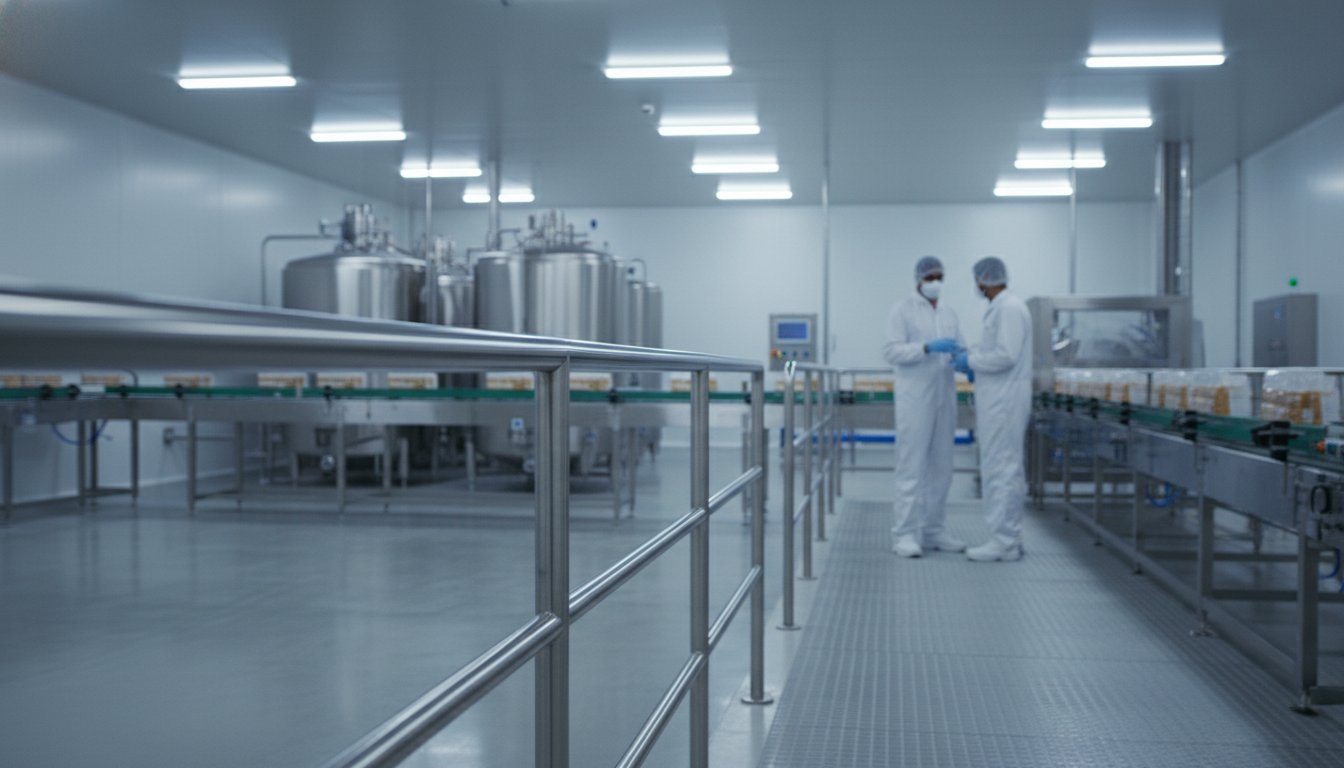
A handrail in a food production facility is often viewed as a simple safety requirement, but if it’s poorly designed, it’s actually a significant biohazard. You’re likely all too familiar with the challenge of keeping your plant compliant with both Work Health and Safety laws and strict food safety audits. It’s a difficult balance to maintain when standard safety equipment often features “bug traps” or crevices that harbour bacteria. Investing in high-quality stainless steel handrails for food processing isn’t just about preventing falls; it’s about protecting your product’s integrity from the ground up.
This guide explores how specialised sanitary design prevents contamination while ensuring your facility remains fully compliant with Australian Standards like AS 1657:2018 and AS 4674-2004. We’ll examine why specific welding techniques are essential to eliminate microbial growth and how choosing the right grade of stainless steel ensures your infrastructure survives harsh chemical washdowns. From navigating regulatory overlaps to achieving zero audit failures, you’ll discover how to build a safer, more hygienic production environment that stands the test of time.
Key Takeaways
- Eliminate microbial “bug traps” by implementing sanitary-first design and continuous welds for your stainless steel handrails food processing systems.
- Select the appropriate material grade, such as 316 stainless steel, to prevent corrosion from saline or acidic products and caustic cleaning agents.
- Ensure your facility meets the dual requirements of AS 1657:2018 for physical safety and AS 4674-2004 for hygienic design.
- Utilise 3D scanning and custom fabrication to achieve a precise fit for safety handrails and protection around complex, existing machinery.
- Minimise the risk of audit failures by prioritising durable, “clean-to-the-core” infrastructure that withstands rigorous Australian production standards.
The Critical Role of Stainless Steel Handrails in Food Processing Safety
In Australian food production, safety infrastructure often focuses on the machinery. However, the handrails that line your walkways and mezzanines are equally critical. Food-grade handrails are specialised safety assets designed specifically to prevent microbial harbourage. While a standard rail might suffice in a warehouse, it becomes a liability in a high-care environment. These rails serve a dual purpose: they provide essential physical fall protection for your team while maintaining biological protection for your products.
Many QLD facilities are currently transitioning away from legacy timber or painted mild steel structures. These older materials simply cannot withstand the uniquely hostile conditions of a modern processing plant. The constant exposure to moisture, organic matter, and aggressive cleaning agents requires a material that won’t degrade or contaminate the line. High-grade stainless steel handrails food processing systems have become the industry benchmark because they satisfy both safety and hygiene requirements simultaneously.
Why Standard Industrial Handrails Fail in Food Zones
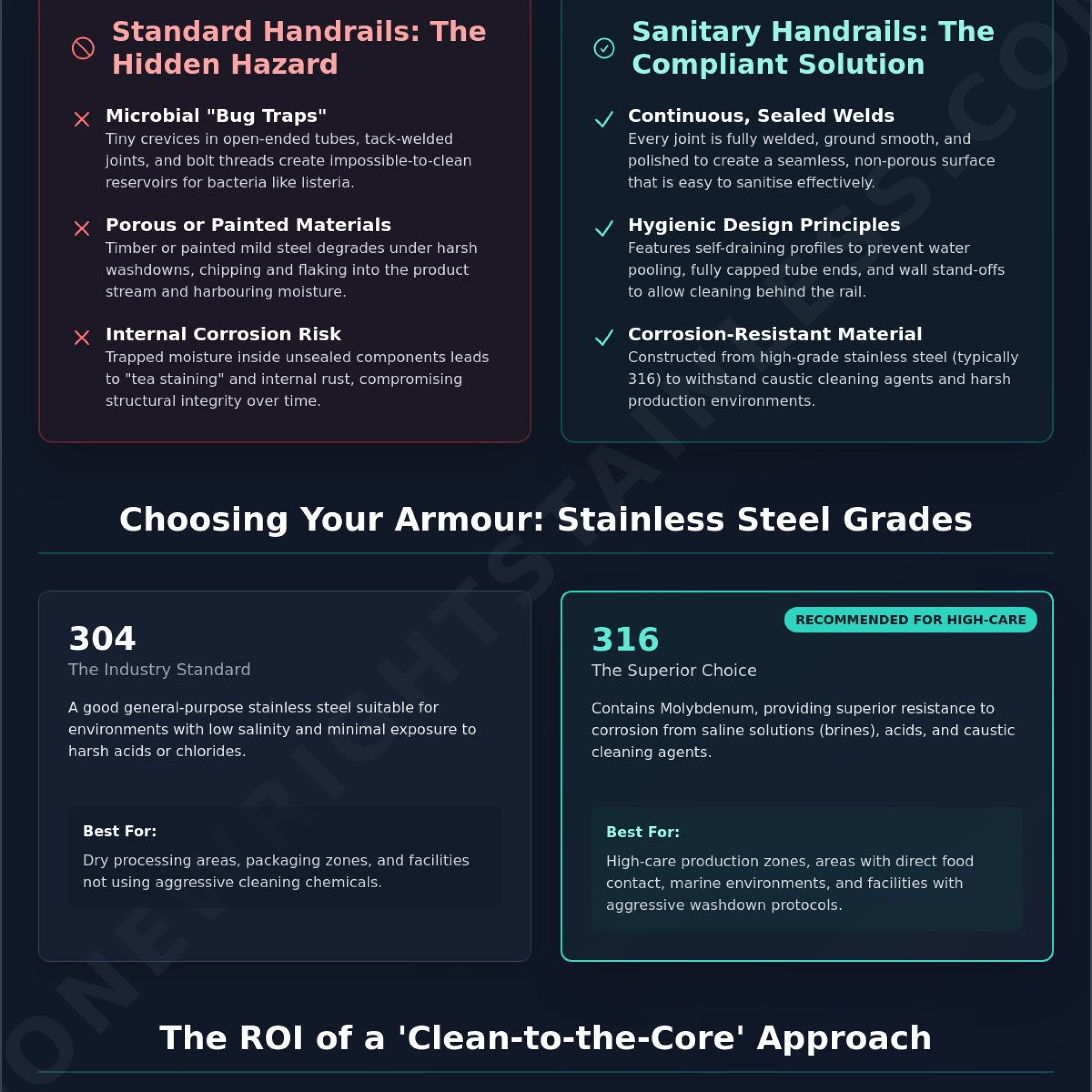
Standard industrial handrails often fail because they weren’t built with microbiology in mind. The most common issues are “bug traps”, which are tiny crevices in open-ended tubes or around tack-welded joints where bacteria can thrive. If a weld isn’t continuous and fully sealed, organic matter gets stuck. It’s impossible to clean these gaps effectively during a standard washdown.
When moisture becomes trapped in these areas, it leads to “tea staining” and internal corrosion. This isn’t just an aesthetic issue; it eventually compromises the structural integrity of the rail. For a plant manager, the cost of a hygiene audit failure due to non-compliant safety hardware often far outweighs the initial investment in sanitary fabrication. A single failed swab test on a handrail can halt production and trigger expensive remediation.
Primary Benefits of Stainless Steel for High-Care Environments
The inherent properties of stainless steel make it the superior choice for high-care zones. Its non-porous surface characteristics resist the formation of bacterial biofilms, making it much easier to sanitise than porous or coated alternatives. This material offers extreme durability against caustic cleaning agents and the high-pressure washdowns typical in Australian facilities.
By choosing stainless steel handrails food processing solutions, you’re securing a long-term ROI. The material’s resistance to pitting and corrosion means it won’t shed particles into the food stream. This reliability is vital for maintaining a sterile environment. The reduced maintenance needs and extended replacement cycles ensure your facility remains compliant and operational without the constant need for repairs. It’s a dependable choice for any facility that values both worker safety and product purity. The same principles of fall prevention and material durability that apply in food processing are equally critical in other regulated environments, as explored in this guide to stainless steel handrails aged care facilities rely on to protect vulnerable residents.
Sanitary Design Principles: Beyond Basic Fabrication
Fabricating stainless steel handrails food processing systems requires a ‘clean-to-the-core’ philosophy that goes far beyond standard metalwork. In a typical industrial setting, a small gap or an open tube end is a minor oversight. In a food plant, it’s a reservoir for listeria. Every component must be fully sealed with continuous welds to eliminate crevices where organic matter could hide. It’s about ensuring that every square millimetre of the rail is accessible to sanitising chemicals and mechanical scrubbing.
The geometry of the installation is just as vital as the material itself. We design rails with self-draining profiles to prevent liquids from pooling on flat surfaces. Water that sits on a rail after a washdown becomes a breeding ground for bacteria as it evaporates. Similarly, wall-mounted rails shouldn’t be bolted directly to the surface. We use specialised spacers and stand-offs to create a gap between the rail and the wall. This allows cleaning teams to wash behind the hardware, ensuring no hidden “hot spots” remain after a shift.
For facilities looking to upgrade their safety infrastructure, choosing a partner experienced in sanitary stainless steel fabrication ensures these design nuances aren’t missed. Investing in specialised stainless steel handrails food processing infrastructure means looking at the microscopic level of the metal itself to guarantee long-term hygiene.
The Importance of Weld Quality and Finishing
TIG welding is the gold standard for food-grade joins because it offers superior control and a cleaner bead. Once joined, we grind and polish every weld to a “flush” finish. This removes the physical ledge where debris might catch. We also take care to remove “heat tint” from the weld zone. This discolouration represents a depleted chromium layer that is highly susceptible to localised corrosion if left untreated, eventually leading to pitting and bacterial harbourage.
Surface Roughness (Ra) and Cleanability
Hygiene is measured by Surface Roughness, or Ra values. A lower Ra number indicates a smoother surface with fewer microscopic “peaks and valleys” for bacteria to cling to. While a mirror-polished finish offers the lowest Ra, it’s often impractical for high-traffic areas due to glare and visible scratching. A #4 brushed finish is the industry standard for handrails because it provides an ideal balance between a low Ra value for easy sanitisation and a durable, non-reflective surface that hides minor wear.
Grade 304 vs. 316: Selecting the Right Stainless Steel
Selecting the correct material grade is a decision that dictates the lifespan of your facility’s infrastructure. While Grade 304 and Grade 316 look identical to the naked eye, their chemical performance in stainless steel handrails food processing applications is vastly different. The primary distinction lies in the addition of molybdenum to Grade 316. This element provides a significant boost to the alloy’s resistance to chlorides and acids, which are prevalent in many food production environments.
In South East Queensland, environmental factors play a major role in material selection. Brisbane’s humid, coastal climate often leads to “tea staining”, a brown discolouration on the surface of the metal. While this is often cosmetic, it indicates that the protective chromium oxide layer is under stress. In high-care zones where hygiene is paramount, any sign of surface oxidation is a red flag for auditors. Choosing the right grade ensures your stainless steel handrails food processing investment doesn’t become a maintenance headache within its first year of service. For Brisbane facilities navigating these environmental challenges, understanding the full scope of stainless steel handrails Brisbane custom fabrication and AS 1657 compliance requirements is essential to making the right specification decision from the outset.
From a cost-benefit perspective, the initial premium for higher-grade materials is almost always recovered through reduced maintenance. Replacing corroded rails or constantly polishing away tea staining is a drain on operational budgets. We believe in getting the material specification right the first time to ensure your safety handrails and protection remain compliant for decades, not just until the next audit.
When to Use Grade 304 Stainless
Grade 304 is the most common stainless steel used in industrial settings. It’s an excellent, cost-effective choice for dry processing zones where moisture levels are controlled and chemical exposure is minimal. We often recommend 304 for general access areas, mezzanines, and staff walkways that are separated from the primary production line. For large-scale installations in low-moisture environments, 304 provides the necessary durability and compliance with Australian Standards without the higher price point of marine-grade alternatives.
The Case for Grade 316 in High-Washdown Zones
For facilities handling meat, seafood, or pickling processes, Grade 316 is the only reliable option. These environments involve high concentrations of salt and organic acids that aggressively attack lower grades of metal. Grade 316 is also essential in areas subjected to heavy daily washdowns using chlorinated cleaning solutions. These chemicals can cause pitting corrosion in 304 stainless steel, creating microscopic holes that harbour bacteria. If your rails are located outdoors or in semi-exposed loading docks in QLD, the superior corrosion resistance of 316 is a non-negotiable requirement for long-term structural integrity. This same Grade 316 specification is also the professional recommendation for choosing stainless steel handrails for aged care environments in Brisbane’s humid coastal climate.
Compliance and Installation: Navigating AS 1657 and Food Safety Standards
Achieving compliance in an Australian production facility requires balancing two distinct sets of regulations. The first is AS 1657:2018, which governs the design and installation of fixed platforms, walkways, stairways, and ladders. This standard is a mandatory requirement under the Work Health and Safety (WHS) Act. The second is AS 4674:2004, which provides the criteria for the design, construction, and fit-out of food premises. When installing stainless steel handrails food processing systems, these two standards must be integrated to ensure that a safety asset doesn’t become a hygiene liability. For a broader understanding of how these compliance requirements apply across different project types, the complete guide to commercial stainless steel handrails covering safety, compliance, and design provides valuable context on navigating the National Construction Code alongside AS 1657.
One of the most critical aspects of this intersection is the placement of handrails in relation to food contact surfaces. These are the “no-go” zones. A handrail should never be positioned directly over an open conveyor or processing bench where it could shed dust, moisture, or cleaning chemicals into the product. Additionally, elevated walkways require robust kick-plates and edge protection. These aren’t just for worker safety; they are essential for preventing tools, debris, or organic matter from being kicked off a platform and into the production line below.
If you need to ensure your facility meets these rigorous requirements, our team can provide a detailed assessment and installation of compliant Safety Handrails and Protection. We specialise in aligning physical safety with the strict cleanliness mandates of the Australian food industry.
Load Ratings and Structural Integrity
Every handrail installation must meet the 0.6kN/m load requirements specified in the Australian building code. This ensures the rail can withstand the force of a worker leaning or falling against it. Secure mounting is vital to prevent vibration and structural fatigue, which can eventually lead to hairline cracks in the welds. Because food plants often have complex layouts with limited space, we often utilise mobile welding services to achieve a perfect, bespoke fitment on-site. This ensures the handrail is structurally sound without creating awkward gaps that are difficult to clean.
Installation Hazards to Avoid
The installation process itself carries risks that must be managed. Cross-contamination is a primary concern; for example, using carbon steel tools on stainless steel can embed iron particles into the surface, leading to rust. We also manage the complexities of hot work permits in active production environments, ensuring that welding fumes or sparks don’t contaminate the facility. Finally, every piece of mounting hardware, from the bolts to the chemical anchors, must be food-grade stainless steel to prevent localised corrosion points from developing over time.
Custom Fabrication and Maintenance for Brisbane Food Facilities
Donewright Stainless specialises in bespoke plant upgrades across Brisbane and Logan. Every food production facility has unique spatial constraints, and standard off-the-shelf components rarely provide the precision required for high-care zones. We utilise 3D scanning technology to map complex machinery layouts before fabrication begins. This ensures that our stainless steel handrails food processing installations fit perfectly the first time. This approach eliminates the need for invasive on-site modifications that could otherwise introduce contaminants into a sterile environment.
Long-term hygiene integrity depends on more than just the initial install. We implement maintenance protocols like passivation and pickling to restore the protective chromium oxide layer of the metal. Over time, heavy chemical exposure can deplete this layer, leaving the steel vulnerable. By chemically treating the steel, we ensure it remains resistant to pitting and bacterial harbourage. Establishing a regular inspection schedule is the most effective way to identify safety and hygiene risks before they lead to a costly audit failure. To maintain clear records of these inspections, using durable industrial labels from DymoOnline ensures that safety and maintenance tags remain visible and secure even after rigorous cleaning cycles.
The Donewright Advantage: Mobile Workshops and Expertise
We understand that downtime is the enemy of production. Our fully equipped mobile welding units function as mobile workshops, allowing us to perform high-precision on-site fabrication and maintenance services. “Wrighty” and the team focus on building long-term industrial partnerships, prioritising the specific operational needs of your facility over one-off sales. In a recent project for a local meat processing facility, we identified and replaced several “bug trap” joints that had been flagged during a preliminary audit. By retrofitting sanitary-grade joins, we secured their compliance and improved the overall cleanability of their mezzanine levels.
Maintenance Tips for Sanitary Stainless
To preserve your infrastructure, use non-abrasive cleaning agents that won’t scratch the surface or damage the oxide layer. Avoid any products containing high concentrations of chlorides, as these can trigger rapid corrosion in even the best grades of steel. During your regular checks, look for early signs of stress corrosion cracking or crevice corrosion, particularly around mounting points and spacers. If you’re unsure about the current state of your facility’s safety hardware, professional guidance is essential. Contact Donewright for a site audit of your food processing handrails to ensure your plant remains both safe and hygienic.
Securing Your Facility’s Future with Sanitary Infrastructure
Investing in the right safety hardware is a fundamental step in protecting both your workforce and your product’s integrity. The difference between a compliant facility and a costly audit failure often lies in the microscopic details of your fabrication. By prioritising Grade 316 material in high-washdown zones and ensuring every join is fully sealed, you eliminate the “bug traps” that threaten food safety. Adhering to the dual requirements of AS 1657 and AS 4674 ensures your plant remains a benchmark for industrial excellence in Queensland.
At Donewright Stainless, we combine expertise in 304 and 316 grade sanitary fabrication with a deep understanding of Australian Standards. Our fully equipped mobile workshop allows us to provide on-site Brisbane installations with minimal disruption to your production schedule. Whether you’re retrofitting a complex mezzanine or planning a new facility, we’re here to ensure your stainless steel handrails food processing systems are built to last. Request a custom quote for your food-grade handrail project today and take the first step toward a safer, more hygienic production environment. We look forward to helping you build a facility that stands up to the most rigorous inspections.
Frequently Asked Questions
What is the difference between industrial and sanitary handrails?
Sanitary handrails prioritise microbial control and ease of sanitisation, whereas standard industrial rails focus primarily on structural strength. While industrial versions may include open tube ends or rough tack welds, sanitary designs feature continuous, fully sealed welds and polished surfaces to eliminate bacteria-harbouring crevices. This ensures the hardware can be thoroughly cleaned during standard plant washdowns without leaving hidden reservoirs of organic matter.
Does AS 1657 apply to handrails inside a food processing clean room?
Yes, AS 1657:2018 remains the mandatory standard for any fixed platform, walkway, or ladder within a food processing facility, including clean rooms. While hygiene standards like AS 4674 govern the material and finish, the structural design, height, and load-bearing capacity must still comply with AS 1657 to ensure worker safety and regulatory compliance under the WHS Act. Balancing these two standards is essential for a successful hygiene audit.
Why is Grade 316 stainless steel preferred for meat processing plants?
Grade 316 is preferred because it contains molybdenum, which provides superior resistance to the pitting corrosion caused by salts, organic acids, and blood. Meat processing environments are particularly aggressive, often requiring daily high-pressure washdowns with chlorinated chemicals. Grade 304 can fail in these conditions, leading to surface degradation that creates microscopic pockets where bacteria can hide and thrive.
How do I prevent ‘tea staining’ on stainless steel handrails in Brisbane?
Preventing tea staining in Brisbane’s humid, coastal climate requires a combination of high-grade material and smooth surface finishing. Specifying Grade 316 stainless steel handrails Brisbane with a low surface roughness (Ra) value reduces the ability of salt and moisture to cling to the metal. Regular maintenance washdowns with deionised water or specialised non-chloride cleaners also help preserve the protective chromium oxide layer that prevents brown discolouration.
What are ‘bug traps’ in stainless steel fabrication and why are they dangerous?
“Bug traps” are microscopic or visible crevices, such as open tube ends, unsealed joints, or rough weld beads, where organic matter and moisture accumulate. These areas are dangerous because they are impossible to reach with standard sanitising procedures, allowing bacteria like Listeria to thrive. Eliminating these traps is a core requirement when fabricating stainless steel handrails food processing systems for high-risk zones where product safety is paramount.
Can I use galvanised handrails in a food production area if they don’t touch the food?
Galvanised handrails are generally unsuitable for food production areas, even if they don’t have direct food contact. The zinc coating can flake or peel over time, posing a physical contamination risk to the production line. Additionally, galvanised steel cannot withstand the caustic cleaning agents used in food plants, leading to rapid corrosion and potential hygiene audit failures that could halt your operations.
How often should stainless steel handrails be inspected in a high-washdown environment?
In high-washdown environments, you should conduct a formal inspection of your stainless steel handrails food processing infrastructure at least every quarter. These checks should look for signs of stress corrosion cracking, loose mounting hardware, or any degradation of the sanitary seals. Facilities with aggressive daily cleaning cycles often benefit from monthly visual inspections to catch surface pitting before it compromises the hygienic integrity of the area.
What finish should I specify for handrails in a HACCP-certified facility?
For a HACCP-certified facility, a #4 brushed finish is the industry standard for handrails and safety infrastructure. This finish provides a smooth, non-porous surface that is easy to sanitise while remaining durable enough to hide minor scratches from daily use. It is essential to ensure the final surface roughness is low enough to prevent biofilm attachment without being so reflective that it creates a glare-related safety hazard for workers. For a comprehensive overview of how finish specifications fit within broader safety and design requirements, the guide to commercial stainless steel handrails safety compliance and design covers the full range of considerations from material selection through to National Construction Code obligations.