
Expert Handrail Design and Installation Brisbane: The 2026 Industrial Guide
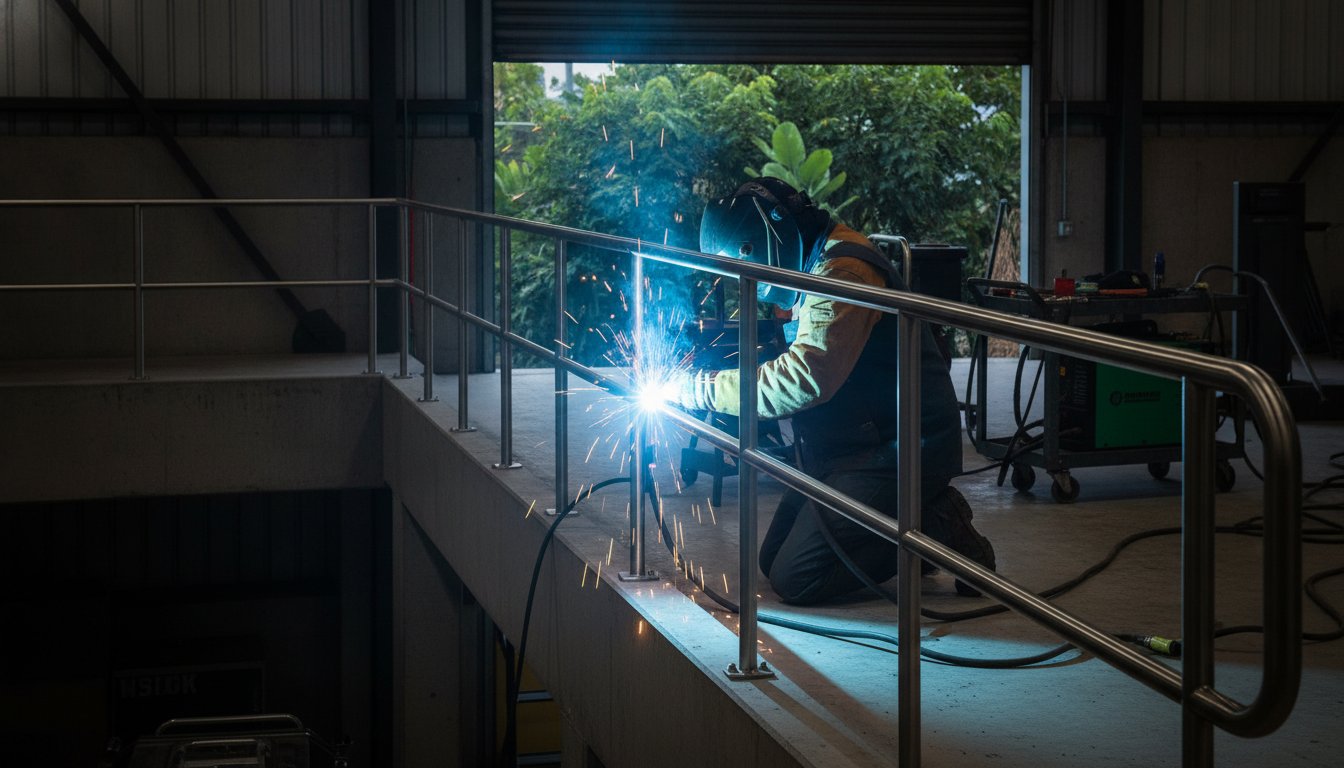
A single millimetre of error during fabrication can be the difference between a passed safety audit and a forced operational shutdown. It is a frustration many facility managers across South East Queensland share: waiting weeks for off-site components only to find they don’t quite fit the real-world dimensions of the shop floor. You know that in an industrial environment, a handrail isn’t just a fixture; it’s a critical safety barrier that must withstand both heavy use and the local humidity. When you’re responsible for site compliance, you need a solution that prioritises precision over shortcuts.
This guide provides the technical roadmap you need to secure the compliant, custom-engineered handrail design and installation Brisbane facilities require to meet the rigorous AS 1657:2018 standards. We’ll examine why Grade 316 stainless steel is the benchmark for resisting corrosion in the Brisbane climate and how a “measure twice, weld once” philosophy prevents costly installation delays. You’ll learn how to navigate the latest 2026 industrial requirements and discover how mobile workshop services can ensure a seamless, on-site fit that keeps your operations moving without the fuss of off-site errors.
In this industrial guide, you’ll discover:
- How to ensure your facility meets the current AS 1657:2018 standards for safety and compliance.
- The technical reasons why Grade 316 stainless steel is the necessary choice for Brisbane’s corrosive coastal air and high humidity.
- The specific benefits of a mobile workshop approach for precise handrail design and installation Brisbane projects.
- Custom fabrication strategies tailored for commercial property managers, body corporates, and industrial site operators.
The Essentials of Handrail Design and Installation in Brisbane
In an industrial or commercial setting, handrail design and installation Brisbane wide is a high-stakes service. It isn’t merely about aesthetics; it is a critical safety requirement that ensures your facility remains compliant with workplace health and safety (WHS) obligations. For Brisbane businesses, the environment adds another layer of complexity. Our local climate, characterised by high humidity and coastal salt spray, is notoriously harsh on metalwork. Without the right material selection and precision engineering, a handrail can quickly become a liability rather than a safety feature.
Effective Handrail design principles dictate that every installation must be fit for purpose. This means considering the specific traffic flow of a warehouse, the corrosive nature of a processing plant, or the high-visibility needs of a public commercial space. Choosing a local partner who understands South East Queensland (SEQ) building codes is essential for avoiding the rework and delays that often plague projects using non-local suppliers. Custom fabrication plays a vital role here, allowing us to address site-specific safety concerns that generic products often overlook.
Why Custom Design Beats Off-the-Shelf Solutions
Modular handrail kits might seem convenient, but they often fall short in complex industrial layouts. These off-the-shelf solutions frequently struggle with non-standard angles, uneven floor levels, or obstructions like existing pipework. Custom fabrication is the process of tailoring metalwork to exact site dimensions, ensuring a perfect fit that modular systems simply cannot replicate.
Bespoke design allows for superior ergonomics and seamless integration into your existing infrastructure. When a handrail is designed specifically for your site, it feels more secure and looks more professional. It eliminates the awkward gaps or mismatched joins that are common with generic kits, providing a continuous, safe grip for every user. This tailored approach ensures that the finished product isn’t just a barrier, but a functional part of your facility’s workflow.
The Local Brisbane Advantage
Working with a Brisbane-based fabricator offers practical benefits that go beyond simple logistics. We provide faster turnaround times for site visits and consultations, which is vital when you’re working to a tight construction schedule. Our team possesses deep knowledge of local council regulations and the unique environmental factors that affect metal longevity in SEQ.
Whether your facility is located in the heart of Brisbane, down on the Gold Coast, or out in Logan and Ipswich, having a local specialist means we can respond quickly to site-specific challenges. This proximity ensures that the final handrail design and installation Brisbane project meets your expectations for quality and durability without the fuss of long-distance communication or off-site fabrication errors.
Compliance and Standards: Meeting AS 1657 Requirements
Safety in the workplace is built on a foundation of strict regulatory adherence. For industrial sites, the governing standard is AS 1657:2018, which provides the framework for the design, construction, and installation of fixed platforms, walkways, stairways, and ladders. Compliance with AS 1657 Requirements is a legal obligation under Work Health and Safety (WHS) laws in Queensland. It ensures that every handrail design and installation Brisbane project provides reliable protection for personnel operating at height or in high-traffic zones.
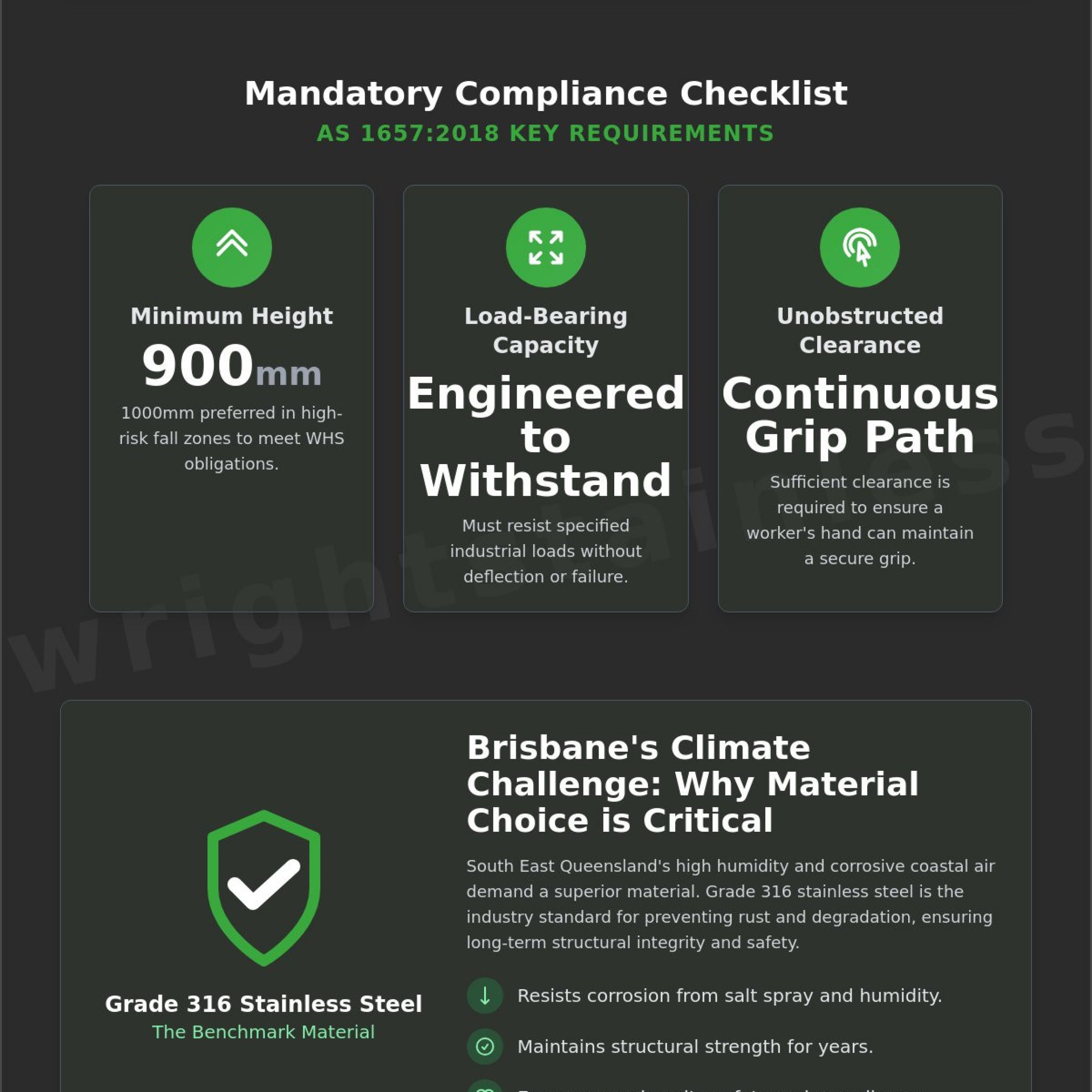
The standard specifies several critical parameters that must be met. For instance, the minimum height for a handrail in an industrial setting is 900mm, though 1000mm is often preferred where there is a significant risk of a fall. Load-bearing capacity is equally vital; stainless steel handrails Brisbane facilities use must be engineered to withstand specific industrial loads without deflection or failure. Clearance distances are also strictly monitored to ensure that a worker’s hand can maintain a continuous, unobstructed grip along the entire length of the rail.
Navigating Safety Protection Systems
It’s important to distinguish between a standard handrail, which provides guidance and stability, and a guard rail or safety barrier, which is designed to prevent a person from falling from one level to another. In environments like aged care facilities, the focus shifts slightly toward ergonomic support and falls prevention. For these sensitive projects, our aged care handrail guide details how to balance strict safety standards with user comfort and accessibility requirements.
The Consequences of Non-Compliant Installation
Cutting corners during installation often leads to significant long-term risks. Common errors include incorrect spacing between stanchions, poor weld quality that compromises structural integrity, or failing to install rails on both sides of a stairway wider than 1000mm. For Brisbane property managers, these mistakes can trigger failed safety audits and create substantial legal liability in the event of an accident. When planning a handrail design and installation Brisbane managers should prioritise trade-qualified installers who understand the nuances of the NCC. Relying on professional fabricators ensures that your installation is documented, tested, and fully compliant. If you’re concerned about your site’s current safety status, a quick review of your existing safety handrails and protection systems can identify potential issues before they lead to a workplace incident.
Material Science: Why Stainless Steel Suits the Brisbane Climate
Selecting the right material is the most significant factor in the longevity of any handrail design and installation Brisbane project. While timber or standard steel might suffice in drier regions, Brisbane’s unique environment presents a specific set of challenges. Our high humidity, combined with the coastal salt air that drifts far inland, creates a highly corrosive atmosphere. Grade 304 and Grade 316 are the two most common stainless steel alloys we use, but their applications differ significantly based on your site’s location and purpose.
Grade 304 is a versatile option suitable for controlled indoor environments. However, for most Brisbane industrial sites, Grade 316 is the non-negotiable “gold standard.” This alloy contains molybdenum, which provides critical resistance to chloride-induced pitting. Choosing Stainless Steel for Brisbane’s Climate is particularly vital for facilities near the Port of Brisbane or along the river, where salt concentrations are highest. Beyond its strength, stainless steel is also prized for its hygiene. Its non-porous surface doesn’t harbour bacteria, which is why we prioritise sanitary handrails in food processing to ensure safety barriers don’t compromise site cleanliness.
Stainless Steel vs. Aluminium and Mild Steel
When evaluating material costs, it’s essential to look at the long-term return on investment. Mild steel is often cheaper at the outset, but it requires expensive galvanising or powder coating that will eventually chip, leading to rust. Aluminium is lightweight and resists some corrosion, but it can be prone to surface pitting and lacks the structural rigidity of steel for heavy-duty industrial loads. Stainless steel offers the best longevity for Brisbane businesses because it remains structurally sound and visually professional for decades with minimal intervention. While we do handle aluminium and mild steel fabrication for specific secondary applications, stainless steel remains our primary recommendation for safety-critical infrastructure.
Maintenance and Longevity in SEQ
Even the highest quality stainless steel requires basic care to combat “tea staining,” a brown surface discolouration common in South East Queensland’s humidity. This isn’t a structural failure, but it can make a facility look neglected. Preventing this requires a high-quality surface finish, such as a fine satin or mirror polish, which reduces the crevices where salt and moisture can settle. For existing installations that are showing signs of age, our stainless steel maintenance services can restore the protective chromium oxide layer. This proactive approach ensures your handrail design and installation Brisbane project stays in peak condition, maintaining both its safety rating and its professional appearance.
The Donewright Workflow: From Design to Mobile Installation
A successful handrail design and installation Brisbane project relies on a disciplined process that bridges the gap between technical drawings and the physical reality of the site. We follow a methodical four-step workflow to ensure every stanchion and rail meets our standards for precision and longevity. The process begins with a detailed site measure and consultation. This initial stage allows us to identify potential obstacles, such as floor drainage gradients or existing machinery, that could interfere with a standard layout or compromise the safety of the final fit.
Once the site data is collected, we move to custom fabrication in our specialised workshop. Here, we prepare the primary components using heavy-duty equipment that ensures clean cuts and consistent bends. This off-site preparation is followed by on-site delivery and mobile welding, where the final assembly takes place. The workflow concludes with a rigorous compliance check and finishing process to ensure the installation adheres to the technical requirements specified in the design phase.
The Advantage of the Mobile Workshop
The transition from a workshop to a live industrial site often reveals minor discrepancies in floor levels or wall alignments. Donewright addresses this by deploying a fully equipped mobile workshop for every installation. This capability allows our team to make real-time adjustments that a shop-only fabricator simply cannot offer. If a floor is uneven or an existing structure has shifted, we can modify components on the spot to maintain the exact rail height and clearance required by safety codes.
This approach significantly reduces downtime for our clients. Instead of sending parts back to a factory for modification, we resolve issues immediately. This efficiency is particularly valuable for operational warehouses or manufacturing plants where every hour of restricted access impacts the bottom line. By bringing the workshop to the site, we ensure a precision fit that respects the unique geometry of your facility without the fuss of repeated site visits.
Precision On-Site Welding and Engineering
Structural integrity depends on the quality of the joins. We use trade-qualified welders who understand the metallurgical properties of the materials being used, ensuring that every weld is deep, clean, and free of defects. On-site welding allows for a seamless finish that is both stronger and more hygienic than mechanical joins. This level of craftsmanship is essential for maintaining the structural load-bearing capacity mandated by Australian Standards, particularly in environments where the handrail will experience heavy daily use.
Our capacity for mobile welding Brisbane wide means we can handle complex retrofits or new builds with equal efficiency. Whether you’re installing a single safety barrier or a comprehensive multi-level walkway system, the focus remains on engineering excellence and site-specific accuracy. If you’re ready to secure your facility with a custom-engineered solution, you can contact our team for a site consultation to discuss your specific requirements.
Custom Handrail Solutions for Brisbane Industries
Brisbane’s industrial landscape is diverse, ranging from the heavy-duty loading docks at the Port of Brisbane to the high-traffic corridors of inner-city commercial hubs. For commercial property managers and body corporates, handrail design and installation Brisbane projects must balance safety with the professional presentation of the building. These environments require a specific focus on longevity and ease of maintenance, particularly in shared spaces where aesthetics matter as much as structural integrity. For a deeper look at these specific requirements, our commercial stainless steel handrail guide provides a comprehensive breakdown of safety compliance for multi-residential and office developments.
In industrial plants, the focus shifts toward protecting personnel on mezzanines, elevated walkways, and technical access platforms. Ian “Wrighty” Wright brings a “no fuss” approach to these complex environments, understanding that site managers need results that work the first time without constant supervision. Whether it’s a simple safety rail or a bespoke protection system for moving machinery, the goal is to deliver a solution that integrates perfectly with your existing operational flow. We ensure that every component is engineered to withstand the specific rigours of your site, from chemical exposure to physical impacts.
Commercial and Public Sector Projects
Public infrastructure projects, including schools, hospitals, and transit centres, demand handrails that can withstand constant use while remaining safe for all users. These projects often require strict adherence to the Disability Discrimination Act (DDA) to ensure accessibility for everyone. We design our stainless steel systems to meet these DDA requirements, providing smooth, continuous surfaces that offer reliable support without snagging or sharp edges. For facilities that must also satisfy disability access mandates, understanding the full scope of AS 1428 handrail requirements is essential to ensuring your installation passes inspection and meets the 2026 compliance standards. The durability of Grade 316 stainless steel ensures these public assets remain functional and look professional even after years of high-volume traffic in Brisbane’s humid conditions.
Industrial Maintenance and Bespoke Fabrication
A handrail installation is rarely an isolated task; it often forms part of a broader site maintenance or upgrade program. Because we are trade-qualified fabricators, we can integrate your handrail design and installation Brisbane project with other bespoke requirements. This might include custom stainless benches for laboratories, heavy-duty trolleys for cleanrooms, or custom bench tops for food preparation areas. This holistic approach to metalwork ensures consistency in material quality and craftsmanship across your entire facility. If you’re looking for a reliable partner who understands the technical demands of Brisbane industry, contact Donewright for a fair dinkum quote on your next project.
Future-Proofing Your Facility’s Safety Standards
Maintaining a safe and compliant industrial facility in South East Queensland requires more than just a standard barrier. You need a system that withstands the local humidity while meeting the rigorous demands of AS 1657. By prioritising Grade 316 stainless steel and precision fabrication, you ensure your infrastructure remains a long-term asset rather than a maintenance burden. The right handrail design and installation Brisbane project bridges the gap between technical safety requirements and the practical realities of a busy shop floor.
Our trade-qualified team, led by Ian “Wrighty” Wright, specialises in delivering these high-stakes solutions without the usual delays or fabrication errors. We use a fully equipped mobile workshop to provide SEQ-wide service, allowing us to handle complex on-site adjustments with total accuracy. This approach guarantees that every weld and stanchion is exactly where it needs to be for maximum structural integrity. It is about providing a steady, experienced hand that you can trust to get the job done right.
If you’re ready to upgrade your site’s protection, we are here to help. Get a no-fuss quote for your Brisbane handrail project and secure a result that is built to last. We look forward to helping you achieve a compliant, professional finish for your facility.
Frequently Asked Questions
Do I need a permit for handrail installation in Brisbane?
Most new handrail installations in Brisbane require building approval from a private certifier to ensure they meet the National Construction Code (NCC) and relevant Australian Standards. While minor maintenance or like-for-like repairs might not always trigger a full permit, any structural addition or modification to safety barriers in a commercial or industrial setting should be certified. This documentation is vital for your insurance and workplace health and safety (WHS) records.
What is the difference between AS 1657 and residential handrail standards?
AS 1657:2018 is specifically designed for industrial environments like factories and warehouses, covering fixed platforms, walkways, and stairways. Residential standards, governed by the NCC, focus on domestic safety and aesthetics, such as preventing children from climbing. Industrial standards prioritise heavy-duty load-bearing capacity and specific grip dimensions for workers using safety equipment, often requiring different heights and clearance than a standard home staircase.
How long does a typical custom handrail installation take?
The timeframe for a custom project depends on the complexity of the site and the total linear metres required. A small industrial retrofit might be completed in a single day, whereas a comprehensive facility-wide upgrade could span several weeks. Most of the technical fabrication occurs in our workshop first, followed by efficient on-site assembly using our mobile welding units to minimise operational downtime for your business.
Can you perform on-site welding for handrail repairs in Brisbane?
Yes, we provide specialised mobile welding services for handrail repairs across the entire Brisbane metropolitan area. Our fully equipped mobile workshop allows us to perform high-quality TIG and MIG welding directly at your facility. This is particularly useful for repairing damaged sections or modifying existing rails to meet new safety requirements without the need to dismantle and transport large sections of metalwork back to a factory.
Is Grade 316 stainless steel necessary for handrails in Logan or Ipswich?
While Logan and Ipswich are further from the coast than the Port of Brisbane, Grade 316 is still highly recommended for any outdoor or high-traffic handrail design and installation Brisbane project. The high humidity levels in South East Queensland can cause Grade 304 stainless steel to “tea stain” or develop surface corrosion over time. Grade 316 contains molybdenum, which provides the superior durability needed to maintain a professional, rust-free finish in our local climate.
What is the difference between a handrail and a balustrade?
A handrail is the specific component designed to be grasped by the hand for support and stability while moving along a path or stairs. A balustrade refers to the entire protective barrier system, including the handrail, vertical posts, and any infill panels or wires. In industrial settings, the focus is often on the handrail’s ergonomic grip and the guard rail’s ability to prevent falls from platforms or mezzanines.
Do your handrail designs comply with Brisbane commercial safety regulations?
Every project we undertake is engineered to meet the current AS 1657:2018 standards and the National Construction Code. We specialise in handrail design and installation Brisbane businesses rely on for passed safety audits and WHS compliance. Our team ensures that all heights, load ratings, and clearance gaps are strictly followed, providing you with the necessary documentation to prove your facility meets Australian legal requirements.
Can you install handrails in food-grade or sanitary environments?
We regularly install handrails in food processing plants and pharmaceutical facilities that require strict sanitary standards. These projects use high-grade stainless steel with specialised hygienic welds that eliminate crevices where bacteria could grow. By using non-porous materials and specific finishing techniques, we ensure your safety protection systems are fully compliant with both safety regulations and food-grade hygiene protocols.
We are ready to assist you in your next project.
Please contact us and we can discus how the Donewright Team can work with you on your next project.