
Mobile Welder for Plant Maintenance in Ipswich: A Guide
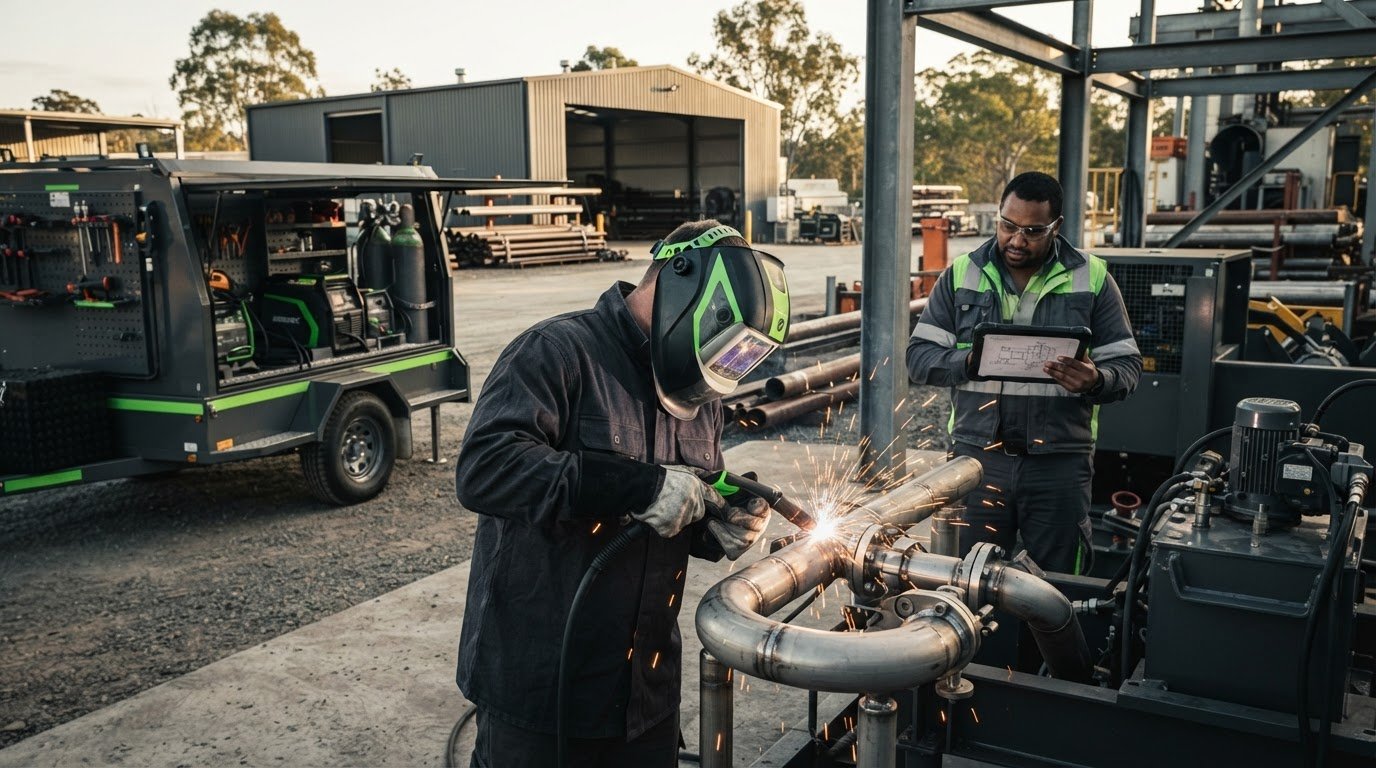
Could a welding repair be completed on site and coordinated with your plant’s maintenance schedule? A mobile workshop can suit some site-based tasks, but the right approach depends on the work, materials and conditions. If you’re looking for a mobile welder for plant maintenance Ipswich, start by matching the repair to the asset and the site rather than assuming every job belongs in a workshop.
Donewright Stainless provides industrial maintenance, pipework services and mobile welding in Ipswich, supported by a fully equipped mobile workshop. The team also fabricates stainless steel, mild steel and aluminium. Its local service coverage includes Brisbane, Gold Coast, Logan and Ipswich, supporting industrial and commercial work across the region.
This guide explains when mobile welding may suit plant maintenance, what information helps define an on-site job and which site conditions to consider. It also outlines how Donewright Stainless’s maintenance, pipework and fabrication services can support a practical next step for your Ipswich site.
Key Takeaways
- Mobile welding brings welding capability to plant equipment or pipework on site when the task and working conditions suit.
- Assess access, equipment location, work scope and operational coordination when comparing on-site and workshop work.
- When arranging a mobile welder for plant maintenance Ipswich, share the task, material and site details to help define the scope.
- Donewright Stainless supports industrial maintenance in Ipswich with a fully equipped mobile workshop, pipework services and fabrication in stainless steel, mild steel and aluminium.
- Clear planning helps organise welding work around site requirements and operational priorities.
When a Mobile Welder for Plant Maintenance in Ipswich Makes Sense
A plant asset or section of pipework may need welding attention while installed on site. Moving it could add handling and coordination to the job. Mobile welding brings the work to the customer’s location, which can be a practical option when the asset is accessible and transporting it to a workshop would complicate the maintenance plan.
On-site work can avoid moving an asset, but it does not guarantee less downtime. The repair still needs to be planned around the task, site conditions and operational requirements. A mobile welder for plant maintenance Ipswich can support scheduled maintenance and industrial pipework work, with the approach determined by the job rather than an assumption that every task is suitable for on-site welding.
On-site welding may suit a maintenance task when the work can be carried out safely and practically at the asset’s location, and moving the item would add unnecessary complexity.
Which plant maintenance jobs may suit on-site welding?
Industrial maintenance can involve welding attention to equipment or fixed components used in a facility’s operations. Pipework is another relevant area: when a section is installed in place, planning work at the site may be more practical than removing and transporting it. Donewright Stainless provides industrial pipework and maintenance services, supported by on-site mobile welding.
The material, work location and surrounding conditions all affect how a task is scoped. Arc welding is a broad welding process; Arc welding provides an overview of its principles and applications. That general information does not determine the right method for a particular repair. The approach needs to reflect the asset and job requirements.
What does Ipswich-based service coverage mean for plant operators?
Donewright Stainless is based in Brisbane and serves Ipswich, along with the Gold Coast and Logan. For plant operators in Ipswich, mobile welding can be considered alongside maintenance and pipework needs at the site. The site location is part of the work-planning discussion, along with the asset, access and operating conditions.
For a planned task involving a fixed asset or pipework, identifying the site and describing the work helps establish whether bringing the mobile workshop to the job is a sensible approach. The decision depends on the specific task, access and operational context.
Mobile welding is one part of planned maintenance support, not an automatic answer to every welding requirement. When moving equipment would add complexity and the site conditions suit the work, an on-site approach may be worth considering. A clear scope helps align the job with the plant’s operational priorities.
What a Mobile Workshop Can Bring to Industrial Maintenance
A fully equipped mobile workshop brings welding and fabrication capability to an industrial site. For plant maintenance, this means the work can be assessed in relation to the asset’s location, rather than treating transport to a separate workshop as the default. Access, task requirements and site conditions help shape the work plan.
Donewright Stainless supports on-site projects with mobile welding, industrial maintenance and pipework services. Its fabrication capabilities cover stainless steel, mild steel and aluminium. Identifying the material is useful when describing a plant job, but it is only one part of defining the scope. A mobile welder for plant maintenance Ipswich can support site-based work, with the approach shaped by the asset and its operating environment.
Good job scoping connects the material, maintenance task and site conditions before the work is organised. Knowing what the component is made from, where it is located and what needs attention gives the discussion a practical starting point.
Matching material and fabrication needs to the job
Identifying the material helps describe the work accurately. Donewright Stainless fabricates stainless steel, mild steel and aluminium. If you know the material, include it when explaining the job. If you do not, describe the component and share any available details rather than guessing. Its location and the maintenance requirement also help define the scope.
The task matters as much as the material. Repairing an existing component differs from fabricating an item, and site access can affect how either job is organised. Start by describing what needs attention and where it sits within the plant. Those details give the discussion a practical foundation without presuming a particular process or specification.
Mobile welding alongside industrial pipework maintenance
Welding and pipework maintenance can be closely connected on an industrial site. A section of pipework may need attention where it is installed, so its location and maintenance context help define the associated welding task. Donewright Stainless provides industrial pipework and maintenance services supported by its mobile workshop. The scope is based on the pipework, material and site conditions, not assumptions about the plant’s systems.
For further context on site-based pipework work, the on-site industrial pipework repair guide explains how repair needs relate to location and maintenance planning.
For plant operators, the mobile workshop is a way to organise suitable welding and fabrication work around the asset and the facility’s operating requirements. Sharing the material, task and site context helps clarify the scope. If your Ipswich maintenance job involves industrial pipework or fabrication, you can also learn about Donewright Stainless services for site-based work.
On-Site Welding or Workshop Work: How to Assess the Job
The choice between on-site welding and workshop work depends on the job. A fixed component may be difficult to remove or transport, while another item may be easier to handle away from its operating location. Site access, the equipment’s position, the work scope and coordination with plant operations all affect which approach is practical.
Use the comparison below to organise your assessment. It is a starting point, not a substitute for considering the individual task and site.
| Assessment factor | On-site work may suit when… | Workshop work may suit when… |
|---|---|---|
| Site access | The work area is accessible and there is suitable space around the asset. | Access is restricted or the work area makes the task difficult to carry out on site. |
| Equipment location | The item is fixed in place or moving it would add handling and coordination. | The component can be removed and transported as part of the maintenance plan. |
| Work scope | The task can be clearly defined for work at the asset’s location. | The job is better suited to being completed away from the plant. |
| Operational coordination | The work area and timing can be organised around site operations. | Removal and separate workshop work fit the facility’s maintenance plan more practically. |
When site access and equipment location shape the decision
Start by identifying exactly where the asset is and how the work area can be reached. Consider access routes, clearance around the component and whether equipment can be moved through the site. A confined or obstructed location may affect the work approach. A fixed asset may also be impractical to transport. These details help establish whether on-site work is suitable.
Do not assume every repair can be completed where the equipment sits. Site conditions and the task determine what is practical. Photos or a clear description of the location can help explain access constraints when scoping the job.
How to weigh operational disruption and work scope
Compare the coordination involved in working at the asset with the steps needed to isolate, remove, transport and return it. Neither option automatically means less disruption. Share the plant’s operating requirements and scheduling constraints so the work can be considered in context. For fabrication-related work, Donewright Stainless’s mild steel fabrication and mobile on-site services can also inform how a project is organised.
Welding method selection depends on the task and site conditions. This applies whether work is planned at the plant or elsewhere. Material, access, equipment location and operational coordination help define the requirements and the appropriate work setting.
If you are comparing options with a mobile welder for plant maintenance Ipswich, describe the asset, its location and the work required. A clear scope makes it easier to weigh site work against equipment removal without presuming one approach suits every maintenance task.
How to Prepare for Plant Maintenance Welding in Ipswich
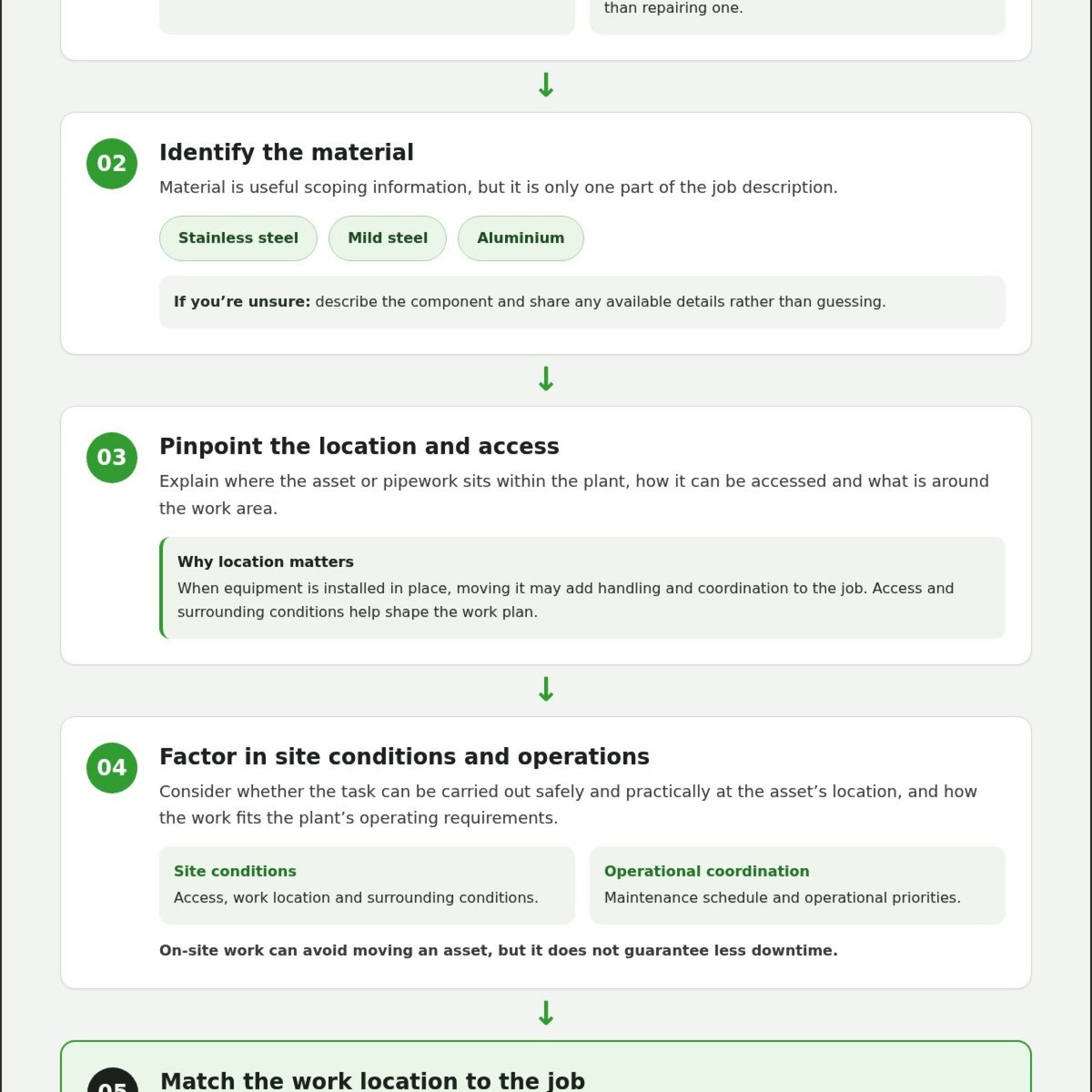
A clear brief helps define the job before on-site welding is organised. You do not need every technical detail at hand. Start with what needs attention, what you know about the item and how the work area operates. For a mobile welder for plant maintenance Ipswich, these details connect the maintenance requirement with site conditions and access arrangements.
Use this sequence to prepare the discussion:
- Describe the task. Identify the affected asset or pipework, what it does and what needs attention. Explain whether the work is a repair or part of planned maintenance.
- Identify the material. Share what you know about the material, such as stainless steel, mild steel or aluminium. If you are unsure, say so rather than guessing.
- Share site details. Give the Ipswich site location and describe where the item is, how the work area is reached and any access or clearance constraints.
- Coordinate access. Note relevant operating schedules and the people responsible for site operations, so access and timing can be considered as part of planning.
Information to assemble before discussing the job
Describe the item and its role in the facility, then explain the maintenance issue in plain terms. Note whether pipework or fabrication is involved and include known material details. Photos, drawings or measurements may help illustrate the item and its location. They provide useful context but do not replace defining the work on site.
Separate what you know from what still needs to be established. You may know which component is affected and where it is located, but not its material. A straightforward description still gives the discussion a starting point and helps identify what information is needed to shape the scope.
Planning access and minimising avoidable disruption
Discuss access and timing early. Consider how the work area is reached, whether moving equipment affects access and which operating requirements could influence the plan. People responsible for plant operations can identify relevant constraints and coordinate the work with the facility’s schedule.
Good coordination does not guarantee a particular duration or downtime outcome. It does make practical considerations visible before arrangements are made, so the job can be planned in relation to the site.
Donewright Stainless provides mobile welding, industrial maintenance and pipework support in Ipswich. Once you have assembled the task, material and site details, discuss your plant maintenance requirements with the team to begin scoping the work.
Choosing Donewright Stainless for Mobile Plant Maintenance in Ipswich
Industrial maintenance requires a practical fit between the task, material and site. Donewright Stainless brings together mobile welding, a fully equipped mobile workshop, industrial maintenance and pipework services for site-based work in Ipswich. Its fabrication capabilities cover stainless steel, mild steel and aluminium. The company serves Brisbane, the Gold Coast, Logan and Ipswich, providing a local point of contact for industrial and commercial maintenance and fabrication requirements.
The value of scoping a job in context is clear when comparing different tasks. A repair involving installed pipework has different site considerations from fabrication work on a removable component. The asset’s location, material, access and operational requirements all help shape the scope. Clear details at the outset support practical planning without assuming every task needs the same approach.
A local industrial maintenance partner serving Ipswich
Donewright Stainless is based in Brisbane and serves Ipswich, as well as the Gold Coast and Logan. Its work includes industrial and commercial maintenance, pipework, mobile welding and fabrication. This is relevant to facilities planning work on plant assets, where the location and operating context can matter as much as the component itself.
For a maintenance requirement involving pipework, describing the affected section and its site conditions helps explain the work. Donewright Stainless also provides industrial pipework services, connecting pipework maintenance with its broader site-based support. The scope is considered around the specific job, not assumed from the type of facility alone.
Discuss your plant maintenance welding requirements
To start a useful discussion, bring together the key details about the work:
- The asset: Describe the item, what it does and the maintenance issue.
- The material: Share whether it is stainless steel, mild steel or aluminium, if known.
- The site: Explain where the work is located and note access or space considerations.
- The operation: Outline relevant scheduling requirements and who coordinates site access.
These details help establish what the job involves and how the work can be organised. If some information is unavailable, a straightforward description of the asset and issue still provides a starting point. The project scope is shaped around the maintenance requirement and site context.
For operators looking for a mobile welder for plant maintenance Ipswich, the next step is a clear conversation about the work. Share the asset, material, location and maintenance need so the task can be discussed in practical terms.
Contact Donewright Stainless to discuss your plant maintenance requirements and on-site mobile welding in Ipswich.
Plan the Next Maintenance Step
A welding requirement can prompt a review of how the repair fits into your wider maintenance plan. Consider the asset’s role, the work that needs attention and how the job can be coordinated with plant operations. This gives your team a clearer basis for discussing the scope and deciding what should happen next.
If you are considering a mobile welder for plant maintenance Ipswich, you do not need to settle every technical detail before starting a conversation. An outline of the issue and site context is enough to begin discussing the work with Donewright Stainless.
Discuss your plant maintenance welding requirements with Donewright Stainless and take the next step towards a clearly scoped maintenance job.
Frequently Asked Questions
Can a mobile welder complete plant maintenance work on site in Ipswich?
Yes. Donewright Stainless provides mobile welding in Ipswich through its mobile workshop. Whether a particular task suits on-site work depends on the job, material and site conditions. A fixed component that is difficult to move may present a different scope from a removable part. Describe what needs attention and where it is located so the work can be considered in context.
What information should I provide when enquiring about plant maintenance welding?
Describe the affected asset, its function and the issue you have noticed. Include the known material, whether pipework or fabrication is involved, and the site location. Explain how the work area is accessed, including any restricted routes or limited clearance. Also mention operating constraints that could affect coordination. If some details are unknown, say so. A clear account of what you do know is still useful.
Can mobile welding be used for industrial pipework maintenance?
Mobile welding can be considered as part of industrial pipework maintenance, depending on the job and site. The pipework’s location, material and maintenance requirement all inform the scope. Donewright Stainless provides industrial pipework and mobile welding services, allowing those needs to be discussed together. Describe the section requiring attention and whether it is installed in place, rather than assuming every pipework task can be completed on site.
Does Donewright Stainless provide mobile welding in Ipswich?
Yes. Donewright Stainless serves Ipswich with mobile welding supported by a fully equipped mobile workshop. Its industrial maintenance and pipework services support site-based plant work, while its fabrication work covers stainless steel, mild steel and aluminium. Share the maintenance task and site context to start a practical discussion about the work required.
What materials can Donewright Stainless fabricate for industrial jobs?
Donewright Stainless fabricates stainless steel, mild steel and aluminium for industrial and commercial applications. Identifying the material helps describe the component and the job. If you are uncertain, provide what you know about the item and its use rather than guessing a specification. The project scope is considered in relation to the material, task and site requirements.
How do I decide between on-site welding and workshop fabrication?
Consider whether the asset can be moved, how accessible it is, what the work involves and how each option fits plant operations. A removable component may be handled differently from an item fixed within the facility. Also account for the effort involved in moving and returning equipment. These factors help frame the decision, but the task and conditions determine the suitable approach.
Can plant maintenance welding be planned around operating requirements?
Plant maintenance welding can be discussed in relation to operating requirements, access needs and the facility’s schedule. Share constraints early, such as when an area is available or which site personnel coordinate the work. This makes relevant considerations clear while the job is scoped. The duration and downtime depend on the project and site arrangements.
