
Commercial Stainless Steel Handrails: The Ultimate Guide to Safety, Compliance, and Design
Commercial Stainless Steel Handrails: The Ultimate Guide to Safety, Compliance, and Design
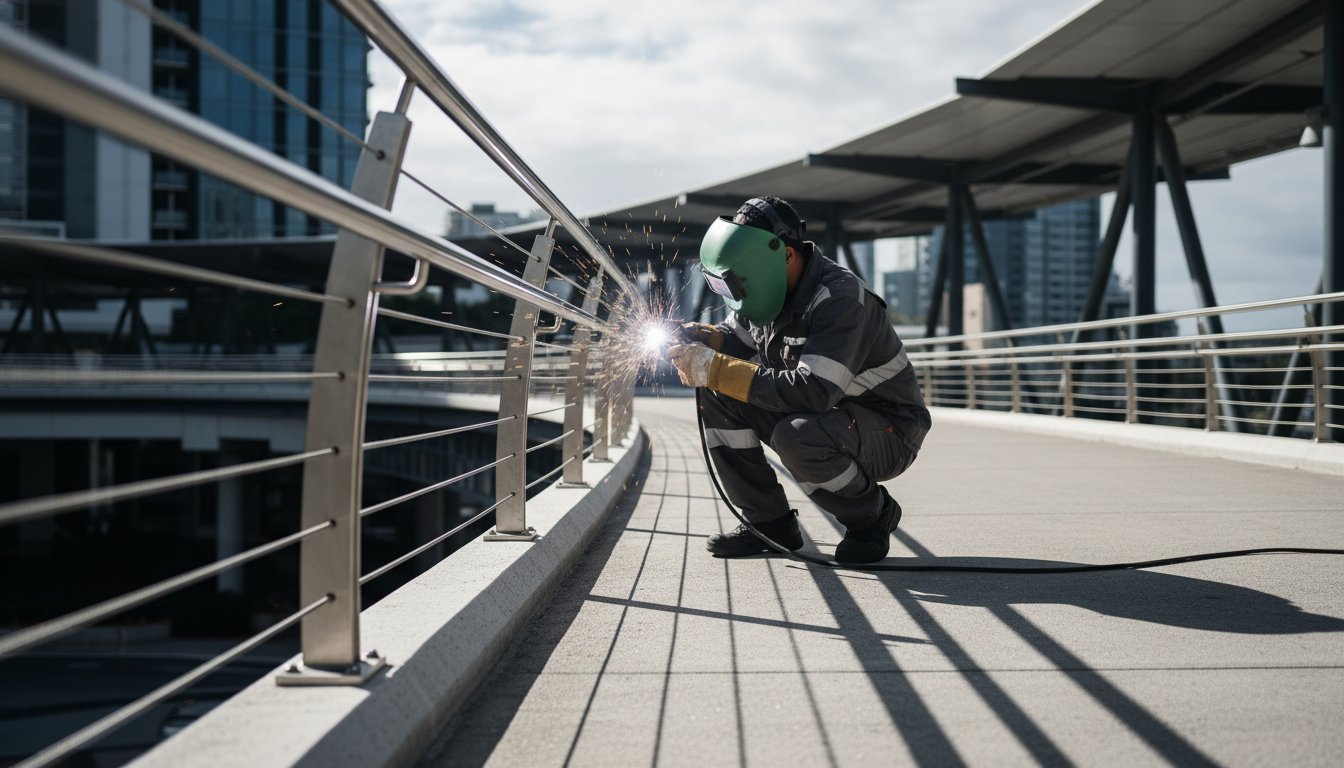
In 2024, falls from a height accounted for 13% of all workplace fatalities in Australia, resulting in 24 lives lost. This sobering data confirms that installing commercial stainless steel handrails is far more than a finishing touch; it’s a fundamental safety requirement. You’re likely aware that sorting through the crossover between AS 1657 and the updated AS 1428.1:2021 standards can be a headache, especially when you’re also worried about tea staining ruining your project’s professional appearance. It’s a common challenge to find a reliable local partner who can manage precise fabrication alongside the practicalities of on-site modifications.
We’ve developed this guide to help you choose and install compliant systems that stand up to the unique demands of the Queensland environment. You’ll discover how to specify the right materials to minimise maintenance and ensure your project meets every legal obligation under the National Construction Code. We’ll also look at the benefits of engaging a fabricator with mobile workshop services to ensure a perfect fit during the installation process. By the end of this article, you’ll have a clear path to delivering a high-quality, durable handrail system that protects both your site users and your professional reputation.
Key Takeaways
- Understand why Grade 316 stainless steel is the benchmark for Brisbane and Gold Coast projects to prevent tea staining and environmental degradation.
- Clarify the distinctions between AS 1657 and AS 1428.1:2021 to ensure your installation adheres to the correct industrial or public access standards.
- Evaluate the structural benefits of custom-fabricated commercial stainless steel handrails over modular systems, focusing on the durability of fully welded joins.
- Learn how mobile workshop services can streamline your project by allowing for immediate on-site modifications and precise final fitment.
- Discover how to specify a low-maintenance system that meets National Construction Code requirements without compromising on professional design.
The Essential Role of Commercial Stainless Steel Handrails
Commercial stainless steel handrails are more than simple architectural accents; they are precision-engineered safety systems designed to protect lives and manage corporate liability. Unlike residential fixtures, commercial-grade installations must withstand rigorous load-bearing requirements and constant physical contact. These systems serve as the primary line of defence against falls in complex environments, where structural integrity is a non-negotiable standard. In the specific context of South East Queensland, these handrails must also endure a sub-tropical climate that is notoriously harsh on metallic surfaces.
For Brisbane commercial assets, stainless steel remains the preferred material due to its exceptional strength-to-weight ratio and inherent resistance to corrosion. While other metals may degrade or require frequent recoating, high-quality stainless steel maintains its structural properties for decades. This durability makes it the logical choice for several critical sectors across the region:
- Aged Care and Healthcare: Providing stable, hygienic support for residents with limited mobility.
- Food Processing and Hospitality: Offering easy-to-sanitise surfaces that meet strict health and safety audits.
- Public Infrastructure: Enduring the high-traffic demands of transport hubs, schools, and civic centres.
The challenge for property developers and facility managers lies in balancing architectural aesthetics with heavy-duty industrial performance. A well-designed handrail system should complement the building’s modern facade while meeting the stringent “point load” requirements dictated by Australian engineering standards. Achieving this balance requires a deep understanding of metal grades and fabrication techniques.
Duty of Care and Public Safety
In any commercial zone, the primary function of a handrail is to mitigate the risk of slips, trips, and falls. Data from 2024 indicates that falls from a height accounted for 13% of all workplace fatalities in Australia, highlighting the critical nature of handrail safety and support in preventing tragedy. In high-traffic Brisbane thoroughfares, handrails must remain steady under the pressure of hundreds of users daily. If a system feels flimsy or shows signs of structural fatigue, it fails its primary purpose. In any commercial building, the provision of compliant handrails is a non-negotiable legal requirement under the National Construction Code to ensure safe egress and accessibility for all occupants.
Enhancing Commercial Property Value
Investing in “set and forget” materials like stainless steel significantly reduces long-term operational expenditure (OPEX). While the initial cost of commercial stainless steel handrails may be higher than timber or mild steel, the absence of ongoing painting, sanding, or rust treatment provides a better return on investment. The choice between a brushed satin finish or a high-shine mirror finish also plays a role in corporate branding; a satin finish is often preferred for its ability to hide fingerprints in busy corridors. Ultimately, high-quality metalwork influences tenant perception, suggesting a well-maintained and secure facility that prioritises safety and professional standards. For those seeking to enhance their property further with high-quality outdoor living structures, patioscoast2coast.com.au provides expert design and installation services tailored to coastal environments.
Selecting the Right Grade: Why Material Science Matters in SE QLD
Selecting the correct material grade is the most critical decision in the procurement of commercial stainless steel handrails. While Grade 304 and Grade 316 may appear identical to the untrained eye, their chemical compositions dictate how they will perform under the relentless Queensland sun. Grade 304 is an excellent all-rounder for inland, climate-controlled environments. However, it lacks the specific corrosion resistance required for the humidity and salt-laden air characteristic of South East Queensland. High humidity acts as a catalyst for oxidation, meaning even sites located several kilometres from the coast are still within a high-risk corrosion zone.
The primary differentiator is the inclusion of molybdenum in Grade 316. This alloying element provides a significant defence against chloride-induced pitting, which is the most common form of corrosion in our coastal regions. In Brisbane and on the Gold Coast, salt spray is a constant factor; it settles on surfaces and creates concentrated chloride pockets. Without molybdenum, the protective chromium oxide layer on the steel breaks down, leading to deep pits that compromise the metal’s strength. For any outdoor or semi-exposed commercial project, Grade 316 isn’t just a recommendation; it’s a necessity for longevity and safety.
Preventing Tea Staining in Coastal Environments
Tea staining is a brown surface discolouration that frequently plagues Brisbane handrails. It’s often mistaken for structural rust, but it’s actually a surface-level reaction where salt and pollutants become trapped in the metal’s microscopic profile. The risk of tea staining is heavily influenced by the surface roughness (Ra) of the finish. A rougher surface provides “valleys” where contaminants can hide and corrode the steel. Professional polishing to a high-grit satin or mirror finish is the best preventative measure. Regular maintenance, including simple fresh-water wash-downs, helps preserve the metal’s lustre. If your existing rails are showing signs of discolouration, our team can provide specialised maintenance services to restore the finish and prevent further degradation.
Specialist Applications: Food Grade and Sanitary Rails
Specific industrial sectors require even higher levels of material precision. The requirements for stainless steel handrails food processing facilities focus heavily on hygiene and bacterial control. These rails must be fabricated with smooth, seamless welds that leave no room for organic matter to accumulate. In these settings, the metal must also resist aggressive chemical cleaning agents used during daily sanitisation. We ensure that every joint is ground flush and polished to a non-porous state, meeting the highest standards of sanitary fabrication. This level of detail ensures your facility passes health audits while providing a safe, durable support system for your workforce.
Navigating Australian Standards: AS 1657 vs. AS 1428.1
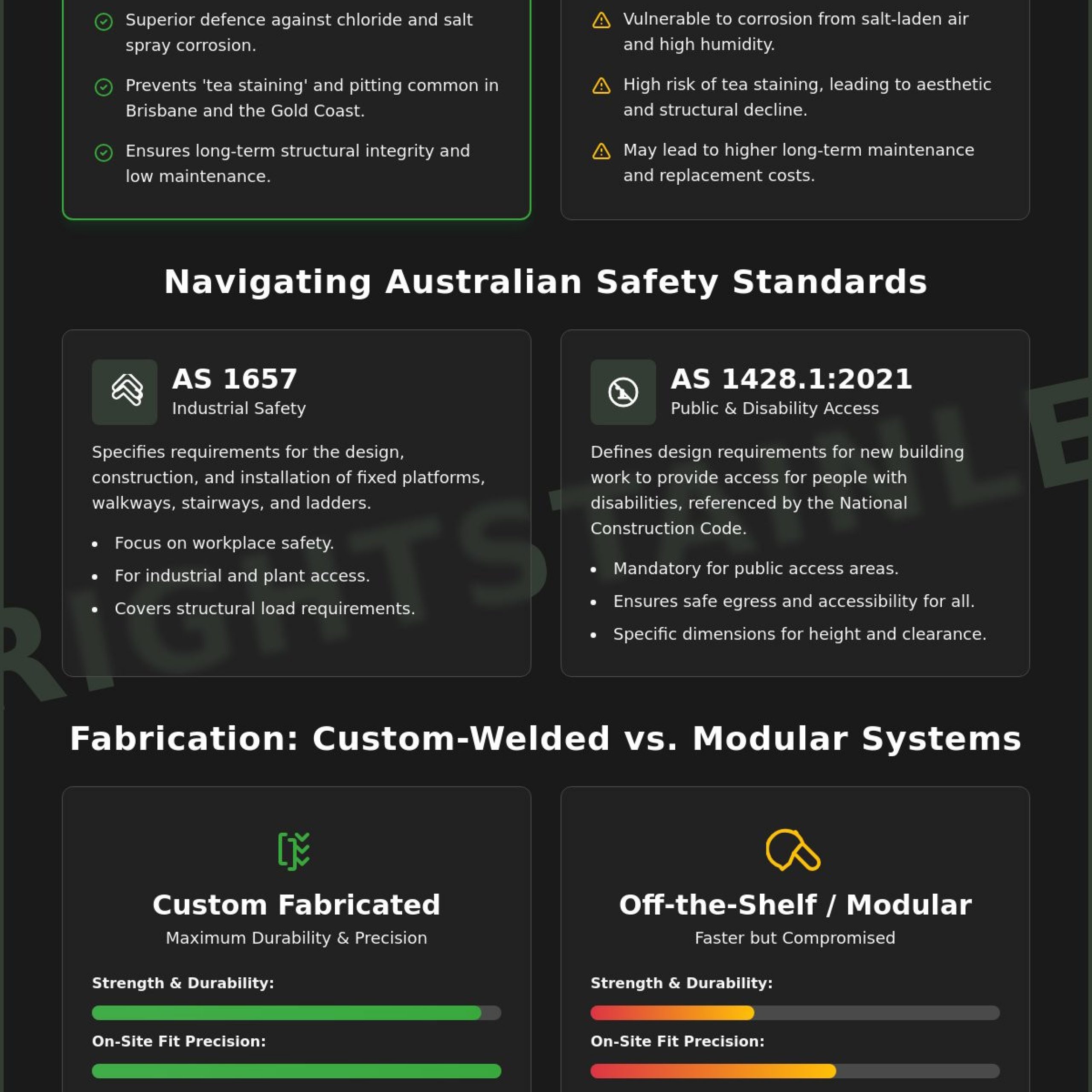
Compliance isn’t optional. When specifying commercial stainless steel handrails, the most frequent source of confusion is the distinction between industrial safety and public accessibility. The intended use of the space dictates which set of rules your fabricator must follow. AS 1657:2018 is designed for areas accessed by workers for maintenance or plant operations. In contrast, AS 1428.1:2021 provides the framework for public access and mobility. Selecting the wrong standard can lead to costly rework or, worse, a failure to receive a certificate of occupancy for your project.
While the technical nuances are many, three key dimensions generally govern the design of a compliant rail. First, the grip diameter must typically fall between 30mm and 50mm to ensure a secure hold. Second, a minimum clearance of 50mm from the wall or any obstruction is required to prevent hand entrapment. Finally, the height must sit between 900mm and 1100mm from the floor or stair nosing. Engaging a specialist in stainless steel handrails Brisbane ensures these measurements are integrated into the design before a single piece of metal is cut.
AS 1657: Fixed Platforms, Walkways, and Ladders
For “back-of-house” commercial environments, such as plant rooms or warehouse mezzanines, AS 1657:2018 is the governing authority. This standard focuses on protecting workers in industrial settings. A critical requirement here is the inclusion of kickboards (at least 100mm high) on walkways to prevent tools or debris from falling onto people below. Guardrail heights are also strictly regulated to ensure they can withstand a specific force, providing a robust barrier in high-risk zones. We ensure every weld and bracket meets these heavy-duty requirements to keep your maintenance staff safe. For facility managers seeking a comprehensive technical roadmap, our guide to handrail design and installation Brisbane industrial facilities require covers the full scope of AS 1657:2018 compliance in detail.
AS 1428.1: Design for Access and Mobility (DDA)
When a building is open to the public, the Disability Discrimination Act (DDA) mandates adherence to AS 1428.1:2021. This updated standard, which became effective on 29 July 2025, includes specific requirements for stainless steel handrails aged care and public facilities. Rails must be continuous, meaning a user should be able to slide their hand along the entire length without hitting a bracket or a break. End-terminations must also be designed to prevent clothing from snagging, typically by turning the rail back to the wall or floor. Additionally, the placement of the rail must coordinate perfectly with tactile ground surface indicators to assist vision-impaired users. For a comprehensive breakdown of every dimension and specification you need to meet, our detailed resource on AS 1428 handrail requirements covers the full scope of the 2026 compliance landscape for Brisbane and Gold Coast projects.
Custom Fabrication vs. Off-the-Shelf Handrail Systems
Choosing between modular components and custom fabrication is a pivotal decision for any project manager. While off-the-shelf kits promise rapid delivery, they often struggle to accommodate the “real world” variations found on a construction site. Commercial stairways frequently feature slight variations in riser height or wall alignment that modular systems simply cannot accommodate without compromising compliance. Custom commercial stainless steel handrails are built to the exact millimetre of your site, ensuring that every transition remains smooth and every bracket lands on a structural stud.
The structural benefits of fully welded joins far outweigh the convenience of modular mechanical fixings. In high-traffic environments, mechanical joints secured by screws or adhesives can loosen over time due to constant vibration and physical pressure. This creates a safety risk and a maintenance burden. By contrast, a bespoke system is engineered as a single, continuous unit. This approach handles complex site geometry and uneven levels with ease, providing a level of rigidity that modular alternatives cannot match. Precise off-site pre-fabrication also means that once the rails arrive at your facility, the installation process is streamlined and efficient.
The Fabrication Process: From Site Measure to Install
A professional site measure is the foundation of a successful project. We use precise measuring tools to account for the unique contours of your building, ensuring that the final product meets every AS compliance requirement. During the fabrication phase, we typically utilise TIG (Tungsten Inert Gas) welding rather than MIG welding. TIG welding allows for much greater control, resulting in the clean, high-quality finishes expected in commercial environments. Every rail undergoes strict quality control to verify its structural load-bearing capacity before it leaves our workshop.
Durability in High-Traffic Commercial Zones
In environments like shopping centres and schools, the physical demands on metalwork are extreme. We specify appropriate wall thicknesses, often moving from standard 1.6mm to 2.0mm or thicker for heavy-duty applications, to prevent denting and deflection. Vandal-resistant mounting options and heavy-duty base plates further secure the system against deliberate damage or accidental impact. Fully welded handrail systems provide a seamless, monolithic structure that eliminates the risk of components loosening or rattling over years of heavy use. If your project requires a solution that combines strength with architectural precision, our team specialises in custom stainless steel fabrication tailored to your specific site requirements.
Professional Installation and On-Site Mobile Welding
The final installation phase is where the structural integrity of commercial stainless steel handrails is truly established. Even the most precisely fabricated rail can fail a compliance audit if it’s installed by non-specialists who don’t understand the nuances of Australian Standards. Specialist installers ensure that every fixing point is chemically anchored or mechanically fastened to meet specific load-bearing requirements. This level of precision protects the building owner from liability and ensures the safety of every user who relies on the rail for support.
Late-stage site changes are a common reality in commercial construction. A wall might be slightly out of plumb, or a concrete slab might have settled differently than the architectural drawings suggested. This is where our mobile workshop services become invaluable. Instead of sending components back to a factory for modification, our team can perform precision adjustments on-site. We use specialised core-drilling techniques to create clean, accurate holes in concrete and stone, ensuring that the building’s moisture barrier and structural envelope remain uncompromised during the fixing process.
Final compliance checks are the concluding step of any professional installation. This involves verifying that the handrail remains continuous, checking the clearance from adjacent walls, and ensuring that all end-terminations are smooth and snag-free. Once these checks are complete, the system is “signed off” as compliant with the relevant AS 1428.1 or AS 1657 standards. This provides the project manager with the necessary documentation for the final building certification.
The Value of Mobile Welding for Brisbane Projects
On-site mobile welding allows for perfect fitment around existing services, such as industrial pipework or electrical conduits, which may not have been visible during the initial site measure. For operational industrial plants, this capability is essential for minimising downtime during handrail upgrades. We can work within your scheduled maintenance windows to remove old sections and install new, compliant rails without disrupting your entire workflow. Our fully equipped mobile workshops are designed to reach remote South East Queensland sites, bringing factory-level precision directly to your doorstep.
Ongoing Maintenance and Repairs
Even the most robust commercial stainless steel handrails require periodic inspection. Over time, high-traffic use or accidental impact from trolleys can lead to structural fatigue or mounting failure. It’s important to identify these issues early before they become a significant safety risk. If a section of your safety barrier or handrail is damaged, our mobile repair services can often restore the system to its original strength and finish without the need for a full replacement. For reliable advice or to discuss your next project, contact Donewright Stainless for a custom fabrication quote.
Securing Your Commercial Project with Compliant Stainless Steel
Choosing the right material and ensuring strict adherence to the latest Australian Standards are the foundations of any successful safety installation. The difference between a compliant project and a liability risk often comes down to the precision of the fabrication and the correct grade of steel. Opting for bespoke commercial stainless steel handrails ensures your facility meets the specific load-bearing and accessibility requirements of the National Construction Code. It’s the most reliable way to withstand the unique Queensland climate while maintaining a professional, low-maintenance finish.
Donewright Stainless brings local Brisbane expertise directly to your site with our fully equipped mobile workshop. We’re specialists in AS 1657 and AS 1428.1 compliance, providing tailored solutions for the industrial, food processing, and aged care sectors. Whether you require a new installation or urgent on-site modifications, our team delivers the technical precision your project demands. Request a Quote for Commercial Stainless Steel Handrails today to discuss your specific requirements. We’re ready to help you create a safer, more reliable environment for your staff and the public.
Frequently Asked Questions
Do commercial handrails in Brisbane always need to be Grade 316 stainless steel?
Grade 316 is not a universal requirement for every project, but it is the industry standard for any outdoor or semi-exposed application in South East Queensland. While Grade 304 is suitable for climate-controlled indoor environments, it often fails when exposed to Brisbane’s high humidity and salt-laden air. Choosing Grade 316 ensures your commercial stainless steel handrails resist pitting and structural degradation over the long term.
What is the difference between AS 1428.1 and AS 1657 for handrails?
The primary difference lies in the intended user of the space. AS 1428.1:2021 governs design for access and mobility, making it mandatory for public buildings, aged care facilities, and retail centres to ensure accessibility for all people. AS 1657:2018 applies to industrial environments, such as plant rooms or factories, where access is limited to trained personnel and maintenance staff using fixed platforms and walkways.
How high should a commercial stainless steel handrail be?
A compliant handrail must generally be positioned between 900mm and 1100mm above the floor surface or the nosing of a stair tread. The specific height within this range often depends on which Australian Standard applies to your project. For example, AS 1428 handrail requirements include very strict specifications for height consistency across the entire length of the rail to ensure safe use for those with mobility impairments.
Can you install stainless steel handrails on-site at a Brisbane industrial plant?
Yes, on-site installation is the preferred method for industrial facilities where existing pipework and machinery make off-the-shelf solutions impossible. We utilise mobile workshop services to perform precision modifications and welding directly at your facility. This approach ensures a perfect fit around complex infrastructure while minimising the downtime of your plant operations.
What is the best finish for a commercial handrail: Satin or Mirror?
A satin or brushed finish is usually the most practical choice for high-traffic commercial zones because it effectively hides fingerprints and minor surface scratches. However, a mirror finish provides superior corrosion resistance in extreme coastal environments. The smoother surface of a mirror finish leaves fewer microscopic “valleys” where salt can settle, making it easier to maintain near the ocean.
How do you prevent tea staining on stainless steel rails near the coast?
Preventing tea staining requires a combination of correct material selection and regular maintenance. You should always specify Grade 316 stainless steel with a low surface roughness (Ra) to prevent contaminants from sticking to the metal. Regular washing with fresh water and mild detergent is essential for removing salt deposits before they can cause the brown discolouration known as tea staining.
Are modular handrail systems compliant with Australian Standards?
Modular systems can be designed to meet standards, but they frequently face compliance issues during the final installation. Because they rely on mechanical fixings and pre-set angles, they often struggle to adapt to slight site variations or uneven floor levels. Fully welded commercial stainless steel handrails offer a more reliable path to compliance because they are custom-fabricated to the exact dimensions of your site.
How much does it cost to install commercial stainless steel handrails?
The total investment for a handrail system depends on several variables, including the grade of stainless steel, the complexity of the site geometry, and the total linear meterage required. High-traffic public zones may also require thicker wall tubing, which influences the material costs. We recommend requesting a site-specific assessment to ensure your quote accurately reflects the structural and compliance needs of your project.