
Workplace Safety Barriers Gold Coast: 2026 Buying Guide
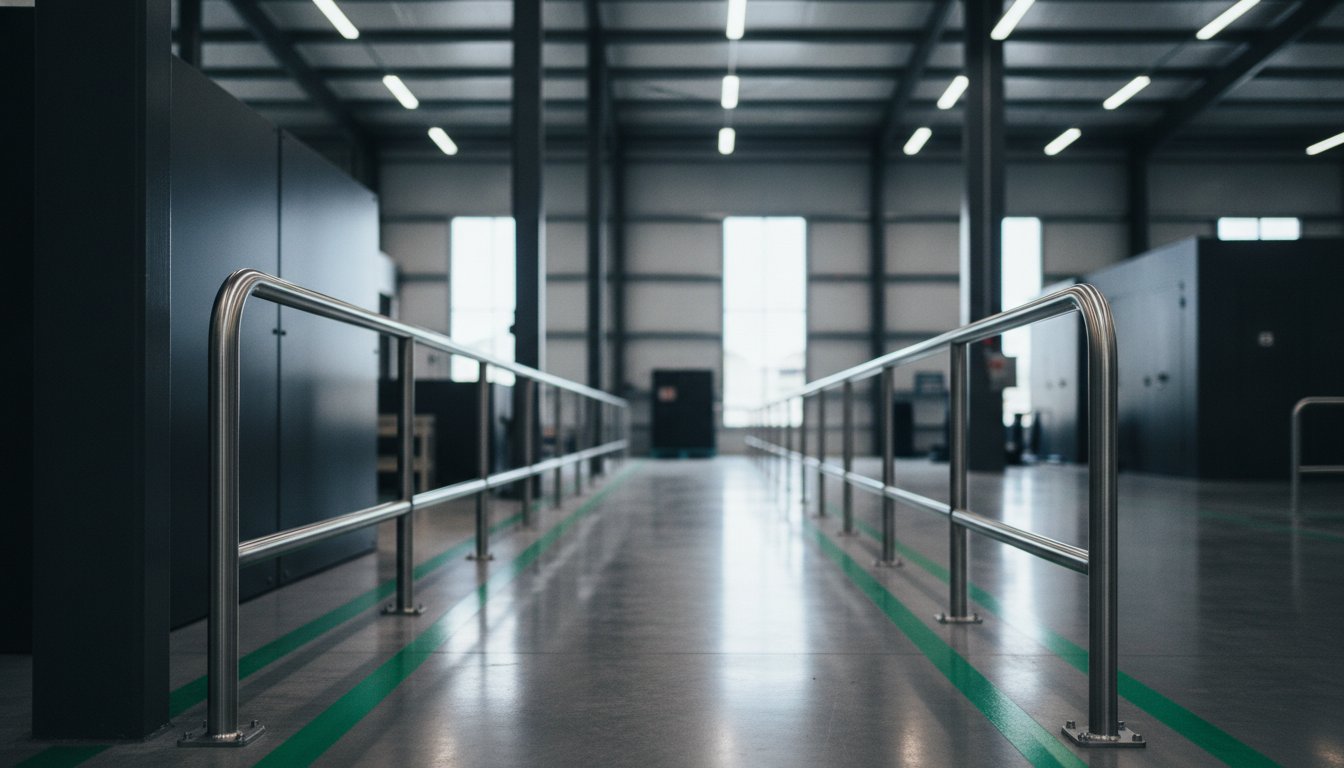
Forklift-pedestrian impacts cause approximately 50 serious injuries every week across Australian workplaces, which means a standard retail guardrail is often little more than a false sense of security. You likely understand that keeping your team safe while maintaining a fast-paced floor is a constant balancing act. It’s frustrating when generic barriers dent at the first sign of a nudge or, worse, fail an unexpected WHS audit because they don’t meet AS 1657:2018 standards. Finding a local partner who understands the specific needs of the Gold Coast industrial corridor shouldn’t be another headache on your list.
This guide will show you how to secure your facility with workplace safety barriers Gold Coast businesses can actually rely on. You’ll discover how custom-fabricated solutions offer maximum longevity and site-specific protection compared to flimsy, off-the-shelf alternatives. We’ll preview the latest 2026 compliance requirements, explain why marine-grade stainless steel is essential for our coastal climate, and show how mobile fabrication ensures a perfect fit with minimal downtime for your operations. By the end, you’ll know exactly how to achieve a fully compliant site that stands up to the heaviest industrial use.
Key Takeaways
- Learn the essential requirements of AS 1657:2018 to ensure your barrier installations pass WHS audits and provide genuine protection against fall risks and impacts.
- Identify the critical differences between grade 304 and 316 stainless steel to choose the right material for the Gold Coast’s humid and coastal industrial environments.
- Discover why custom-fabricated workplace safety barriers Gold Coast facilities use are superior to off-the-shelf retail options for managing complex traffic flows and tight intersections.
- Understand how a mobile workshop service can eliminate operational downtime by bringing precision fabrication and on-site welding directly to your facility floor.
- Master a two-step site assessment process to map pedestrian-vehicle intersections and avoid the common pitfalls of using standard barrier lengths in bespoke industrial spaces.
The Industrial Landscape: Why Safety Barriers Matter on the Gold Coast
The Gold Coast industrial corridor has evolved rapidly, stretching from the massive 3,300-hectare Yatala Enterprise Area down to the specialised manufacturing hubs in Burleigh Heads and Molendinar. As these precincts grow, the density of traffic within warehouses and factories increases. Managing this growth requires more than just a few painted lines on the floor. While visual cues serve as basic administrative controls, they offer no physical protection during a mechanical failure or operator error. Installing engineered industrial safety barriers is now a structural necessity for any facility aiming to maintain a high safety standard.
The financial and legal stakes for local operators have never been higher. As of 1 July 2026, the value of a penalty unit in Queensland increased to $172.70. Under the Work Health and Safety Act 2011, a body corporate can face fines up to $10 million for industrial manslaughter. These aren’t just abstract figures; they represent the very real cost of failing to provide adequate physical separation between people and plant. Beyond the legal liability, the Gold Coast’s coastal air introduces a unique challenge. In areas like the Coomera Marine Precinct, salt-heavy humidity accelerates corrosion, meaning the workplace safety barriers Gold Coast managers choose must be built from high-grade materials to avoid premature structural failure.
Identifying High-Risk Zones in Your Facility
Effective protection starts by mapping where forklifts and pedestrians intersect. Vehicle-related incidents account for 42% of all worker fatalities nationally, making heavy-duty separation essential in high-traffic thoroughfares. Loading docks and mezzanine levels require specific edge protection to prevent falls exceeding 300 mm, as mandated by AS 1657:2018. We also look at protecting your infrastructure. A single impact can rupture industrial pipework or disable critical machinery, leading to costly repairs and operational downtime that far exceeds the initial investment in custom-fabricated steel protection.
The Shift Toward Permanent Safety Infrastructure
Many facilities are moving away from temporary plastic bollards in favour of permanent, engineered steel solutions. While plastic might absorb minor bumps, it often lacks the structural integrity to stop a multi-tonne forklift. Custom-fabricated workplace safety barriers Gold Coast businesses install provide a sense of security that improves overall staff confidence and workflow efficiency. When workers feel safe in their designated lanes, they move more decisively. Investing in permanent, high-quality fabrication isn’t just about meeting a checklist; it’s about building a long-term asset that survives the rigours of a busy industrial environment.
Australian Standards and Compliance: Staying Above Board
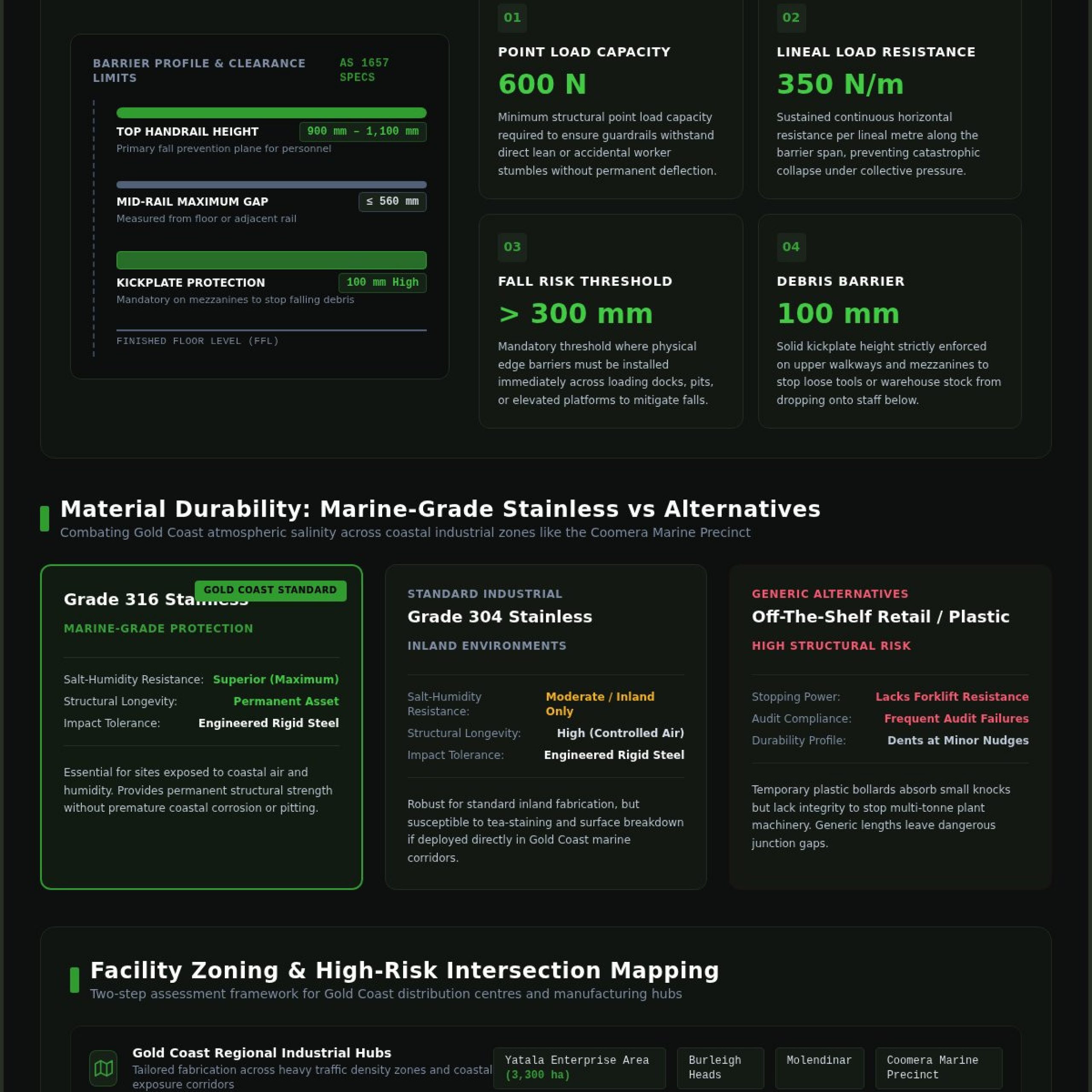
AS 1657:2018 is the primary Australian Standard governing the design, construction, and installation of fixed platforms, walkways, stairways, and ladders in industrial environments. This standard provides the technical framework to ensure that the workplace safety barriers Gold Coast facilities install are structurally sound and fit for purpose. Compliance isn’t just a recommendation; it’s a legal benchmark that determines whether your site is viewed as safe during a WHS audit. For example, barriers must withstand a minimum point load of 600 N or a lineal load of 350 N per metre. This level of structural integrity ensures a guardrail won’t buckle when a worker leans against it or during a minor equipment stumble.
AS 1657 Compliance for Gold Coast Industry
Precision in measurement is the difference between a compliant barrier and a liability. Under AS 1657, top handrails must sit between 900 mm and 1,100 mm above the floor surface. If there’s a potential fall risk exceeding 300 mm, edge protection becomes mandatory. We often see local facilities overlook mid-rail placement, which must not exceed a 560 mm gap from the floor. On mezzanines or elevated walkways, kickplates are a non-negotiable requirement. These 100 mm high plates prevent tools or debris from falling onto workers below. Our extensive experience with safety handrail fabrication Brisbane standards translates directly to Gold Coast sites, ensuring every weld and anchor point meets these strict thresholds.
WHS Queensland Obligations for Business Owners
Queensland business owners have a non-delegable duty of care to provide a safe working environment. Physical segregation is an engineering control, which is prioritised over administrative rules like floor tape or high-vis vests under the Safe Work Australia traffic risk management guidelines. It’s vital to remember that as of 2026, it’s unlawful in Queensland to use insurance to pay for WHS fines. With penalties for industrial manslaughter reaching $10 million for companies, the cost of non-compliance is terminal. Professional documentation and certification of your barrier systems provide the evidence needed during audits to prove you’ve met your obligations. If you’re concerned your current setup doesn’t meet these 2026 standards, it’s worth having a specialist assess your site’s physical protection to ensure you stay above board.
Material Selection: Stainless Steel vs. Alternatives
Choosing the right material for workplace safety barriers Gold Coast facilities install is a decision that dictates the system’s lifespan and its ability to withstand impact. While many retail suppliers push lightweight or flexible alternatives, industrial environments demand materials that don’t degrade under pressure or environmental stress. Grade 304 stainless steel is the standard for most indoor applications; however, grade 316 is the preferred choice for areas exposed to harsher conditions. Following the Safe Work Australia traffic management guidance, your focus should always be on engineering controls that provide reliable, long-term segregation between mobile plant and workers.
Mild steel remains a robust and cost-effective option for dry, indoor warehouses where corrosion isn’t a primary concern. It provides excellent structural rigidity, though it requires powder coating or galvanising to prevent rust. Aluminium is often used for non-structural safety applications where weight is a factor, such as removable light-duty gates. In contrast, polymer and plastic barriers are often marketed for their flexibility, but for the heavy-duty workplace safety barriers Gold Coast businesses require, the structural certainty of steel is often the safer bet. These flexible systems can absorb minor bumps, but they often lack the ultimate stopping power of engineered steel in high-speed forklift zones.
Why Stainless Steel Wins on the Gold Coast
The Gold Coast’s coastal microclimate is notoriously tough on industrial infrastructure. In suburbs like Burleigh Heads and Southport, salt-laden air quickly compromises painted or powder-coated mild steel. Once the surface is chipped by a forklift tine, rust takes hold almost immediately. Stainless steel, particularly marine-grade 316, remains impervious to this atmospheric salinity. It also satisfies the strict hygiene requirements of food processing and pharmaceutical hubs in Yatala. These facilities require barrier systems that can endure high-pressure chemical washdowns without blistering or harbouring pathogens, a standard that stainless steel meets effortlessly.
Comparing Durability and Maintenance
The initial cost of stainless steel is offset by its significantly lower lifecycle expenses. Mild steel barriers often require regular repainting and maintenance to address chips and corrosion; stainless steel requires almost none. Custom-fabricated steel systems also outperform thin-walled retail units during an impact. Because they’re built with thicker wall sections and engineered baseplates, they resist deformation and protect your facility’s assets more effectively. Beyond maintenance, stainless steel is fully recyclable, retaining its value as a high-quality industrial asset long after its primary service life ends.
Assessing Your Site: Designing a Custom Safety Layout
Designing a cohesive safety system requires a methodical approach that prioritises high-risk intersections. The first step involves mapping your facility’s traffic flow to identify exactly where forklifts and pedestrians cross paths. It’s a common mistake to assume that standard barrier lengths will fit into bespoke industrial spaces. Measuring twice is critical; off-the-shelf units often leave dangerous gaps or block essential thoroughfares. When selecting workplace safety barriers Gold Coast facilities need, you must decide between specialised bollards for impact protection, handrails for pedestrian guidance, or heavy-duty guardrails for high-speed zones.
Planning for access is just as vital as the protection itself. Integrating self-closing gates and removable sections ensures that safety doesn’t come at the cost of productivity. These features allow for the movement of oversized goods or maintenance access without compromising the integrity of the barrier line. Finally, engaging a fabricator for an on-site consultation is the only way to secure a precision quote. A professional assessment accounts for subtle floor gradients, existing machinery footprints, and structural columns that off-site estimators might miss.
Optimising Pedestrian and Vehicle Separation
Creating clear safe zones allows staff to move between warehouse bays without entering vehicle paths. We recommend using stainless steel safety bollards Brisbane businesses trust to protect vulnerable building corners and roller door tracks. These bollards act as the first line of defence for your infrastructure. Strategic placement should guide traffic intuitively, preventing bottlenecks while ensuring that every workplace safety barriers Gold Coast installation serves a specific, engineered purpose. When pedestrians know exactly where they belong, the risk of accidental incursions into forklift zones drops significantly.
Custom Features for Unique Site Challenges
Many Gold Coast facilities feature complex layouts that standard products simply can’t accommodate. This includes designing barriers to navigate safely around existing industrial pipework Brisbane teams have already installed. Mezzanine levels often present non-standard floor heights that require custom handrail fabrication to remain compliant with AS 1657. We also specialise in integrating safety barriers directly with custom stainless benches or trolleys on production lines. This ensures a seamless interface between safety and operation, protecting workers without slowing down the assembly process. To get your layout right the first time, book an on-site site assessment with our experienced fabrication team.
The Donewright Advantage: Bespoke Safety Solutions and Mobile Installation
Ian “Wrighty” Wright and the team have built a reputation across South East Queensland for delivering more than just metalwork. We provide a sense of security rooted in industrial-grade precision and a deep understanding of local compliance needs. When you choose Donewright Stainless, you’re opting for a partner that prioritises long-term relationships over quick sales. Retail barriers often require you to “make do” with standard lengths that don’t quite fit your floor plan, leaving awkward gaps or encroaching on pedestrian paths. Our custom-fabricated workplace safety barriers Gold Coast systems are designed specifically for your facility’s unique geometry. This ensures every inch of your site remains protected and fully compliant with AS 1657 standards. We believe that safety infrastructure should be a permanent asset that integrates perfectly with your workflow rather than a temporary fix that gets in the way.
Mobile Welding and On-Site Fabrication
Our fully equipped mobile workshop is the cornerstone of our service. We bring the factory directly to your Gold Coast site, which allows us to install and modify barriers while your operations continue. This approach minimises downtime and eliminates the logistical headache of off-site transport and long lead times. If a forklift strike damages your existing infrastructure, our mobile welding team provides rapid on-site repairs to restore compliance immediately. We understand that a broken barrier is a liability that can’t wait. We serve the entire corridor from Logan down to the Gold Coast, providing expert mobile engineering and maintenance services where they’re needed most. Our mobile workshop is stocked with the tools required for precision welding and structural adjustments, ensuring that even the most complex on-site challenges are handled with professional efficiency.
From Design to Installation: A Seamless Process
We take a consultative approach to every project we undertake. We don’t just sell products; we help you identify the most efficient safety barrier layout to protect your team and your assets. Our process begins with a thorough understanding of your site’s traffic management needs and ends with a durable, high-quality installation. Every weld and finish undergoes strict quality control to ensure it meets our established standards for industrial durability and longevity. Whether you need stainless steel handrails, custom benches, or heavy-duty protection, our process ensures that every workplace safety barriers Gold Coast project we complete is built to last. We take pride in our workmanship and our commitment to providing honest advice that benefits your business in the long run. Contact Donewright Stainless today for a custom Gold Coast safety barrier quote and experience the difference that bespoke craftsmanship makes to your facility’s safety.
Future-Proofing Your Facility’s Safety
Your facility deserves more than just “good enough” protection. We’ve explored how strict AS 1657 compliance and deliberate material selection can protect your business from significant WHS liabilities and operational disruptions. Choosing marine-grade 316 stainless steel ensures your infrastructure survives the Gold Coast’s salt air, while a custom layout eliminates the dangerous gaps often left by retail products. Donewright Stainless is a proudly Australian owned and operated specialist in compliant safety handrail fabrication. Our expert mobile welding workshop brings the factory to you, ensuring precision for every on-site installation. Investing in workplace safety barriers Gold Coast teams can truly rely on is a strategic decision for the longevity of your operation. Secure your Gold Coast site with custom safety barriers by contacting Donewright Stainless today. We look forward to helping you build a more secure and efficient working environment.
Frequently Asked Questions
Are workplace safety barriers mandatory for Gold Coast warehouses?
Yes, physical barriers are legally required under the Work Health and Safety Act 2011 (Qld) when a risk assessment identifies potential vehicle-pedestrian collisions or falls. Administrative controls like painted lines are considered weak. For high-traffic warehouses, installing engineered workplace safety barriers Gold Coast businesses trust is the most effective way to meet your duty of care. These systems provide a physical engineering control that isolates workers from mobile plant hazards.
What is the Australian Standard for industrial safety barriers?
AS 1657:2018 is the governing standard for fixed platforms, walkways, and guardrails. It dictates the design, construction, and installation requirements to ensure safety at heights and on floor levels. Additionally, AS 4084:2023 specifically addresses steel storage racking protection, requiring frame guards on all exposed ends. Adhering to these standards ensures your barrier system is structurally capable of resisting mandatory point loads and protecting your staff from impact.
Is stainless steel better than plastic for forklift safety barriers?
Stainless steel is typically the superior choice for longevity and hygiene. While polymer barriers offer flexibility, they can degrade over time and may not provide the ultimate stopping power of engineered steel in high-speed zones. In the Gold Coast’s humid climate, marine-grade stainless steel resists corrosion better than any other material. It’s particularly essential for food processing or pharmaceutical facilities where high-pressure washdowns and sterile conditions are mandatory for daily operations.
Can you install safety barriers on an existing concrete floor?
Absolutely. Most industrial safety systems are retrofitted to existing concrete slabs using heavy-duty baseplates and high-tensile anchors. Our team assesses the condition and thickness of your concrete to ensure the mounting system meets the load-bearing requirements of AS 1657. We use precision drilling and chemical or mechanical anchoring to create a permanent, rigid connection that survives the rigours of daily warehouse traffic and occasional mechanical nudges.
How often should safety barriers be inspected for compliance?
We recommend monthly visual checks by your safety officer to identify any dents, loose anchors, or surface corrosion. A formal compliance audit should be conducted annually by a specialist. If a barrier is struck by a forklift or heavy equipment, it must be inspected immediately. Even a minor impact can compromise the structural integrity of the weld or the floor fixings, rendering the entire system non-compliant and unsafe for your team.
Do you provide mobile welding for safety barrier repairs on the Gold Coast?
Yes, Donewright Stainless provides a fully equipped mobile workshop for on-site welding and repairs. This service is designed to restore damaged workplace safety barriers Gold Coast facilities use without the need for off-site transport. We can modify, repair, or extend your existing barrier systems while your site remains operational. Our mobile engineering team services the entire corridor from Logan to the Gold Coast, ensuring your safety infrastructure remains compliant with minimal disruption.
What is the difference between Grade 304 and Grade 316 stainless steel for barriers?
Grade 304 is the standard industrial stainless steel, offering excellent durability for indoor environments. Grade 316, however, contains molybdenum, which provides superior resistance to chlorides and salt air. For Gold Coast facilities in coastal zones like Burleigh Heads or the Coomera Marine Precinct, Grade 316 is the “gold standard”. It prevents the tea-staining and pitting corrosion that often affects lesser materials in our humid, salt-heavy environment, ensuring a much longer service life.
How do I ensure my mezzanine handrails meet AS 1657?
Mezzanine compliance relies on precise geometry. You must have a top rail between 900mm and 1100mm high, a mid-rail with a gap no larger than 560mm, and a 100mm kickplate to prevent tools from falling. Custom fabrication is the most reliable way to achieve this, as it allows for adjustments around structural columns and non-standard floor heights. Our team specialises in AS 1657 compliant handrails that pass WHS audits every time.
