
Safety Handrail Fabrication Brisbane: The Industrial Guide to Compliance and Quality
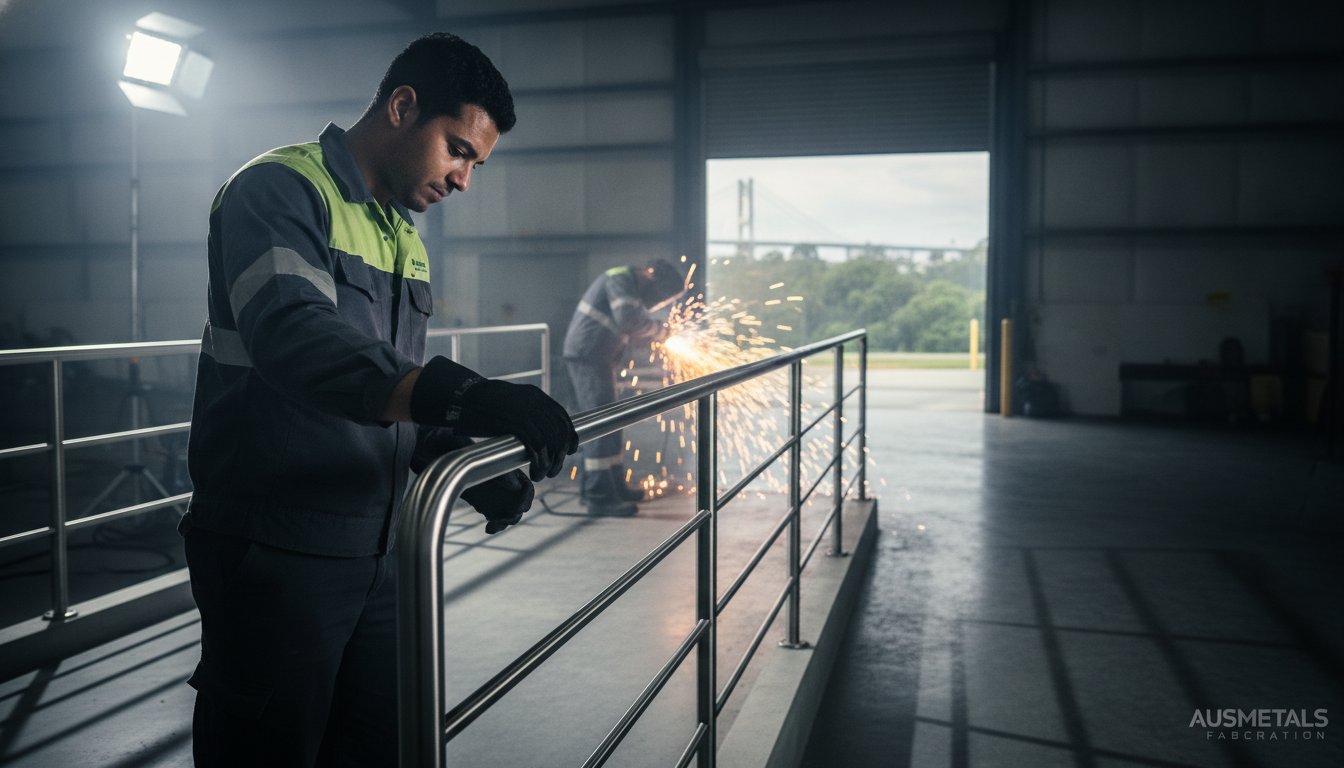
Would your current facility pass a surprise safety audit today? For many site managers, the answer is often buried under a pile of technical manuals and a nagging worry about the latest AS 1657:2018 requirements. When you invest in safety handrail fabrication Brisbane, the goal isn’t just to install a barrier; it’s to protect your workforce while ensuring your infrastructure stands up to the salt air and humidity of the River City. It’s a high-stakes balance between immediate compliance and long-term durability.
We understand the frustration of deciphering complex NCC codes or dealing with the premature failure of low-quality steel in coastal environments. This guide provides a clear roadmap through the technicalities of custom fabrication in South East Queensland. We’ll cover the specific load requirements and dimensions mandated by the current 2018 standards; we’ll also compare material choices like 316-grade stainless steel and hot-dip galvanised mild steel. You’ll learn how to secure a zero-maintenance system that integrates into your daily operations without causing costly downtime or installation headaches.
Key Takeaways
- Understand how AS 1657:2018 standards protect your facility and ensure every walkway or ladder meets strict Australian safety regulations.
- Compare the longevity of 316-grade stainless steel against the cost-effectiveness of galvanised mild steel for Brisbane’s coastal and industrial environments.
- Discover why custom-welded finishes are the preferred choice for food-processing plants where hygiene and seamless surfaces are non-negotiable.
- Learn how precision measurement and 3D scanning during safety handrail fabrication Brisbane eliminate site errors and minimise operational downtime.
- Evaluate the trade-offs between modular systems and bespoke engineering to find a solution that balances your budget with long-term durability.
Understanding Safety Handrail Standards in Brisbane (AS 1657)
AS 1657:2018 serves as the primary benchmark for safety in industrial environments across South East Queensland. This standard governs the design, construction, and installation of fixed platforms, walkways, stairways, and ladders. When commissioning safety handrail fabrication Brisbane, adhering to these guidelines isn’t merely a suggestion; it’s a legal necessity. Non-compliance exposes business owners to significant liability should an incident occur, making a thorough understanding of these regulations essential for any facility manager or site supervisor.
While AS 1657 focuses on industrial access, the National Construction Code (NCC) also dictates requirements for commercial building accessibility and safety. These frameworks overlap to ensure that every guard rail safety standards application provides a consistent level of protection. In many cases, the distinction between a restricted industrial zone and a public-facing commercial area determines the specific fabrication approach. A seasoned fabricator knows how to interpret these nuances to ensure the final product passes every safety audit without requiring expensive rework.
Key Requirements for Industrial Handrails
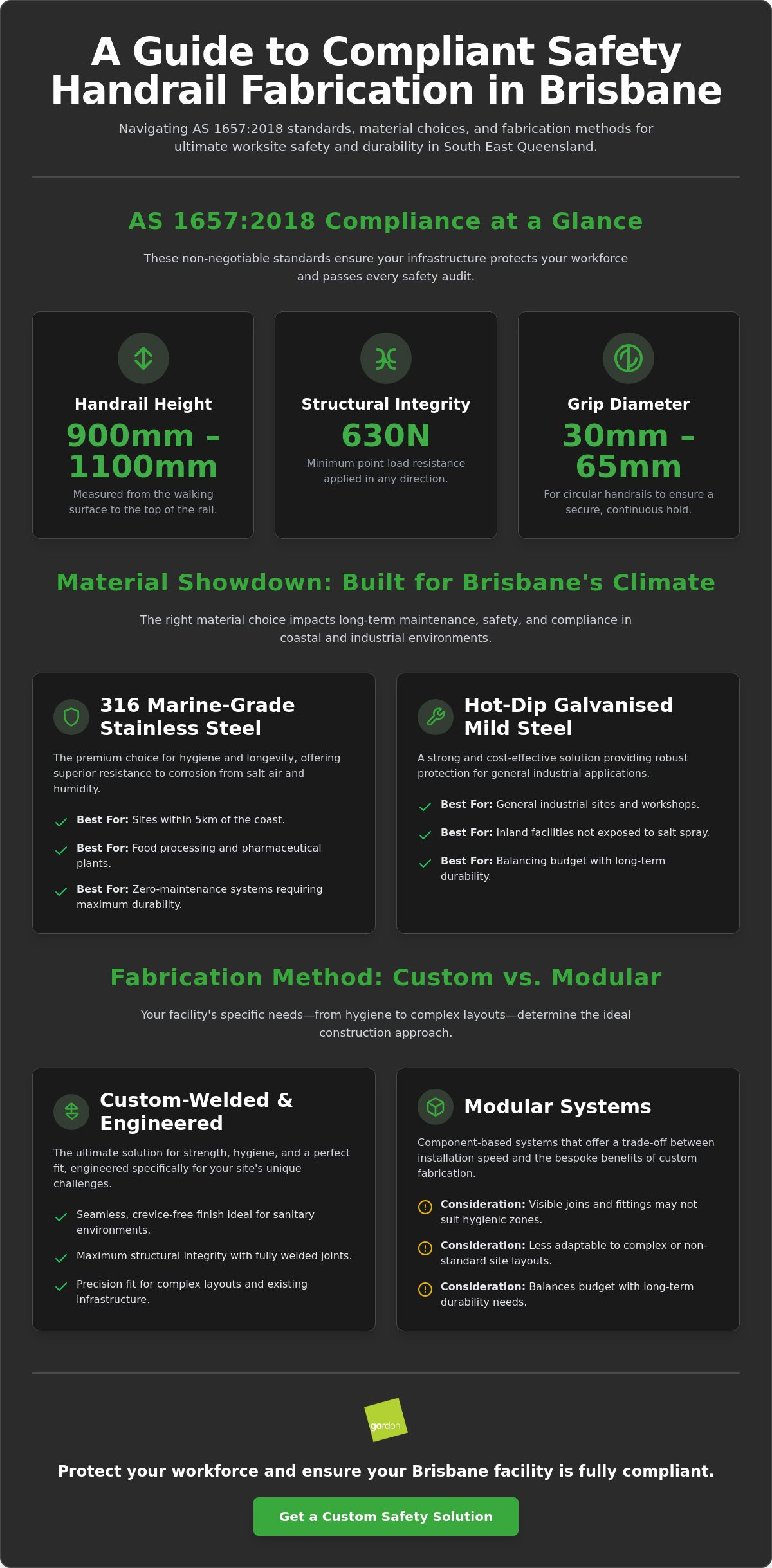
The current 2018 revision of the standard specifies that handrail heights must sit between 900mm and 1100mm above the walking surface. For guardrails, the minimum height is set at 900mm. Beyond height, the structural integrity is paramount. Every connection must withstand a point load of 630N applied in any direction. This ensures the system won’t buckle or fail under the weight of a worker during a slip or fall. Additionally, circular handrails must maintain a diameter between 30mm and 65mm to provide a secure, continuous hand-hold surface for users navigating stairways or steep inclines.
Brisbane-Specific Regulatory Considerations
Operating in Brisbane means navigating local council expectations alongside national standards. Brisbane City Council often requires specific documentation for safety installations in commercial precincts to ensure they meet broader urban planning and safety goals. In restricted industrial zones, the focus shifts heavily toward the ruggedness of AS 1657 compliance. Choosing a certified fabricator is vital here. They provide the necessary compliance documentation and material certificates that safety auditors require. This paperwork proves that the steel used and the weld quality achieved meet the rigorous demands of the South East Queensland industrial landscape, giving you peace of mind that your site is fully protected.
Material Selection: Stainless Steel vs Mild Steel for Safety Systems
Selecting the right metal for safety handrail fabrication Brisbane requires more than just looking at a price tag. The decision influences everything from the initial install speed to the maintenance schedule for the next twenty years. Brisbane’s humidity and coastal proximity mean that a “one size fits all” approach usually leads to premature corrosion and safety failures. While the upfront cost of high-grade alloys might seem steep, the long-term savings on maintenance and replacement often justify the investment for permanent industrial fixtures. Material selection for safety handrails is a critical phase where site environmental stresses must be matched to material properties.
For weight-sensitive structures, such as mezzanine levels or older platforms with limited load capacity, aluminium fabrication provides a lightweight yet durable solution. However, most industrial sites in South East Queensland will find themselves choosing between stainless steel and treated mild steel. Our team at Donewright Stainless often guides clients through this selection process based on their specific facility requirements and proximity to the Brisbane River or Moreton Bay.
The 304 vs 316 Stainless Steel Debate
Stainless steel is the gold standard for hygiene and longevity. In food-grade facilities or pharmaceutical plants, the non-porous surface is essential for meeting strict sanitary requirements. However, the specific grade matters immensely. 304-grade stainless is suitable for indoor commercial use where humidity is controlled. For any site within five kilometres of the coast, 316 marine-grade stainless is non-negotiable. It contains molybdenum, which provides superior resistance to the “tea-staining” or surface rust commonly seen on lower-grade steels in salty air. A polished finish further enhances this resistance by removing microscopic crevices where contaminants can settle.
Mild Steel: When to Choose Galvanised Solutions
Mild steel remains a robust and cost-effective alternative for large-scale industrial projects. To ensure these systems survive the Queensland elements, hot-dip galvanising (HDG) is the industry standard. This process creates a metallurgical bond that protects the steel from the inside out. For enhanced safety visibility, powder coating can be applied over the galvanised layer. This is particularly useful for highlighting stairs or restricted zones with high-visibility safety yellow. While mild steel requires more frequent inspection than stainless steel, it offers a high-strength solution for heavy-duty safety handrail fabrication Brisbane applications where budget constraints are a primary factor.
Custom Welded vs Modular Handrails: Which Suits Your Facility?
Choosing between a modular kit and bespoke safety handrail fabrication Brisbane often comes down to the specific environment of your facility. Modular systems offer convenience for straightforward walkways; however, they often lack the structural rigidity required for heavy industrial use. In high-vibration environments, mechanical fasteners in modular systems can loosen over time. This creates a maintenance burden and a potential safety risk. Custom-welded systems eliminate this issue by creating a single, monolithic structure. This approach aligns with the national guidelines for Managing the risk of falls at workplaces, providing a permanent and unyielding safety barrier.
Bespoke fabrication is particularly valuable for facilities with non-standard layouts or tight spaces where off-the-shelf components simply won’t fit. While modular kits are designed for 90-degree angles and straight runs, industrial sites rarely follow such simple geometry. A custom-built rail follows the exact contours of your machinery or platforms. This ensures there are no dangerous gaps or awkward transitions that could lead to a trip or fall. The result is a system that feels like an integrated part of your infrastructure rather than an afterthought.
The Benefits of Seamless Welded Joints
In food processing or pharmaceutical plants, hygiene is the priority. Modular joints create tiny gaps or “dead zones” where bacteria and grime accumulate. Custom fabrication allows for fully seal-welded joints that are ground smooth. This provides a seamless surface that is easy to sanitise and maintain. Beyond hygiene, these smooth finishes offer superior aesthetics for high-end commercial entries in the Brisbane CBD. They also provide excellent vandal resistance in public spaces, as there are no exposed bolts or fasteners for someone to tamper with.
Mobile Welding: The Hybrid Solution
Sometimes a project requires a hybrid approach to balance workshop quality with site speed. We use mobile welding Brisbane services to bring the precision of the workshop directly to your site. This is particularly valuable when a safety audit identifies non-compliant sections of existing rails. Rather than replacing the entire system, we can modify and strengthen current structures on-site. This capability ensures a perfect fit in non-standard layouts while minimising operational downtime. It allows for the customisation of a bespoke system with the efficiency of an on-site installation.
The Fabrication and Installation Process for Brisbane Sites
A successful safety handrail fabrication Brisbane project relies on a disciplined workflow that bridges the gap between engineering drawings and site reality. Precision measurement is the foundation of every safety system we build. It’s the difference between a rail that bolts down perfectly and one that requires hours of messy on-site grinding. By focusing on a methodical process from the initial site visit to the final bolt, we ensure that the finished product meets both the client’s operational needs and the rigid requirements of Australian safety law.
Off-site fabrication in our controlled workshop environment significantly reduces the safety risks and logistical hurdles at your facility. By completing the bulk of the welding and polishing away from your production lines, we minimise the need for hot-work permits and restricted access zones. This approach allows your daily operations to continue with minimal interference while we prepare the components for a swift, efficient installation phase.
Precision Planning with 3D Laser Scanning
Modern industrial sites often feature complex geometry that traditional tape measures struggle to capture accurately. We utilise 3D laser scanning technology to map your facility to within millimetres. This data allows us to identify potential clashes with existing pipework or structural beams before the first piece of steel is cut. These digital scans create a “digital twin” of the work area, which provides facility managers with an invaluable resource for future maintenance and planning. Because the fitment is verified in a digital environment, we eliminate the need for repeated site visits and costly modifications during the install.
Managing On-Site Installation and Safety
The final installation is a coordinated effort that prioritises site safety and production uptime. Our team works closely with site managers to follow our industrial metal fabrication Brisbane project planning checklist, ensuring every phase of the install is accounted for. We arrive with a fully equipped mobile workshop, which allows for any final precision adjustments to be made immediately without delaying the handover. This self-sufficiency is vital for maintaining momentum on busy Brisbane worksites.
The final step in any safety handrail fabrication Brisbane project is the verification against AS 1657:2018. We perform a comprehensive check of all heights, clearances, and load-bearing connections to ensure the system is audit-ready the moment we leave the site. To ensure your next project follows this rigorous planning process, consult with the expert team at Donewright Stainless today for a solution built to last.
Specialist Safety Handrail Solutions from Donewright Stainless
At Donewright Stainless, we don’t just build barriers; we engineer reliability for some of the most demanding industrial environments in South East Queensland. Led by “Wrighty” and a team of seasoned professionals, our approach to safety handrail fabrication Brisbane is built on a foundation of honest advice and uncompromising Australian craftsmanship. We understand that every facility has its own set of challenges, whether it’s the high-sanitation requirements of a food processing plant or the heavy-duty protection needed in a Brisbane manufacturing hub. Our expertise spans stainless steel, mild steel, and aluminium, allowing us to select the most appropriate material and fabrication method for your specific site stresses.
Our reputation is built on being a helpful, local partner who delivers technical precision without the fuss. We treat every project as a long-term commitment to your site’s safety and efficiency. By combining our deep knowledge of AS 1657 standards with a practical, on-the-job perspective, we ensure that your safety infrastructure is more than just a compliance checkbox. It’s a robust system designed to protect your people and your assets for years to come.
Food Grade and Sanitary Safety Rails
In food-safe environments and wash-down zones, the quality of the weld is just as important as the grade of the steel. We utilise specialised TIG welding techniques to create smooth, crevice-free joints that eliminate the risk of bacterial growth or grime accumulation. These sanitary finishes are essential for meeting the strict hygiene audits common in the food and beverage sector. For a comprehensive approach to facility safety, we often integrate these handrail systems with stainless steel safety barriers, providing total plant protection that stands up to aggressive cleaning chemicals and high-moisture conditions.
Industrial Maintenance and Site Support
Safety compliance is an ongoing responsibility as your facility evolves and expands. We provide dedicated support to keep your systems audit-ready, offering rapid response for repairs and modifications through our industrial plant maintenance welding service. Whether you need to strengthen an existing platform or install a completely new safety handrail fabrication Brisbane solution, our mobile workshop is equipped to handle the task with minimal disruption to your production schedule. We take pride in being the steady, experienced hand you can trust for honest advice and high-quality results. Contact Donewright Stainless today for a consultation to discuss the specific safety requirements of your Brisbane project.
Secure Your Facility with Compliant Safety Systems
Navigating the complexities of AS 1657:2018 doesn’t have to be a source of stress for your operations. By matching the right materials to your site’s environmental pressures and choosing custom-welded integrity over modular compromises, you ensure a safety system that stands the test of time. Whether you’re managing a high-sanitation food plant or a rugged industrial site, the focus remains on precision and long-term reliability. It’s about protecting your people while eliminating future maintenance headaches.
Donewright Stainless brings a wealth of expertise in food-grade and heavy industrial applications to every project. As AS 1657 compliance specialists, we use our fully equipped mobile workshop to provide seamless site work across the region. When you’re ready to upgrade your infrastructure with professional safety handrail fabrication Brisbane, our team is here to provide the honest advice and meticulous craftsmanship your facility deserves. We look forward to helping you build a safer, more efficient workplace.
Get a Quote for Custom Safety Handrail Fabrication
Frequently Asked Questions
What is the required height for an industrial safety handrail in Australia?
According to AS 1657:2018, the top of the handrail must be between 900mm and 1100mm above the walking surface. Guardrails must maintain a minimum height of 900mm. These specific measurements ensure that the barrier provides adequate support for workers while preventing accidental falls. It is also essential that the rail diameter remains between 30mm and 65mm to allow for a secure grip during use in industrial settings.
Do I need 304 or 316 grade stainless steel for my Brisbane facility?
You should choose 316-grade stainless steel if your facility is located within five kilometres of the coast or the Brisbane River to prevent tea-staining. 304-grade is a reliable choice for indoor applications or dry industrial zones where salt air isn’t a factor. For any safety handrail fabrication Brisbane project, we evaluate your site’s specific humidity and exposure levels to ensure the metal grade matches the environmental stresses it will face.
How often should safety handrails be inspected for compliance?
Safety handrails should be inspected at least annually or immediately following any workplace incident or structural impact. While AS 1657:2018 sets the design standards, ongoing Work Health and Safety (WHS) obligations require business owners to maintain a safe environment. Regular checks focus on weld integrity, fastener tightness, and signs of corrosion. Keeping a detailed maintenance log ensures your facility remains audit-ready and protects you from potential legal liability.
Can you repair existing handrails on-site without removing them?
Yes, we can perform on-site repairs and modifications using our fully equipped mobile workshop and welding services. This approach is often the most efficient way to address non-compliance issues identified during a safety audit. By bringing the workshop to you, we can strengthen joints or adjust rail heights directly at your facility. This hybrid service minimises downtime and avoids the logistical complexity of removing large sections of infrastructure for repair.
What is the difference between AS 1657 and the NCC for handrails?
AS 1657:2018 is the primary standard for industrial fixed platforms and walkways, while the National Construction Code (NCC) applies to commercial and public building access. AS 1657 focuses on the safety of workers in restricted zones; the NCC often prioritises broader accessibility and public safety requirements. Understanding which standard applies to your specific Brisbane site is crucial for ensuring the fabrication meets the correct legal benchmarks for your facility’s intended use.
How long does the fabrication and installation process typically take?
The timeframe for a safety handrail fabrication Brisbane project generally ranges from one to three weeks depending on the scale and complexity. This includes the initial 3D laser scanning, workshop fabrication, and final site installation. By completing the bulk of the work in our controlled workshop, we significantly reduce the time spent on-site. This disciplined workflow ensures your facility experiences minimal disruption while we deliver a fully compliant safety system.
Are modular handrails as strong as custom-welded handrails?
Custom-welded handrails typically offer superior structural rigidity and longevity compared to modular systems. While modular kits are convenient for straight runs, their mechanical fasteners can loosen over time in high-vibration industrial environments. A fully welded system creates a single, monolithic structure that eliminates moving parts and “dead zones” where bacteria can grow. This makes custom fabrication the preferred choice for heavy-duty plants and food-grade facilities requiring maximum durability and hygiene.
What finishes are available for safety handrails to improve visibility?
Safety yellow powder coating is the most common finish used to enhance visibility in high-traffic or hazardous industrial areas. For mild steel applications, hot-dip galvanising provides essential corrosion protection with a functional, industrial look. Stainless steel can be provided in a polished or mill finish, which offers excellent hygiene and a professional appearance. We help you select a finish that balances your need for visual safety with the specific environmental demands of your Brisbane site.