
Stainless Steel Grades: Queensland Engineering Guide
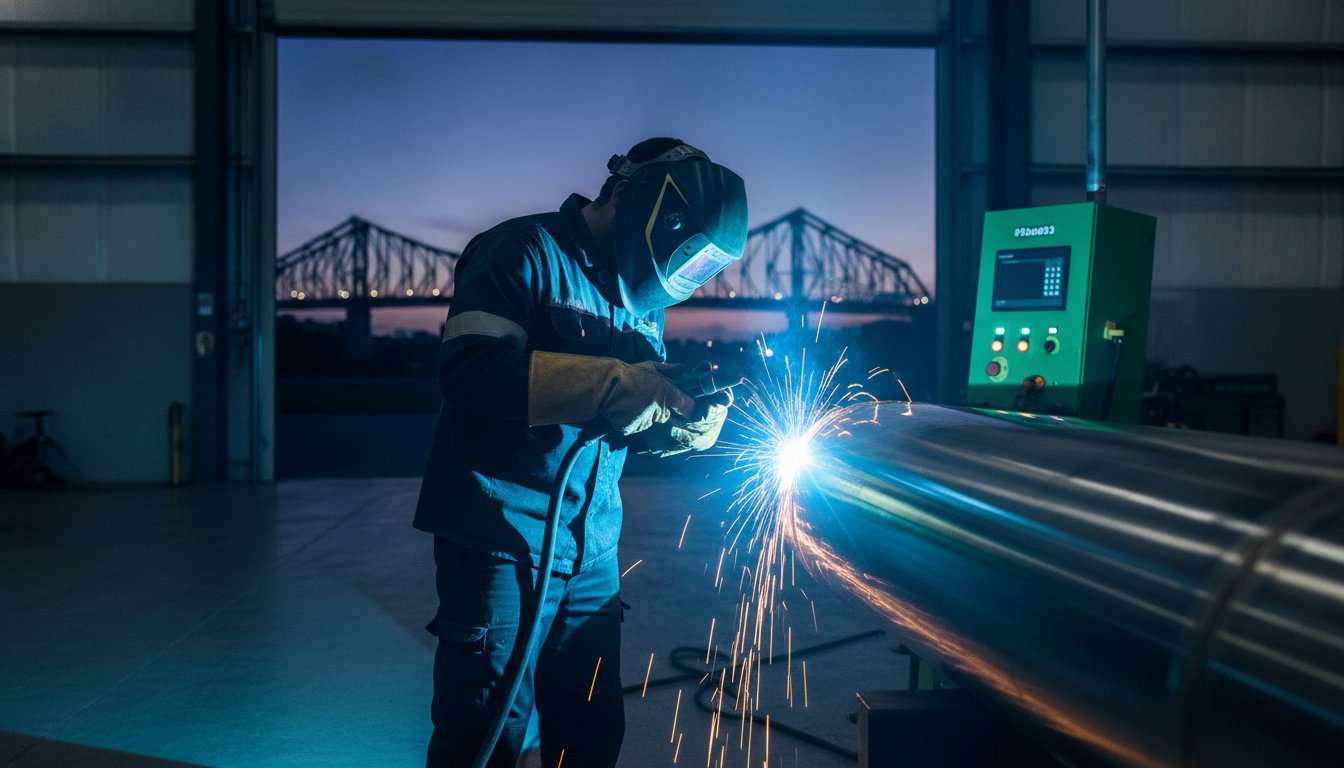
Last summer, a project manager in Moreton Bay watched as their brand-new industrial handrails developed unsightly brown tea staining just six months after installation. It wasn’t a failure of the welder’s skill, but a critical mismatch in material selection. Choosing the right stainless steel grades for industrial fabrication is the difference between an asset that lasts forty years and one that requires a costly, premature replacement.
It’s a common frustration in South East Queensland where the salt air and high humidity quickly expose any technical oversight. You understand that your installations must be durable, but the confusion between international grades and the latest AS/NZS 5131:2024 updates can make procurement difficult. This guide provides the clarity you need to ensure your projects survive the Brisbane climate while remaining fully compliant with Australian Standards. We’ll examine the specific use cases for 304 and 316 grades, look at the recent changes to fabrication standards, and help you select materials that pass every safety audit with confidence.
Key Takeaways
- Identify the distinct metallurgical properties of the five stainless steel families to select the most durable material for your specific industrial application.
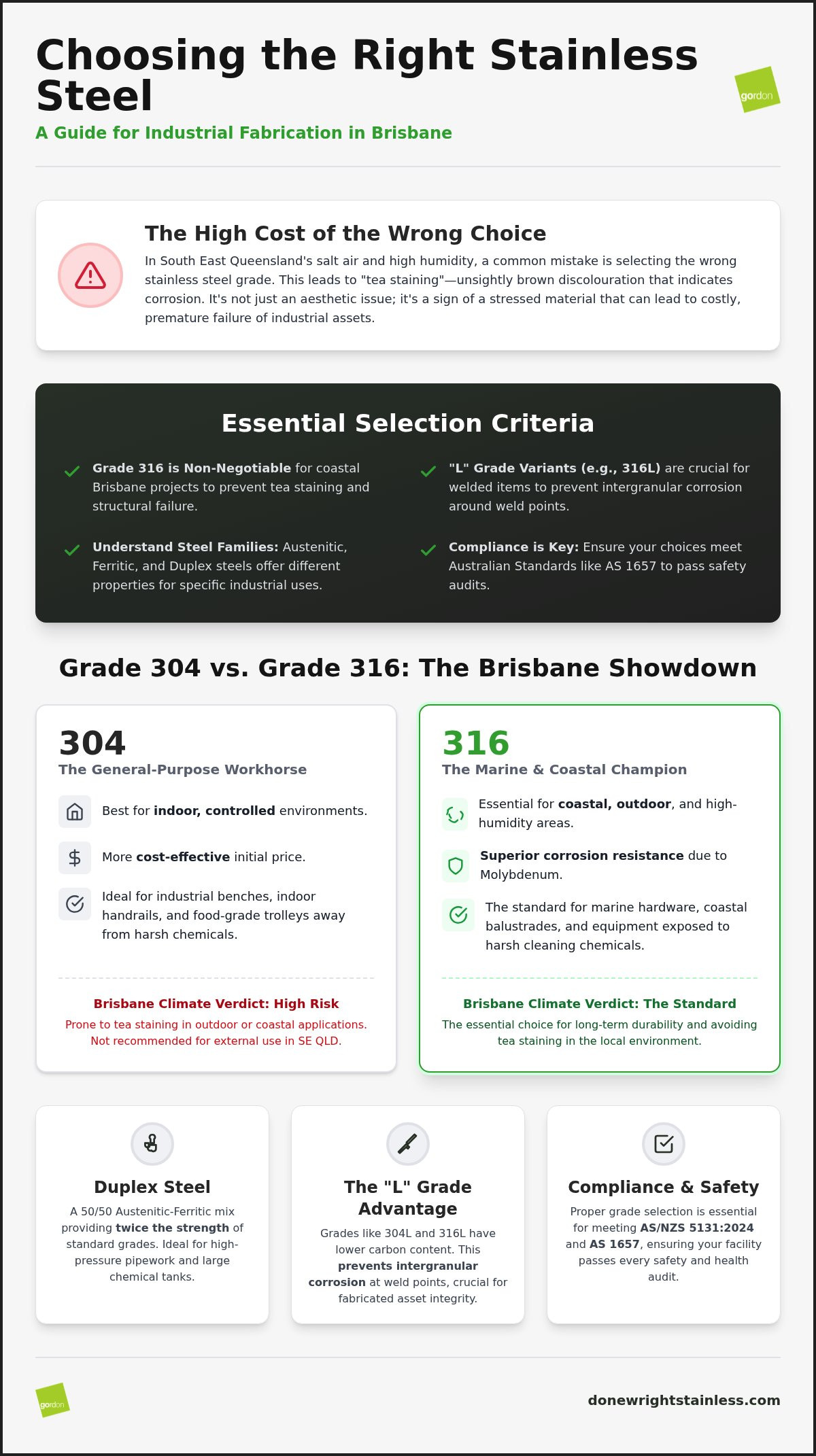
- Learn why Grade 316 is the non-negotiable standard for coastal Brisbane projects to avoid the costly aesthetic and structural failure known as tea staining.
- Understand the technical necessity of “L” grade variants when choosing stainless steel grades for industrial fabrication to prevent intergranular corrosion around weld points.
- Navigate the complexities of AS 1657 compliance for safety handrails and custom assets to ensure your facility passes every safety and health audit.
- Discover how material hardness affects fabrication lead times and why certain grades require specialised mobile welding techniques to maintain their integrity.
The Five Families: Classifying Stainless Steel Grades for Industrial Use
Stainless steel isn’t a single material but a diverse category of iron-based alloys. To be technically classified as stainless, the metal must contain a minimum of 10.5% Chromium. This Chromium reacts with oxygen to form a microscopic, self-healing passive layer that prevents surface rust. When engineers evaluate The Five Families of Stainless Steel, they are looking at how the metallurgical structure reacts to heat, chemicals, and physical stress. Choosing the right stainless steel grades for industrial fabrication requires a deep understanding of these families to ensure the finished asset can withstand the specific environmental pressures of a Brisbane facility.
While there are dozens of specialised alloys, most industrial projects in Queensland utilise three primary groups: Austenitic, Ferritic, and Duplex. Ferritic steels (400 series) are magnetic and contain high Chromium but little to no Nickel. They offer good corrosion resistance and are often a cost-effective choice for non-critical internal components or decorative trim. Martensitic grades are the “hard” branch of the family, often used for wear-resistant parts like pump shafts or industrial blades. However, for most heavy-duty fabrication, the focus remains on the Austenitic and Duplex families.
Ensuring a consistent supply of these alloys is critical for large-scale projects; international suppliers such as JABAL AL NOOR Steel play a vital role in providing the long and flat steel products used throughout the industrial and construction sectors.
Austenitic Stainless: The Gold Standard for Custom Fabrication
The 300 series of Austenitic stainless steel is the undisputed workhorse of the Brisbane industrial sector. This family dominates the food, beverage, and pharmaceutical industries because of its exceptional ductility and weldability. The secret lies in the addition of Nickel, which modifies the physical structure of the steel to make it non-magnetic and highly resistant to cracking during the fabrication process.
In our workshop, we primarily work with 304 and 316 grades. Grade 304 is the standard for indoor industrial benches and trolleys where hygiene is paramount but chemical exposure is moderate. Grade 316, often called marine grade, includes Molybdenum to fight off pitting corrosion. This makes it the essential choice for any equipment exposed to the salt air of the Gold Coast or the harsh cleaning chemicals used in sanitary environments. These stainless steel grades for industrial fabrication provide the reliability needed for long-term asset management.
Duplex and Beyond: Solving High-Stress Engineering Challenges
When standard 300 series alloys aren’t enough, we turn to Duplex stainless steel. This family features a 50/50 metallurgical mix of Austenitic and Ferritic structures. This “best of both worlds” approach results in a material that is roughly twice as strong as standard 304 or 316. It also provides superior resistance to stress corrosion cracking, which is a common failure point in high-temperature or high-vibration environments.
We typically specify Duplex for high-pressure industrial pipework Brisbane projects or large-scale chemical storage tanks. While the material cost is higher than 304, the cost-to-performance ratio is often superior for heavy-duty assets. Because the material is so strong, we can often use thinner sections to achieve the same structural integrity, reducing the overall weight of the installation. This precision in material selection ensures that your engineering project meets Australian Standards while remaining efficient and durable.
Grade 304 vs 316: Selecting the Right Material for the Brisbane Climate
Selecting the right material for a Queensland facility often comes down to a technical choice between Grade 304 and Grade 316. While both belong to the Austenitic family, their performance in the humid, salt-laden air of South East Queensland differs significantly. When evaluating stainless steel grade specifications, engineers must look beyond the initial price tag. Grade 304 is the most common of the stainless steel grades for industrial fabrication, offering excellent durability for indoor applications. However, once a project moves outdoors or into a high-chloride environment, Grade 316 becomes the engineering standard.
The phenomenon known as “tea staining” is a constant challenge for Brisbane assets. This brown discolouration occurs when salt particles become trapped on the metal surface, leading to localised corrosion. While often aesthetic, it indicates that the passive layer is under stress. Choosing the correct grade is the first step in prevention, but the surface finish is just as critical. A smoother, mirror-polished finish has fewer microscopic valleys for salt to settle in, making it far more resistant than a rough, brushed finish in coastal zones.
The Molybdenum Difference in Coastal Environments
The primary distinction between these two grades is the addition of approximately 2% Molybdenum in Grade 316. This specific element provides a critical defence against pitting corrosion and chloride-induced stress. For any stainless steel handrails Brisbane businesses install near the river or coastal reaches, 316 is mandatory. In drier inland areas like Logan or Ipswich, 304 might suffice for some outdoor assets, but the longevity of 316 usually justifies the investment. The Molybdenum content ensures that your infrastructure maintains its structural integrity even when exposed to constant sea breezes.
When 304 is the Smart Engineering Choice
Grade 304 remains a highly effective solution for controlled, indoor environments. It’s the ideal choice for fabricating custom stainless trolleys, dry storage benches, and internal wall cladding. Because 304 is more cost-effective than 316, it allows for a more efficient allocation of the project budget without compromising on hygiene or strength. The key to making 304 last in a Brisbane facility is a strict cleaning protocol. Regular washing prevents the buildup of industrial grime that can bypass the metal’s passive layer. If you’re unsure which grade fits your facility’s specific micro-climate, our team can provide a technical assessment of your site requirements.
Choosing between these stainless steel grades for industrial fabrication involves a careful cost-benefit analysis. While Grade 316 carries a higher initial cost, it significantly reduces the long-term maintenance cycle and the risk of premature asset failure. Balancing the initial project budget against these long-term maintenance cycles is essential for sustainable industrial engineering. By matching the grade to the specific environmental stresses of your site, you ensure that your investment remains a high-performing asset for decades.
Specialised Grades for Food Processing and Chemical Fabrication
While 304 and 316 are the industry workhorses, certain high-consequence environments demand specific alloy modifications. These specialised stainless steel grades for industrial fabrication provide the metallurgical stability required for chemical processing and food production. For instance, food processing facilities in Brisbane must strictly adhere to AS 4674-2004. This standard, used by Brisbane City Council health inspectors, mandates fully welded, seamless surfaces and coved junctions to prevent bacterial growth. Achieving this level of hygiene requires more than just the right grade; it requires a deep understanding of how the metal behaves during the welding process.
Low Carbon Grades and Weld Integrity
The “L” in grades like 304L and 316L stands for low carbon content, typically restricted to below 0.03%. In standard stainless steels, the heat from a welding torch can cause “sensitisation.” This is where chromium and carbon combine to form carbides at the grain boundaries, depleting the surrounding metal of its corrosion-resistant chromium. The result is “weld decay,” where the metal rusts from the inside out along the heat-affected zone. By using low-carbon variants, we ensure that the metal maintains its integrity after fabrication. This is why we prioritise 316L for critical on-site industrial pipework repair Brisbane. It guarantees that heavy-wall structures remain durable without the need for post-weld heat treatment.
Material Selection for Chemical and Acid Resistance
In the brewery and dairy sectors, Clean-In-Place (CIP) systems are standard. These systems use aggressive caustic and acidic washes to maintain sanitation. While 316L is generally resistant to these cycles, extreme chemical environments may require Grade 904L. Originally developed to resist sulphuric acid, 904L contains higher levels of Nickel and Copper, offering a significant step up in protection for high-concentration chemical lines. For less demanding areas, such as magnetic splashbacks or specific food-safe bench tops, Grade 430 provides a magnetic, ferritic alternative. It is cost-effective and compliant with Australian health regulations for food contact, provided it is used in dry environments. Selecting between these alloys ensures your facility meets safety audits while managing the total cost of asset ownership.
High-temperature applications, such as industrial furnaces or exhaust manifolds, require yet another set of specialised alloys. Grades like 310 or 321 are engineered to resist oxidation and maintain structural strength at temperatures exceeding 800 degrees Celsius. In these scenarios, standard 304 would quickly scale and fail. By matching the specific grade to the thermal and chemical profile of your operation, we provide assets that don’t just pass inspection but continue to perform under extreme stress.
How Grade Selection Impacts Fabrication and Mobile Welding
The metallurgical properties of different stainless steel grades for industrial fabrication dictate exactly how a material behaves under a cutting tool or welding torch. Austenitic grades like 304 and 316 are prone to work hardening. This means if the machining speed is too slow or the tooling is dull, the metal becomes significantly harder and more difficult to work as you process it. Successful fabrication requires sharp, specialised tooling and precise feed rates to prevent the material from becoming brittle or damaging equipment. While these 300-series alloys are relatively forgiving to weld, high-strength options like Duplex require much tighter control over heat input to maintain the 50/50 balance of its crystalline structure.
Our workshop team understands that every grade has its own personality. Joining 304 is a standard procedure for most experienced fabricators, but moving to 316L or specialty alloys requires a more nuanced approach to gas shielding and filler wire selection. If the incorrect filler is used, the weld zone can become a weak point for corrosion, undermining the very reason for choosing a premium grade. Precision is the only way to ensure the finished asset meets the structural requirements of your engineering specifications.
Mobile Welding Challenges for High-Alloy Steels
Performing mobile welding Brisbane wide presents unique environmental challenges that don’t exist in a controlled workshop. Wind can easily strip away shielding gas, leading to porosity and contamination in the weld pool. This is particularly dangerous when working with Grade 316 pipework, where even a tiny inclusion can lead to premature failure. Our mobile units are equipped with portable screens and high-quality regulators to ensure gas coverage remains consistent even on exposed industrial sites.
Contamination is another critical risk during on-site repairs. If a tool used on carbon steel is subsequently used on stainless steel, microscopic iron particles can become embedded in the surface. This leads to “cross-contamination” where the stainless steel begins to rust at the contact points. We maintain strict tool separation in our mobile workshops to prevent this issue. Ensuring full weld penetration and surface integrity on-site is essential for maintaining the sanitary standards required by our food and chemical industry clients.
Surface Finishing and Passivation
A weld isn’t truly finished until the corrosion resistance has been restored. The welding process depletes chromium from the surface, leaving a “heat tint” that is vulnerable to rust. We use chemical pickling and passivation to remove this depleted layer and encourage the rapid reformation of the protective passive film. This step is non-negotiable for assets destined for Brisbane’s corrosive coastal environments. Without proper post-weld treatment, even the highest stainless steel grades for industrial fabrication will eventually fail.
The physical smoothness of the metal, measured as surface roughness (Ra), also plays a role in longevity. For commercial kitchen benches and food processing equipment, a “No. 4 Finish” is the industry standard. This brushed finish is smooth enough to be easily sanitised while remaining durable enough for heavy daily use. In pharmaceutical applications, we may move to mechanical polishing or electropolishing to achieve an even lower Ra value, eliminating microscopic pits where bacteria or chemicals could hide. If your equipment requires urgent attention, our mobile workshop services can provide on-site finishing and passivation to keep your operations compliant.
Partnering with Brisbane Experts for Compliant Grade Selection
Selecting the appropriate alloy represents only half the challenge. The true value lies in how those materials are integrated into your facility’s specific environment. A local fabricator brings a level of geographical insight that a global supplier simply cannot match. We understand that a coastal processing plant in Wynnum faces different atmospheric stresses than a dry storage warehouse in Archerfield. By choosing the right stainless steel grades for industrial fabrication and applying them with local expertise, you ensure your assets remain structurally sound and aesthetically clean for their entire service life.
Our approach focuses on balancing technical performance with project ROI. We don’t just recommend the most expensive grade by default; we assess the chemical exposure, cleaning protocols, and physical demands of your site. This methodical assessment prevents over-engineering while ensuring that critical components never fall victim to premature corrosion or mechanical failure. It’s about providing a steady, experienced hand to guide your material procurement from the initial design phase through to the final weld.
Navigating Australian Standards and Compliance
Compliance isn’t optional in the industrial sector. Every project we undertake, particularly safety handrail fabrication Brisbane wide, must adhere to strict Australian Standards like AS 1657. This standard dictates everything from the height of the rail to the slip resistance of the walk-way. Using the correct grade is a core part of this compliance; a handrail that develops structural pitting is no longer a safety asset. We provide full material traceability for our projects, ensuring that every piece of steel has a verified grade and origin for your safety audits.
We also specialise in managing the transition between different metals. In many Brisbane facilities, stainless steel components must be integrated with mild steel fabrication Brisbane projects. If these metals are joined incorrectly, galvanic corrosion can occur, where the more noble stainless steel causes the mild steel to rust at an accelerated rate. We use specialised insulating gaskets and specific fastening techniques to prevent this reaction, ensuring that your multi-metal structures remains secure and compliant.
The Donewright Advantage: From Design to On-Site Installation
Ian “Wrighty” and the team have spent decades working within the unique conditions of the Queensland industrial landscape. This experience allows us to select stainless steel grades for industrial fabrication based on real-world performance rather than just theoretical data sheets. We’ve seen which alloys thrive in local food processing plants and which ones fail when exposed to the humidity of a Brisbane summer. This practical knowledge is what allows us to offer honest, fuss-free advice that protects your bottom line.
Our mobile workshop services further enhance this capability by providing rapid on-site assessment and grade verification. Whether you’re dealing with an urgent repair or a new installation, we can bring our technical expertise directly to your facility, reducing downtime and ensuring that the work is performed to the highest standards of precision. If you’re ready to ensure your next project is built for longevity and compliance, Contact Donewright Stainless for a technical consultation on your next fabrication project. We’ll help you navigate the complexities of material selection with the confidence that only comes from years of on-the-job experience.
Securing Long-Term Integrity for Your Queensland Assets
Selecting the correct material isn’t just about meeting a project budget; it’s about ensuring your infrastructure survives the specific atmospheric challenges of the South East Queensland environment. From preventing unsightly tea staining on coastal handrails to maintaining the rigorous sanitary standards of a Brisbane food processing plant, the technical nuances of stainless steel grades for industrial fabrication determine the ultimate lifespan of your investment. By prioritising Grade 316 for outdoor exposures and utilising low-carbon “L” variants for critical welded pipework, you effectively mitigate the risk of premature failure and expensive maintenance cycles.
Donewright Stainless provides the technical expertise and local insight needed to navigate these metallurgical choices with confidence. Our Brisbane-based mobile workshop is fully equipped for rapid on-site repairs and grade verification, ensuring every installation is fully compliant with AS 1657 standards. We specialise in custom industrial pipework and safety handrails that are built to last. Get a Custom Fabrication Quote from the Brisbane Experts today. We’re ready to help you build durable industrial assets that perform reliably for decades to come.
Frequently Asked Questions
What is the most common stainless steel grade for industrial fabrication?
Grade 304 is the most common of the stainless steel grades for industrial fabrication used across Brisbane. It provides a reliable balance of cost and performance for indoor assets like custom benches and trolleys. While it offers excellent corrosion resistance in dry environments, it’s often replaced by Grade 316 for outdoor applications or coastal projects where the risk of tea staining is much higher.
Is Grade 316 worth the extra cost for a Brisbane-based project?
Grade 316 is absolutely worth the additional investment for any project exposed to the salt air of the Brisbane River or the Gold Coast. The inclusion of Molybdenum provides the necessary protection against pitting and tea staining that Grade 304 lacks. Choosing the higher grade initially prevents the significant long-term costs associated with early asset failure and structural degradation in our humid, subtropical climate.
Can you weld different grades of stainless steel together?
You can weld different grades together, such as joining 304 to 316, provided you use the correct filler material. Typically, a Grade 316L filler is used to ensure the weld zone maintains the corrosion resistance of the superior grade. Our mobile workshop team carefully selects consumables to match the metallurgical requirements of both materials, preventing the formation of weak points that could lead to cracking or localised rusting.
What causes stainless steel to rust in a coastal environment like the Gold Coast?
Rusting in coastal areas is primarily caused by chloride ions from sea spray settling on the metal surface. These ions penetrate the protective passive layer, leading to localised pitting or the brown discolouration known as tea staining. Without regular cleaning or the selection of a Molybdenum-bearing alloy like Grade 316, these deposits eventually break down the metal’s natural defences, particularly in crevices or rough surface finishes.
Which grade should be used for food-grade industrial benches?
Grade 304 is the standard choice for most food-grade industrial benches in temperature-controlled, indoor facilities. However, if the facility handles high-salt brines or undergoes aggressive chemical cleaning, Grade 316 is preferred for its superior chemical resistance. Both grades are compliant with AS 4674-2004, provided the fabrication features fully welded, seamless joins and coved junctions that prevent bacterial accumulation.
How do I know if the stainless steel I have is Grade 304 or 316?
You can identify the grade through a chemical Molybdenum spot test or by reviewing the original mill certificates. Because 304 and 316 are both non-magnetic and visually identical, physical inspection isn’t enough to confirm the alloy. Our team can perform on-site verification to ensure your stainless steel grades for industrial fabrication are correctly matched before beginning any critical maintenance or structural modifications.
What is the difference between 316 and 316L stainless steel?
The primary difference is the carbon content; 316L contains a maximum of 0.03% carbon, while standard 316 allows up to 0.08%. This lower carbon level is essential for preventing sensitisation during the welding process, which can lead to “weld decay” or intergranular corrosion. We use 316L for heavy-wall industrial pipework to ensure the structural integrity of the joint matches the rest of the asset.