
Industrial Plant Maintenance Welding: Minimising Downtime in Brisbane
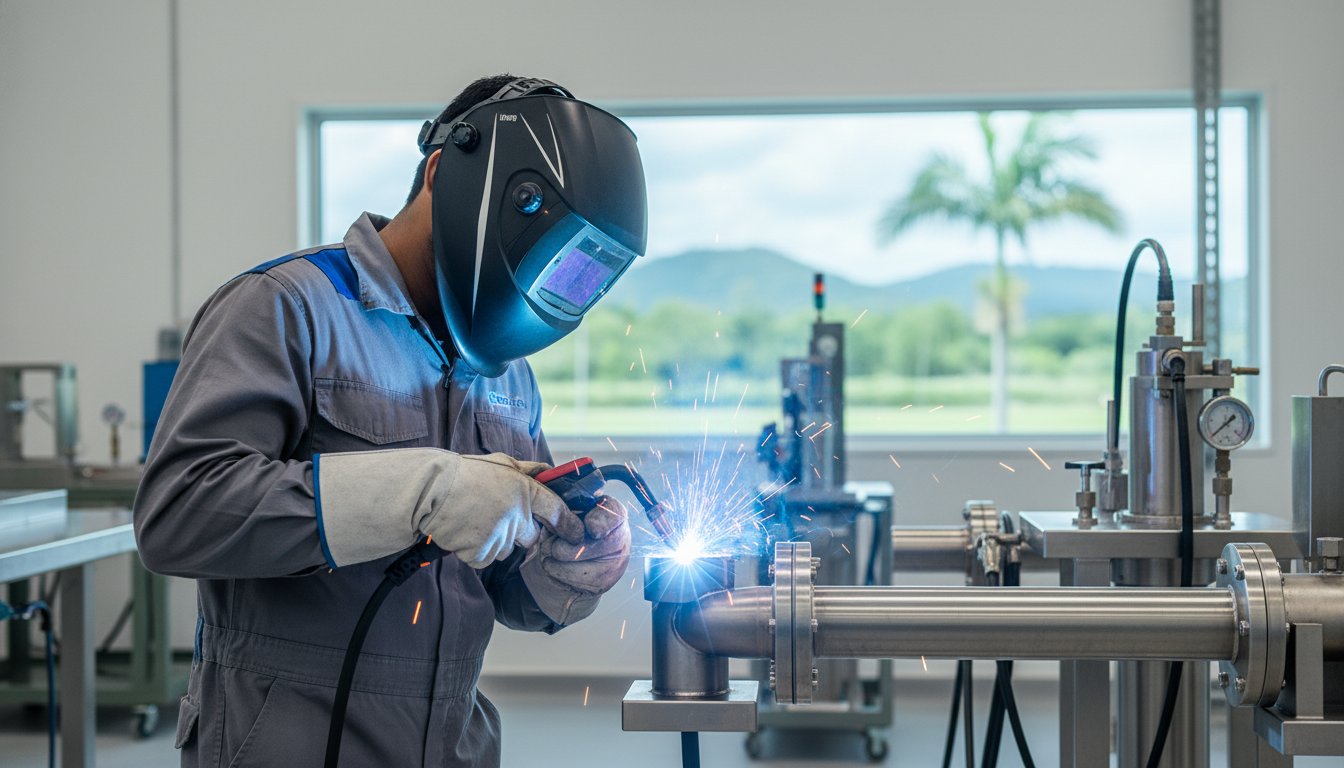
What if the “quick fix” on your production line is actually the most expensive decision you’ll make this year? When a critical component fails, the pressure to resume operations often leads to rushed repairs that overlook long term structural integrity. You likely understand the frustration of production downtime caused by contractors who don’t fully grasp the nuances of AS 1657 compliance or the technical requirements of industrial plant maintenance welding. Poor quality welds don’t just risk safety; they lead to repeat failures that drain your maintenance budget and compromise your site’s efficiency.
We’ll show you how a strategic approach to maintenance welding and on-site fabrication keeps South East Queensland plants running at peak performance with zero compliance risks. With the 2026 introduction of AS/NZS ISO 15608 and stricter workplace exposure limits for welding fumes, the margin for error has never been smaller. This guide provides a clear look at how professional standards, material traceability, and rapid response capabilities ensure your facility remains safe, productive, and fully compliant with Australian food-grade and safety regulations.
Key Takeaways
- Learn why shifting from reactive repairs to a strategic asset life-cycle approach reduces long-term operational costs and prevents unexpected production halts.
- Understand the specific advantages of using stainless steel and aluminium for industrial pipework and access platforms to ensure durability in demanding environments.
- Discover how professional industrial plant maintenance welding balances rapid mobile response for immediate breakdowns with the precision of workshop-based fabrication.
- Identify the critical requirements of AS 1657 and AS 4674 to ensure your facility’s platforms, ladders, and food-grade zones meet current Australian standards.
- Gain insights into how precision-engineered maintenance services across South East Queensland can extend the service life of your plant assets and improve site safety.
The Strategic Importance of Industrial Plant Maintenance Welding
Effective industrial plant maintenance welding is far more than a series of emergency repairs. It represents a disciplined approach to asset life-cycle management. Instead of treating a weld as a temporary fix, a professional maintenance strategy treats every join and bead as a critical component of the plant’s long-term health. This is particularly vital in South East Queensland, where industrial environments range from heavy processing facilities to sensitive food production zones. Precision in these environments is non-negotiable.
Relying on generalist welders often leads to frustration and repeat costs. While a generalist might understand basic welding processes, they frequently lack the specific knowledge required for high-pressure industrial pipework or specialised stainless steel fabrication. This knowledge gap results in welds that might look acceptable on the surface but fail under the stress of daily operations. True maintenance welding ensures that structural integrity and operational safety remain uncompromised; it protects both the machinery and the people who operate it.
Reactive vs. Preventative Maintenance Welding
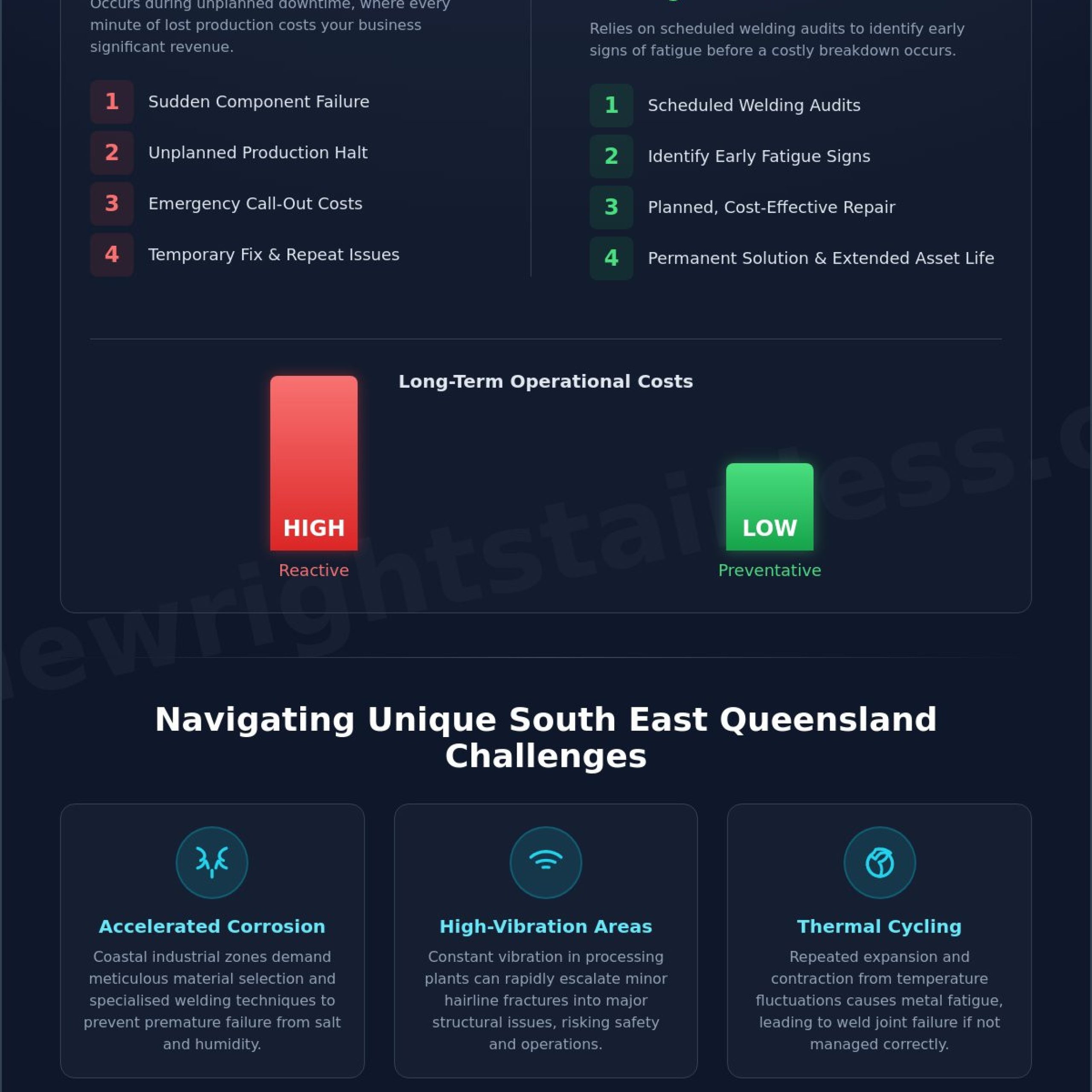
The financial difference between reactive and preventative maintenance is stark. Reactive repairs usually occur during unplanned downtime, where every minute of lost production costs your business significant revenue. Preventative industrial plant maintenance welding relies on scheduled welding audits to identify early signs of fatigue in pipework and structural supports before a break occurs. We take what we call the “Wrighty” approach. We don’t just look for the crack; we look for the root cause. If a support is failing due to poor alignment or excessive stress, simply patching the metal won’t solve the problem. We aim for a permanent resolution that prevents the same failure from recurring in six months.
Common Industrial Welding Challenges in SEQ
Plants operating across Brisbane and the Gold Coast face unique environmental pressures. In coastal industrial zones, accelerated corrosion requires meticulous material selection and specific welding techniques to prevent premature failure. High-vibration areas in processing plants also pose a constant threat, as they can rapidly turn a minor hairline fracture into a major structural issue. Thermal cycling is the repeated expansion and contraction of metallic materials due to temperature fluctuations, which can lead to fatigue and eventual failure of the weld joint if not managed correctly. Addressing these challenges requires a partner who understands how local conditions affect different alloys and structural designs.
Material Expertise: Specialising in Stainless Steel, Aluminium, and Mild Steel
Success in industrial plant maintenance welding hinges on a deep understanding of metallurgy. Choosing the wrong filler material or failing to account for galvanic corrosion when joining dissimilar metals can lead to rapid structural failure. For instance, connecting stainless steel to mild steel without proper isolation creates a battery-like effect that accelerates rust in the less noble metal. Our approach prioritises material compatibility to ensure every repair or modification lasts as long as the original asset. Adhering to the latest welding safety protocols also means managing the specific fumes and hazards associated with different alloys, particularly when working with galvanised surfaces or specialised coatings.
Food-Grade Stainless Steel Requirements
In the food, beverage, and pharmaceutical sectors, stainless steel is the non-negotiable standard for hygiene and durability. We focus on 316-grade stainless for environments involving high acidity or salt, as it provides superior pitting resistance compared to 304-grade. The technical challenge here is the “sanitary weld.” These welds must be perfectly smooth and free of pits or crevices where bacteria could colonise. After the weld is complete, post-weld treatments like pickling and passivating are essential. These processes remove heat tint and restore the protective chromium oxide layer, ensuring the material remains truly stainless. If you need bespoke solutions for your facility, our team specialises in stainless steel fabrication designed for hygiene and longevity.
Aluminium and Mild Steel Applications
While stainless handles hygiene, aluminium and mild steel provide the backbone for structural plant components. Aluminium is the preferred choice for lightweight access platforms, gantries, and safety railings due to its natural corrosion resistance and ease of installation. Its high strength-to-weight ratio makes it ideal for retrofitting existing structures where weight limits are a concern. Conversely, mild steel remains the workhorse for heavy-duty manufacturing hubs. We use it for mezzanine floors, heavy machinery mounts, and warehouse protection where sheer mass and impact resistance are required. Achieving full weld penetration in these heavy-load settings is critical for safety. Whether we are repairing a cracked gantry or installing new machinery supports, we focus on the specific structural demands of the site to prevent future fatigue. Our mobile welding Brisbane services allow us to handle these heavy-duty repairs directly on your floor, reducing the logistical burden of moving large components.
While our focus remains on the maintenance and custom modification of existing plants, many industrial operators choose to expand their facilities using pre-engineered steel buildings for sale, which provides a versatile and durable framework for housing new production lines or storage zones.
Mobile Welding vs. Workshop Fabrication: The Best of Both Worlds
Choosing between on-site repairs and off-site fabrication isn’t a binary decision. It’s about efficiency. For immediate breakdown repairs, on-site mobile welding is essential to get the line moving again. However, complex plant upgrades often benefit from the controlled environment of a workshop. We provide both, ensuring that the work is performed where it makes the most sense for your production schedule. Managing the logistics of a live plant environment requires a disciplined approach to safety and space. We coordinate closely with site managers to ensure our presence doesn’t create a secondary bottleneck.
Maintaining high standards during these transitions is vital. Adhering to quality essentials for welding ensures that whether a join is made on a factory floor or a workshop bench, the structural integrity remains identical. This consistency is what separates a professional engineering partner from a basic repair service. Reliability in these settings comes from having the right equipment and the right mindset for the job at hand.
The Fully Equipped Mobile Workshop Advantage
A common mistake is hiring a “welder in a ute” for complex industrial plant maintenance welding. While basic tools might fix a simple bracket, they often fall short when dealing with industrial pipework or heavy structural frames. Our mobile welding Brisbane services are designed to bring high-level technical capabilities directly to your facility. We arrive with the equipment necessary for TIG, MIG, and stick welding, allowing us to handle diverse materials without leaving the site. Safety is our primary concern. We strictly follow site-specific hot work permits and fire watch protocols to protect your assets and personnel during every operation.
Custom Fabrication for Plant Upgrades
Some tasks are simply better suited for a workshop environment. Designing and building bespoke trolleys, benches, or hoppers in our Brisbane facility allows for a level of precision that’s difficult to achieve in a busy plant. We take precise measurements and consider 3D spatial requirements before we even strike an arc. This process often involves modular fabrication, where we build large sections of an upgrade off-site. By doing the heavy lifting in our workshop, we significantly reduce the time our team spends on your floor during the final installation. This methodical approach minimises disruption and ensures a cleaner, faster integration into your existing workflow.
Compliance and Australian Standards for Industrial Welding
Adherence to Australian Standards isn’t merely a matter of ticking boxes; it’s a fundamental requirement for site safety and operational legality. In the Brisbane industrial landscape, failing to meet these benchmarks can lead to significant liability and, more importantly, workplace accidents. Professional industrial plant maintenance welding must be performed with a clear understanding of the specific codes that govern structural integrity and hygiene. Whether it’s a minor repair to a gantry or the installation of new industrial pipework, the work must stand up to rigorous inspection and the daily stresses of a high-output environment.
Verification is a key part of this process. For high-pressure pipework or critical structural joins, weld testing and certification provide the necessary assurance that a join won’t fail under load. This level of precision ensures that handrails and safety protection systems meet both Australian Standards and local Brisbane council codes, providing a secure environment for your workforce.
Using a dedicated platform like SOCWeld allows for the seamless automation of this documentation, ensuring all compliance data is easily accessible and audit-ready.
Ensuring Safe Access with AS 1657
AS 1657 is the definitive benchmark for fixed platforms, walkways, stairways, and ladders. Compliance with this standard requires specific welding techniques to ensure that components like kick plates and non-slip surfaces are permanently and securely attached. When we design and install custom-fabricated industrial stairs, we prioritise load-bearing calculations to ensure the structure can handle its intended capacity without deflection. Choosing a compliant installation over a “cheap” alternative is a strategic decision. A compliant safety rail protects your personnel and your business from the catastrophic costs of structural failure. For high-traffic zones where corrosion resistance is equally critical, purpose-built stainless steel safety barriers offer a durable, audit-ready solution that generic off-the-shelf options simply cannot match.
Sanitary Pipework and AS 4674
For facilities involved in food, beverage, or pharmaceutical production, AS 4674 dictates the requirements for the construction and fit-out of the premises. In these environments, industrial plant maintenance welding must focus on eliminating “dead legs” and crevices in liquid processing lines. These are areas where product can stagnate and bacteria can flourish, compromising the entire production batch. Surface finish requirements are equally strict; welds in food-contact zones must be ground smooth and passivated to maintain a sanitary environment. We maintain thorough documentation and material traceability for every project, ensuring that your maintenance records are audit-ready and fully transparent. If you’re looking to upgrade your facility’s safety infrastructure, we offer specialised safety handrails and protection that meet all current Australian regulatory requirements.
Partnering with Donewright Stainless for Plant Maintenance
Partnering with Donewright Stainless means securing a technical specialist who understands the operational pressures of South East Queensland’s industrial corridors. Our service area extends across Brisbane, the Gold Coast, Logan, and Ipswich, providing local manufacturers with a dependable partner for industrial plant maintenance welding. We don’t just provide labour; we provide precision engineering that integrates seamlessly with your existing infrastructure. When organising industrial shutdowns, our focus is on meticulous preparation to maximise your return on investment. By minimising on-site variables and coordinating closely with your floor managers, we ensure that every hour of downtime is used productively to restore and enhance your assets. This methodical approach is designed to eliminate the need for repeat repairs and ensure long-term structural integrity.
Transitioning from initial site audits to final installation requires a disciplined workflow. We handle the entire process, starting with a comprehensive assessment of your current equipment and safety systems. This allows us to identify exactly where industrial plant maintenance welding can most effectively extend the life of your assets. From there, we move into expert fabrication, often utilising our workshop to create custom components like trolleys, benches, or industrial pipework before bringing them to your site. This end-to-end service ensures that every component is built to the exact specifications required for your specific plant layout and operational needs.
Our Local Experience in South East Queensland
Our reputation is built on a history of supporting local food processors and heavy manufacturers with reliable solutions. We understand that in a high-stakes production environment, “near enough” is never good enough. Our team has built a name for getting it done right the first time, whether that involves complex stainless steel modifications or structural repairs. For urgent issues that threaten your production schedule, our mobile workshop services provide rapid response across the Brisbane region. This local presence allows us to offer a level of responsiveness and site-specific knowledge that larger, more detached contractors simply cannot match. We take pride in being the steady, experienced hand that local industry relies on to maintain peak efficiency.
Schedule Your Maintenance Audit Today
A proactive maintenance audit is the most cost-effective insurance policy for your facility. Instead of waiting for a catastrophic failure, we help you identify fatigue points and compliance gaps before they escalate. We work as a collaborative extension of your internal maintenance teams, sharing technical insights to improve overall plant efficiency. This partnership ensures that your facility remains safe, compliant, and ready for future growth. Our team is passionate about the finer points of our trade, and we bring that meticulous attention to detail to every audit we perform. Contact Donewright Stainless for a site-specific maintenance quote to discuss how we can support your next scheduled shutdown or upgrade project.
Securing Your Plant’s Operational Future
Maintaining a high-output industrial facility requires more than just keeping the machines running; it demands a commitment to long-term structural integrity and strict adherence to safety standards. By prioritising professional industrial plant maintenance welding, you protect your production schedule from the high costs of unplanned downtime. Whether you are managing high-pressure pipework or ensuring your access platforms meet AS 1657 requirements, the right engineering partner ensures every repair is a permanent solution rather than a temporary fix.
Our team at Donewright Stainless specialises in custom stainless, aluminium, and mild steel fabrication, offering the flexibility of a fully equipped mobile workshop for site-wide support across South East Queensland. We bring deep expertise in food-grade standards and Australian safety regulations to every project, ensuring your site remains audit-ready and efficient. Taking a proactive approach today is the most effective way to safeguard your operations and your workforce for the years ahead.
Book an Industrial Site Audit with Donewright Stainless to identify potential risks and optimise your facility’s maintenance schedule. We look forward to helping you keep your plant running at peak efficiency.
Frequently Asked Questions
What industries do you provide maintenance welding for in Brisbane?
We serve a broad range of sectors including food and beverage processing, pharmaceutical manufacturing, and heavy industrial hubs across Brisbane. Our team is experienced in the specific requirements of high-output environments where hygiene and structural integrity are paramount. We tailor our industrial plant maintenance welding to the unique operational demands of each site, ensuring that repairs and modifications support your facility’s long-term efficiency.
Can you perform TIG welding on-site for food-grade stainless steel?
Yes, we perform high-quality TIG welding on-site for food-grade stainless steel using our mobile workshop services. This process is essential for creating sanitary joins that are free from crevices and pits where bacteria could accumulate. We use high-purity argon shielding to ensure the back of the weld is as clean as the front, meeting the strict hygiene requirements of Australian food premises standards.
Do your welders hold certifications for AS 1657 compliance?
Our fabrication and installation processes are specifically designed to meet the requirements of AS 1657 for fixed platforms, walkways, and ladders. We ensure that every weld and structural join complies with the load-bearing and safety specifications outlined in the standard. This focus on compliance provides peace of mind that your facility’s safety infrastructure is legally sound and physically secure for your workforce.
How quickly can your mobile welding workshop respond to a breakdown in Logan or Ipswich?
We offer mobile welding services across Logan and Ipswich and strive to respond to breakdowns as efficiently as possible within our current schedule. While response times vary based on location and the complexity of the repair, our local presence in South East Queensland allows us to coordinate site visits quickly. We recommend contacting us directly to check current availability for your specific industrial plant maintenance welding needs.
Do you provide hot work permits and safety documentation for on-site welding?
Yes, we handle all necessary safety documentation, including hot work permits, Job Safety Environmental Analysis (JSEA), and risk assessments. Safety is a non-negotiable part of our service, and we work closely with your site’s safety officers to ensure all protocols are strictly followed. This professional approach minimises risk to your personnel and assets while maintaining a transparent record of all on-site work.
Can you fabricate custom industrial parts off-site and install them during a shutdown?
We frequently fabricate custom industrial components off-site in our workshop to be installed during scheduled plant shutdowns. This modular approach significantly reduces the time our team spends on your production floor, allowing for a faster return to full operational capacity. By completing the heavy fabrication in a controlled environment, we ensure higher precision and a cleaner final installation at your facility.
What is the difference between 304 and 316 stainless steel for plant maintenance?
The primary difference lies in their chemical composition; 316 stainless steel contains molybdenum, which makes it much more resistant to corrosion from chlorides and acids than 304. For plant maintenance in coastal areas or environments involving harsh cleaning chemicals, 316 is the superior choice for longevity. We assess your specific operating conditions to recommend the most cost-effective material that won’t fail prematurely.
Do you offer maintenance services for aluminium safety systems as well as steel?
Yes, we provide comprehensive maintenance and repair services for aluminium safety systems, including gantries, handrails, and access platforms. Aluminium requires specialised welding techniques and equipment to ensure a strong, durable join without compromising the material’s properties. Our team is equipped to handle these repairs on-site, ensuring your lightweight access systems remain fully compliant and safe for daily use.