
On-Site Pipework Repair Brisbane: Industrial Maintenance & Engineering Solutions
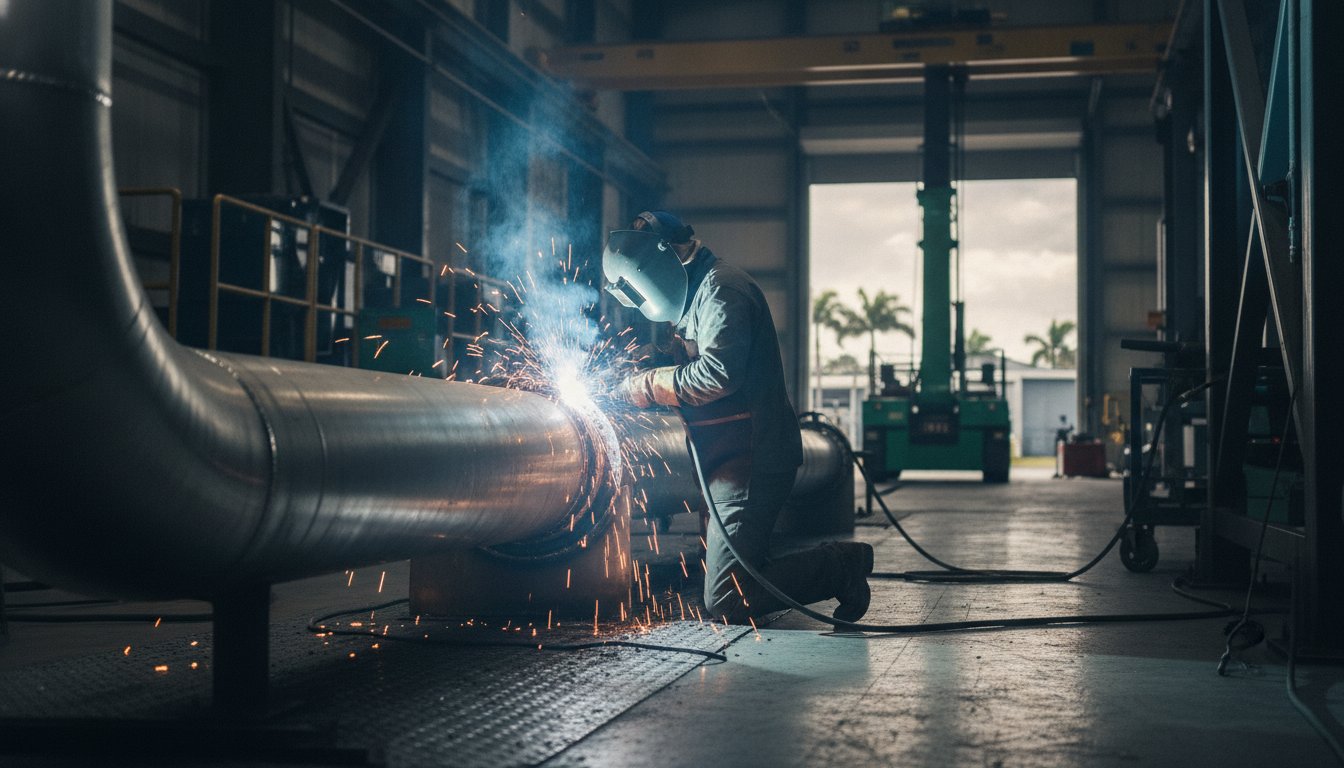
Imagine standing on a factory floor in Hemmant or Pinkenba while a critical processing line sits silent because of a single fractured weld. Every hour of unplanned downtime isn’t just a technical headache; it’s a direct hit to your bottom line that can’t be recovered. When your infrastructure fails, you don’t have the luxury of dismantling entire systems to send them to a workshop. This is where professional on-site pipework repair Brisbane becomes the difference between a minor disruption and a week-long catastrophe.
It’s frustrating to manage aging assets in Queensland’s corrosive coastal air, especially when finding welders qualified for AS 4041 or food-grade standards feels like a constant hurdle. You’ll learn how to restore plant operations rapidly and implement proactive maintenance strategies that keep your facility compliant with the latest WHS regulations and high-risk plant standards. This guide explores the technical advantages of mobile engineering, the importance of material selection for longevity, and how a no-fuss approach to on-site fabrication ensures your pipework stands up to the harshest industrial demands.
Key Takeaways
- Discover how mobile workshops and “measure-fit-weld” techniques eliminate the need to dismantle systems, significantly reducing unplanned downtime and logistical costs.
- Compare the long-term lifecycle costs of stainless steel versus mild steel to make informed decisions for Queensland’s corrosive coastal industrial environments.
- Learn the essential points for monthly and quarterly maintenance audits to ensure your facility remains compliant with AS 4041 and modern WHS standards.
- Understand how expert on-site pipework repair Brisbane services provide the precision required for high-pressure and sanitary food-grade systems.
- Identify the specific visual indicators of pipework degradation that signal the need for immediate engineering intervention before a catastrophic failure occurs.
The Critical Need for On-Site Pipework Repair in Brisbane
Brisbane’s industrial hubs, from the Port of Brisbane to the manufacturing corridors of Acacia Ridge, operate under unique environmental and operational pressures. Maintaining these facilities requires a specialised understanding of how local conditions degrade infrastructure over time. Professional on-site pipework repair Brisbane services aren’t just a convenience; they’re a necessity for food processing plants, chemical facilities, and manufacturing centres that cannot afford to halt production for workshop-based repairs.
Unplanned downtime in a high-output plant can cost thousands of dollars per hour in lost revenue. It isn’t just the pause in production that hurts; it’s the labour costs of idle staff and the potential for spoiled inventory in temperature-sensitive systems. Investing in proactive maintenance is a far more reliable strategy than reactive crisis management. Beyond the financial impact, deteriorating pipework is a major safety hazard. Leaks involving high-pressure steam or hazardous chemicals lead to serious workplace injuries and environmental breaches, making pipe integrity a core component of Workplace Health and Safety (WHS) compliance.
Environmental Challenges for South East Queensland Sites
Queensland’s humidity and proximity to the coast create a perfect storm for metal degradation. “Tea staining” is a frequent issue in Brisbane facilities, where salt spray causes surface discolouration on stainless steel. If you ignore these signs, the metal often develops pitting corrosion, which compromises the pipe wall’s structural integrity. The intense South East Queensland sun also causes significant thermal expansion and contraction. This movement puts constant stress on joints and welds, often requiring a professional approach to what is industrial pipework repair and maintenance to reinforce weakened sections without removing the entire assembly. Navigating local environmental regulations for industrial discharge also requires pipes to be in peak condition to prevent accidental soil or waterway contamination.
Compliance with Australian Standards for Pipework
Operating an industrial site in Queensland requires strict adherence to AS 4041 for pressure piping. This standard ensures that systems are designed and maintained to handle specific pressures safely. Regular technical audits are essential for maintaining site certification and ensuring insurance coverage remains valid. Documentation is the backbone of these audits. You need clear records to prove your facility’s safety and reliability.
- Maintenance logs: Detailed history of all inspections and repairs.
- Material certificates: Verification of the grades of steel used in replacement sections.
- Weld records: Documentation of weld procedure specifications and qualification records.
- Testing data: Results from hydrostatic or pneumatic testing where required by law.
Reliable on-site pipework repair Brisbane ensures that every fix meets these rigorous standards, providing the paperwork and the peace of mind required for modern industrial operations.
What is Industrial Pipework Repair? An Engineering Definition
Industrial pipework repair is often miscategorised as a branch of commercial plumbing. While both deal with fluid transport, the engineering requirements of process piping are vastly different. A commercial plumber might manage low-pressure water and waste in a kitchen or bathroom; however, industrial systems involve high-pressure steam, corrosive chemicals, and food-grade liquids. These systems demand a systematic approach to restoration that prioritises operational continuity and structural integrity. This is why on-site pipework repair Brisbane is viewed through an engineering lens rather than a maintenance one.
Effective repair work integrates mechanical engineering, precision fabrication, and specialised welding. It requires the ability to read complex schematics and understand the metallurgical properties of the materials involved. Because industrial lines are often fixed in place or too large to transport easily, mobile workshop capabilities are non-negotiable. Having the right equipment for on-site pipework repair Brisbane allows for rapid response without the logistical nightmare of dismantling entire sections of the plant. It’s about bringing the precision of a controlled workshop directly to the factory floor.
The Role of Specialised Welding in Repairs
The integrity of an industrial process line is only as strong as its weakest weld. TIG and MIG welding are the primary methods used to ensure these systems can withstand the stresses of high-pressure environments. In food processing and pharmaceutical plants, purge welding is essential. This technique involves filling the interior of the pipe with an inert gas to prevent oxidation during the welding process, ensuring a smooth, sanitary finish that prevents bacterial growth. Industrial pipework repair is the specialised engineering process of inspecting, fabricating, and welding process lines to ensure system integrity. Adhering to the Maintenance Checklists for Queensland Industrial Facilities provided by Safe Work Australia is a critical part of managing the risks associated with these high-risk welding tasks.
Beyond the Leak: Comprehensive System Refurbishment
A leak is often just a symptom of a broader mechanical issue. Comprehensive repair involves looking at the entire support structure. Corroded brackets or vibration-damaged supports can lead to premature pipe failure if left unaddressed. While the team is on-site, it’s often practical to evaluate adjacent infrastructure, such as safety handrail fabrication Brisbane, to maintain a safe and compliant working environment. Once a repair is complete, the work is verified through pressure testing or non-destructive testing (NDT) to confirm the new weld’s strength.
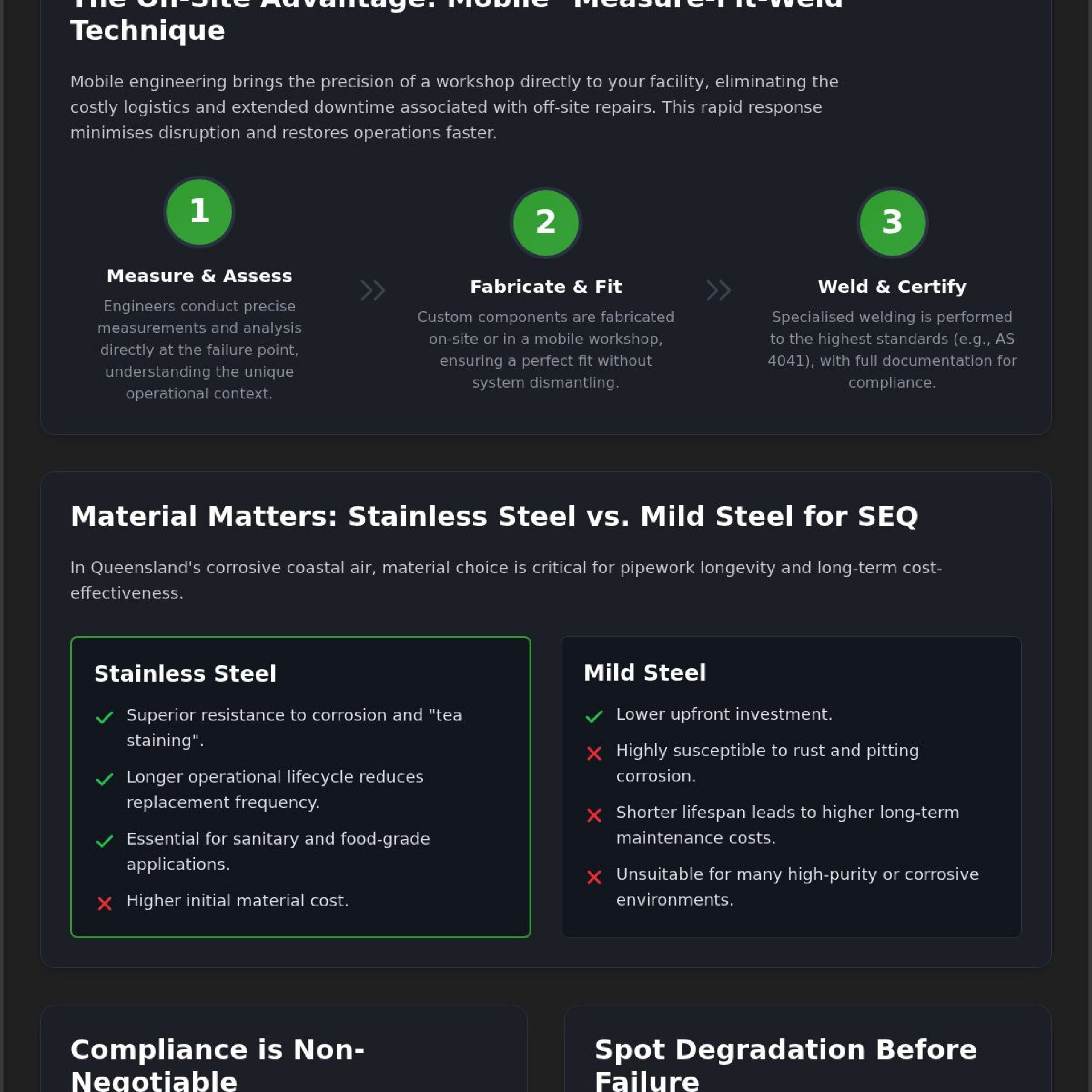
Integrating new, custom-fabricated components into aged infrastructure is a delicate task. It requires a “measure-fit-weld” approach to account for the slight shifts and settlements that occur in older plants over decades. If your facility is facing these challenges, engaging a reliable mobile engineering partner ensures that your repairs are not just temporary fixes, but long-term engineering solutions.
Stainless Steel vs. Mild Steel: Longevity and Maintenance
Choosing the right material for industrial process lines is a balance of immediate budget and long-term operational costs. While selecting the right alloys is critical, understanding the quality of cast components is equally important; you can learn more about Bowmanville Foundry to see how high-standard iron castings are manufactured. In South East Queensland’s aggressive climate, mild steel often presents a lower initial price point. However, when you factor in the regular need for recoating and the risk of failure from internal corrosion, the value proposition shifts. Professional on-site pipework repair Brisbane often highlights that while stainless steel carries a higher upfront cost, its potential lifespan can exceed several decades in environments where mild steel might fail much sooner. For many Brisbane facilities, the reduction in maintenance frequency justifies the initial investment within just a few years of operation.
Routine maintenance shutdowns provide the ideal window for material upgrades. If a section of galvanised pipework shows recurring issues with scale or external rust, replacing it with a stainless alternative can eliminate future repair cycles. This proactive approach reduces the frequency of emergency call-outs and ensures the system remains robust under high-pressure conditions. Utilising specialist on-site pipework repair Brisbane during scheduled shutdowns allows for a seamless transition between material types without extending the window of lost production.
In food processing and pharmaceutical plants across the Gold Coast and Brisbane, stainless steel is the non-negotiable standard. Maintaining these systems requires more than just a leak fix; it involves preserving the material’s sanitary properties. Techniques such as passivation are used after welding to restore the protective chromium oxide layer, ensuring the pipe remains resistant to bacterial growth and chemical cleaners. Grade 316 stainless steel is the preferred choice for coastal SEQ industrial sites due to its superior resistance to chloride-induced pitting, which is a common threat in our humid, salt-heavy air.
Mild Steel and Aluminium Pipework Maintenance
While stainless is king for process lines, mild steel fabrication Brisbane remains essential for secondary systems, structural supports, and non-corrosive fluid transport. Managing oxidation in these systems requires diligent monitoring of protective coatings and galvanised finishes. If the coating is breached during a repair, it must be restored immediately to prevent rapid localized corrosion.
Aluminium fabrication also plays a critical role in specialised industrial applications, particularly where weight is a factor or in specific chemical environments. Welding aluminium requires a different technical approach and equipment set compared to steel. A cost-benefit analysis often reveals that while aluminium or mild steel works for secondary infrastructure, the critical process lines should remain stainless to ensure the highest levels of plant reliability and safety.
Maintenance Checklists for Queensland Industrial Facilities
A structured maintenance regime is the most effective way to prevent the need for emergency on-site pipework repair Brisbane. In South East Queensland, the combination of high humidity and operational stress means that “set and forget” isn’t a viable strategy. By implementing a tiered checklist, maintenance supervisors can catch minor issues before they escalate into plant-wide shutdowns. This methodical approach ensures that every component, from the smallest valve to the largest process line, is accounted for during the facility’s lifecycle.
Monthly inspections should focus on accessible process lines, looking for early indicators of failure like stress corrosion cracking or vibration fatigue. Quarterly audits go deeper, examining the integrity of joints, valves, and seals that handle thermal movement. Annually, every system should undergo comprehensive pressure testing to maintain certification and ensure it still meets AS 4041 standards. Consistent on-site pipework repair Brisbane based on these findings prevents the catastrophic revenue loss associated with unplanned outages.
Visual Inspection: Critical Signs of Failure
Look for “weeping” joints. This is often visible as a small build-up of residue or discolouration around a weld or flange. It suggests a slow leak that will eventually fail under pressure. You should also assess the condition of peripheral safety infrastructure. For instance, check for damage to stainless steel safety bollards Brisbane or impact damage to pipe supports. If a bollard is loose or a support is bent, it often indicates a structural shift that could have stressed the connected pipework. Vibration-induced stress is another silent killer; check handrails and protection systems for hairline fractures near mounting points where they meet the main structure.
Organising Your Site Maintenance Logs
Keeping a “Site Health” folder is essential for satisfying safety auditors and insurance providers. This documentation should include every inspection report, weld certification, and material data sheet. When you identify a defect during a checklist walk-through, you don’t always need to wait for the next major shutdown. Scheduling minor maintenance downtime to align with production breaks allows you to bring in a mobile workshop to address issues immediately. This proactive scheduling keeps the plant running while ensuring all repairs meet the required engineering standards.
Using mobile welding services ensures that checklist findings are rectified with workshop-level precision without the need for off-site transport. If your latest audit has flagged concerns or you need a professional second opinion on a suspect joint, you can book a maintenance inspection to verify your system’s integrity and keep your facility running smoothly.
Mobile Welding and On-Site Engineering in SEQ
Transporting large pipe spools or complex manifold assemblies to a remote workshop is a logistical nightmare that most site managers prefer to avoid. It requires heavy lifting equipment, transport permits, and the inherent risk that once the part returns, it might not align perfectly with aged infrastructure that has settled over time. Delivering specialised expertise directly to the plant floor eliminates these variables. This nimble, mobile-first approach is essential for maintaining operational continuity across South East Queensland, from the industrial hubs of Logan and Brisbane to the processing facilities in Ipswich and the Gold Coast. Similar efficiency-focused models are used internationally for critical machinery, such as mobile hydraulic repair Cleburne TX, ensuring that essential equipment is restored without the delays of off-site transport.
The core of this service is a fully equipped mobile workshop that brings high-level technical fabrication capabilities directly to your facility gate. This setup allows for rapid-response on-site industrial pipework repair Brisbane, significantly reducing the duration of both planned and emergency shutdowns. You aren’t just getting a technician; you are getting direct access to Ian “Wrighty” Wright and a team that understands the nuances of food-grade standards and high-pressure systems. This direct line of communication ensures that complex engineering challenges are solved with practical, long-term solutions rather than temporary patches.
Custom Solutions for Complex Pipework Layouts
Established industrial sites often feature non-standard layouts where off-the-shelf fittings are simply not an option. Integrating custom stainless steel fabrication Brisbane with your existing lines allows for bespoke routing and improved flow dynamics. This level of customisation is particularly valuable when replacing sections of aged pipework that were originally installed under different engineering codes. The “measure twice, weld once” philosophy ensures that every bespoke component fits perfectly the first time, maintaining the structural integrity of the entire system. Whether it’s a stainless manifold for a brewery or a mild steel line for a manufacturing plant, the goal is always a precise, durable result that keeps your operations moving without unnecessary delays.
Securing Your Plant’s Operational Future
Maintaining the structural and operational integrity of an industrial facility requires more than just fixing leaks; it demands a systematic approach to engineering and compliance. By prioritising Grade 316 stainless steel for process lines and adhering to rigorous technical audits, you protect your plant from the corrosive effects of Brisbane’s coastal humidity and the high costs of unplanned downtime. Professional on-site pipework repair Brisbane offers the precision of a controlled workshop with the flexibility needed to address complex layouts directly on the factory floor.
Donewright Stainless has been trusted by Brisbane industrial plants for over a decade to deliver no-fuss, high-quality results. With a fully equipped mobile workshop for rapid site response and deep expertise in AS 1657 and AS 4041 compliance, the team ensures your infrastructure remains safe and productive. You can contact the Donewright team for a no-obligation quote on your industrial pipework maintenance to secure your facility’s long-term reliability. Taking the lead on maintenance today ensures your systems are robust enough to handle the demands of tomorrow.
Frequently Asked Questions
How often should industrial pipework be inspected in Queensland?
Monthly visual inspections are recommended for high-use process lines, while quarterly technical audits are necessary for joints and valves. Annual comprehensive system pressure testing is often required to maintain certification and insurance validity. These frequencies ensure you catch early signs of stress corrosion or pitting before they cause a failure. Factors like the age of the plant and the chemicals being transported will ultimately dictate the specific schedule for your facility’s maintenance log.
What are the most common causes of pipework failure in Brisbane factories?
Corrosion from Queensland’s coastal salt air is a leading factor, especially for systems using mild steel. Vibration fatigue from heavy machinery and thermal expansion caused by our extreme temperature fluctuations also put constant stress on welds and supports. If pipework wasn’t correctly fabricated for the specific pressures it handles, these environmental stressors lead to “weeping” joints and eventual structural compromise. Regular monitoring of these stressors is a core part of effective on-site pipework repair Brisbane.
Can you perform on-site welding repairs while our plant is still operational?
Many repairs can be completed while the plant remains operational, provided strict hot works permits and safety protocols are followed. We use documented hazard assessments and fire watch procedures to manage risks effectively. However, certain high-pressure systems or repairs involving hazardous chemical lines may require a brief, isolated shutdown to ensure the safety of the site and the engineering team. We always coordinate with your maintenance supervisor to find the least disruptive window.
What is the difference between food-grade and standard industrial stainless steel?
Food-grade stainless steel requires a specific surface roughness (Ra value) to prevent bacterial growth and must be joined using purge welding techniques. This ensures the internal weld bead is smooth and sanitary. Standard industrial stainless steel focuses more on structural integrity and general corrosion resistance without the same level of internal finish. Grade 316 is typically the benchmark for food-grade applications in Brisbane due to its superior resistance to chloride-induced pitting in humid environments.
Do you provide maintenance services for mild steel and aluminium pipework?
Yes, we provide comprehensive maintenance and fabrication services for mild steel and aluminium systems in addition to stainless steel. Our mobile workshop is equipped to handle the specific welding and cutting requirements of all three materials. Whether you need repairs for structural mild steel supports or specialised aluminium non-process lines, we apply the same engineering precision to ensure the result is durable and compliant with relevant Australian Standards.
How does a mobile workshop help reduce our total maintenance costs?
A mobile workshop reduces costs by eliminating the logistical expense of transporting large, heavy pipe spools to an off-site facility. It also minimises plant downtime because fabrication and fitment happen simultaneously on the plant floor. This “measure-fit-weld” approach prevents the common issue of workshop-fabricated parts not aligning with settled on-site infrastructure. By getting the repair right the first time without transport delays, you significantly lower the total cost of ownership for your pipework.
Are your on-site welding services compliant with Australian safety standards?
All on-site pipework repair Brisbane services are fully compliant with Australian Standards, specifically AS 4041 for pressure piping and AS 1657 for fixed platforms and walkways. We maintain rigorous documentation, including weld procedure specifications and material certificates, to satisfy safety auditors and insurance providers. This adherence to national standards ensures that every repair or modification meets the required safety thresholds for high-risk industrial environments across South East Queensland.
What areas of South East Queensland do you cover for emergency pipework repairs?
We provide coverage for industrial facilities across the entire South East Queensland region. This includes the major manufacturing and processing hubs in Brisbane, Logan, Ipswich, and the Gold Coast. Our mobile units are designed for rapid response, allowing us to bring full technical fabrication capabilities directly to your site. Whether your plant is located near the Port of Brisbane or in the industrial estates of Yatala, we can deploy to resolve your engineering challenges quickly.