
Mild Steel vs Aluminium Fabrication Brisbane: Choosing the Right Metal for Your Industrial Project
Mild Steel vs Aluminium Fabrication Brisbane: Choosing the Right Metal for Your Industrial Project
Selecting the lowest quote based on material price alone often leads to a cycle of costly repairs that far outweigh the initial savings. In Brisbane’s industrial landscape, balancing upfront expenses with long-term durability is a constant challenge for any project manager. You understand that every dollar spent on mild steel vs aluminium fabrication Brisbane needs to justify itself through years of reliable service, yet our local humidity and coastal salt air are notoriously unforgiving on structural components.
We’ve put this guide together to help you choose the right metal for your specific application, ensuring your project is both cost-effective and fit for purpose. We will examine the critical differences in corrosion resistance, weight, and structural integrity to help you meet Australian Standards and reduce your ongoing maintenance overheads. By understanding how these materials perform under local conditions, you can make a practical decision that protects your assets for the long haul.
Key Takeaways
- Understand how Brisbane’s unique humidity and coastal salt air impact material lifespan, helping you avoid premature corrosion and costly repairs.
- Evaluate the structural trade-offs in mild steel vs aluminium fabrication Brisbane to decide when heavy-duty strength is non-negotiable. This ensures your project remains fit for purpose without over-engineering.
- Identify the hidden costs of finishing, such as galvanising or powder coating, to ensure your project remains cost-effective over its entire life cycle.
- Select the ideal material for specific industrial needs, ranging from robust plant maintenance and pipework to specialised transport and rooftop applications.
- Learn how on-site mobile welding and expert fabrication can streamline your project while maintaining strict compliance with Australian Standards.
Selecting the Right Metal for Brisbane’s Industrial Environment
Brisbane’s industrial landscape is shaped by its unique geography. Between the humid river reaches and the salt-sprayed corridors of the Gold Coast and Logan, metal choice is a survival decision. The choice between mild steel vs aluminium fabrication Brisbane often dictates whether a structure lasts decades or requires constant maintenance after just a few seasons. Straight talk from an experienced fabricator is essential here. You need to know if the extra cost of aluminium is a smart investment or if treated mild steel will do the job just as well for your specific application.
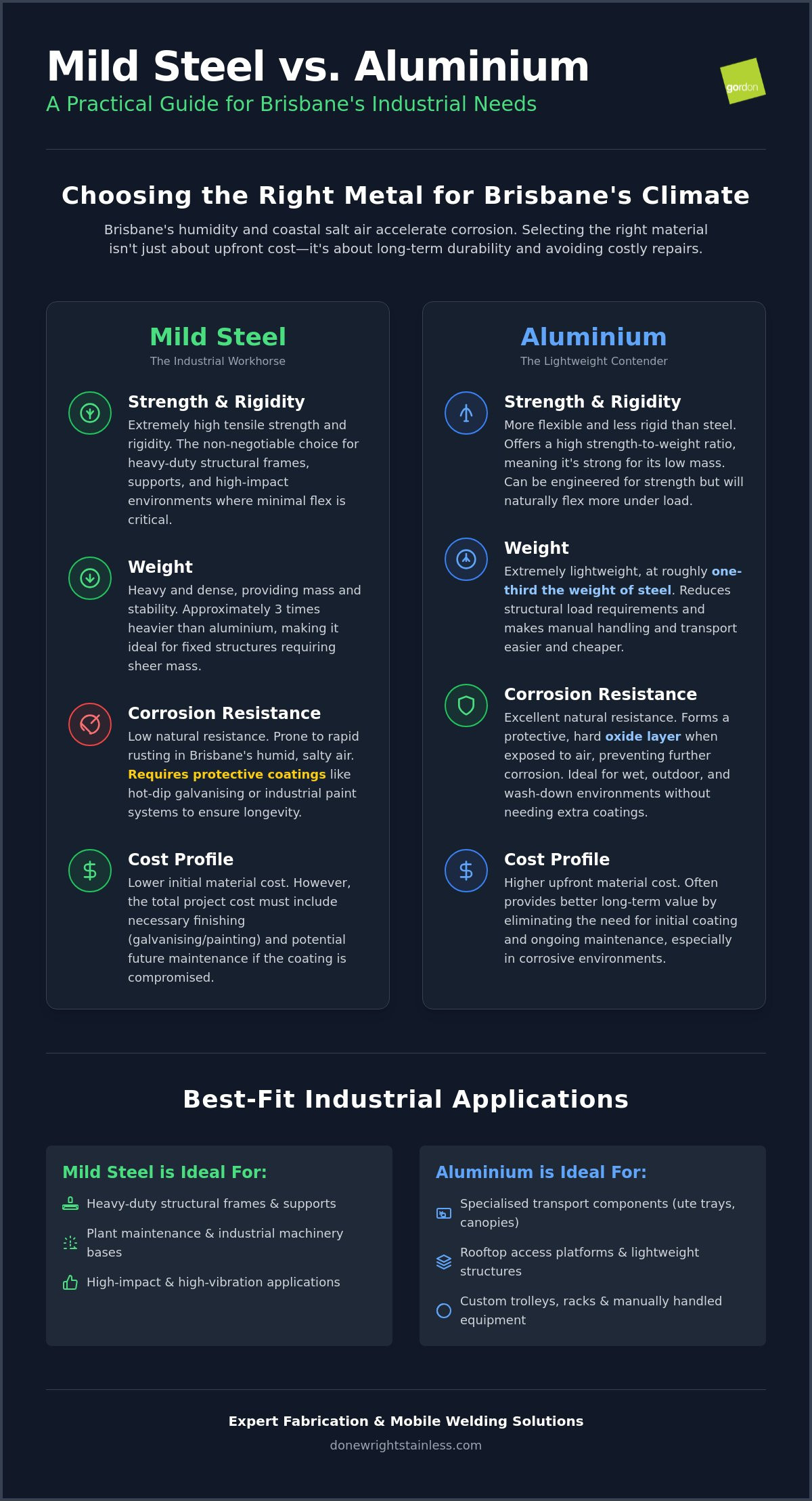
Mild steel is the undisputed workhorse of local industry. It is a low-carbon steel that offers high tensile strength and excellent weldability, which makes it the standard choice for heavy-duty frames, brackets, and structural supports. It provides a level of toughness that is difficult to match at a similar price point. Because it’s highly versatile, it can be adapted through various metal fabrication processes to meet specific engineering requirements. However, its lack of inherent corrosion resistance means it requires a robust protection strategy to survive the South East Queensland elements.
Aluminium serves as the lightweight, corrosion-resistant alternative for specific industrial applications. At roughly one-third the weight of steel, it’s the go-to material for projects where structural load or ease of manual handling is a priority. When comparing mild steel vs aluminium fabrication Brisbane, it is not just about weight. Aluminium’s ability to withstand wet conditions without rusting makes it a strategic choice for outdoor or wash-down environments. While it requires specialised welding techniques compared to steel, its longevity in the right setting provides significant long-term value.
The Impact of Brisbane’s Climate on Metal Longevity
Salt air is a silent killer for industrial assets. In Brisbane, coastal breezes carry microscopic salt particles kilometres inland, where they settle on metal surfaces. Unprotected mild steel reacts quickly with this salt and moisture, leading to rapid surface rust and structural degradation. To prevent this, custom mild steel projects usually involve hot-dip galvanising or high-build industrial paint systems. Aluminium handles these conditions differently. It forms a thin, hard oxide layer when exposed to air, which naturally seals the metal and prevents deeper corrosion without the need for additional coatings.
Duty Cycle and Industrial Wear
Before you commit to a material, you must assess the duty cycle of your equipment. Mild steel is non-negotiable for high-impact environments where sheer mass and rigidity are required. It handles the vibrations of heavy machinery better than most alloys. However, if your application involves frequent transport or rooftop installation, the high strength-to-weight ratio of aluminium can significantly reduce labour costs and structural loads. For facilities requiring the highest levels of hygiene or chemical resistance, we often recommend custom stainless steel fabrication Brisbane as a superior alternative to both.
Mild Steel vs Aluminium: Comparing Strength, Weight, and Durability
Determining the right material for your facility requires a clear look at mechanical performance. In the debate of mild steel vs aluminium fabrication Brisbane, strength is usually the first point of discussion. Mild steel offers a high modulus of elasticity, meaning it is incredibly rigid. This makes it the non-negotiable choice for heavy-duty structural frames, plant supports, and mezzanine levels where deflection must be kept to an absolute minimum. According to the Australian Steel Institute, the predictable performance of structural steel under heavy loads remains its greatest asset in industrial construction.
Aluminium, conversely, is more flexible. While it can be engineered to match the strength of steel by increasing the wall thickness or using specific alloys, it will naturally flex more under the same load. This isn’t always a disadvantage. In transport applications or equipment subject to constant vibration, this flexibility can prevent the stress cracking that sometimes affects more rigid materials. However, for a fixed industrial platform or a heavy-duty trolley, the stiffness of mild steel is often preferred.
Thermal conductivity is another factor often overlooked until the project is on the shop floor. Aluminium conducts heat far more efficiently than mild steel. For industrial pipework or heat exchange components, this is a primary benefit. For welding, it means heat dissipates quickly, requiring a more intense heat source and a specialised hand to ensure proper penetration. Choosing between mild steel vs aluminium fabrication Brisbane also comes down to long-term wear in high-traffic zones, where the harder surface of steel resists dents and abrasions more effectively than its lighter counterpart.
Structural Strength and Rigidity
Mild steel remains the industry standard for heavy-duty frames because of its superior yield strength. It handles the immense pressure of industrial plant maintenance without warping. When using aluminium, we often compensate for its lower density by using thicker sections, which can equal steel’s strength while still offering a weight advantage. Understanding this balance is key to ensuring your project meets engineering specifications without being over-engineered.
Weight, Portability, and Installation
The most immediate advantage of aluminium is what many local trades call the “ute factor.” Because aluminium is roughly one-third the weight of mild steel, a single worker can often handle components that would require a two-person lift or mechanical assistance if made of steel. This significantly reduces the labour hours required for fabrication and installation Brisbane projects. Reducing the dead load on existing structures is also a critical consideration for rooftop safety systems. If you need a hand deciding which material fits your weight constraints, Donewright Stainless can walk you through the practical pros and cons for your specific site.
Cost Factors and Fabrication Lead Times in South East Queensland
Budgeting for an industrial project in South East Queensland requires looking beyond the price per kilogram of raw material. While mild steel is generally more affordable upfront, the total cost of mild steel vs aluminium fabrication Brisbane often equalises once you factor in labour and protective treatments. Mild steel provides a cost-effective solution for large-scale structural frames, but its susceptibility to our humid climate means it cannot be left raw. You must account for the secondary processes required to make the metal durable enough for the local environment.
The complexity of the fabrication process also influences your bottom line. Aluminium requires a higher level of technical skill, particularly when TIG welding is involved to ensure structural integrity. According to the Australian Aluminium Council, the material’s high thermal conductivity and low melting point demand precise control from the fabricator. This often results in higher labour costs compared to the faster, more straightforward MIG welding used for heavy steel sections. When comparing mild steel vs aluminium fabrication Brisbane, it’s vital to consider whether the project requires the speed of steel or the specialised precision of aluminium.
Fabrication Complexity and Labour
Quality aluminium fabrication isn’t something you can rush. It requires a clean environment and specialised equipment to prevent contamination, which can add to the lead time. Conversely, mild steel is faster to cut, prep, and weld for massive industrial supports. For repairs that can’t wait, our mobile welding Brisbane service brings these capabilities directly to your site, handling the specific nuances of both metals to keep your operations running without the need for off-site transport.
Finishing and Protective Coatings
Finishing is the “hidden” cost that often surprises project managers. For mild steel fabrication Brisbane, hot-dip galvanising is usually essential for longevity. This adds a logistical step: the finished item must be transported to a galvaniser, dipped, and returned, which can add a week or more to your schedule. Aluminium skips this entire process. It can be installed in its mill finish, which not only saves on coating costs but also significantly shortens the total lead time from the workshop to your facility.
When you calculate a 10-year return on investment, aluminium often wins on maintenance. You won’t be dealing with peeling paint or the need for re-galvanising in five years’ time. However, if your project involves high-impact zones where components are likely to be bashed by forklifts, the lower cost of replacing steel sections might still make it the more practical choice for your facility’s budget.
Application Guide: From Custom Trolleys to Industrial Pipework
Moving from technical specifications to practical application requires a clear understanding of how equipment is used daily. In the field of mild steel vs aluminium fabrication Brisbane, the choice often comes down to the environment and the physical strain on the operator. For heavy-duty industrial plant maintenance, mild steel is the standard. Its ability to withstand the rigours of a hard-working workshop makes it ideal for permanent fixtures, heavy machine guards, and structural supports that won’t budge under pressure. It is the material of choice when the primary goal is sheer toughness and impact resistance.
Aluminium finds its niche in sectors where weight and moisture are the primary constraints. In marine environments or transport applications across South East Queensland, the natural corrosion resistance of aluminium is a significant advantage. It is also the preferred material for rooftop installations. When adding equipment to an existing structure, minimising the additional load is critical for engineering approval. Hybrid projects can also be an effective solution; using a robust mild steel base for stability combined with aluminium upper components to reduce the overall centre of gravity.
Industrial and Commercial Benches and Trolleys
The design of custom trolleys and benches highlights the practical trade-offs between these metals. For a stationary workbench in a Brisbane warehouse, mild steel provides the necessary mass to stay put during heavy grinding or assembly work. However, for mobile trolleys, lightweight aluminium is superior. It reduces the physical effort required for staff to move goods, which is a key factor in workplace health and safety. We focus on ensuring longevity in custom-built commercial furniture by matching the material to the expected duty cycle, whether it’s a heavy-duty steel bench for a fitter or a nimble aluminium trolley for a cleanroom.
Safety Protection and Handrails
Compliance is a major factor in material selection for safety systems. When we undertake safety handrail fabrication Brisbane projects, we must adhere strictly to AS 1657 standards. For external safety barriers in high-traffic industrial zones, galvanised mild steel is often the best choice because it can absorb the impact of a stray pallet jack or vehicle without losing structural integrity. Aluminium is highly effective for rooftop safety systems and access ladders. Its lightweight nature allows for easier installation on heights, and it won’t leave rust streaks on the building facade over time. If you are unsure which material meets your specific compliance needs, reach out to Donewright Stainless for straight-talking advice on your next industrial install.
Expert Metal Fabrication and Mobile Welding Solutions by Donewright Stainless
Choosing the right material is only half the battle; the quality of the execution determines the final outcome. At Donewright Stainless, “Wrighty” and the team bring a level of technical expertise that spans the entire spectrum of industrial metals. We don’t just weld; we provide a consultative approach to ensure your choice in mild steel vs aluminium fabrication Brisbane aligns with your operational goals. This grounded, no-fuss perspective is what has built our reputation as a dependable partner for South East Queensland’s industrial sector.
Our mobile workshop serves as a fully equipped engineering unit on wheels. It is designed to bridge the gap between workshop precision and on-site convenience. By bringing our capabilities to your door, we drastically reduce the logistical headaches often associated with large-scale fabrication. Whether you are situated in the heart of Brisbane or out in Logan, we ensure that your facility’s infrastructure is maintained to the highest standards without the need for off-site transport.
On-Site Mobile Welding and Maintenance
The skills required to handle different alloys in a field environment vary significantly. While mild steel is relatively forgiving and fast to repair, aluminium requires a meticulous approach to prevent oxidation and ensure a clean weld. We maintain the equipment and the specialised training necessary to perform high-grade aluminium TIG welding on-site. This capability is vital for maintaining industrial pipework Brisbane, where a single faulty joint can compromise an entire system’s efficiency. By addressing these issues where they stand, we help you minimise downtime and keep your production lines moving.
Why Brisbane Businesses Trust Donewright Stainless
Trust is earned through consistent results over decades. With extensive experience across the region, we have a deep understanding of the specific challenges faced by local businesses, from the salt air of the coast to the heavy-duty demands of inland workshops. Our advice on mild steel vs aluminium fabrication Brisbane is always based on real-world longevity and the practicalities of your site, not just a theoretical preference.
We perform all work with a focus on precision and strict adherence to Australian safety and compliance standards. We take pride in being the steady, experienced hand that project managers can rely on for honest advice and high-quality results without the fuss. If you are looking for a fabrication partner who values long-term relationships and clear communication, we are ready to assist. Contact the team today for a straight-talking quote that reflects the true requirements of your next project.
Building for Longevity in South East Queensland
Choosing the right metal involves balancing structural rigidity with environmental exposure. Mild steel remains the industry standard for heavy-duty frames and permanent shop fixtures, provided it’s properly protected against the elements. Conversely, aluminium’s natural resistance to humidity and its superior strength-to-weight ratio make it a strategic investment for rooftop systems and mobile equipment. Understanding the nuances of mild steel vs aluminium fabrication Brisbane ensures your project remains compliant and fit for purpose for years to come.
At Donewright Stainless, Wrighty and the team focus on providing straight talk and practical results. Whether you need a custom trolley or complex industrial pipework, our specialists ensure every weld meets strict Australian Standards. We operate a fully equipped mobile workshop for on-site repairs and installations across Brisbane, the Gold Coast, and Logan, helping you maintain AS 1657 compliance while minimising operational downtime. Our goal is to deliver a solution that stands up to the rigours of your specific facility.
Get a no-fuss quote for your Brisbane fabrication project from Wrighty and the team. We look forward to helping you build something that lasts.
Frequently Asked Questions
Is aluminium harder to weld than mild steel for on-site projects?
Aluminium is more technically demanding to weld on-site because it is highly sensitive to contamination and dissipates heat rapidly. While mild steel is relatively forgiving, aluminium requires specialised TIG welding equipment and a clean environment to ensure structural integrity. Our mobile workshop is specifically configured to handle these requirements, bringing workshop-level precision directly to your Brisbane facility to ensure every joint meet strict industrial standards.
Does mild steel always need to be galvanised in Brisbane?
Mild steel requires hot-dip galvanising or a high-performance industrial coating if it is exposed to Brisbane’s humid or coastal air. Without this protection, the salt and moisture in our local climate will cause rapid oxidation and surface rust. For internal, climate-controlled environments, a standard industrial paint system might be sufficient, but galvanising remains the most reliable method for ensuring long-term durability in South East Queensland.
What is the price difference between mild steel and aluminium fabrication?
Mild steel generally has a lower upfront material cost, but aluminium can be more cost-effective when you factor in finishing and labour. When comparing mild steel vs aluminium fabrication Brisbane, you must account for the cost of galvanising steel and the specialised labour required for aluminium welding. Aluminium often provides better value over a ten-year cycle because it eliminates the need for ongoing corrosion maintenance and reduces transport costs.
Can you combine mild steel and aluminium in the same structure?
You can combine these materials, but it requires careful insulation to prevent galvanic corrosion. When these two metals touch in a moist environment, an electrochemical reaction occurs that causes the aluminium to degrade rapidly. We use specialised gaskets, nylon washers, or insulating coatings to keep the metals separated. This approach allows you to utilise the strength of a steel base with the lightweight benefits of aluminium upper components.
Which metal is better for outdoor safety handrails in Brisbane?
The best choice depends on the specific location and the potential for physical impact. Galvanised mild steel is superior for ground-level industrial zones where handrails might be bumped by heavy machinery or trolleys. Aluminium is the better choice for rooftop safety systems or coastal walkways where reducing the structural load is a priority and corrosion resistance is essential. Both materials can be fabricated to meet AS 1657 compliance standards.
How does aluminium perform in high-temperature industrial environments?
Aluminium is not recommended for environments where temperatures consistently exceed 200 degrees Celsius, as it begins to lose its structural temper and strength. Mild steel maintains its mechanical properties at much higher temperatures, making it the safer choice for heat-intensive industrial plant maintenance. If your project involves proximity to furnaces or high-heat exhaust systems, we generally advise using treated steel or stainless steel to ensure long-term safety.
What are the lead times for custom aluminium fabrication in Brisbane?
Lead times for aluminium are often shorter than steel because the material does not require the additional week usually spent at a galvanising plant. Once the fabrication and welding are complete, the item is typically ready for immediate installation in its mill finish. While the actual fabrication time depends on the complexity of your custom project, skipping the secondary coating process can significantly fast-track your delivery schedule.
Do you provide on-site welding for both mild steel and aluminium?
We provide full on-site welding services for both mild steel and aluminium across Brisbane, Gold Coast, and Logan. Our mobile engineering unit is equipped with the specialised power sources required for high-quality aluminium TIG welding and heavy-duty steel MIG welding. This capability allows us to perform emergency repairs and custom installs at your site, which effectively eliminates the downtime and transport costs associated with off-site workshop repairs.