
Industrial Safety Handrails Brisbane: Custom Fabrication & AS 1657 Compliance
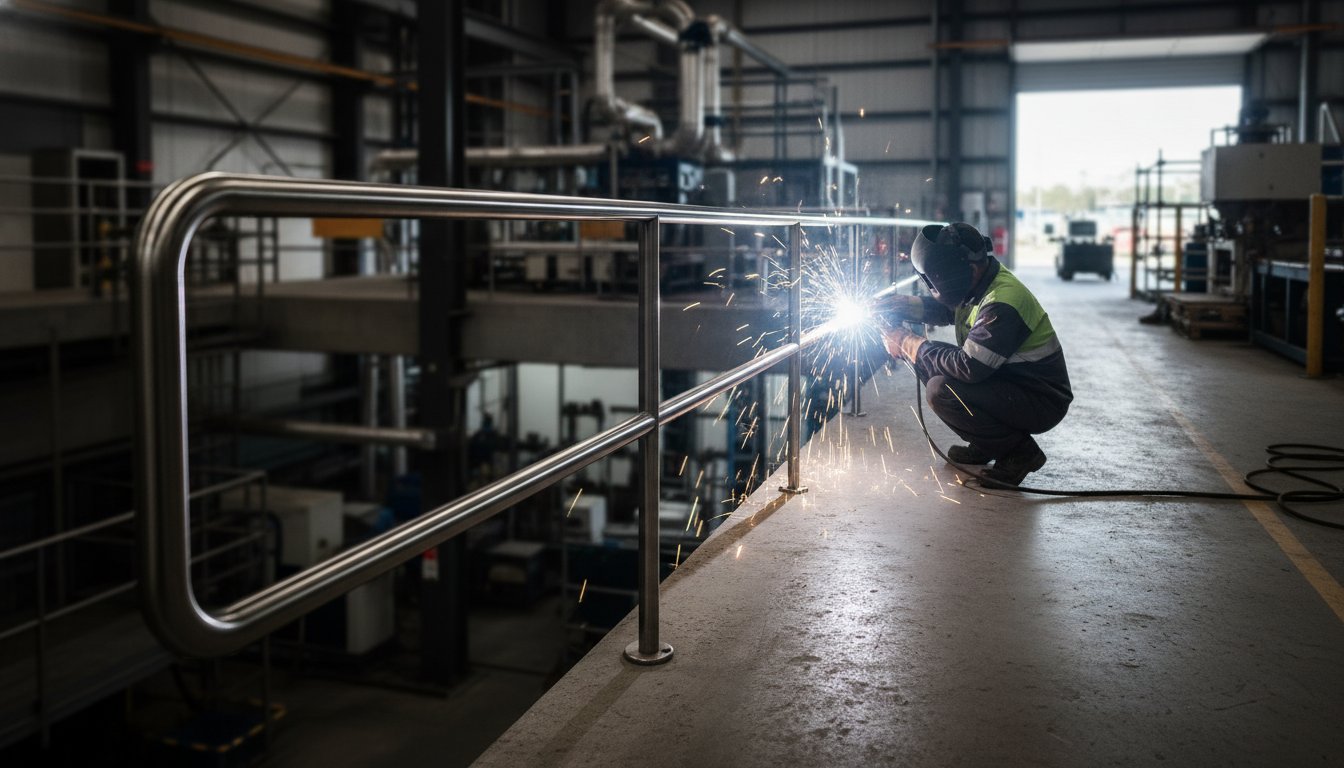
A modular handrail might seem like a quick fix, but in the humid environment of Southeast Queensland, a “near enough” approach often leads to a “not good enough” safety audit. For facility managers, the sight of tea-staining or structural corrosion on industrial safety handrails Brisbane wide is a clear signal that the installation isn’t up to the task. You shouldn’t have to choose between keeping your team safe and keeping your plant running.
We understand that maintaining a compliant site is a constant challenge, especially when you’re balancing strict safety regulations with the need to avoid operational downtime. That’s why we’ve put together this guide to help you discover why custom-welded stainless steel is the gold standard for long-term durability and how to ensure your facility meets every requirement of AS 1657. You’ll learn about the critical height requirements for platforms, the benefits of bespoke fabrication over off-the-shelf kits, and how mobile welding services can get the job done without halting your production line.
Key Takeaways
- Understand the mandatory requirements of AS 1657-2018 to ensure your site remains fully compliant with WHS Queensland safety audits.
- Learn why 316-grade stainless steel is the preferred material for industrial safety handrails Brisbane facilities need to withstand high humidity and coastal corrosion.
- Identify the structural risks of modular systems and why custom-welded fabrication prevents the “rattle factor” in high-vibration environments.
- Discover how mobile workshop services allow for precise on-site welding and installation without causing significant operational downtime.
- Gain insights into the “Done Right” philosophy that prioritises precision and long-term durability for safety-critical infrastructure.
Navigating AS 1657: Why Compliant Handrails are Non-Negotiable in Brisbane
AS 1657-2018 is the mandatory benchmark for safety in Australian industrial settings. For businesses operating with industrial safety handrails Brisbane wide, staying on the right side of the law means more than just ticking a box. It’s about protecting workers on every platform, walkway, and staircase. WHS Queensland inspectors look for specific adherence to these rules during site audits. If your facility falls short, you’re looking at potential fines, work-stop orders, or worse; a preventable workplace injury that could have been avoided with proper engineering.
Understanding the technical distinction between various safety structures is the first step toward a compliant site. While many use the terms interchangeably, there is a clear functional difference between Guard rails and handrails. Guardrails are primarily designed to prevent a person from falling from height, while handrails provide a steady grip for support. AS 1657-2018 dictates the exact engineering requirements for both to ensure they can withstand the specific load-bearing forces they’ll encounter in a heavy-duty Brisbane warehouse or processing plant.
Critical Dimensions for AS 1657 Compliance
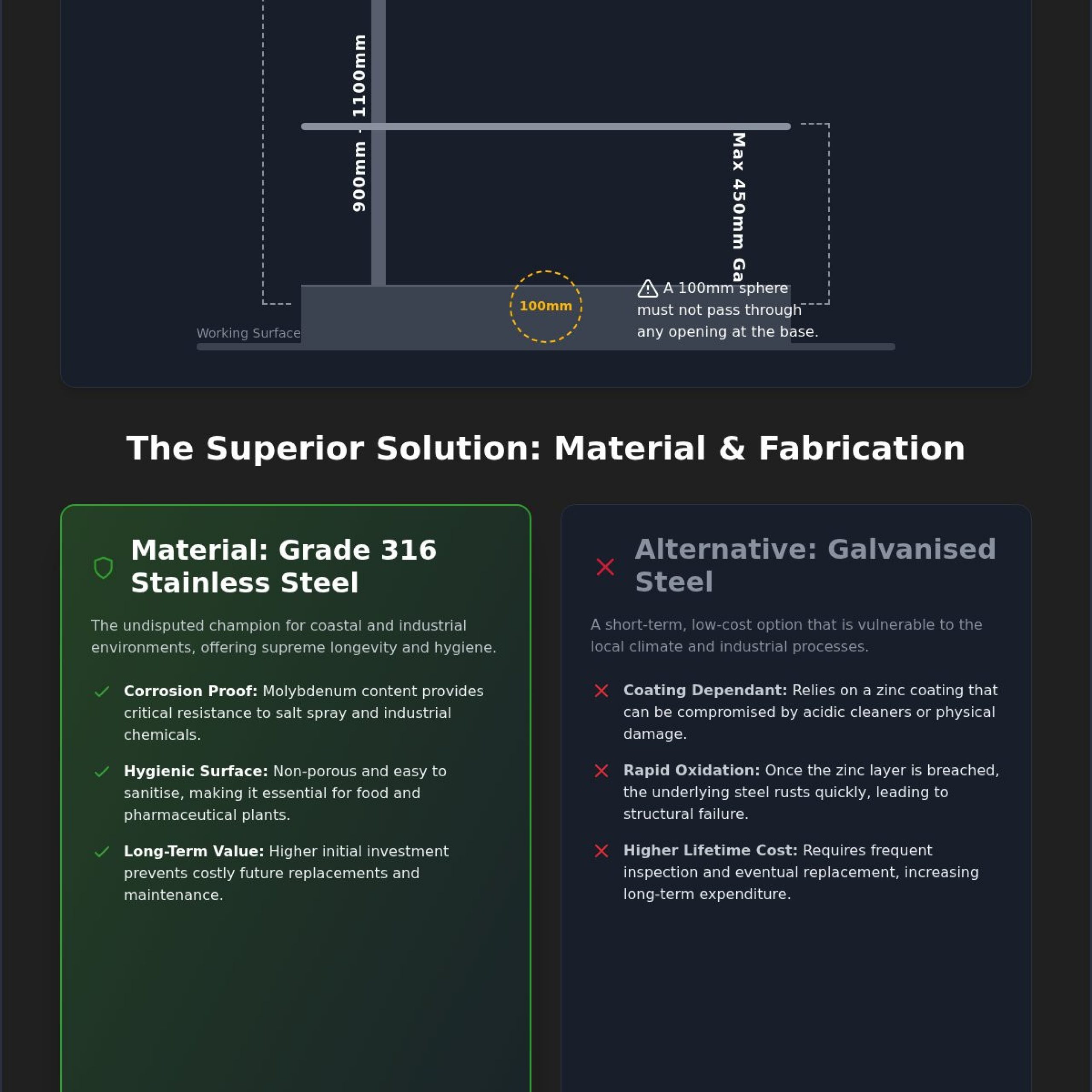
The standard is precise. For platforms and walkways, the top rail must sit between 900mm and 1100mm above the floor surface. If you’re installing a mid-rail, it has to be positioned so that the gap between any two rails doesn’t exceed 450mm. Then there’s the 100mm sphere rule. This requires that a toe board is installed if there’s no permanent structure to prevent objects from falling through a gap. It also ensures that a 100mm sphere cannot pass through any opening at the base of the railing. These measurements aren’t suggestions. They’re the difference between a safe site and a legal liability.
WHS Queensland and Your Duty of Care
Maintaining a safe environment is a core duty of care for any Brisbane business owner. Compliant installations don’t just keep you out of court; they can actually help lower workplace insurance premiums by demonstrating a proactive approach to risk management. Most industrial accidents involve slips, trips, and falls. High-quality, properly fabricated railings are your first line of defence against these incidents.
For a more detailed look at the technical specifications and how they apply to your specific facility, you can read our guide on Safety Handrail Fabrication Brisbane. Choosing a partner who understands the local regulatory landscape ensures that your infrastructure is built to last and passes every inspection without fail. We don’t believe in shortcuts when it comes to safety or materials.
Stainless Steel vs. Galvanised: Choosing the Right Material for SE Queensland
Material selection for industrial safety handrails Brisbane wide isn’t just a matter of price; it’s a calculation of longevity. In our humid Southeast Queensland climate, the wrong choice leads to surface rust and structural failure within years. Stainless steel is often viewed as a premium option, but when you factor in the cost of replacing corroded galvanised rails, the investment makes sense. Beyond the technical specs, aesthetics play a role. For commercial frontages or public-facing industrial sites, stainless steel provides a clean, professional look that galvanised pipes simply can’t match.
Grade 316 is the undisputed champion for our region. While Grade 304 works for basic indoor applications, it lacks the molybdenum found in 316. This extra element provides critical resistance against the chlorides and salt spray blowing in from Moreton Bay. Without it, you’ll likely see “tea-staining,” which is that unsightly brown discolouration that can lead to deeper pitting. Regular cleaning with fresh water helps maintain the finish, but choosing the right grade from the start is the best way to ensure your stainless steel fabrication stands the test of time.
Galvanised mild steel relies on a zinc coating. In food processing or chemical plants, this coating can be compromised by acidic cleaners or harsh industrial processes. Once the zinc is gone, the underlying steel is exposed to rapid oxidation. Stainless steel is non-porous and easy to sanitise. This makes it the only real choice for pharmaceutical or food-grade environments where hygiene is as important as safety.
Why Grade 316 Stainless is the Brisbane Gold Standard
Salt air is a silent killer for metal infrastructure. If your site is located near the coast or in high-humidity zones like Logan or the Port of Brisbane, Grade 316 offers superior protection. Key benefits include:
- Chloride Resistance: Specifically engineered to resist pitting in salt-heavy environments.
- Longevity: Outlasts powder-coated aluminium and galvanised steel in outdoor settings.
- Hygiene: A non-porous surface is ideal for food-grade and pharmaceutical plants.
When to Opt for Mild Steel or Aluminium
We recognise that not every project requires the high-end finish of stainless. For dry, climate-controlled warehouses or indoor mezzanine levels, Custom Mild Steel Fabrication Brisbane offers a robust and cost-effective alternative. Aluminium is another option when weight is a concern, such as on lightweight platforms or roof access points. Regardless of the material, every component must still meet the load-bearing and design standards outlined in AS 1657:2018. Choosing the right material for your industrial safety handrails Brisbane project ensures you don’t overspend on over-engineered solutions where they aren’t required.
Custom Welded vs. Modular Systems: Why Bespoke Fabrication Wins
Modular handrail kits are often marketed as a convenient, “off-the-shelf” solution for rapid site upgrades. While they have their place in light commercial settings, they frequently fall short in heavy industrial environments. For industrial safety handrails Brisbane facilities, the choice between a modular system and a custom-welded one comes down to structural longevity. A fully fused, continuous handrail system functions as a single structural unit, providing a level of rigidity that modular components simply cannot match. When safety is the priority, a permanent, bespoke installation is the reliable choice.
One of the most significant advantages of custom fabrication is the “snag-free” finish. In an industrial plant, workers often rely on handrails for stability while wearing gloves or carrying equipment. Modular systems typically feature protruding bolts, set-screws, or overlapping joints that can catch on high-vis clothing or PPE. A professionally welded joint is ground and polished until it’s perfectly smooth. This seamless finish isn’t just about aesthetics; it’s a practical safety feature that prevents minor injuries and clothing snags during daily operations.
The Problem with Modular Joint Failures
We often see modular systems suffer from what we call the “rattle factor.” In plants with heavy machinery or high-vibration equipment, the set-screws used in modular fittings eventually vibrate loose. This creates wobbly sections that feel insecure and often fail safety audits. Thermal expansion is another critical issue in Southeast Queensland. The intense Brisbane sun causes metal to expand and contract significantly. In a modular setup, this constant movement puts repetitive stress on the joints, eventually compromising the integrity of the entire run. Bespoke fabrication eliminates these weak points by creating a unified structure that handles environmental and operational stress as one.
Bespoke Design for Complex Brisbane Sites
Industrial sites rarely follow a perfect grid. Most Brisbane facilities feature complex layouts with existing pipework, machinery footprints, and odd-angled platforms that modular kits struggle to navigate. Custom fabrication allows for a perfect fit, mapping the handrail footprint exactly to the site’s unique requirements. This precision ensures that there are no dangerous gaps or awkward transitions. We can also integrate your railing system with other protective elements, such as stainless steel safety bollards, to create a comprehensive protection barrier for both staff and equipment. This level of integration ensures that your industrial safety handrails Brisbane project is “Done Right” the first time, providing a seamless and highly functional safety solution.
Mobile Welding and On-Site Installation: Minimising Site Downtime
One of the biggest hurdles in upgrading facility protection is the fear of operational disruption. Traditional fabrication often involves off-site construction followed by a hope that everything fits perfectly when it arrives. When you’re installing industrial safety handrails Brisbane wide, site dimensions rarely match the original blueprints exactly. A pipe might have been moved, or a concrete slab might be slightly uneven. Our approach eliminates this friction by bringing the factory directly to your site. The Donewright Mobile Workshop is a fully equipped unit designed to handle complex fabrication and modifications on the spot, ensuring a millimetre-perfect fit without sending parts back to a remote warehouse.
We service the entire Greater Brisbane area, from the industrial hubs at the Port of Brisbane to the manufacturing zones in Ipswich and Logan. Our team is trained to operate within active industrial environments, adhering to strict hot work protocols and safety exclusion zones. We understand that your facility doesn’t stop just because a new safety barrier is being installed. By coordinating closely with plant managers, we can often schedule installations during planned shutdowns or after-hours to ensure your production remains unaffected. If you require assistance with other technical infrastructure, our expertise also extends to On-Site Industrial Pipework Repair Brisbane, allowing you to bundle maintenance tasks for maximum efficiency.
The Mobile Welding Advantage
The primary benefit of on-site welding is the ability to make instant modifications. If a handrail needs a slight adjustment to clear a new piece of machinery, we don’t have to halt the project. Our mobile units are equipped for high-precision work with stainless steel, mild steel, and aluminium. This capability is also vital for emergency repairs. If a forklift damages a safety barrier, your site is immediately non-compliant and potentially dangerous. We can deploy quickly to cut out the damaged section and weld in a compliant replacement, restoring your duty of care in a single visit.
Planning Your Installation for Zero Disruption
Success starts long before we strike an arc. We use precise site measurements, and where necessary, 3D scanning to map the installation area. This preparation allows us to pre-fabricate large sections in our workshop while leaving critical joinery for the mobile team. This hybrid approach significantly reduces the time we spend on your floor. Our goal is to leave your site safer than we found it, with zero mess and no lingering “to-do” lists. If you’re ready to upgrade your facility protection with minimal fuss, you can learn more about our mobile workshop services today.
Donewright Stainless: The Choice for Industrial Handrails in Brisbane
Choosing a partner for industrial safety handrails Brisbane wide requires a balance of technical expertise and local reliability. Ian “Wrighty” Wright has built this business on a simple premise: if it isn’t done right, it isn’t finished. This philosophy is especially critical when dealing with safety-critical infrastructure where a single shortcut can lead to a failed audit or a workplace accident. We don’t just supply metal; we provide a complete engineering solution that prioritises the long-term integrity of your facility.
Our team takes the time to understand the specific workflow of your facility, ensuring that every rail we install enhances safety without becoming an obstacle. We handle the entire project lifecycle in-house. From initial CAD drawings and design consultations to the final pass of the polishing wheel on-site, you’re dealing with the same team of specialists. This continuity ensures that the original design intent and AS 1657 requirements are maintained through every weld and bracket.
Our Proven Process for Safety Systems
We’ve refined our workflow to ensure maximum precision and minimal disruption for our clients. Our methodical approach is designed to catch potential issues before they reach the shop floor. The process follows three distinct stages:
- Step 1: Detailed Site Consultation: We conduct a thorough AS 1657 audit of your existing platforms and walkways, identifying any non-compliant zones or potential fall risks.
- Step 2: Local Custom Fabrication: Your handrail system is fabricated in our local Brisbane facility using high-grade materials. We use precise measurements to pre-build sections, reducing the time required on your site.
- Step 3: Professional Installation: Our mobile workshop arrives at your facility for the final fitment. We perform all final welds and polishing on-site to ensure a seamless, snag-free finish that fits your site’s actual dimensions.
Contact the Brisbane Specialists
We’re proud to support local industries across Brisbane, Logan, and the Gold Coast. Whether you’re managing a major processing plant or a suburban warehouse, our commitment to quality remains the same. Tier 1 contractors and facility managers trust Donewright Stainless because we speak their language. We understand the pressure of deadlines, the necessity of compliance, and the value of a job that doesn’t require a return visit for repairs. Precision matters. Reliability matters. Most importantly, your team’s safety matters.
If you’re ready to upgrade your facility with a system that meets the highest Australian standards, it’s time to talk to a specialist who values craftsmanship as much as you do. Get a quote for your industrial handrails today and experience the difference of a project that’s Done Right from start to finish.
Secure Your Site with Compliant Safety Infrastructure
Ensuring your facility remains compliant with AS 1657 is a long-term commitment to your workers’ safety and your business’s legal standing. We’ve explored how 316-grade stainless steel provides the necessary resistance to Brisbane’s humidity, while custom-welded fabrication eliminates the vibration and snagging risks inherent in modular systems. Investing in high-quality industrial safety handrails Brisbane wide means you’re building for a future with minimal maintenance and total peace of mind. Precision is our standard.
As AS 1657 compliance specialists, we take pride in being a proudly Brisbane owned and operated business that doesn’t believe in shortcuts. Our fully equipped mobile workshop ensures that your project is installed with millimetre-perfect accuracy and minimal operational disruption. It’s about getting the job done right the first time so you can focus on your core operations. Don’t leave your site’s safety to chance or off-the-shelf kits that aren’t built for heavy-duty environments.
Request an AS 1657 Compliant Handrail Quote from Donewright Stainless to secure your facility with local experts who value craftsmanship as much as you do.
Frequently Asked Questions
Do industrial handrails in Brisbane have to be stainless steel?
No, AS 1657 does not mandate a specific material, but it does require that the chosen metal withstands the specific environmental conditions of the site. While galvanised steel is an option, 316-grade stainless steel is the preferred choice for industrial safety handrails Brisbane facilities need to combat high humidity and coastal salt air. We also provide mild steel and aluminium fabrication depending on your site’s specific budget and exposure levels.
What is the standard height for an industrial handrail in Australia?
According to AS 1657-2018, the top rail must sit between 900mm and 1100mm above the walking surface. This height is measured vertically from the floor or the nosing of a stair tread. Consistency is vital for compliance; if your rails sit outside these measurements, they’ll likely fail a WHS Queensland audit. We measure every custom project to the millimetre to ensure your site meets these legal specifications.
How long does it take to fabricate and install a custom handrail system?
Timelines vary based on the project’s scale, but our mobile workshop significantly reduces the total time spent on-site. Once the design is finalised and initial fabrication is completed in our workshop, the on-site installation is streamlined. We coordinate with plant managers to perform the final welding and fitment during scheduled shutdowns, often completing the physical installation much faster than modular alternatives that require extensive on-site assembly.
Can you repair existing safety handrails that have failed an audit?
Yes, we specialise in bringing non-compliant systems back up to the AS 1657 standard. Our mobile welding team can visit your Brisbane facility to reinforce weak joints, adjust rail heights, or replace corroded sections that have been flagged during an inspection. Repairing an existing system is often a practical and cost-effective way to restore your duty of care without the expense of a full teardown.
Is a kickplate (toe board) always required on industrial walkways?
A kickplate is mandatory if there is a risk of objects falling from a platform or walkway onto people or machinery below. Specifically, AS 1657 requires a toe board if the gap between the platform and the bottom rail allows a 100mm sphere to pass through. If your walkway is positioned above a work zone or a trafficable area, a 100mm high kickplate is a non-negotiable requirement for compliance.
Do you provide mobile welding services for handrails on the Gold Coast?
Yes, our mobile workshop services cover the entire Gold Coast, Logan, and Greater Brisbane regions. We bring the factory to you, which allows us to perform high-precision stainless steel, mild steel, and aluminium fabrication directly at your facility. This local service area ensures we can respond quickly to both emergency repairs and large-scale industrial safety handrails Brisbane projects across the Southeast.
What is the difference between AS 1657 and the BCA handrail requirements?
AS 1657 is the dedicated standard for industrial platforms, walkways, and stairways used primarily for maintenance and plant access. The BCA (Building Code of Australia), now part of the NCC, generally applies to public areas in commercial and residential buildings. For industrial sites, AS 1657 is the benchmark that WHS auditors use to assess fall protection and structural integrity in workplace environments.
How do I prevent my stainless steel handrails from rusting near the coast?
Prevention starts with specifying 316-grade stainless steel, which contains molybdenum for superior corrosion resistance. Even with the right grade, “tea-staining” can occur in Brisbane’s humid climate if salt and industrial contaminants aren’t removed. We recommend a regular maintenance routine of washing the rails with fresh water and a mild detergent. For sites near Moreton Bay, a professional polish during fabrication provides an extra layer of protection for the metal’s surface.