
Industrial Handrail Inspection Checklist: AS 1657 Compliance Guide
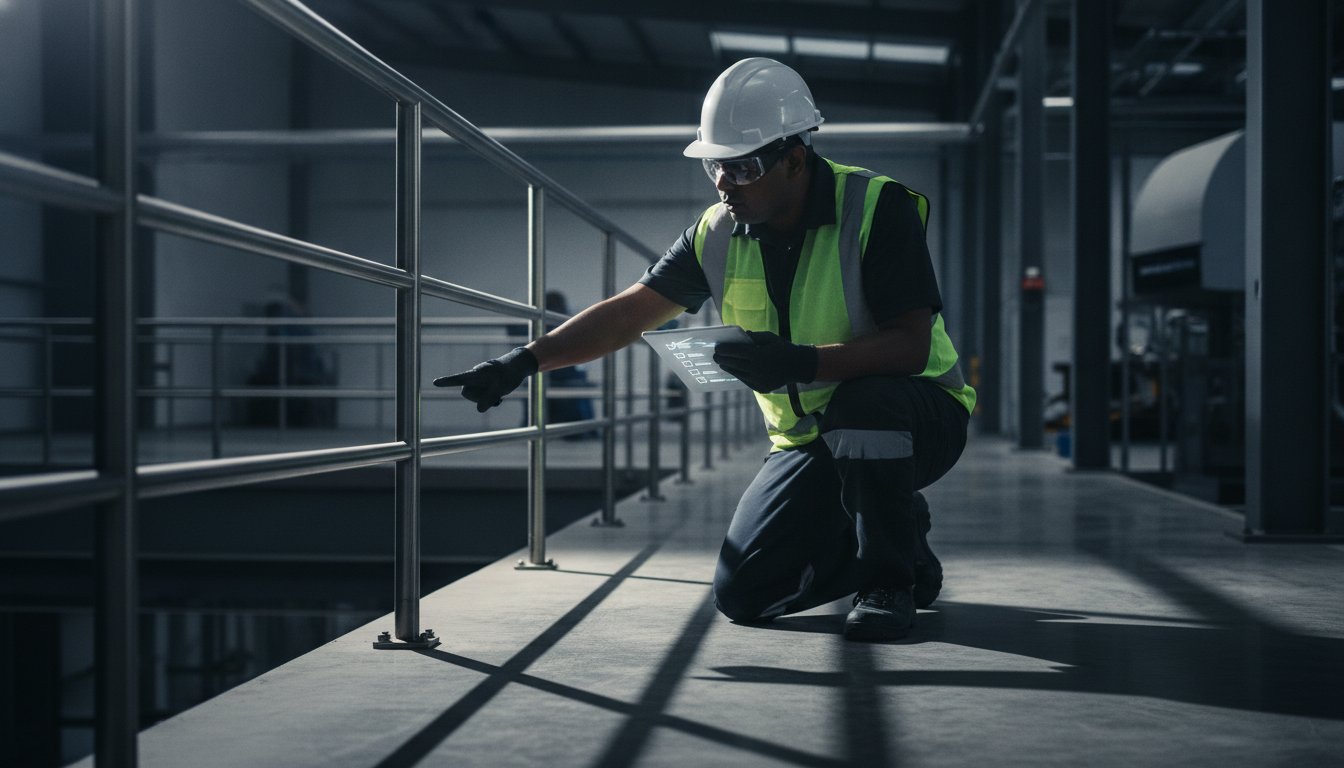
Did you know that falls from height accounted for 13% of all Australian workplace fatalities in 2024? It’s a sobering statistic that underscores why safety infrastructure is the most critical investment in any industrial facility. You likely understand the pressure of maintaining a site that’s both productive and compliant, yet the fear of a surprise audit or a preventable injury often lingers. Corrosive environments only add to this stress, as salt air or chemicals can quietly compromise the structural integrity of your rails long before they look dangerous to the naked eye.
This guide provides a comprehensive industrial handrail inspection checklist designed specifically for AS 1657-2018 compliance. By using this tool, you can master your monthly safety walks and gain the peace of mind that comes with knowing your existing rails are legally sound and physically secure. We’ll walk through the specific requirements for rail heights, explain the vital differences between 304 and 316-grade stainless steel, and identify the exact moments when you should call in a professional for repairs to ensure your site remains a secure environment for every worker.
Key Takeaways
- Understand the critical requirements of AS 1657-2018 to ensure your facility meets its mandatory Duty of Care and avoids costly non-compliance penalties.
- Utilise our comprehensive industrial handrail inspection checklist to systematically verify structural stability, focusing on often-overlooked areas like chemical anchors and floor mounts.
- Identify early warning signs of material degradation, such as tea staining on 304-grade steel, and learn why 316-grade is the reliable choice for Brisbane’s humid environments.
- Master the precise dimensional standards for handrail heights and clearances to prevent falls and maintain a secure working environment on all fixed platforms.
- Establish a clear remediation strategy for failed inspections, including how mobile welding services can provide immediate on-site repairs to restore safety without removing infrastructure.
Why Regular Industrial Handrail Inspections are Essential
Under the Australian Work Health and Safety (WHS) Act, facility managers hold a non-negotiable Duty of Care to provide a safe working environment. This legal obligation isn’t satisfied by simply having rails in place; it requires active verification that those barriers can actually arrest a fall. Using a structured industrial handrail inspection checklist is the most reliable way to demonstrate that you’ve taken “reasonably practicable” steps to mitigate risk. When an incident occurs, “we didn’t know the rail was loose” is never a valid legal defence.
The “set and forget” mentality is a significant liability in industrial settings. Constant vibration from heavy machinery, floor shifts, and the harsh Australian climate all work to degrade metal integrity over time. In Brisbane and South East Queensland, high humidity and salt air can lead to rapid oxidation. Without regular oversight, a rail that was compliant five years ago might now be a structural hazard held together by little more than habit and surface tension.
Prevention is always more cost-effective than emergency remediation or litigation. Safe Work Australia estimates that workplace injuries cost the national economy $28.6 billion annually. While an inspection takes an hour of a supervisor’s time, a single failure can result in six-figure fines, increased insurance premiums, and devastating impacts on staff morale. Regular audits ensure you identify minor issues, like a loosening chemical anchor, before they escalate into a total system failure.
The Role of AS 1657 in Industrial Safety
AS 1657-2018 is the primary Australian Standard for the design, construction, and installation of fixed platforms, walkways, stairways, and ladders. It provides the technical Handrail Specifications required to ensure worker safety at height. This standard applies to any area where a person could fall more than 300mm. Ensuring your facility meets these benchmarks is a technical task, which is why safety handrail fabrication Brisbane specialists focus on precision engineering. The 2018 revision introduced stricter requirements for kickboards and rail heights that every modern site manager must understand to remain compliant.
Frequency and Documentation Requirements
The frequency of your safety walks should reflect the intensity of your operations. We recommend a formal review using an industrial handrail inspection checklist at the following intervals:
- High-Traffic Zones: Monthly inspections for stairs, mezzanines, and loading docks where forklift activity or heavy pedestrian use is common.
- Corrosive Environments: Quarterly checks for areas exposed to chemicals, wash-downs, or coastal air.
- Low-Traffic Zones: Bi-annual or annual reviews for roof access points or isolated plant rooms.
Documentation is your primary evidence of compliance. Every inspection must be logged in a dedicated safety register, noting the date, the specific rail inspected, any defects found, and the corrective actions taken. This paper trail is essential for insurance renewals and external safety audits.
The Structural Integrity Checklist: Fixings and Stability
Structural stability is the cornerstone of any safety barrier. While a rail might look solid from a distance, its ability to withstand a sudden impact depends entirely on its connection points. As you work through your industrial handrail inspection checklist, the first priority is the base. You aren’t just looking for rust; you’re looking for movement. Even a millimetre of play at the base plate can translate into significant instability at the top rail, potentially failing to meet the rigorous OSHA Handrail Requirements often used as international benchmarks for safety loads.
The “shake test” remains a practical starting point for any supervisor. By applying firm pressure at the mid-point between posts, you can quickly identify loosening fixings or shearing bolts. If the system rattles or deflects visibly, it requires immediate load testing to determine if it still meets the force requirements specified in AS 1657. Don’t overlook the welds either. Hairline fractures in joins or mitres often hide under layers of dust or grease, but they signal a critical failure in the metal’s structural capacity.
Identifying these faults early prevents the need for total replacements. Small fractures or loose brackets can often be addressed with targeted maintenance services to restore the system to its original strength.
Mounting and Anchoring Systems
Surface-mounted base plates are common, but they’re vulnerable to concrete spalling. Inspect the substrate around each anchor for cracks or “blowing out” of the concrete. In vibration-heavy processing plants, mechanical anchors can vibrate loose over time. Chemical anchors generally offer better resistance to these dynamic loads, but they must be checked for chemical degradation or moisture ingress. If you find wobbly posts during your audit, it’s vital to re-secure or replace failing anchors before the substrate deteriorates further.
Joints, Bends, and Terminations
A compliant handrail must be continuous and snag-free. Run your gloved hand along the rail to check for sharp edges at joins or terminations. Wall-mounted brackets should be checked for “pull-out” from the masonry, especially in older facilities. Finally, ensure all rail ends return safely to a wall or post. Open-ended rails are a significant hazard, as they can catch clothing or cause impalement during a fall. Every termination must be smooth and rounded to ensure a worker’s hand can glide along the rail without interruption.
Material Condition and Corrosion: Managing Stainless Steel
In the humid climate of South East Queensland, corrosion is more than just an eyesore; it’s a slow-motion structural failure. When you’re using an industrial handrail inspection checklist, you must distinguish between surface-level blemishes and deep-seated degradation. While stainless steel is prized for its longevity, it isn’t invincible. Environmental factors like salt air from the coast or chemical vapours in a processing plant can aggressively attack the metal’s passive layer, leading to premature failure if not monitored; to understand how industrial assets are protected in such demanding environments, you can learn more about BIS Group.
Tea staining is the most common issue we see across Brisbane sites. It appears as a brown, rust-like discolouration on the surface of the steel. While it starts as an aesthetic problem, ignoring it allows pitting to occur, which eventually compromises the tube’s wall thickness. Chloride stress corrosion cracking is a far more sinister threat. It’s often invisible to the naked eye, occurring in high-stress areas of the rail when exposed to chloride-rich environments like water treatment facilities. If left unchecked, the metal can fail suddenly under load without any prior warning signs.
Crevice corrosion is another critical point for your audit. This occurs in the tiny gaps between brackets, bolts, and the main rail. These areas trap moisture and prevent the protective oxide layer from reforming. During your walk, pay close attention to any “bleeding” of rust from these joints, as it indicates the internal structure is already under attack. If you notice rust weeping from a join, it’s a clear sign that the integrity of the connection is no longer guaranteed.
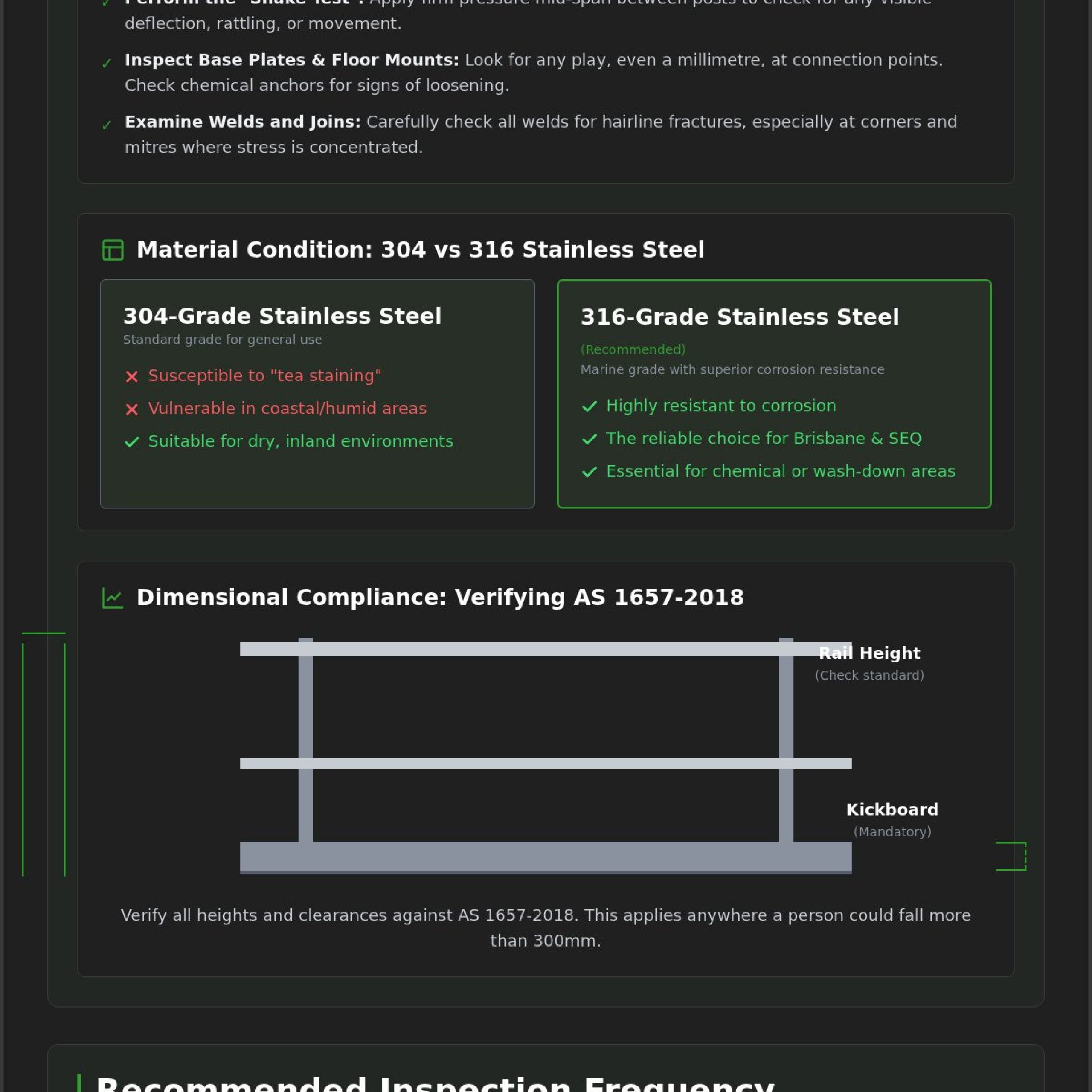
The choice between 304 and 316-grade stainless steel often dictates the lifespan of your safety infrastructure. 304-grade is suitable for controlled indoor environments, but it frequently fails in the humidity of Queensland. This is why custom stainless steel fabrication Brisbane experts almost exclusively recommend 316-grade for industrial applications. It contains molybdenum, which provides significantly better resistance to chlorides and pitting. To maintain this protection, regular wash-downs with fresh water are essential to remove salt and chemical buildup before they can initiate the corrosion cycle.
Sanitary and Food-Grade Inspection Points
For food processing or pharmaceutical plants, the inspection criteria shift from simple stability to hygiene. You must check for smooth, crevice-free welds that don’t allow for bacterial growth. Any “dead legs” or pockets where product can accumulate are major non-compliance risks. During your inspection, verify that your material certificates are on file to prove food-safe compliance. If you find pitting or rough joins, the rail isn’t just a safety risk; it’s a contamination hazard that requires immediate remediation to maintain site certification.
Dimensional Compliance: Verifying AS 1657 Measurements
Precision is the difference between a compliant safety barrier and a legal liability. When you’re running through your industrial handrail inspection checklist, your tape measure is your most important tool. AS 1657-2018 provides strict geometric requirements that ensure a rail is at the correct height to prevent a fall while remaining accessible for a worker to grab in an emergency. Unlike some international standards that use imperial units, Australian compliance is measured in millimetres; even a small deviation can result in a non-conformance report during a safety audit.
The primary focus of your dimensional check should be the vertical distance from the floor or nosing line to the top of the handrail. If this height is too low, it won’t effectively stop a person’s momentum; if it’s too high, it becomes difficult for shorter workers to use for stability. Beyond the top rail, the placement of the knee rail is equally critical. This intermediate rail is designed to prevent a person from slipping through the gap under the main rail, and its position must be verified against the latest standards to ensure no large openings exist.
If your site audit reveals heights or gaps that fall outside these legal ranges, our team can provide the necessary Safety Handrails and Protection upgrades to bring your facility back into alignment.
AS 1657 Dimensional Standards
To ensure your facility meets the current 2018 standards, verify these key measurements during your next walk:
- Top Rail Height: Must be between 900mm and 1100mm from the floor surface or stair nosing.
- Intermediate Rail Gap: The clear space between the top rail and the knee rail, or the knee rail and the kickboard, must not exceed 450mm.
- Kickboard Height: If there’s a risk of objects falling onto people below, a kickboard of at least 100mm must be installed with a gap of no more than 10mm from the floor.
- Handrail Diameter: The rail should have an outside diameter between 30mm and 50mm to ensure it’s easy to grip for most workers.
- Wall Clearance: There must be a minimum of 50mm clearance between the rail and the wall to allow for a full, unobstructed hand grip.
Stairway and Ramp Specifics
Transitions are where many compliance failures occur. On stairways, the handrail height must remain consistent as it moves from the flight to the landing. For ramps, the rail should extend at least 300mm past the end of the incline to provide support before the user reaches the level surface. You should also check the surface finish of the rail itself. While stainless steel is durable, it shouldn’t be so polished that it becomes slippery when wet or greasy. A consistent, tactile finish is essential for maintaining “graspability” in industrial environments.
Remediation and Maintenance: What to do if a Rail Fails
When a walk-through using your industrial handrail inspection checklist reveals a non-compliance issue, the first step is an immediate risk assessment. A failed rail doesn’t always require a total facility shutdown, but it does demand a clear exclusion zone. If the structural integrity is compromised, the area must be cordoned off until a qualified professional can restore the safety barrier to its original load-bearing capacity. Safety is the priority; leaving a known hazard unattended is a significant breach of your Duty of Care.
Many managers assume that a failed rail means a long lead time for off-site fabrication. However, most industrial handrails can be repaired in-situ. Utilising mobile welding Brisbane services allows for rapid remediation without the need to dismantle large sections of your infrastructure. This approach is significantly more efficient than complete replacement, as it targets specific failure points like sheared bolts or cracked welds while ensuring the final result still meets the design intent of AS 1657. Once the repair is complete, it must be verified to ensure it provides the same level of protection as the original installation.
Industrial Maintenance Strategies
Organising a preventative maintenance schedule is the most effective way to reduce long-term operational costs. Rather than waiting for a catastrophic failure, scheduled reviews allow you to catch minor issues like surface tea staining or slight movement in floor mounts early. Donewright Stainless specialises in on-site maintenance services that work around your production schedule, ensuring your safety systems remain legal without causing unnecessary downtime. Using qualified fabricators who understand the nuances of industrial metalwork is essential; a poor-quality weld from an unqualified contractor can actually create new stress points that lead to future failures.
Upgrading Legacy Systems
There comes a point where patching old infrastructure is no longer viable. Many older Brisbane facilities still rely on mild steel rails that require constant painting to stave off rust. During planned plant shutdowns, it’s often more cost-effective to modernise these legacy systems by replacing them with high-grade 316 stainless steel. This upgrade eliminates the recurring cost of corrosion management and ensures your site stays ahead of evolving safety regulations. If your latest industrial handrail inspection checklist has flagged multiple points of failure across an old system, it’s a clear signal that a strategic upgrade is required.
Need an urgent safety fix or a comprehensive site audit? Contact Wrighty and the team for mobile welding services to secure your facility today.
Securing Your Site with AS 1657 Precision
Maintaining safe access in an industrial environment requires more than a casual visual scan. It demands a systematic verification of structural stability, material condition, and dimensional accuracy. By implementing a rigorous industrial handrail inspection checklist, you ensure that every fixing and rail height meets the strict requirements of AS 1657-2018. This proactive approach doesn’t just satisfy your legal Duty of Care; it protects your most valuable asset: your workforce.
If your site audit reveals stability issues or signs of tea staining, you don’t have to manage the remediation alone. Donewright Stainless brings over 30 years of industrial fabrication experience directly to your facility. Our fully equipped mobile workshop serves Brisbane and the Gold Coast, providing immediate on-site safety fixes and expert compliance support. Request a Site Inspection or Handrail Repair Quote from our AS 1657 compliance specialists today. Taking action now ensures your site remains secure, compliant, and productive for the long term.
Frequently Asked Questions
Is AS 1657 mandatory for all industrial handrails in Australia?
AS 1657-2018 is the recognised benchmark for compliance under the Work Health and Safety (WHS) Act. While the standard itself is not a law, it is the primary document used by regulators and courts to determine if a business has met its legal Duty of Care. Adhering to these specifications is the most reliable way for Brisbane facility managers to ensure their fixed platforms, walkways, and ladders are legally compliant and physically secure.
How often should I conduct an industrial handrail inspection?
High-traffic industrial zones in South East Queensland should be reviewed monthly using a formal industrial handrail inspection checklist. For lower-traffic areas like roof access points, a bi-annual or annual check is typically sufficient. However, if your facility is located near the coast or involves chemical processing, more frequent audits are necessary to catch corrosion early. Consistent documentation in a safety register is vital for insurance and audit purposes.
What is the difference between a guardrail and a handrail in AS 1657?
A handrail is designed specifically for a person to grasp for support while moving, whereas a guardrail is a structural barrier intended to prevent a person from falling to a lower level. AS 1657 provides technical specifications for both. In many industrial settings, these systems are integrated, with the top rail of a guardrail system also serving as the graspable handrail, provided it meets the required diameter and clearance standards.
Can I repair a rusted stainless steel handrail or must it be replaced?
Minor surface rust or tea staining can often be remediated through professional cleaning and passivation, but structural corrosion requires a different approach. If the base metal has thinned or welds have cracked, our mobile welding team can often perform on-site repairs to restore structural integrity. However, if the pitting is deep enough to compromise the wall thickness of the tube, a partial or full replacement is the only safe option.
What are the height requirements for industrial handrails in Queensland?
For industrial platforms and stairways in Queensland, the top rail must be positioned between 900mm and 1100mm above the floor surface or stair nosing. This height range is strictly defined by AS 1657 to ensure the rail is effective for the majority of the workforce. Consistency is key; any sudden change in height along a continuous run of railing can create a trip hazard and lead to non-compliance during a safety audit.
What is tea staining and does it affect the safety of my handrail?
Tea staining is a brown surface discolouration common in Brisbane’s humid and coastal environments, particularly on 304-grade stainless steel. While it starts as an aesthetic issue, it is a precursor to pitting corrosion. If left untreated, tea staining allows chlorides to eat into the metal, eventually causing structural failure. Regular maintenance and the use of 316-grade stainless steel are the best ways to prevent this degradation from affecting site safety.
Who is qualified to conduct a formal handrail safety audit?
While site supervisors can perform routine checks using an industrial handrail inspection checklist, formal compliance audits should be conducted by experienced structural engineers or specialised fabricators. Donewright Stainless provides expert assessments across Brisbane and the Gold Coast, identifying subtle failures in fixings or geometry that an untrained eye might miss. A formal audit provides the necessary documentation to prove your facility meets current Australian safety standards.
Do food processing plants have different handrail requirements?
Yes, food processing environments require handrails that meet both safety and hygiene standards. Beyond AS 1657 stability requirements, these rails must feature smooth, crevice-free welds to prevent bacterial growth and “dead legs” where organic material can accumulate. We typically utilise 316-grade stainless steel for these applications to withstand aggressive wash-down chemicals and high humidity while maintaining a sanitary surface that is easy to clean and inspect.
