
Food Grade Stainless Steel Benches Brisbane: Custom Fabrication & Compliance Guide
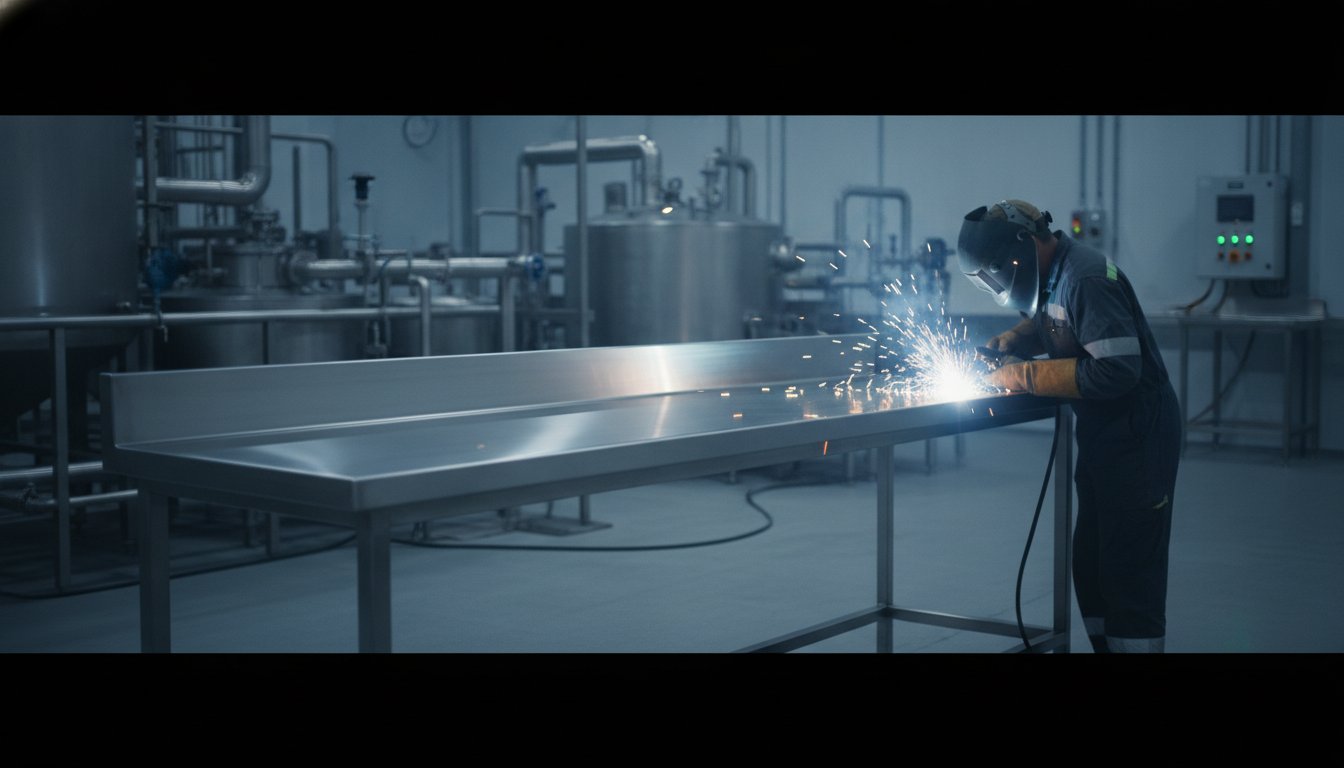
An off-the-shelf bench might save a few dollars upfront, but it is often the fastest way to fail a Brisbane City Council health audit. In the high-humidity environments of South East Queensland, choosing the wrong material or a generic fit leads to more than just surface tea-staining; it creates hygiene risks that can shut down a production line. When you are investing in food grade stainless steel benches Brisbane food processors need more than just a flat surface. You need a setup that is built for the rigours of industrial use while remaining strictly compliant with AS 4674-2004.
We understand that every plant layout has its own quirks, and a standard catalogue item rarely makes the best use of your available space. This guide outlines how to navigate the complexities of custom fabrication, from selecting the right grade of steel to ensuring your benches are installed without gaps or dead spots where bacteria can thrive. You will learn the essential steps to achieve a seamless, hygienic workspace that passes every inspection and stands up to years of heavy-duty cleaning.
Key Takeaways
- Identify why a No. 4 brushed finish is the non-negotiable standard for maintaining hygiene and resisting bacterial growth in industrial settings.
- Navigate the complexities of AS 4674 compliance to ensure your facility meets all local health regulations and avoids costly audit failures.
- Optimise your plant layout with custom food grade stainless steel benches Brisbane specialists design to fit your specific workflow rather than settling for generic sizes.
- Compare the structural longevity of fully welded frames against bolted flat-pack alternatives to ensure your surfaces withstand heavy-duty industrial use.
- Learn how on-site mobile welding and expert installation provide a seamless finish that eliminates the gaps and crevices where contaminants hide.
What Defines Food Grade Stainless Steel Benches in Brisbane?
Food grade stainless steel benches Brisbane food businesses rely on are far more than simple work surfaces. They are precision-engineered tools designed to prevent bacterial growth while withstanding the aggressive cleaning chemicals used in industrial sanitation. In Brisbane’s sub-tropical climate, high humidity creates a breeding ground for contaminants. Using non-porous materials isn’t optional; it’s a structural requirement for any facility aiming to pass a health audit. These surfaces must be inert, ensuring no metallic flavours or chemical residues leach into the food products during processing.
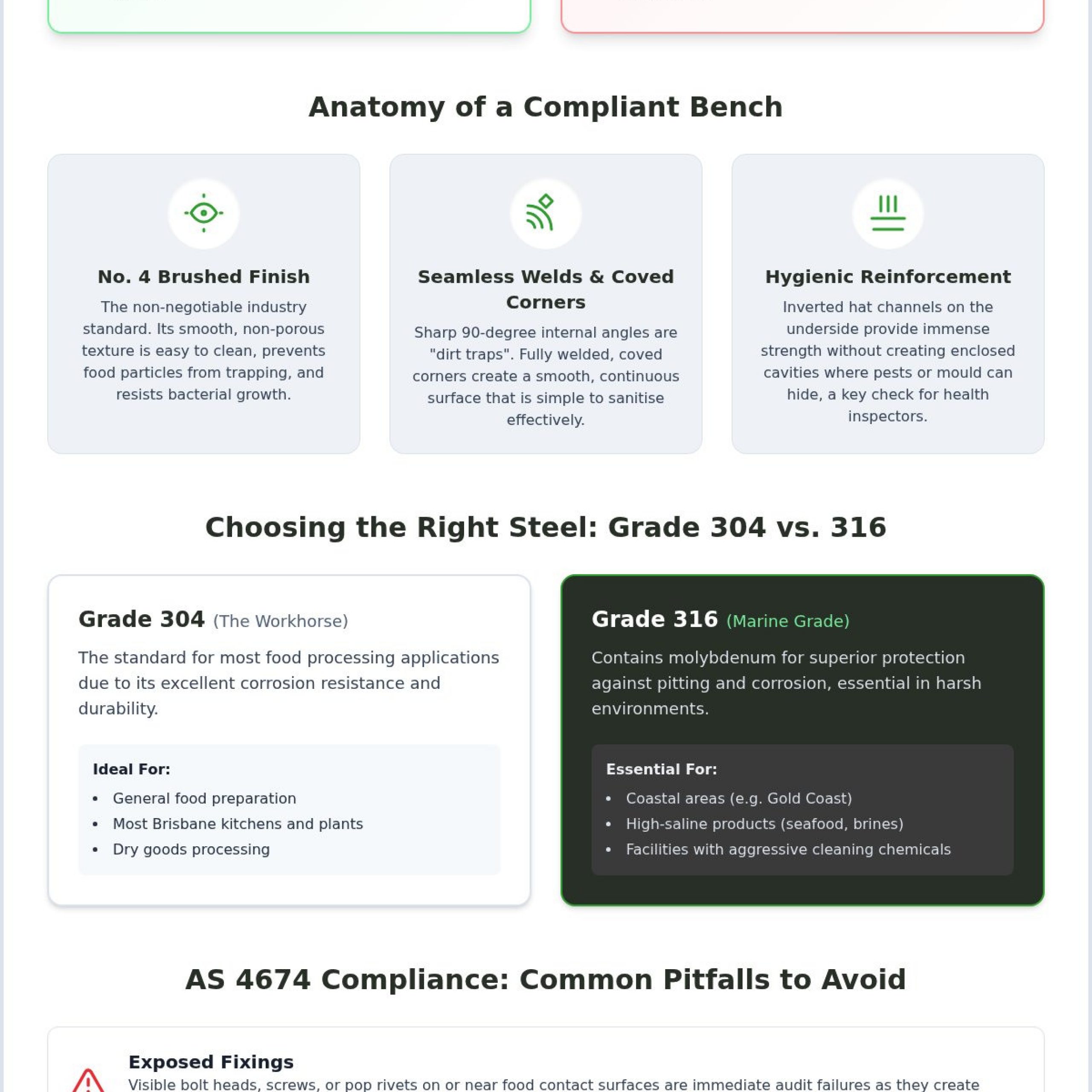
A critical factor in hygiene is the surface finish. The industry standard is a ‘No. 4’ brushed finish. This specific texture is smooth enough to prevent food particles from becoming trapped, yet it’s durable enough to hide the light scratches that occur during daily industrial use. When we fabricate these units, we focus on seamless welds and radius corners. Sharp 90-degree angles are “dirt traps” where grime accumulates. By coving the internal corners, we ensure that every millimetre of the bench is reachable during the wash-down process, eliminating the risk of hidden microbial colonies.
Grade 304 vs Grade 316: Which is Right for You?
Selecting the right alloy depends on your specific application and proximity to the coast. Most Brisbane kitchens and processing plants use Grade 304, which offers excellent corrosion resistance for general food prep. However, if your facility is near the Gold Coast or handles high-saline products like seafood or brines, Grade 316 is the superior choice. This “marine grade” steel contains molybdenum, providing extra protection against pitting. You can find more technical data on SAE steel grades to understand how these alloys differ. While 316 carries a higher upfront cost, it’s a necessary investment for long-term durability in corrosive environments.
The Anatomy of a Sanitary Bench
Structural integrity shouldn’t come at the expense of hygiene. We use inverted hat channels for underside reinforcement. This design provides the strength needed for heavy machinery without creating the enclosed cavities where pests or grime could hide. Queensland health inspectors typically look for splashbacks that are integrated into the bench top rather than bolted on. We also offer various leg bracing styles to suit your workflow. For heavy industrial use, a fully welded H-frame provides maximum stability, while enclosed cabinets are better for storing sensitive equipment. Integrating these with other custom items like stainless steel trolleys ensures a consistent, compliant workflow across your entire floor.
Navigating AS 4674: Compliance for Brisbane Food Premises
Compliance in a commercial kitchen or industrial food plant isn’t just about the quality of the steel; it’s about how that steel is integrated into the building. AS 4674-2004 remains the definitive Australian Standard for the design, construction, and fit-out of food premises. While this standard is technically under review, Brisbane City Council health inspectors continue to use it as the benchmark for determining if a facility is fit for purpose. When sourcing food grade stainless steel benches Brisbane business owners often discover that the “bargain” of a flat-pack unit quickly evaporates when an auditor identifies non-compliant bolted joints or unsealed gaps against the walls.
The core requirement of the standard is that all surfaces must be smooth, impervious, and easy to clean. Flat-pack benches usually fail this test because they rely on mechanical fixings, such as bolts and screws, which create microscopic crevices where organic matter accumulates. In contrast, custom-fabricated benches are fully welded. This creates a monolithic surface that prevents liquid ingress. Guidance from Safe Food Australia emphasises that equipment must be designed to minimise the harbourage of pests and bacteria. Achieving this in a high-volume Brisbane plant requires a precise fit where every bench is scribed to the wall and permanently sealed.
Common Compliance Pitfalls in Custom Benches
- Exposed Fixings: Any visible bolt heads or pop rivets on a food-contact surface are immediate red flags during an audit.
- Inadequate Drainage: Large-scale preparation benches must be engineered with a slight fall to ensure wash-down water doesn’t pool in the centre.
- The Coving Requirement: The junction between the bench and the wall must be coved or tightly sealed with food-grade silicone to eliminate 90-degree “dirt traps” that are impossible to sanitise effectively.
Preparing for a Brisbane City Council Health Audit
A successful health audit starts long before the inspector arrives. Investing in high-quality custom stainless steel fabrication Brisbane ensures that your infrastructure meets the local interpretation of the national code. Your fabricator should be able to provide material certifications to prove you are using genuine food-grade alloys. This documentation is vital for your food safety program records.
The long-term cost of retrofitting a non-compliant kitchen often triples the initial saving of buying off-the-shelf. If you are unsure if your current layout meets the mark, it’s a good idea to consult with a specialist fabricator who understands the specific nuances of Queensland health regulations. Getting the installation right the first time protects your brand and ensures your production line stays operational without the threat of forced closures or costly remedial works.
Custom Fabrication vs. Off-the-Shelf: The Industrial Reality
In a large-scale food processing facility, floor space is a premium asset. Choosing off-the-shelf furniture often leads to significant inefficiencies because standard 600mm or 700mm depths rarely align with the structural layout of a plant. When you specify food grade stainless steel benches Brisbane fabricators can design units that wrap around pillars or fit snugly into alcoves, reclaiming square metres that would otherwise be lost to “dead zones”. This bespoke approach is particularly vital when you need to accommodate heavy industrial mixers or vibrating machinery that would quickly buckle a lightweight retail bench.
The structural difference between a fully welded frame and a bolted flat-pack assembly isn’t just about strength; it’s about longevity. Bolts loosen under the constant vibration of an industrial floor, creating gaps where moisture and food particles settle. In Brisbane’s high-humidity climate, these unsealed hollow sections become internal rust factories. A fully welded bench, however, is hermetically sealed. This prevents “tea-staining” and internal corrosion, ensuring the unit remains structurally sound for decades. This level of detail aligns with the best practice guide to fit-out and construction, which prioritises durability and hygiene in food-handling environments.
When Custom is the Only Option
Industrial layouts are rarely straightforward. You might need to fit benches around existing industrial pipework Brisbane facilities already have in place. Customisation allows us to integrate sinks, ice wells, or scrap holes exactly where your workflow demands, rather than forcing your staff to adapt to an awkward, generic setup. We also adjust bench heights to meet specific ergonomic requirements. In high-volume production lines, a few centimetres of height adjustment can significantly reduce worker fatigue and the risk of repetitive strain injuries.
Calculating the Real ROI of Custom Benches
The return on investment for custom food grade stainless steel benches Brisbane plants install is measured in years, not months. While retail options might last five years before the joints fail or the surfaces pit, a custom-fabricated bench often has a service life exceeding 20 years. You also save on daily operational costs. Superior sanitary design reduces the labour time required for deep cleaning, as there are no bolt heads or overlapping joints to scrub. By getting the installation “right the first time,” you avoid the hidden costs of downtime and the eventual need for expensive retrofitting when standard units fail under pressure.
Designing Your Food Grade Bench: Key Industrial Considerations
Designing food grade stainless steel benches Brisbane facilities require starts with a comprehensive workflow analysis. It’s not enough for a bench to be the right size; it must facilitate a logical movement from raw ingredients to finished product. This planning is the primary defence against cross-contamination. We often design these work surfaces to integrate perfectly with stainless steel trolleys, allowing for a modular system where materials move through the plant without ever touching a non-sanitary surface. This seamless transition is vital for maintaining the high-volume throughput expected in industrial processing.
Physical safety and floor layout are equally important. Your new installations must remain compatible with existing safety handrail fabrication Brisbane standards, particularly in facilities with elevated prep areas or mezzanine levels. We also help you decide between mobility and permanent stability. While fixed benches are best for heavy machinery, many Brisbane plants prefer heavy-duty lockable castors. These allow equipment to be moved for thorough floor sanitisation or to reconfigure the production line for different product runs. When we build food grade stainless steel benches Brisbane businesses can rely on, we ensure every castor and leg assembly is rated for the specific weight of your industrial equipment.
Bench Top Profiles and Edging
For wet areas or industrial wash-down zones, we recommend a marine or “wet-edge” profile. This raised perimeter contains spills on the bench top, preventing liquids from dripping onto the floor and creating slip hazards. The choice between a square or bullnose edge often comes down to the specific task. Bullnose edges are gentler on staff who spend hours leaning against the bench, while square edges allow for tighter joins between multiple units. If your work involves heavy impact or high-vibration machinery, we reinforce the underside of the top to prevent structural fatigue and reduce noise levels.
Under-Bench Storage and Access
Storage solutions must balance accessibility with hygiene. Solid shelves provide maximum storage space, but pipe shelves are often superior for areas requiring high airflow, such as cooling zones. A critical industrial detail is ensuring sufficient clearance for cleaning. We design leg bracing to allow floor scrubbers and manual mops to reach right to the wall, leaving no “dead zones” for bacteria. For specialised needs, we can fabricate integrated bin housings or custom drawer units that keep your tools within reach while protecting them from floor-level contaminants.
If you’re looking to upgrade your facility with precision-engineered equipment, contact Donewright Stainless today to discuss a custom design tailored to your industrial workflow.
The Donewright Advantage: On-Site Mobile Welding & Install
Large-scale industrial plants present unique installation challenges that standard delivery services simply can’t handle. When installing food grade stainless steel benches Brisbane facilities often require on-site welding to join long runs of benching into a single, seamless unit. This process is essential for eliminating the mechanical joins and silicone gaps that would otherwise fail a strict health audit. Our fully equipped mobile workshop brings industrial-grade fabrication capabilities directly to your floor, allowing us to scribe and weld benches to fit the specific contours of your walls and existing infrastructure in real-time.
We recognise that production downtime is a major concern for any food processing plant. We coordinate our installation schedules to align with your planned maintenance windows or shift changes, ensuring your facility returns to full operation as quickly as possible. This comprehensive service model extends beyond work surfaces; we provide full-service industrial pipework and maintenance to ensure your entire processing line remains efficient, hygienic, and compliant with current safety regulations.
The Donewright Process: From Quote to Handover
Every project begins with a detailed site measure and consultation, typically led by ‘Wrighty’ or our senior fabrication team. This initial step ensures personal accountability and allows us to identify potential installation hurdles before the steel is even cut. We perform the primary fabrication in our Brisbane workshop to maintain strict quality control. However, the critical final steps happen on your site. By performing on-site welding and final high-grit polishing, we ensure the food grade stainless steel benches Brisbane processors receive are perfectly integrated into their environment with no visible seams or crevices where bacteria could thrive.
Ongoing Maintenance and Repairs
Our commitment to your facility doesn’t end at the point of handover. We also specialise in refurbishing existing stainless surfaces that may have suffered from years of heavy-duty use, bringing them back to a standard that meets updated health regulations. If an urgent issue arises, our mobile welding service is available for rapid repairs to prevent production halts. Whether it’s a cracked weld on a legacy bench or a modification to an existing line, we provide the steady, experienced hand needed to keep your plant running without fuss.
Ready to upgrade your facility with surfaces built for the long haul? Get a no-fuss quote for custom stainless benches today.
Secure Your Facility’s Future with Compliant Fabrication
Building a facility that withstands the rigours of industrial food processing requires a strategic approach to AS 4674 compliance. By prioritising fully welded construction and bespoke layouts, you eliminate the hygiene risks associated with generic, bolted alternatives. Investing in high-quality food grade stainless steel benches Brisbane facilities can depend on ensures that your production line remains both efficient and audit-ready for decades.
Donewright Stainless has spent years serving the industrial hubs of Brisbane, Logan, and the Gold Coast as established compliance experts. Our fully equipped mobile welding workshop allows us to handle complex on-site installations that other fabricators can’t manage. We deliver precision-engineered solutions that fit your workflow perfectly, ensuring your plant meets the highest sanitary standards.
Get a Fair-Dinkum Quote for Custom Stainless Benches
We look forward to helping you build a workspace that stands the test of time and keeps your operations running smoothly.
Frequently Asked Questions
What is the difference between 304 and 316 stainless steel for food benches?
Grade 304 is the standard alloy for most Brisbane food processing environments because it offers excellent corrosion resistance and durability. Grade 316, often called marine grade, contains molybdenum, which provides superior protection against pitting in high-saline environments. If your facility handles heavy brines or is located near the coast, Grade 316 is the necessary choice to prevent long-term surface degradation.
Do your custom stainless steel benches meet AS 4674 standards?
Yes, every unit we fabricate is designed to meet or exceed the requirements of AS 4674-2004. We focus on fully welded construction and radius corners to ensure there are no crevices where bacteria can hide. This meticulous approach to food grade stainless steel benches Brisbane health inspectors expect ensures your facility passes audits without the need for costly remedial works.
How long does it take to fabricate and install a custom bench in Brisbane?
Most custom projects are ready for installation within 2 to 4 weeks following the final site measure and quote approval. Because we utilise a mobile workshop, the on-site installation and final welding are scheduled to align with your production breaks. This methodical process ensures precision while minimising any potential downtime for your processing line or commercial kitchen.
Can you repair existing food-grade benches on-site?
We provide comprehensive mobile welding and maintenance services to refurbish legacy equipment. If your existing benches have cracked welds, surface pitting, or non-compliant joins, our team can often repair them on-site to restore hygiene standards. This is a cost-effective way to extend the life of your current infrastructure while ensuring it remains fit for industrial food handling.
Are custom stainless steel benches more expensive than flat-pack options?
Custom-fabricated benches involve a higher initial investment than mass-produced flat-pack furniture, but they offer a much lower total cost of ownership. A custom bench is built to last 20 years or more in a heavy industrial setting, whereas lightweight retail options often fail within five years. The superior sanitary design also reduces daily labour costs associated with deep cleaning and maintenance.
What splashback height is required for commercial kitchens in Queensland?
While a 150mm splashback is a common baseline, the specific height required depends on your local council regulations and the nature of your food prep. We customise splashback heights to ensure they provide adequate protection against wall contamination. Integrating the splashback as a single, coved piece of steel eliminates the need for problematic silicone joins that often fail health inspections.
Do you provide mobile welding services for food plants in the Gold Coast and Logan?
Our service area extends across the entire South East Queensland region, including Logan and the Gold Coast. We bring our fully equipped mobile workshop to your site, providing the same high-level fabrication and repair services available at our Brisbane facility. This allows us to handle large-scale industrial projects and urgent repairs regardless of your specific location in the region.
Can you integrate sinks and drainage directly into the bench top?
We specialise in welding sinks, ice wells, and drainage systems directly into the food grade stainless steel benches Brisbane businesses use. Unlike drop-in sinks that rely on silicone seals, a fully integrated sink creates a seamless, one-piece surface. This prevents liquid from leaking into the cabinetry below and eliminates the grime-trapping gaps that are common in standard commercial fit-outs.