
Custom Stainless Steel Trolleys: The Ultimate Guide to Industrial Performance
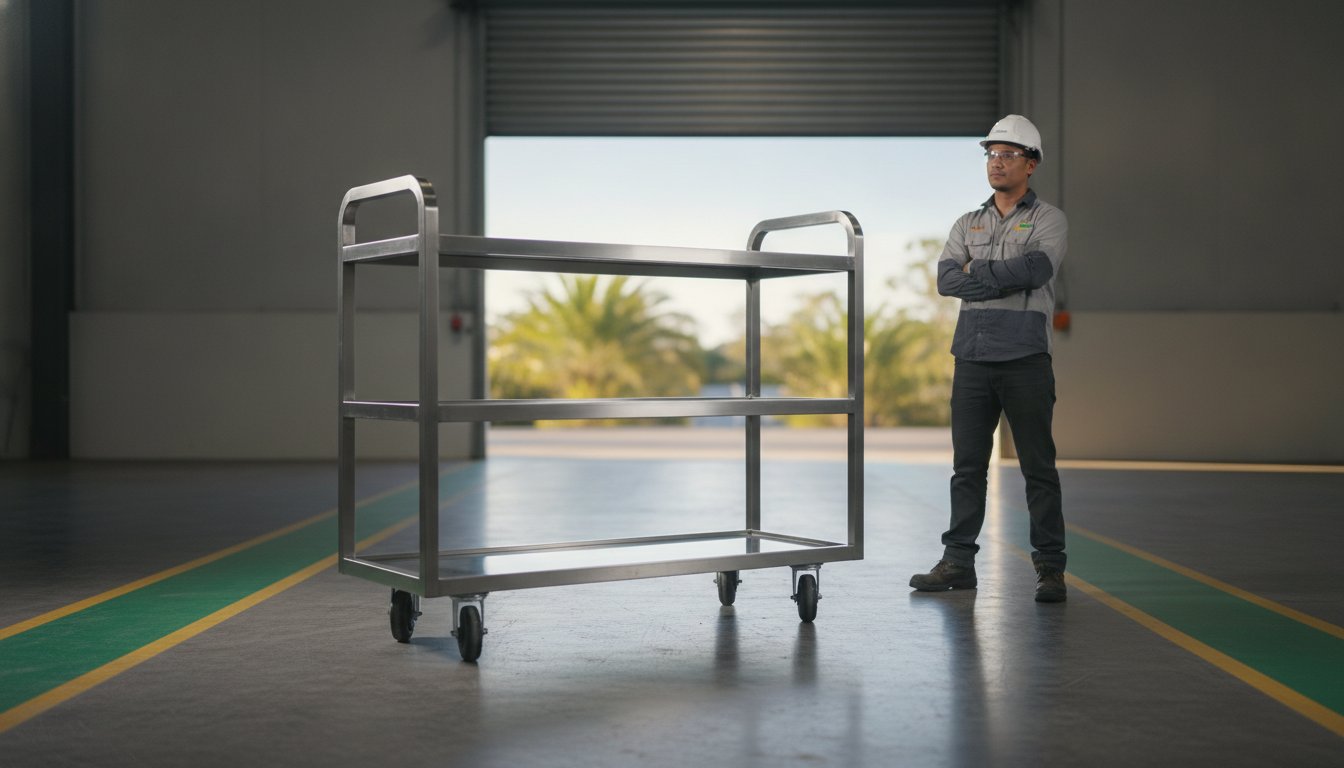
A “bargain” industrial trolley often becomes the most expensive piece of equipment in your facility once you factor in the cost of weld failure and hygiene breaches. Most floor managers in Brisbane and the Gold Coast know the frustration of watching a standard unit rust at the joints or buckle under a load it was supposedly rated to carry. It’s a common headache when off-the-shelf sizes don’t fit through narrow aisles or align with your specific machinery. We agree that equipment should be a tool for efficiency, not a constant maintenance burden.
This guide explores how investing in custom stainless steel trolleys transforms these daily bottlenecks into streamlined, compliant workflows that protect your staff and your bottom line. We’ll examine the technical differences between material grades, the role of ergonomic design in reducing manual handling risks, and why a precision-engineered build is the only way to ensure a service life of ten years or more in demanding Australian environments. From food-grade compliance to heavy-duty industrial logistics, discover how bespoke fabrication provides the durability that mass-produced alternatives simply cannot match.
Key Takeaways
- Learn why purpose-built fabrication outperforms mass-produced alternatives in high-pressure industrial settings.
- Understand the critical differences between Grade 304 and Grade 316 to ensure your custom stainless steel trolleys withstand their specific environment.
- Discover how to calculate load capacities and select the right castors to reduce manual handling risks for your staff.
- Analyse the total cost of ownership to see how a higher initial investment prevents expensive downtime and frequent repairs.
- Find out how local Brisbane fabrication ensures your equipment integrates perfectly with existing industrial pipework and benches.
What are Custom Stainless Steel Trolleys?
At its core, a custom stainless steel trolley is a purpose-built piece of manual handling equipment designed to meet the exact operational demands of a specific workspace. Unlike mass-produced alternatives found in retail catalogues, these units are engineered from the ground up. They address the unique physical constraints of your facility, whether that involves navigating a narrow cleanroom or supporting the dead weight of industrial pump components. For sectors like food processing, pharmaceuticals, and heavy manufacturing, custom stainless steel trolleys are essential tools that ensure workflow continuity and strict adherence to safety standards.
The decision to use stainless steel isn’t merely about aesthetics. It’s about the inherent stainless steel properties that allow for frequent, aggressive chemical sanitisation without the risk of structural degradation. In medical and pharmaceutical environments, where hygiene is a non-negotiable requirement, the non-porous surface of high-grade stainless steel prevents bacterial harbourage in a way that plastics or coated mild steels cannot match. This material choice ensures that the equipment remains a sterile, reliable asset rather than a liability.
The Difference Between Custom and Off-the-Shelf
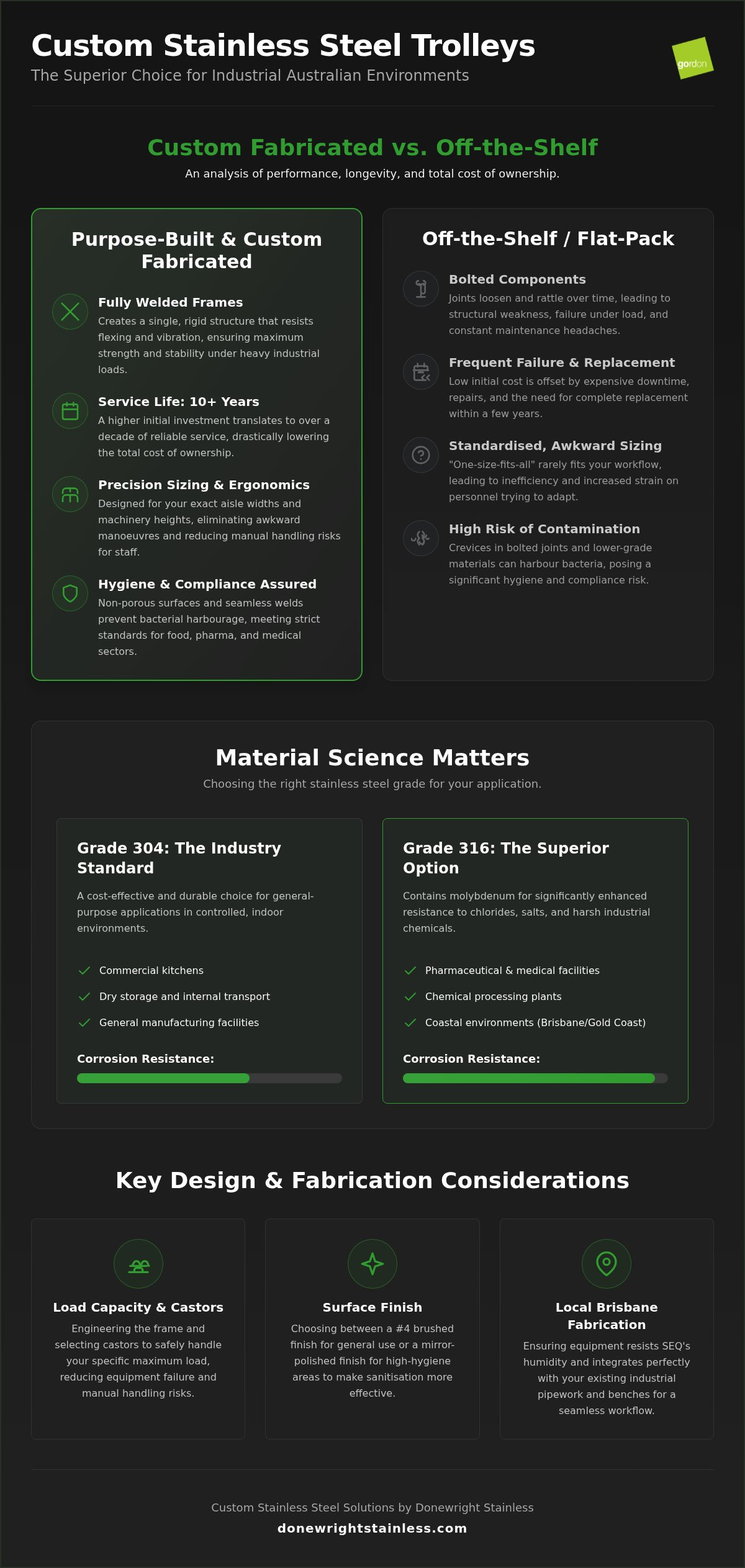
The most immediate distinction lies in structural integrity. Retail “flat-pack” trolleys usually rely on bolted components that eventually loosen, rattle, and fail under the constant vibration of a factory floor. In contrast, a bespoke unit features fully welded frames. This creates a single, rigid structure capable of handling heavy industrial loads without flexing. Precision sizing also plays a vital role. When a trolley is designed for specific aisle widths or machinery heights, it eliminates the ergonomic strain of staff having to overreach or manoeuvre awkwardly. While the initial outlay is higher, the longevity of a custom unit often spans a decade or more, making it a far more economical choice over its lifecycle.
Why Material Choice Matters in Brisbane
Operating in South East Queensland presents unique environmental challenges, particularly regarding humidity and salt air. Lower-grade imports often succumb to “tea staining”, a brown surface discolouration that compromises the professional look of your facility and can lead to deeper corrosion if left unchecked. Our approach to custom stainless steel fabrication Brisbane focuses on selecting the correct grade and surface finish to resist these local conditions. By using high-quality materials and professional welding techniques, we ensure your equipment remains compliant and structurally sound, regardless of the local climate’s intensity. This level of precision is something standard retail units simply don’t offer.
Material Science: Choosing the Right Grade and Finish
Selecting the correct material for custom stainless steel trolleys involves more than just picking a metal that won’t rust. It requires an understanding of how specific alloys react to cleaning chemicals, atmospheric salt, and high-pressure washdowns. Grade 304 is the industry workhorse, serving as the standard for commercial kitchens and general internal transport. It offers excellent durability and corrosion resistance for most indoor applications where moisture is managed. However, it is not a universal solution for every industrial environment.
Grade 316 is required for pharmaceutical plants, chemical processing, or coastal facilities in South East Queensland. The primary chemical difference is the addition of approximately 2% to 3% molybdenum, which provides significantly higher resistance to chlorides and industrial solvents. This inclusion of molybdenum creates a robust barrier against pitting corrosion, which is the localised breakdown of the metal’s protective layer often seen in harsh environments. If you are unsure which grade suits your facility, you can speak with our fabrication team for a technical assessment of your specific site conditions.
The surface finish of the steel is just as vital as the grade itself. A #4 brushed finish is the most common choice for industrial settings, providing a clean, professional appearance that hides minor scratches from daily use. For medical or high-risk food environments, a mirror-polished finish is often specified. This smoother surface reduces the surface area where microscopic contaminants can cling, making the sanitisation process more effective and ensuring the unit meets strict health standards.
Grade 304 vs 316 Stainless Steel
While Grade 304 provides a cost-effective solution for dry-store transport or general assembly lines, it can fail prematurely in high-humidity conditions. Grade 316 is mandatory for any trolley exposed to aggressive cleaning agents or salt air. Choosing the wrong grade often results in surface discolouration within months, eventually leading to structural weakness at the joints. We always recommend 316 for any equipment that will be used in outdoor loading docks or near chemical wash-down bays.
The Importance of TIG Welding
The quality of the weld determines the hygiene compliance and structural integrity of the entire unit. We utilise Tungsten Inert Gas (TIG) welding to create smooth, non-porous joints that eliminate “bacteria traps”, which are the tiny crevices where organic matter can hide from cleaning sprays. This meticulous approach to joining metal is a core part of our safety handrail fabrication Brisbane expertise, where precision is critical for both safety and sanitation. By applying these same high standards to our trolley builds, we ensure every corner is easy to sterilise and free from sharp, dangerous edges.
Designing for Purpose: Key Considerations for Custom Units
Designing custom stainless steel trolleys requires a holistic approach that balances structural physics with human factors. The process begins with a precise calculation of load capacity. We don’t just look at the total weight but consider the distribution across each tier. A trolley carrying 200kg of liquid containers has vastly different stability requirements than one carrying 200kg of flat-packed components. If the centre of gravity sits too high, the risk of tipping during rapid directional changes increases significantly. By tailoring the tier configuration to your specific trays or bulk containers, we ensure the cargo remains secure without the need for makeshift straps or bungees.
Handle ergonomics are another critical factor that off-the-shelf units rarely get right. A handle positioned too high or too low forces the operator into an awkward posture, leading to repetitive strain injuries (RSI) and long-term fatigue. We design handles to promote a neutral wrist position and ensure the height is optimised for the specific staff members using the equipment. This focus on the human element reduces manual handling risks and improves overall workplace safety.
Castors and Manoeuvrability
Selecting the right wheels involves more than just weight ratings. For cleanroom or hospital environments, non-marking wheels are a strict requirement to maintain the integrity of specialised floor coatings. In contrast, heavy-duty polyurethane castors are better suited for the uneven floors of a warehouse or factory, as they provide better shock absorption and durability. The placement of these castors dictates the trolley’s turning circle and ease of use. While a standard four-corner swivel setup offers maximum agility, a combination of fixed and swivel castors provides better tracking for long-distance transport. Placing castors in a central “diamond” configuration allows the unit to rotate on its own axis, which is ideal for navigating the tightest industrial corridors. For broader insights into space-saving equipment, United Lift LLC offers a comprehensive guide on selecting the best machinery for high-density warehouse environments.
In food processing and pharmaceutical facilities, the design must account for aggressive wash-down cycles. We incorporate drainage points into the frame to ensure sanitising fluids don’t pool inside hollow sections, which could lead to internal corrosion or bacterial growth. Every component must be compatible with the harsh chemical cleaning agents used in your specific industry. To further enhance safety, we ensure that incorporating rounded corners and radiused internal edges improves sanitisation efficiency by eliminating the “dead zones” where organic matter typically accumulates. This meticulous attention to detail ensures your equipment remains fully compliant with health standards for years to come.
Custom Fabrication vs. Off-the-Shelf: A Cost-Benefit Analysis
Customisation also acts as a productivity multiplier in the warehouse. When a trolley is built to the exact height of a conveyor or the specific width of a cool-room aisle, staff move faster and with less physical strain. To ensure your wider material handling systems are just as efficient, you can visit Quintec Conveyors for expert conveyor integration. This precision ensures your facility remains compliant with Australian manual handling regulations, which are designed to prevent long-term musculoskeletal injuries. Investing in gear that fits the job eliminates the makeshift workarounds that often lead to accidents.
Mass-produced units often fail at the castor mounting points. These areas are under constant stress, and in retail models, the metal is usually too thin to support heavy-duty industrial loads over time. Bespoke builds use reinforced bases and thicker gauge steel to handle the rigours of a 24/7 operation. For instance, in a Brisbane meat plant where equipment faces daily high-pressure wash-downs and heavy carcasses, a standard retail trolley’s welds will often corrode and fail within months. A custom-fabricated unit, designed for those specific chemical and weight stresses, can easily exceed a ten-year service life.
Meeting Australian Safety Standards
Safety in an industrial facility is a holistic concern. We often integrate our trolley designs with existing safety infrastructure, such as stainless steel handrails Brisbane, to ensure a seamless and protected workflow. This integration ensures that edge protection and load stability are maintained throughout the transport process. By designing for specific load types, we eliminate the risk of cargo shifting, which is a primary cause of tipping accidents in busy warehouses. If you need equipment that meets these rigorous standards and is built to last, contact our Brisbane fabrication team for a detailed consultation on your requirements.
Bespoke Fabrication and Maintenance in Brisbane
Choosing a partner for custom stainless steel trolleys shouldn’t feel like a transaction with a faceless corporation. At Donewright Stainless, we follow a methodical process that begins with a genuine understanding of your floor plan and operational hurdles. This hands-on approach, led by Ian “Wrighty” Wright, ensures that the final product isn’t just a generic piece of equipment but a precision-engineered solution that integrates with your existing workflows. By keeping fabrication local to South East Queensland, we eliminate the logistical delays and potential transport damage often associated with interstate shipping.
Our fully equipped mobile workshop allows us to bring high-level engineering directly to your loading dock or production floor. This capability is vital for businesses that can’t afford to have equipment off-site for weeks at a time. Whether we’re fabricating a new fleet or providing maintenance on existing units, our focus remains on precision and longevity. We treat every weld as a reflection of our reputation, ensuring that the gear we deliver today still performs a decade from now.
Mobile Welding and On-Site Repairs
Minimising downtime is the cornerstone of our service model. We apply the same technical rigour found in our on-site industrial pipework repair Brisbane to our trolley maintenance services. If your existing fleet is showing signs of fatigue at the castor mounts or handles, we can often perform on-site reinforcements to extend their service life and avoid the cost of full replacements. Additionally, as your production lines evolve, we can modify your current custom stainless steel trolleys to accommodate new tray sizes or container heights, ensuring your capital assets continue to provide value as your business grows.
Your Local Partner in Gold Coast, Logan, and Ipswich
We understand the specific regulatory landscape facing Queensland’s food and medical sectors, including local health department expectations for equipment sanitation. Serving industrial hubs across the Gold Coast, Logan, and Ipswich, we provide the fast response times that local businesses require. This proximity allows for iterative design consultations where we can measure twice and weld once, ensuring a perfect fit for your specific machinery or narrow aisles. If you’re ready to upgrade your facility’s manual handling capabilities with equipment that is built to last, contact Donewright Stainless for a custom trolley quote today and speak directly with an expert who understands the rigours of Australian industry.
Investing in Long-Term Industrial Efficiency
Building a facility that operates with peak efficiency requires equipment as resilient as your team. We’ve explored how selecting the correct material grade and prioritising ergonomic design can eliminate the bottlenecks caused by failing, mass-produced units. By investing in custom stainless steel trolleys, you aren’t just buying transport gear; you’re securing a decade of compliant, maintenance-free service that protects your staff and your bottom line.
Donewright Stainless is owner-operated by Ian “Wrighty” Wright, bringing over 20 years of local experience to every project across South East Queensland. We’re specialists in AS 1657 and food-grade compliance, ensuring your equipment meets the strictest Australian standards from the moment it hits the floor. Our fully equipped mobile workshop is always ready for on-site Brisbane repairs or modifications, keeping your production lines moving without the frustration of off-site delays.
If you’re ready to replace disposable imports with gear that is truly built to last, we’re here to provide the expertise you need. Get a Custom Quote from Wrighty at Donewright Stainless and ensure your facility is equipped for a productive future.
Frequently Asked Questions
What is the best grade of stainless steel for a custom trolley?
Grade 304 is the standard for commercial kitchens and indoor transport. If your facility is located near the coast or handles aggressive chemicals, Grade 316 is the superior choice due to its molybdenum content. This addition prevents pitting corrosion and tea staining, which are common issues in the humid South East Queensland climate. We assess your specific environment during the design phase to recommend the grade that ensures maximum longevity.
How much weight can a custom stainless steel trolley carry?
The weight capacity of custom stainless steel trolleys is determined by the gauge of the steel and the rating of the selected castors. Unlike retail units, we can reinforce the base and mounting points to support loads exceeding 500kg if required. We calculate the structural requirements based on your heaviest anticipated cargo to ensure the frame doesn’t buckle or flex under pressure, providing a safe and stable manual handling solution.
Can you repair my existing stainless steel trolleys on-site in Brisbane?
Yes, we provide comprehensive on-site repair and maintenance services across Brisbane, Gold Coast, Logan, and Ipswich. Our fully equipped mobile workshop allows us to perform precision welding and structural reinforcements at your facility, which minimises operational downtime. We can repair castor mounts, handles, or frames on your existing fleet, extending the service life of your equipment and ensuring it remains safe for your staff to use daily.
How long does it take to fabricate a bespoke trolley?
Fabrication timelines vary based on the complexity of the design and the current workshop schedule. A standard bespoke unit typically moves from the initial design consultation through to final fabrication within a few weeks. We prioritise precision and quality over speed to ensure every weld meets our strict industrial standards. Once the design is finalised, we provide a clear timeframe so you can plan your facility’s workflow accordingly.
Are custom trolleys compliant with Australian food safety standards?
Our custom trolleys are designed and fabricated to meet or exceed Australian food safety standards, including AS 4674 requirements. We use TIG welding to create smooth, crevice-free joints that eliminate bacteria traps, making the equipment easy to sanitise during high-pressure wash-downs. This meticulous attention to detail ensures your facility remains compliant with health regulations while providing a durable tool that withstands the rigours of a commercial food production environment.
Do you provide custom trolleys for medical and pharmaceutical use?
We specialise in fabricating high-grade equipment for medical and pharmaceutical applications where hygiene is critical. These units are typically constructed from Grade 316 stainless steel and feature a mirror-polished finish to facilitate effective sterilisation. Our designs focus on non-porous surfaces and rounded corners to prevent contamination. We understand the specific regulatory needs of these sectors and deliver bespoke solutions that maintain the integrity of your cleanroom or laboratory.
What types of castors are best for heavy-duty industrial trolleys?
The best castors depend entirely on your floor surface and load requirements. For heavy-duty industrial applications, polyurethane-on-iron wheels offer excellent durability and floor protection. In hospital or cleanroom settings, non-marking synthetic wheels are essential to prevent damage to specialised floor coatings. We often recommend a combination of swivel and fixed castors to balance manoeuvrability with tracking stability, ensuring the trolley remains easy to control even when fully loaded.
Can custom trolleys be integrated with other stainless steel equipment?
Customisation allows for seamless integration with your existing infrastructure, such as industrial pipework, benches, or conveyor systems. We can design trolleys with specific heights and widths to align perfectly with your workstation bench tops, reducing the need for staff to lift heavy items. This integrated approach improves overall facility safety and creates a more ergonomic environment, ensuring your manual handling equipment works in harmony with your wider production line.
