
Commercial Stainless Steel Handrails Brisbane: The 2026 Guide to Quality and Compliance
Commercial Stainless Steel Handrails Brisbane: The 2026 Guide to Quality and Compliance
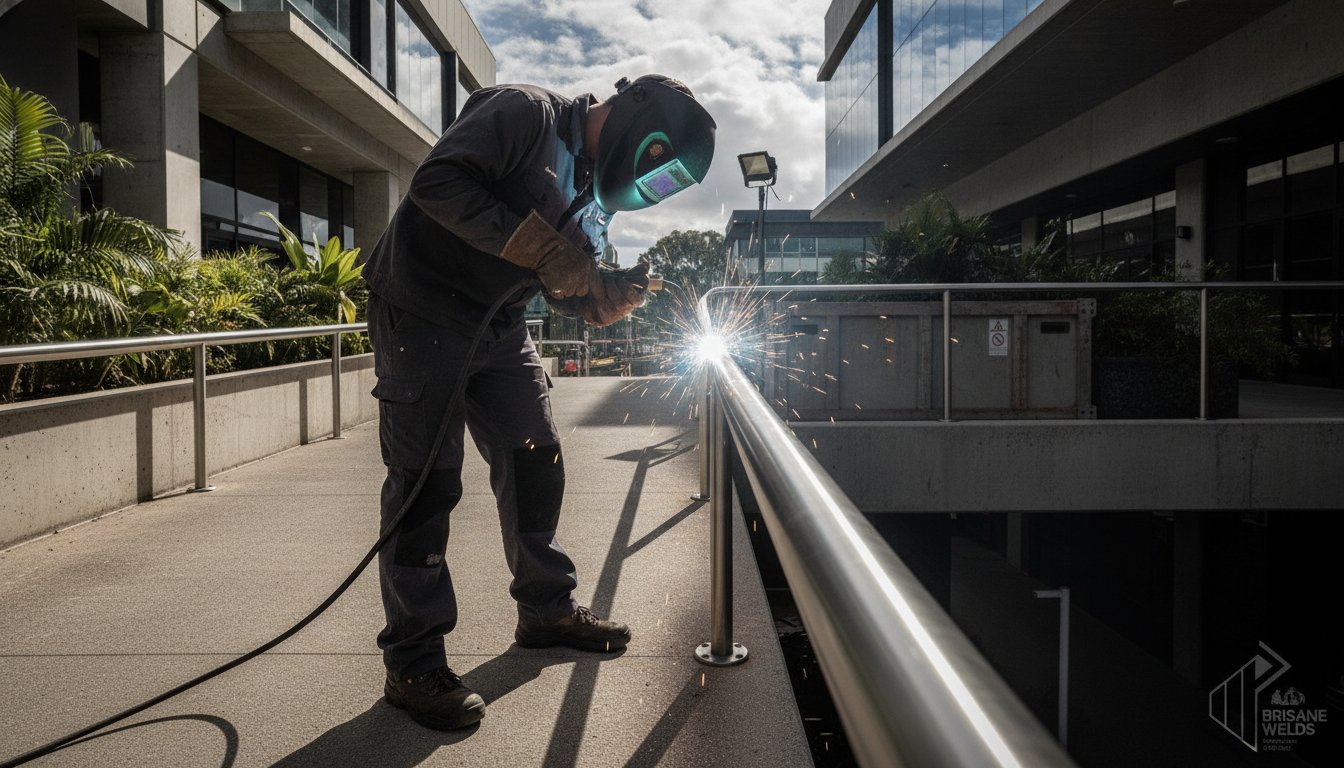
A handrail that looks perfect on day one can quickly become a rusted liability if it’s not built specifically for the Queensland coast. We know it’s frustrating to balance aesthetic appeal with the strict technical requirements of the National Construction Code, especially when you’re caught between conflicting advice on AS 1428.1 and AS 1657. You need a safety solution that stays compliant and looks professional for decades, which is why specifying 316 grade stainless steel handrails Brisbane businesses can rely on is the only way to ensure long-term durability against tea staining and humidity.
This 2026 guide explains how to specify, install, and maintain high-quality stainless steel that survives our harsh local climate. We’ll break down the latest compliance standards and show you how mobile fabrication ensures a precision fit without disrupting your daily operations. Whether you’re upgrading an industrial walkway or a public ramp, you’ll learn how to secure a “set and forget” result that protects your visitors and enhances your property value.
Key Takeaways
- Understand the technical specifications that distinguish high-strength commercial handrails from standard residential balustrades in high-traffic environments.
- Discover why 316 grade stainless steel handrails Brisbane installations require molybdenum to provide superior protection against coastal salt air and the common issue of tea staining.
- Learn how to navigate the critical differences between AS 1428.1 (DDA compliance) and AS 1657 (industrial safety) to ensure your property remains fully legal and safe.
- Explore the benefits of on-site fabrication and mobile welding in achieving a precision fit for complex layouts without causing operational downtime.
- Master the essential maintenance techniques required to preserve the professional finish of your stainless steel and distinguish between surface marks and structural corrosion.
What Defines a Commercial Grade Stainless Steel Handrail?
Commercial grade handrails aren’t just about appearance; they’re critical safety infrastructure designed to withstand high-traffic industrial loads and constant public use. For Brisbane property managers and business owners, these systems serve as a primary tool for risk mitigation. A failure in a high-traffic area doesn’t just represent a maintenance cost; it creates a significant liability. This is why stainless steel has become the standard for South East Queensland. It offers a unique combination of structural integrity, hygiene, and resistance to our subtropical environment that other materials simply cannot match.
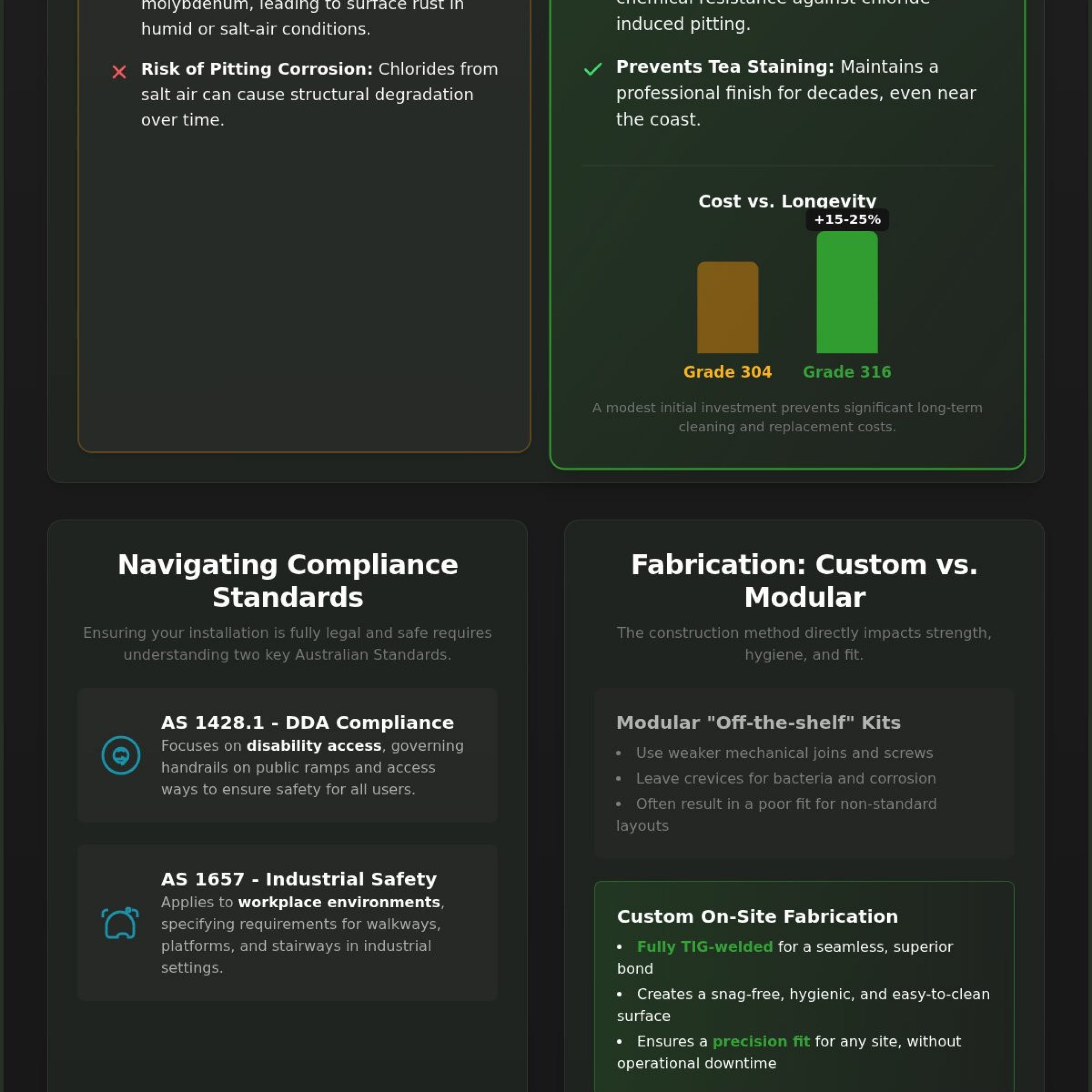
When selecting materials, understanding the technical difference between 304 vs. 316 Grade Stainless Steel is essential. While 304 grade is suitable for indoor, low-moisture environments, 316 grade stainless steel handrails Brisbane wide are the industry standard for any external or high-exposure application. The addition of molybdenum in 316 grade provides the necessary chemical resistance to prevent the pitting and structural degradation often seen in Brisbane’s coastal corridors. Choosing the correct grade from the outset is the difference between a system that lasts thirty years and one that shows signs of failure within three.
The Anatomy of a Commercial Railing System
A robust commercial system consists of three core elements: structural posts, the handrail itself, and heavy-duty fixings that anchor the system to the substrate. To ensure a snag-free finish that won’t catch on clothing or skin, we prioritise fully TIG-welded joints. Unlike mechanical joins, TIG welding creates a seamless bond that eliminates crevices where bacteria or corrosion can take hold. For optimal graspability and safety, commercial handrails typically maintain a diameter between 32mm and 50mm, providing a secure grip for users of all abilities. These specifications ensure the rail can withstand the 2026 requirements for concentrated loads in busy commercial hubs.
Custom Fabrication vs. Modular Kits
Many businesses are tempted by modular “off-the-shelf” kits because they seem convenient. However, these systems often fail in complex industrial environments where floor levels are uneven or layouts are non-standard. Opting for custom stainless steel fabrication Brisbane allows for a bespoke site fit that accounts for every architectural nuance. Custom work ensures that industrial-strength durability doesn’t come at the expense of the building’s design. By tailoring the fabrication to the specific site, you get a result that is both aesthetically integrated and structurally superior to any pre-fabricated alternative. Investing in 316 grade stainless steel handrails Brisbane businesses can trust ensures your facility meets the highest safety standards while resisting the local elements.
304 Vs. 316 Grade Stainless Steel: The Brisbane Choice
In Brisbane, the distinction between stainless steel grades is the difference between a lasting asset and a constant maintenance headache. While they look identical to the untrained eye, their chemical makeup dictates how they react to our local environment. The primary differentiator is the addition of molybdenum in 316 grade stainless steel. This element provides superior resistance to chloride-induced pitting, which is a major concern for any property within reach of the Moreton Bay breeze or the Brisbane River.
Brisbane’s high humidity and salt-laden air frequently cause a phenomenon known as “tea staining.” This is a cosmetic surface rust that appears as brown discolouration on the metal. It doesn’t usually indicate structural failure immediately, but it looks unprofessional and can lead to deeper corrosion if ignored. While 304 grade is a versatile material, it lacks the chemical resilience to stop tea staining in South East Queensland’s outdoor conditions. Investing in 316 grade stainless steel handrails Brisbane wide is a strategic choice. Although it carries a price premium of approximately 15 to 25 percent over 304 grade, the long-term return on investment is clear through significantly lower cleaning costs and a longer lifecycle.
Selection also involves choosing the right finish. A satin or brushed finish is popular for its modern, matte look and ability to hide fingerprints. However, in high-salt areas, a mirror-polished finish is often superior. The smoother surface makes it harder for salt and contaminants to cling to the metal, further reducing the risk of corrosion. Choosing 316 grade stainless steel handrails Brisbane ensures your infrastructure survives these local elements with ease.
Grade 304: Best for Controlled Environments
Grade 304 is best reserved for indoor lobbies, climate-controlled offices, or dry storage facilities. In these stable environments, it remains pristine with minimal effort. We don’t recommend it for any external application in Brisbane. Even a few kilometres from the coast, the combination of our summer heat and moisture can trigger surface oxidation on 304 grade within months of installation. It requires frequent, specialist cleaning to prevent permanent staining.
Grade 316: The Gold Standard for SEQ
For any project in the Gold Coast, Ipswich, or the Brisbane CBD riverfront, 316 grade is the only reliable option. It is specifically engineered to resist the stress corrosion and pitting common in industrial plants and marine environments. We specify this grade for all stainless steel handrails Brisbane projects to ensure they meet the highest standards of longevity. If you’re unsure which grade suits your specific site, consulting with a local fabrication expert can save you from costly remedial work down the track.
Navigating Compliance: AS 1428.1 and AS 1657 Standards
Compliance with Australian Standards is the backbone of any commercial installation. In Brisbane, failing to meet these regulations doesn’t just invite a building inspection failure; it exposes property owners to severe legal and insurance risks. If a slip or fall occurs on a non-compliant staircase, the liability can be catastrophic. Professional fabricators ensure every rail sits between 865mm and 1,000mm above the stair nosing, maintaining a minimum 50mm clearance from walls to allow for a proper grip. These measurements are precise, and even a few millimetres of deviation can result in a non-compliance notice.
Choosing 316 grade stainless steel handrails Brisbane services is often the first step in a compliant project. This material ensures that the safety features remain structurally sound and graspable even after years of exposure to the elements. By working with an expert who understands the National Construction Code, you ensure that terminations are turned back to the wall or floor, preventing the “spear” effect that causes injuries during a fall. We focus on these details because they turn a simple metal bar into a certified safety system.
DDA Compliance for Public Access
AS 1428.1:2021 is the standard for public access and mobility. It requires handrails to be continuous and have specific extensions at the top and bottom of ramps or stairs. These extensions typically reach 300mm past the last step to provide support before a person changes elevation. The design must be “no-snag,” meaning there are no sharp edges or gaps that could catch a sleeve or a handbag. For vision-impaired users, we also consider colour contrast and the installation of tactile ground surface indicators to signal changes in direction or grade.
Industrial Safety and AS 1657
AS 1657:2018 applies to industrial sites like mezzanine floors, plant rooms, and catwalks. These environments require high-strength safety protection systems that can withstand significant industrial loads. Integrating these needs with safety handrail fabrication Brisbane protocols ensures that every platform and ladder meets the strict load-bearing standards required for workplace safety. Using 316 grade stainless steel handrails Brisbane in these settings provides the necessary durability for chemical-heavy or high-humidity manufacturing plants where standard steel would quickly fail.
The Advantage of On-Site Fabrication and Mobile Welding
Architectural drawings are a necessary starting point, but they rarely reflect the true conditions of a live commercial site. Floor levels can shift, walls aren’t always perfectly square, and existing pipework can create obstacles that weren’t on the original plans. This is why “measure twice, cut once” isn’t always enough for complex renovations. On-site fabrication allows us to solve these architectural discrepancies in real-time, ensuring a perfect fit that modular kits simply cannot achieve.
Structural integrity is the primary benefit of this approach. While modular systems rely on bolted joints, on-site TIG welding creates a unified, permanent bond. Bolted connections can rattle or loosen over time, especially in high-traffic environments or industrial zones with heavy machinery. By welding 316 grade stainless steel handrails Brisbane wide, we eliminate these mechanical weak points. This seamless finish also removes small crevices where salt and moisture could otherwise trigger corrosion, a vital consideration for our local climate.
Minimising Operational Downtime
Maintaining business continuity is a priority for any facility manager. Our mobile workshop Brisbane service is designed to work around your schedule, whether that means operating during plant shutdowns or outside standard business hours. We follow rigorous safety protocols for performing hot work in active environments, using specialised screens and fire-watch procedures to keep your site safe. This flexibility ensures your safety upgrades happen without stalling your daily operations.
On-Site Repairs and Safety Upgrades
Not every safety issue requires a full system replacement. Often, existing infrastructure can be brought up to 2026 Australian Standards with targeted modifications. Our mobile welding Brisbane service provides urgent safety fixes, such as repairing damaged sections or adding compliant extensions to existing 316 grade stainless steel handrails Brisbane. This is a cost-effective way to manage your assets while ensuring total compliance. If your facility requires a precision fit or an urgent safety upgrade, book an on-site consultation with our fabrication experts.
Long-Term Maintenance: Preserving Your Stainless Steel
The idea that stainless steel is entirely “maintenance-free” is a common industry myth that leads to premature asset degradation. While 316 grade stainless steel handrails Brisbane wide provide the best resistance to the elements, they still require periodic care to maintain their protective oxide layer. Environmental contaminants, such as salt spray and industrial pollutants, accumulate on the surface and trigger chemical reactions. If these aren’t removed, even the highest quality metal will eventually succumb to surface discolouration and lose its professional lustre.
Property managers must be able to distinguish between tea staining and structural corrosion. Tea staining appears as a light brown discolouration. It is purely cosmetic and occurs when contaminants sit on the surface of the metal. Structural corrosion, or pitting, involves deep cavities that compromise the metal’s integrity. Identifying these issues early prevents small cosmetic problems from becoming expensive safety hazards. When surface marks become difficult to remove with standard cleaning, it’s time to engage professional stainless steel maintenance services to restore the finish and protect the substrate.
Cleaning Protocols for Brisbane and Gold Coast
Your cleaning schedule should be dictated by your proximity to the coast. Facilities within five kilometres of the ocean or the Brisbane River generally require monthly cleaning, while inland industrial sites may only need quarterly attention. To remove salt build-up and atmospheric pollutants, use warm water with a mild detergent and a soft cloth. Never use bleach or chloride-based cleaners, as these chemicals actively destroy the chromium oxide layer that prevents rust. Avoid steel wool or abrasive pads; these leave behind carbon steel particles that will rust and contaminate your 316 grade stainless steel handrails Brisbane.
Annual Safety Audits and Certification
Visual cleanliness is only part of the equation. An annual safety audit is essential to check for loose fixings, structural fatigue, or weld degradation that might not be visible to the untrained eye. We ensure your handrails still meet the current load-bearing requirements for industrial sites, which is vital for maintaining compliance with 2026 standards. Donewright supports local facility managers by providing thorough inspections and on-site repairs, ensuring your safety infrastructure remains a reliable, long-term asset. This proactive management approach extends the life of your rails and protects you from the liability of a failed safety system.
Securing Your Facility with Precision Safety Systems
Choosing the right handrail system is a long-term investment in both property value and public safety. We’ve explored why 316 grade stainless steel handrails Brisbane businesses install are the only reliable defence against tea staining and our humid South East Queensland climate. Beyond material choice, ensuring your infrastructure meets AS 1428.1 and AS 1657 standards is essential for legal compliance and risk mitigation. It’s a complex area, but working with a specialist ensures your site remains safe and professional for decades.
Our team acts as your authoritative expert in AS 1428.1 and AS 1657 compliance, providing custom fabrication that fits your specific site layout. With our mobile workshop, we deliver on-site mobile welding and custom fabrication across Brisbane, Logan, Ipswich, and the Gold Coast. This approach minimises operational downtime while guaranteeing a durable safety solution. Get a Professional Quote from Donewright Stainless to start your project. We’re ready to provide the reliable results your facility requires.
Frequently Asked Questions
What is the main difference between AS 1428.1 and AS 1657 for handrails?
AS 1428.1:2021 focuses on public access and mobility, ensuring facilities are accessible for people with disabilities through specific extensions and grip diameters. Conversely, AS 1657:2018 applies to industrial environments such as mezzanine floors and plant rooms. While both prioritise safety, the industrial standard focuses on load-bearing capacity for workers, whereas the DDA standard emphasises continuous support and accessibility in public spaces.
Why is my “stainless” steel handrail showing brown spots (tea staining)?
These brown spots, known as tea staining, occur when salt or industrial contaminants accumulate on the metal surface and trigger oxidation. This is common in Brisbane due to high humidity and coastal air. While it is often cosmetic, it indicates that the protective chromium oxide layer is under stress. Regular cleaning and specifying 316 grade stainless steel handrails Brisbane wide are the most effective ways to prevent this discolouration from appearing.
Is 316 grade stainless steel really necessary for inland areas like Ipswich or Logan?
Yes, 316 grade is still highly recommended for inland areas like Ipswich and Logan. Although these regions are further from the coast, Brisbane’s high humidity and the presence of industrial atmospheric pollutants can still cause 304 grade steel to tea stain. Investing in 316 grade provides a much higher level of corrosion resistance, ensuring the handrails maintain their structural integrity and professional appearance without the need for constant, aggressive cleaning.
Can you perform on-site welding without disrupting our daily operations?
We utilise fully equipped mobile workshops to perform on-site fabrication with minimal impact on your daily operations. By scheduling work during plant shutdowns or outside peak business hours, we ensure your facility remains functional. Our team follows strict hot-work safety protocols, including the use of protective screens and fire-watch procedures, to manage the welding process safely in active commercial or industrial environments.
What are the current height requirements for commercial handrails in 2026?
Under the current 2026 National Construction Code requirements, handrails on stair flights, landings, and ramps must be positioned between 865mm and 1,000mm above the floor surface or stair nosing. This height ensures the rail is reachable and provides adequate support for all users. Maintaining these precise measurements is a critical part of achieving certification and ensuring your property meets the necessary safety and insurance standards.
How much does custom commercial handrail installation cost in Brisbane?
The total investment for a custom installation depends on several variables, including the complexity of the site layout, the required material grade, and the total linear metres required. While 316 grade stainless steel carries a higher initial cost than 304 grade, it significantly reduces long-term maintenance expenses. We provide detailed, site-specific quotes that account for these factors to ensure you receive a durable, compliant safety solution tailored to your facility.
Do you provide sanitary-grade handrails for food processing facilities?
Stainless steel is the premier choice for food processing facilities due to its non-porous surface and superior hygiene properties. We provide custom fabrication for these environments, focusing on fully TIG-welded joints that eliminate crevices where bacteria could otherwise thrive. Our 316 grade stainless steel handrails Brisbane installations are designed to withstand the harsh chemical cleaning agents typically used in sanitary-grade environments without corroding or degrading.
How long does a typical on-site handrail installation take?
Installation timeframes vary based on the scale of the project and the complexity of the architectural layout. A standard commercial staircase might be completed in a single day, whereas a large-scale industrial mezzanine could take several days of on-site work. Because we use mobile workshops to fabricate and weld in real-time, we eliminate the delays associated with off-site adjustments, allowing for a much faster and more precise handover than modular systems.