
Commercial Kitchen Bench Tops Stainless: The Ultimate Selection & Compliance Checklist
Commercial Kitchen Bench Tops Stainless: The Ultimate Selection & Compliance Checklist
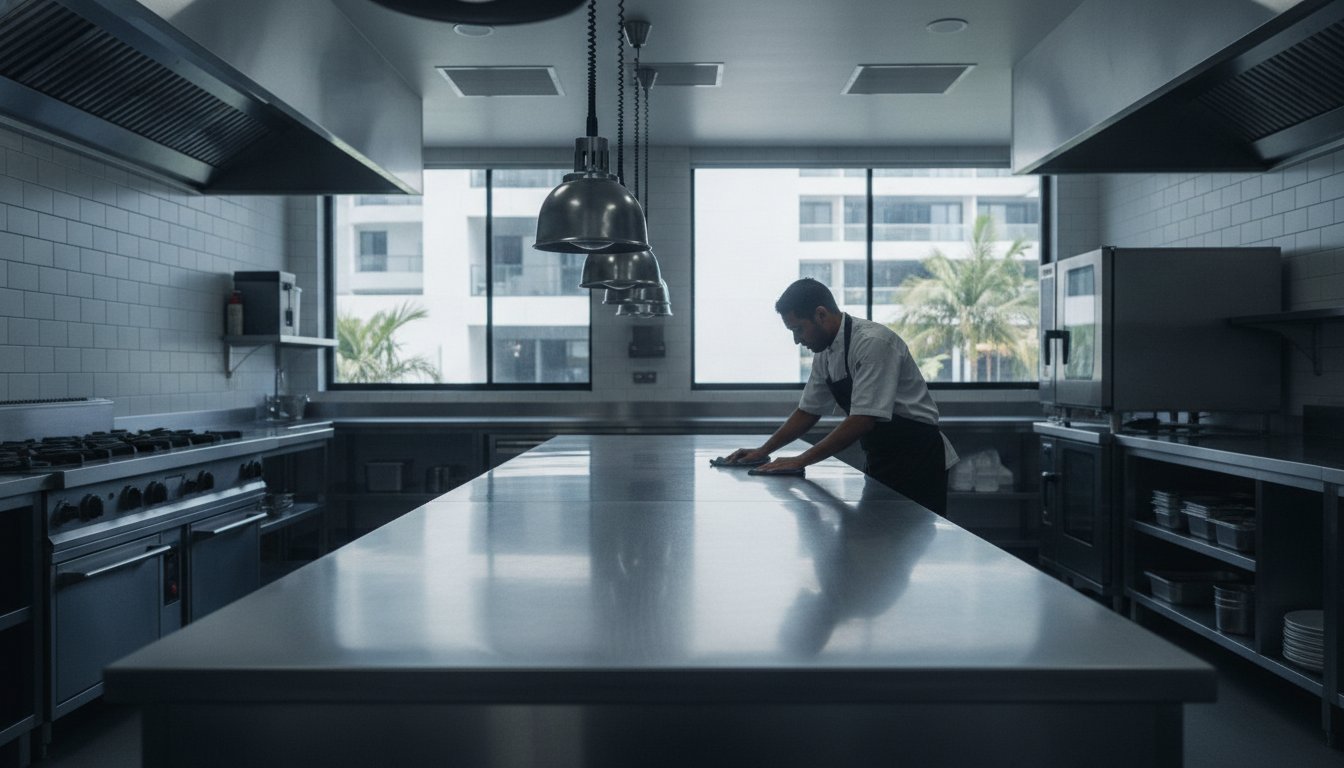
A commercial kitchen bench is not just a piece of furniture; it is a precision-engineered sanitary system that serves as the backbone of your entire operation. When you are facing a surprise health audit, the difference between a seamless pass and a costly rectification often comes down to the quality and specification of your commercial kitchen bench tops stainless. We understand the stress of managing surfaces that sag under industrial weight or standard units that simply won’t fit into a unique Australian kitchen footprint.
You know that a kitchen is only as efficient as its hardest-working surface, and there is nothing more disruptive than discovering rust or porous seams that harbour bacteria. This guide will help you master the technical requirements and design choices needed to ensure your setup is compliant, durable, and built for a twenty-year lifespan. We will examine the mandatory Australian Standard AS 4386 requirements, the critical differences between 304 and 316 grade steel, and how to choose between off-the-shelf components and bespoke solutions that integrate perfectly with your existing appliances and pipework.
Key Takeaways
- Understand the critical role of AS 4674 in ensuring your kitchen surfaces remain non-porous, smooth, and fully compliant with Australian food safety standards.
- Learn why Grade 304 is the industry standard for most kitchens, while Grade 316 provides the necessary corrosion resistance for coastal or high-chlorine environments.
- Compare the structural integrity of fully welded commercial kitchen bench tops stainless against flat-pack units to avoid the gaps and “dead space” that attract pests and bacteria.
- Master the logistics of professional site measurement and discover how on-site mobile welding ensures a seamless fit in even the most awkward kitchen footprints.
- Establish daily cleaning protocols that protect the passive layer of your steel, ensuring your surfaces remain durable and hygienic for decades.
Essential Standards for Commercial Kitchen Bench Tops in Australia
Compliance is the non-negotiable foundation of any professional food service operation. In Australia, AS 4674 provides the definitive framework for the design, construction, and fit-out of food premises. This standard exists to ensure that every surface, particularly where food is prepared, is easy to clean and incapable of harbouring bacteria. While residential kitchens might prioritise aesthetics, the commercial sector demands surfaces that are non-porous, smooth, and entirely impervious to liquids. This is why timber, which absorbs moisture and food juices, or low-grade plastics that scratch and melt, are flatly rejected by health authorities during fit-outs. When you invest in commercial kitchen bench tops stainless, you’re choosing a material that meets these rigorous legislative requirements by default.
One of the most critical elements of a compliant bench is the implementation of “coving” and sealed joins. Coving refers to the curved transition between the horizontal bench surface and the vertical splashback. This eliminates the sharp 90-degree internal corners where grease and food particles inevitably collect. Without these radius edges, sanitisation becomes nearly impossible, leading to a build-up of organic matter that will catch the eye of any experienced auditor. Every join must be a seamless, liquid-tight seal to prevent moisture from seeping into the substrate or the cabinetry below, which would otherwise lead to mould and structural decay.
Understanding AS 4674 Compliance for Benches
Under AS 4674, the expectation for cleanliness is absolute. Health inspectors across Brisbane and the Gold Coast look specifically for “cleanability” during their rounds. It’s a simple metric: can the surface be wiped clean of all contaminants in a single pass? This is why joins must be flush and fully welded rather than bolted. Bolted flat-pack units often create tiny crevices and exposed threads that are impossible to sanitise properly. Custom-fabricated benches ensure that every intersection is a smooth, continuous surface. This level of precision doesn’t just pass inspections; it protects your reputation by ensuring your prep areas remain truly hygienic under the pressure of a busy service.
The Role of Food-Grade Certification
True food-grade stainless steel is defined by its chemical stability and its refusal to leach metallic elements into ingredients. You can explore a detailed breakdown of stainless steel properties and grades to see why specific alloys are mandatory for industrial food contact. In a commercial setting, food-grade isn’t a vague claim; it refers to specific material certifications like 304 or 316 grade. Industrial plant audits frequently require documentation of material origin to prove the steel meets Australian standards. Don’t be fooled by domestic “lookalike” stainless. True commercial kitchen bench tops stainless use a heavier gauge, typically 1.2mm to 1.5mm, providing the structural integrity needed to support heavy industrial mixers and ovens without sagging or bowing over decades of use.
Choosing the Right Grade: 304 vs 316 Stainless Steel
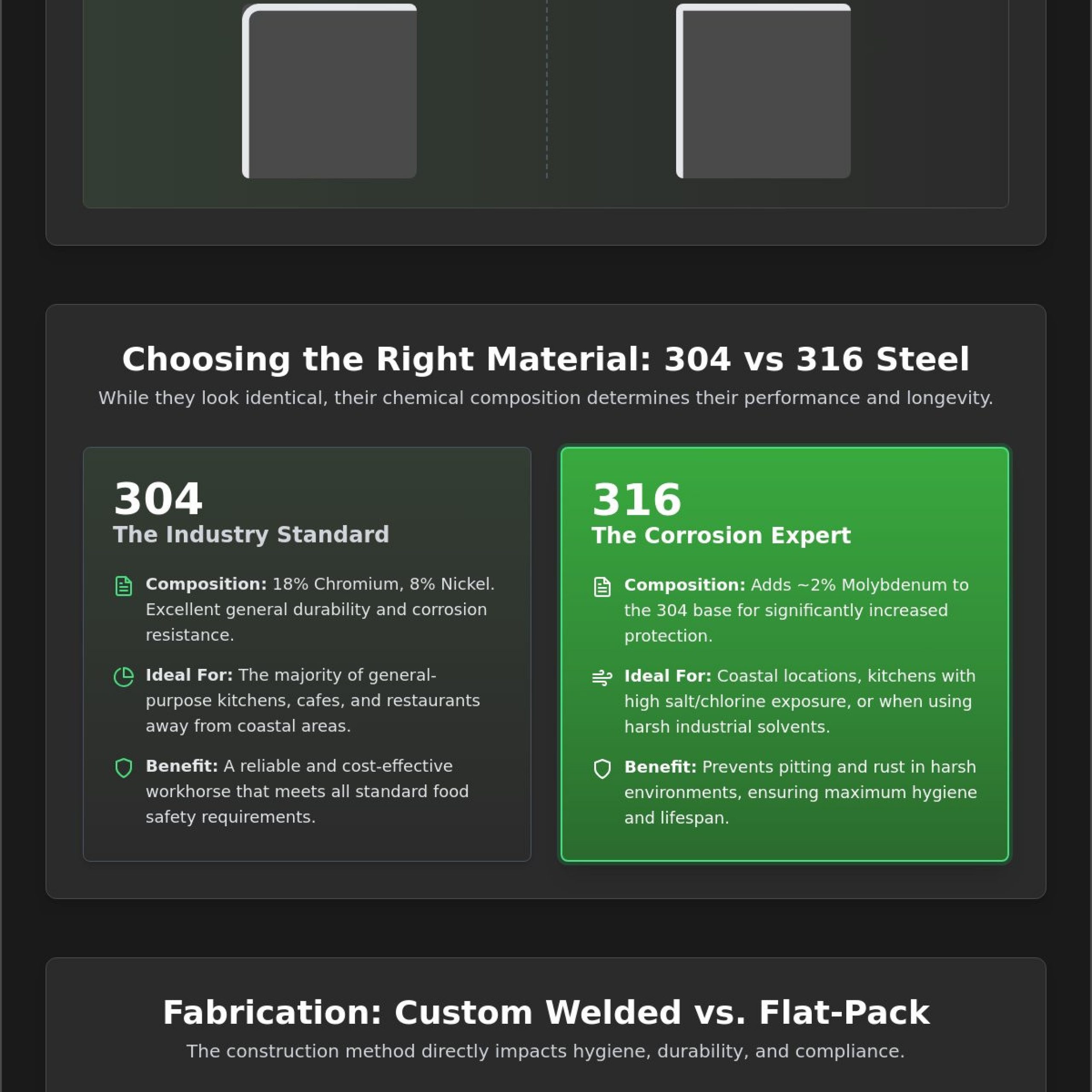
Selecting the correct alloy for your fit-out is as vital as the kitchen layout itself. While different grades of steel may look identical to the untrained eye, their chemical makeup dictates how they perform under the daily rigours of a professional environment. Most commercial kitchen bench tops stainless are fabricated from either Grade 304 or Grade 316. Adhering to Australian food safety standards requires using materials that won’t corrode or contaminate food, making this choice a matter of long-term compliance rather than just aesthetics.
The primary difference lies in the elemental composition. Grade 304 typically contains 18% chromium and 8% nickel. Grade 316 takes this baseline and adds approximately 2% molybdenum. This specific addition significantly increases the metal’s resistance to chlorides, salts, and industrial solvents. Without this extra protection, surfaces in certain environments can develop pitting, which are tiny holes that compromise the non-porous nature of the bench and create a sanctuary for bacteria.
Grade 304: The Industry Standard
For the majority of restaurants, cafes, and hospitality venues, Grade 304 is the reliable workhorse. It offers an excellent balance of durability and cost-effectiveness. This grade easily handles common kitchen acids, such as citric acid from lemons or acetic acid from vinegar, without flinching. It’s the standard choice for commercial kitchen bench tops stainless in inland locations where humidity is controlled and salt exposure is non-existent. When properly maintained, a 304 bench will remain hygienic and structurally sound for decades.
Grade 316: Marine and High-Corrosion Solutions
There are specific scenarios where 316 is mandatory. Seafood processing facilities, beachfront venues on the Gold Coast, or kitchens using heavy-duty caustic cleaning agents require the superior protection of molybdenum. In coastal Queensland, we frequently encounter “tea staining,” a brown, superficial discolouration that mimics rust. While it doesn’t always affect the structural integrity immediately, it is an eyesore that can lead to failed health audits. Using 316 grade significantly reduces this risk in high-salinity areas. This grade is also the preferred choice for industrial pipework where chemical resistance is paramount.
If you’re designing a new space and need guidance on material selection to suit your specific location, we specialise in custom stainless benches that are built to withstand the harshest Queensland conditions.
Custom Fabrication vs Off-the-Shelf: A Decision Checklist
Choosing between a ready-made unit and a bespoke build is often a choice between short-term savings and long-term operational peace of mind. While the lower entry price of a flat-pack unit is tempting for a new start-up, high-volume commercial environments place extreme stress on equipment that light-duty models aren’t designed to handle. When you specify commercial kitchen bench tops stainless for a professional fit-out, the construction method is just as important as the material grade itself.
Fully welded custom benches offer a level of structural integrity that bolted alternatives simply cannot match. In a busy kitchen, benches are subjected to constant vibration from mixers, the heavy impact of chopping, and the weight of industrial-scale stockpots. Over time, the bolts in flat-pack units can loosen, leading to a “rattle” that eventually compromises the stability of the entire surface. Bespoke fabrication eliminates these mechanical failure points, providing a rigid, silent, and permanent solution that can comfortably last two decades or more.
The Custom Fabrication Advantage
The primary benefit of custom stainless benches is their ability to adapt to the unique “quirks” of your site. Most commercial buildings, particularly older structures in Brisbane or the Gold Coast, don’t have perfectly square walls or floors. Custom fabrication allows for the integration of benches around structural pillars or existing pipework, ensuring every square centimetre of floor space is utilised. We can also specify heavier gauge steel, such as 1.6mm or 2.0mm, for heavy-duty industrial zones where standard 1.2mm steel might dent. This bespoke approach allows for the seamless integration of sinks, ice wells, and scrap holes directly into the surface, removing the need for silicone-heavy joins that eventually degrade.
When Off-the-Shelf Might Fail You
Economy ranges often suffer from weight capacity limitations that can lead to sagging under heavy appliances. Beyond structural concerns, the “dead space” issue is a significant hygiene risk. Standard-sized benches rarely fit a kitchen footprint perfectly, leaving small gaps between the bench and the wall or between adjacent pieces of equipment. These 5mm to 10mm gaps become inaccessible traps for food waste and grease, creating a breeding ground for pests. Furthermore, bolted joints are susceptible to “crevice corrosion,” where moisture trapped between two overlapping metal plates begins to eat away at the steel from the inside out. In contrast, commercial kitchen bench tops stainless that are custom-fitted to the wall and fully welded create a continuous, sanitary barrier that passes every health audit with ease.
Ergonomics also play a vital role in chef retention and safety. While standard benches sit at a fixed height, custom fabrication allows you to adjust bench levels and depths to suit specific tasks, such as lower benches for heavy lifting or deeper surfaces for complex plating-up stations.
Site Preparation and On-Site Fabrication Logistics
The transition from a design on paper to a physical installation requires meticulous planning and a deep understanding of the site’s unique constraints. Precise measurement is the only way to ensure that commercial kitchen bench tops stainless integrate perfectly with existing structural elements. In the hospitality and food processing sectors, even a five-millimetre discrepancy can lead to gaps that compromise hygiene or interfere with the installation of industrial pipework. We treat site preparation as an engineering challenge rather than a simple delivery task.
Success in a kitchen refit relies on the ability to adapt to the reality of the building. While off-the-shelf suppliers assume your walls are plumb and your floors are level, seasoned professionals know this is rarely the case. Proper site preparation involves more than just clearing space; it requires a logical progression from surveying the footprint to coordinating with other essential trades to ensure a seamless handover.
Mobile Workshop and On-Site Engineering
Old Brisbane buildings and established Gold Coast venues rarely feature perfectly square corners or level floors. This is where standard delivery services often fail. Our mobile welding Brisbane services bridge the gap between the workshop and the kitchen. By bringing engineering capabilities directly to your site, we can perform “last-mile” modifications that ensure a seamless fit against uneven masonry or around awkward plumbing stacks. This capability is also vital for modifying existing benches to accommodate new appliances, allowing you to upgrade your workflow without the cost of a full replacement. For large-scale plants, on-site welding is the only way to maintain the continuous, sanitary joins required by modern food safety standards.
Preparing Your Facility for Installation
A successful installation depends on the readiness of the surrounding environment. Before the benches arrive, it’s essential to verify the integrity of walls, especially if you have specified heavy wall-mounted units that must support significant industrial weight. Checking floor levels early allows for the adjustment of bench feet or the fabrication of custom plinths to maintain a perfectly level work surface. Access is another critical factor. Because fully welded units offer superior hygiene, they are often bulky. We coordinate with you to ensure clear paths through doorways and corridors, minimising the risk of damage to the new steel or your facility. Coordinating with plumbers and electricians is the final piece of the puzzle. By aligning our installation schedule with other trades, we ensure that sinks are connected and power points are accessible immediately upon handover, significantly reducing operational downtime during your refit.
If you are planning an upgrade and need an expert team to handle the complexities of a tricky installation, we invite you to discuss your project requirements with our mobile workshop services team today.
Maintaining Compliance and Longevity in Busy Kitchens
The long-term value of your investment depends entirely on what happens after the initial installation. While the structural integrity of commercial kitchen bench tops stainless is designed for decades of service, the surface’s hygienic properties require consistent, informed care. We often see high-quality fit-outs compromised by well-intentioned cleaning crews using the wrong tools. Maintaining a compliant kitchen means moving beyond “warm soapy water” and understanding the specific requirements of industrial-grade metal.
Identifying early signs of stress is vital for avoiding health code violations. Fine scratches might seem like a cosmetic issue, but in a high-pressure environment, they become micro-sanctuaries for bacteria. Similarly, any sign of superficial rust or “tea staining” indicates that the metal’s protective qualities are under attack. Regular inspections of the bench’s underside and support frames are equally important, as grease can migrate into hidden areas, creating fire hazards and attracting pests. Professional maintenance ensures that your surfaces remain as impervious as the day they were installed.
The Science of Stainless Steel Care
Stainless steel’s resistance to corrosion comes from a microscopic “passive layer” of chromium oxide that forms on the surface. This layer is self-healing, provided it has access to oxygen. However, common kitchen chemicals like bleach or cleaners containing chlorides can strip this layer away, leading to “halide attack” and permanent pitting. For commercial kitchen bench tops stainless, we always recommend PH-neutral cleaners. When dealing with stubborn carbon build-up or baked-on grease, avoid steel wool at all costs. Steel wool leaves behind tiny carbon steel particles that will rust, creating a bridge for corrosion to enter your bench. Instead, use nylon pads or specialised stainless steel scrapers that won’t compromise the metal’s integrity.
Professional Maintenance and Refurbishment
There comes a point where daily cleaning isn’t enough to rectify years of heavy use. In these instances, professional re-polishing can restore the passive layer and remove deep scratches that harbour contaminants. We also provide expert weld repairs for stainless steel work benches commercial operators rely on, ensuring that joints remain liquid-tight and structurally sound. Upgrading your workflow doesn’t always require a full kitchen replacement. Integrating new food grade stainless steel trolleys or modifying existing benches to suit new appliances can significantly improve efficiency. Regular professional audits of your fixings and frames will prevent small issues from becoming major operational failures, keeping your kitchen compliant and your team safe.
Securing the Future of Your Kitchen Fit-Out
Designing a workspace that stands the test of time requires more than just picking a layout. It demands a technical understanding of material grades and a commitment to Australian standards like AS 4674. Whether you’re selecting 316 grade for a beachfront Gold Coast venue or 304 for a Brisbane cafe, the performance of your commercial kitchen bench tops stainless is the deciding factor in your facility’s hygiene and longevity.
Custom fabrication isn’t just about fit; it’s about eliminating the “dead spaces” and structural weaknesses that lead to audit failures. As a family-owned and operated business led by industry veteran Ian “Wrighty” Wright, we pride ourselves on providing meticulous craftsmanship that meets the strictest industrial sanitary standards. From our expert mobile welding services across Brisbane, the Gold Coast, and Ipswich to our bespoke workshop builds, we ensure your fit-out is as reliable as it is compliant.
While our team specialises in high-grade metalwork, for those seeking a partner for full-scale room transformations, you can discover WDC Services to see how they handle comprehensive kitchen and laundry renovations.
For those interested in smaller-scale bespoke additions or creative gifts, you can discover 2d6 Designs for unique 3D-printed home improvement solutions.
Ready to upgrade your prep area with a surface that lasts? Get a Custom Quote for Your Commercial Kitchen Fit-out today. Let’s build a workspace that supports your team and passes every inspection with ease.
Frequently Asked Questions
What is the best thickness for a commercial kitchen bench top?
The industry standard for professional environments is a thickness of 1.2mm to 1.5mm. While domestic models often use thinner 0.9mm steel, these are prone to denting and vibration under heavy use. A 1.2mm gauge provides the necessary structural rigidity for commercial kitchen bench tops stainless while remaining cost-effective. For extreme industrial applications or heavy-duty prep areas, we may recommend 2.0mm steel to ensure the surface doesn’t bow under weight.
Do commercial kitchen benches need to be bolted to the floor?
Most standard benches don’t require floor bolting and instead use adjustable bullet feet to achieve a level work surface. However, fixing to the floor or wall is necessary for narrow, top-heavy units or benches supporting high-vibration machinery. Securing the unit prevents shifting during busy service and ensures that the sanitary seals between the bench and the wall remain intact, which is a key requirement for long-term health compliance.
Can I use Grade 304 stainless steel for a seafood processing bench?
Grade 316 is the mandatory choice for seafood processing due to the high salt content involved in these environments. While 304 grade is excellent for standard kitchens, it lacks the molybdenum found in 316, which provides critical resistance to chloride-induced pitting. Using 304 for seafood or high-salinity tasks will lead to rapid corrosion and tea staining, eventually compromising the non-porous surface required by Australian food safety standards.
How do I remove heavy tea staining from my stainless steel benches?
Heavy tea staining should be treated with a specialised non-abrasive stainless steel restorer or a mild phosphoric acid-based cleaner. It is vital to avoid steel wool or any carbon steel brushes, as these leave behind particles that cause further rust. Once the staining is lifted, the surface must be thoroughly rinsed with fresh water and dried completely. This process allows the protective chromium oxide layer to reform and prevents the oxidation from returning.
Is it cheaper to repair a damaged stainless bench or replace it?
Repairing a high-quality custom bench is typically more cost-effective than a total replacement. Our mobile welding services can often fix cracked welds or deep gouges that would otherwise fail a health inspection. However, if the damaged unit is a light-duty flat-pack bench with structural sagging, the cost of repair might exceed its value. We assess the gauge and construction of your commercial kitchen bench tops stainless to provide the most practical advice.
What are the specific coving requirements for commercial kitchen benches in Brisbane?
Under AS 4674, any join between a horizontal bench surface and a vertical splashback must be coved with a minimum radius of 5mm. This requirement ensures that the intersection is smooth and easy to wipe clean. Brisbane health auditors look specifically for these curved transitions because they prevent the accumulation of grease and food waste in sharp internal corners. Fully welded coving is the gold standard for maintaining a truly sanitary prep area.
Can Donewright Stainless modify my existing benches on-site?
Yes, we specialise in on-site modifications through our mobile workshop services. We can cut, weld, and re-polish your existing benches to accommodate new appliances like fryers or combi ovens without removing the equipment from your kitchen. This capability allows you to update your workflow or repair damaged sections with minimal disruption to your daily service. It’s a practical solution for extending the life of your current stainless steel assets.
How long does a custom stainless steel bench fabrication typically take?
Custom fabrication generally takes between two to four weeks from the point of final site measurement and approval. This timeframe ensures that every weld is precise and the final polish meets industrial sanitary standards. While off-the-shelf units are available faster, they don’t offer the seamless fit or heavy-duty gauge of a bespoke build. We coordinate our fabrication schedule with your fit-out timeline to ensure a smooth installation and handover process.