
Stainless Steel Work Benches: Commercial Design & Custom Fabrication Guide
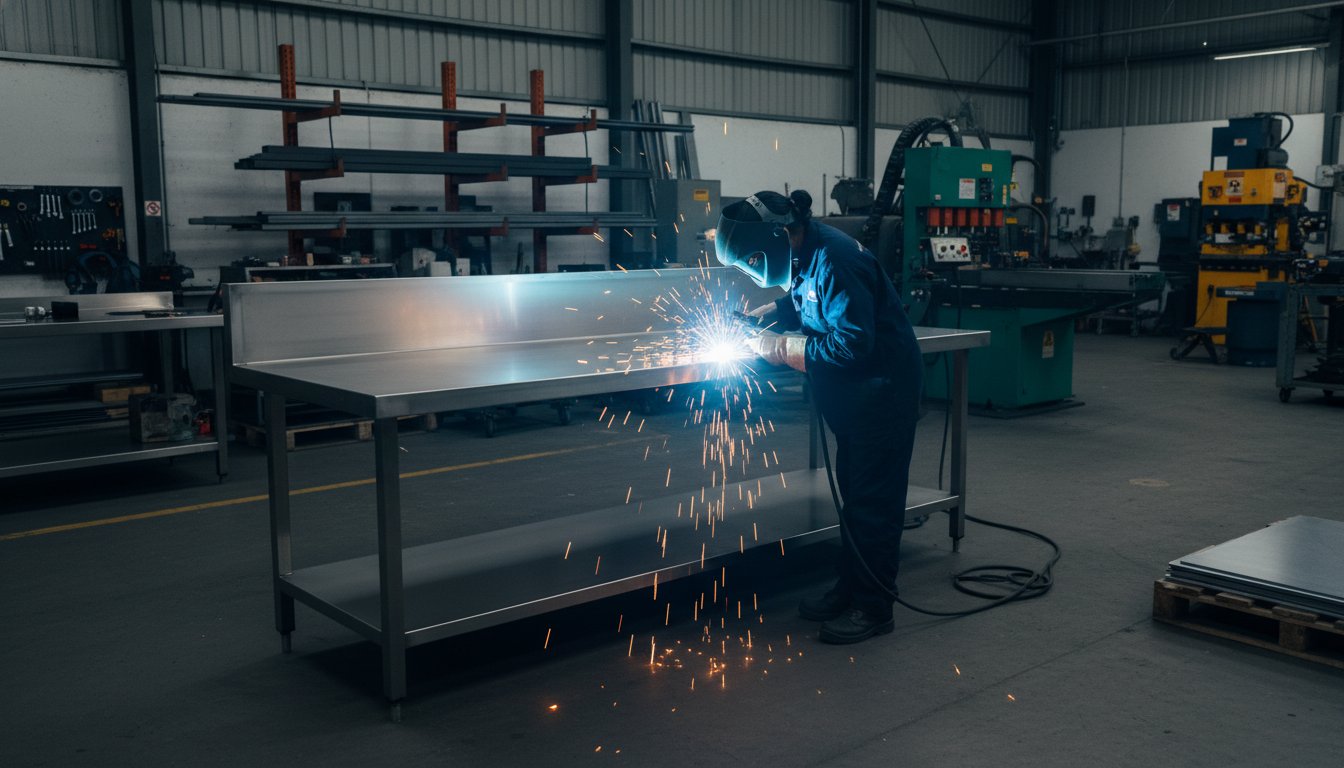
An off-the-shelf bench that wobbles under pressure isn’t just a nuisance; it’s a liability to your facility’s safety and operational flow. When you invest in stainless steel work benches commercial grade, you’re looking for more than just a surface. You’re looking for a foundation that stands up to heavy daily use without rusting or failing health inspections. Many Brisbane facility managers have felt the frustration of generic units that don’t quite fit the room’s dimensions or meet the strict requirements of AS 4674-2004 for food premises.
We understand that a reliable, sturdy workspace is essential for maintaining a high-functioning environment. In this guide, you’ll discover how custom-engineered stainless steel solutions improve hygiene, durability, and overall workflow in your facility. We’ll walk through the benefits of bespoke fabrication, from ensuring total compliance with local health and safety regulations to making the most efficient use of your floor space with precision-built designs that are made to last.
Key Takeaways
- Learn why selecting the correct grade of stainless steel, such as 304 or 316, is vital for ensuring long-term corrosion resistance in your specific facility environment.
- Discover how custom-engineered features like integrated splashbacks and bespoke storage help stainless steel work benches commercial installations meet strict Australian hygiene and safety standards.
- Understand the structural advantages of fully welded, custom-fabricated benches over bolted flat-pack units to prevent instability and ensure durability in high-use areas.
- See how bespoke sizing allows for seamless integration with existing industrial pipework and awkward floor plans to maximise your available workspace.
- Explore the value of a full-service fabrication approach, from initial 3D scanning to professional on-site installation across the Brisbane and Gold Coast regions.
What are Commercial Stainless Steel Work Benches?
Commercial stainless steel work benches are heavy-duty work surfaces engineered specifically to withstand the rigours of industrial and food-service environments. Unlike standard retail furniture, these units are designed with a primary focus on hygiene, structural strength, and corrosion resistance. In Australia, the design and construction of these benches are heavily influenced by AS 4674-2004, which sets the standard for food premises. A compliant bench must feature non-porous surfaces and smooth, easy-clean joins to prevent bacterial growth. The core components typically include a reinforced worktop, adjustable undershelves, integrated splashbacks, and a robust structural frame.
The Science of Steel: 304 vs 316 Grade
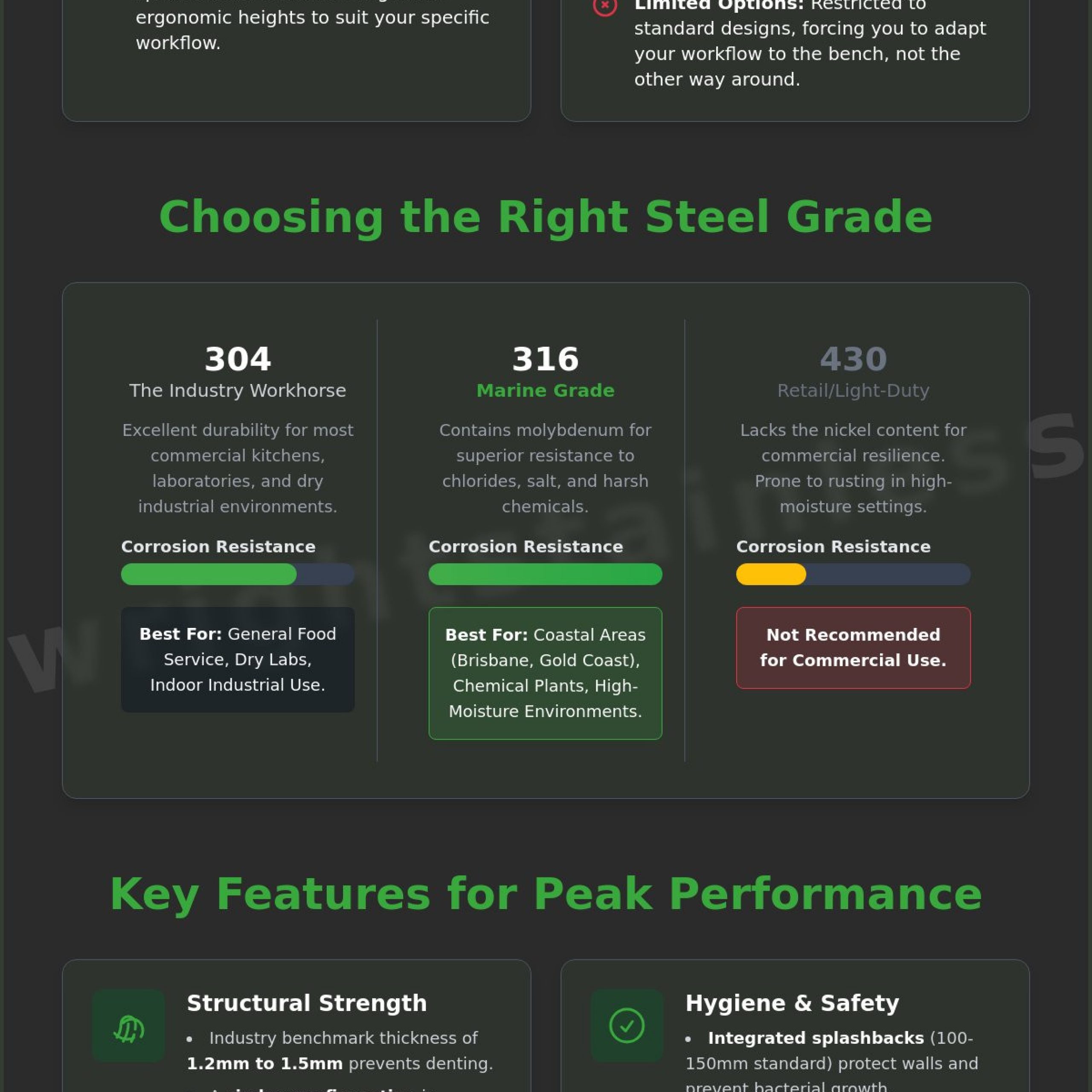
Choosing the right material is critical to the longevity of your fit-out. Grade 304 stainless steel is the “workhorse” of the industry, offering excellent durability for most commercial kitchens and dry laboratories. However, for facilities located near the Brisbane River or coastal areas, or those handling corrosive chemicals, Grade 316 is the necessary choice. Known as “marine grade,” 316 contains molybdenum, which significantly enhances its resistance to pitting and chloride corrosion. We often see 430 grade stainless steel in retail products, but it lacks the nickel content required for commercial resilience and often fails due to rust in high-moisture environments. Understanding the properties of stainless steel ensures you select a grade that matches your facility’s specific atmospheric conditions.
Key Terminology for Commercial Buyers
When sourcing stainless steel work benches commercial buyers should pay close attention to material gauge and construction methods. A thickness of 1.2mm or 1.5mm is the industry benchmark. Anything thinner risks denting or “drumming” under heavy use. Another vital distinction is the assembly method. While flat-pack benches use mechanical fixings that can loosen and cause “wobble” over time, a fully welded frame provides permanent rigidity and eliminates crevices where grime can accumulate. Finally, consider the bench’s function: “wet” benches often include integrated sinks or marine edges to contain liquid, whereas “dry” benches focus on maximum surface area for preparation or assembly tasks.
A well-specified bench serves as the backbone of an efficient workspace. It supports workflow by providing a stable, sanitary area that meets local health and safety regulations. By focusing on these technical details early in the design phase, you ensure the final product is fit for purpose and capable of delivering years of reliable service.
Essential Design Features for High-Performance Benches
Achieving peak efficiency in a commercial environment requires more than just a flat surface. High-performance stainless steel work benches commercial operators rely on are defined by specific design elements that address hygiene, safety, and operational flow. Ergonomics play a vital role in this process. While standard bench heights are typically 900mm, custom fabrication allows you to adjust levels to suit specific tasks or staff requirements, reducing the risk of repetitive strain injuries in busy industrial plants. Adhering to commercial food service construction standards ensures that every component, from the weld quality to the surface finish, meets global benchmarks for safety and sanitation.
Splashbacks and Capping
Integrated splashbacks are essential for protecting walls from moisture and preventing bacterial growth in “wet” areas. In most commercial kitchens, a splashback height of 100mm to 150mm is the standard for compliance. For facilities with complex utility layouts, “boxed” splashbacks provide a clean way to hide services and pipework. We also recommend coved edges; these rounded internal corners eliminate sharp angles where grime accumulates, making the sanitisation process significantly faster and more effective.
Storage and Leg Configurations
Storage should be tailored to the specific equipment you use daily. Solid undershelves are ideal for preventing small items from falling through, while tubular shelves or pot racks encourage air circulation, which is vital in cool rooms or damp environments. Structural integrity is equally important. For any bench exceeding 2100mm in length, a six-leg configuration is necessary to prevent the centre from bowing under pressure. A reinforced 1.5mm stainless steel top, supported by a precision-engineered frame, provides a heavy-duty weight-bearing capacity that remains stable under significant industrial loads.
Mobility is another factor that transforms a static workspace into a versatile asset. If you need a mobile solution for a changing floor plan, adding heavy-duty castors to custom stainless benches provides the flexibility required without sacrificing stability. These castors should feature robust locking mechanisms to ensure the bench remains stationary during precision tasks. By integrating these essential features, you create a workspace that doesn’t just hold equipment but actively supports your team’s productivity and safety.
Custom Fabrication vs. Off-the-Shelf: Making the Right Choice
Choosing between off-the-shelf and custom stainless steel work benches commercial grade involves balancing immediate costs against long-term operational value. Many mass-produced benches fall into the “flat-pack trap.” These units rely on bolts and mechanical fixings that naturally loosen under the vibration and pressure of a busy facility. Over time, this leads to a persistent wobble that compromises both safety and precision. A fully welded frame, by contrast, provides permanent rigidity that mechanical fixings simply cannot match.
When to Choose Off-the-Shelf
Retail solutions have their place in certain environments. If you’re outfitting a low-traffic area where standard depths of 600mm or 700mm fit perfectly, an off-the-shelf bench might be a sensible choice for a tight budget. They’re also suitable for temporary setups or light-duty applications where the bench isn’t the primary work surface. However, facility managers should account for the hidden cost of assembly time. Spending hours putting together multiple units can quickly erode any initial savings on the purchase price, particularly in large-scale facilities.
The Case for Custom Fabrication
Custom fabrication is the superior choice for high-use environments where structural integrity is non-negotiable. A fully welded frame eliminates the risk of loosening joints, ensuring the surface remains perfectly level for years. Customisation also solves complex spatial challenges. We can design benches with precise cut-outs to accommodate industrial pipework or fit around awkward building columns that would otherwise waste valuable floor space. When specifying stainless steel work benches commercial facilities often find that bespoke designs are the only way to achieve total floor space efficiency.
For heavy-duty requirements, custom benches can be reinforced to handle loads exceeding 200kg without the top bowing or “drumming.” This level of durability means a single bespoke bench often outlasts three retail alternatives, providing a much higher return on investment over the life of the facility. Additionally, custom fabrication allows you to maintain a unified aesthetic by matching your benches to existing stainless steel handrails or other protective equipment.
Finally, the value of professional on-site installation shouldn’t be underestimated. Having a local team handle the fit-out in Brisbane or the Gold Coast ensures that every bench is perfectly level, securely fixed, and ready for immediate use. This hands-on approach eliminates the guesswork of DIY assembly and ensures your facility meets all relevant standards from day one. For facilities that also need to manage vehicle traffic around workstations, pairing your bench fit-out with compliant stainless steel safety bollards Brisbane installations provides a comprehensive approach to workplace safety.
Industry Examples: Benches for Every Application
Every industry requires a specific approach to surface design to ensure operational efficiency and safety. While a laboratory needs chemical stability, a food processing plant prioritises rapid sanitisation and moisture management. For stainless steel work benches commercial applications often dictate the thickness of the steel and the complexity of the drainage systems. In food processing plants, compliance with AS 4674 is the primary driver. This requires benches with integrated drainage solutions and coved splashbacks to handle high-pressure washdowns without pooling water or trapping debris in corners.
Hospitality and Food Prep
Workflow efficiency in a commercial kitchen often depends on the integration of specialised features within the work surface. Prep benches can be fabricated with built-in cooling wells or ingredient bins to keep essential supplies at arm’s reach during service. Dishwasher inlet and outlet benches are another essential component, designed with precise heights and marine edges to manage water flow and steam effectively. Grade 304 stainless steel is non-negotiable for food contact surfaces because its non-porous structure prevents bacterial absorption and resists the corrosive acids found in common ingredients.
In medical and laboratory settings, the focus shifts to total contamination control and chemical resistance. Medical-grade benches often utilise Grade 316 stainless steel to withstand harsh disinfectants and frequent chemical exposure. These surfaces are finished to a high-grit polish to ensure no microscopic pits remain where pathogens could hide, ensuring a truly sterile environment for sensitive work.
Industrial Maintenance and Workshops
Industrial settings demand a level of impact resistance and structural load capacity that standard benches cannot provide. Heavy-gauge tops, often 2.0mm or thicker, are used for component assembly and tool storage to prevent denting from heavy parts. To improve mobility within large plants, many facilities integrate food grade stainless steel trolleys to transport heavy equipment between workstations safely. For some workshop applications, using a mild steel frame with a stainless steel bench top can be a cost-effective alternative that maintains a durable work surface while reducing overall material costs for the facility.
If you need a workspace tailored to your specific industry requirements, our team can design and fabricate custom stainless benches that meet your exact operational needs and local regulations. By choosing a solution built for your specific application, you ensure the longevity of your investment and the safety of your staff.
The Donewright Advantage: Professional Bench Fabrication in Brisbane
Donewright Stainless provides a comprehensive service that bridges the gap between technical design and practical application. We’ve spent years supporting the industrial and food-service sectors across Brisbane, the Gold Coast, Logan, and Ipswich. When you invest in stainless steel work benches commercial facilities require more than just a delivery; they need a partner who understands the local regulatory environment and the specific demands of South East Queensland operations. Our full-service approach starts with precise 3D scanning and moves through a disciplined design phase to final on-site installation.
Why Local Fabrication Matters
Choosing a local fabricator significantly reduces the lead times often associated with interstate or overseas shipping. It also provides the unique advantage of direct communication. You can speak directly with “Wrighty” and our technical team to ensure every detail of your bench is correct before the first cut is made. Accountability is the cornerstone of our business. We stand by the integrity of our welds and the quality of our materials because our reputation is built on long-term relationships within the Brisbane industrial community. Local service means local trust.
Mobile On-Site Support
Our mobile workshop services are a critical component of our service model. We understand that industrial plants cannot afford lengthy periods of downtime. If you have existing stainless steel work benches commercial or industrial grade that need modifications to fit new machinery, or if you require on-site repairs for cracked welds or damaged safety barriers, our mobile team can handle the work on your premises. This capability ensures a perfect fit every time, as we can make real-time adjustments that factory-only fabricators simply cannot manage.
By integrating technical expertise with a service-oriented mindset, we help facilities streamline their workflows and maintain high standards of safety. Whether your project involves a single workstation or a complex facility fit-out requiring extensive custom fabrication, we provide the steady, experienced hand needed to deliver results that last. We’re here to ensure your workspace isn’t just functional, but a long-term asset to your business.
Optimise Your Facility with Professional Fabrication
Selecting the right workspace is a critical decision that impacts your facility’s hygiene, safety, and long-term operational costs. The difference between a reliable fit-out and a failing one often comes down to material grade and construction quality. By prioritising fully welded, industrial-grade frames over bolted alternatives, you eliminate the risk of structural instability and ensure your equipment meets specific Australian standards like AS 4674 for food premises or AS 1657 for safety protection.
Donewright Stainless brings technical precision and local accountability to every project. Our Brisbane-based mobile workshop allows us to provide on-site fabrication and modifications, ensuring that your stainless steel work benches commercial requirements are met with an exact fit. We pride ourselves on being reliable partners who value quality workmanship and clear communication. If you’re ready to upgrade your workspace with a solution built to endure heavy-duty use, our team is ready to deliver a result that stands the test of time.
Get a Quote for Custom Stainless Steel Benches today and take the first step toward a more efficient, compliant facility.
Frequently Asked Questions
What is the best grade of stainless steel for commercial work benches?
Grade 304 is the industry standard for most commercial applications because it offers an excellent balance of durability and corrosion resistance. It’s perfectly suited for food preparation, healthcare, and general laboratory environments. For facilities located in coastal areas or those handling highly corrosive chemicals, Grade 316 is the superior choice. This “marine grade” contains molybdenum, which provides enhanced protection against pitting and chloride-induced corrosion in harsh environments.
How much weight can a commercial stainless steel bench actually hold?
A standard commercial stainless steel bench can typically support loads between 150kg and 250kg when engineered with a reinforced frame. The exact capacity depends on the steel gauge used and the underlying support structure. For heavy-duty industrial tasks, we can fabricate custom benches with additional support ribs and thicker 2.0mm tops to handle even greater weights without the surface bowing or vibrating under significant pressure.
Do commercial kitchen benches need to be bolted to the floor?
Bolting a bench to the floor isn’t always a legal requirement, but it’s highly recommended for safety in high-traffic or industrial settings. Fixing the unit ensures it remains perfectly level and stable, preventing movement that could lead to accidents or equipment damage. This is particularly important for benches supporting heavy machinery or those positioned in permanent production lines where any shift in position could disrupt your workflow.
How do I clean and maintain my stainless steel bench to prevent tea-staining?
Regular cleaning with warm soapy water and a soft cloth is the most effective way to maintain the surface, always wiping in the direction of the grain. To prevent tea-staining, you must avoid using harsh chemicals or bleach, which can damage the protective chromium oxide layer. If your facility is in a coastal area, more frequent rinsing with fresh water is necessary to remove salt deposits that cause surface discolouration over time.
What is the difference between a flat bench and a splashback bench?
A flat bench provides a clear work surface on all four sides, making it ideal for central preparation areas where staff work from multiple angles. A splashback bench features an integrated vertical rear edge, usually 100mm to 150mm high. This design is essential for wall-mounted units, as it prevents liquids and debris from falling behind the bench, protecting your walls and ensuring your facility meets strict health and hygiene regulations.
Can you custom-make a bench to fit around existing pipework or columns?
Yes, custom fabrication allows for precise cut-outs and bespoke shaping to fit around structural columns, awkward corners, or existing industrial pipework. Unlike standard retail units, a custom-made bench is designed to utilise every available centimetre of floor space. We use detailed measurements to ensure the final product integrates seamlessly with your facility’s unique layout, eliminating wasted gaps and improving the overall efficiency of your workspace.
Does Donewright Stainless provide on-site installation in the Gold Coast and Logan?
Donewright Stainless provides comprehensive on-site installation and fabrication services across the entire South East Queensland region, including the Gold Coast, Logan, and Ipswich. Our mobile workshop is fully equipped to handle final adjustments and welding on your premises. This local presence ensures we can respond quickly to your needs and provide ongoing maintenance support for your stainless steel work benches commercial installations without the delays of interstate shipping.
Is a custom-fabricated bench more expensive than a flat-packed one from a retailer?
A custom-fabricated bench typically requires a higher initial investment than a flat-packed retail unit, but it offers a significantly better return on investment. Bespoke stainless steel work benches commercial grade are fully welded for permanent rigidity, meaning they won’t develop the “wobble” common in bolted imports. Because they’re built to specific standards and use higher-quality materials, a single custom bench often outlasts several cheap alternatives, reducing long-term replacement costs.