
Bespoke Stainless Steel Fabrication: The Industrial Guide to Custom Solutions in Brisbane
Bespoke Stainless Steel Fabrication: The Industrial Guide to Custom Solutions in Brisbane
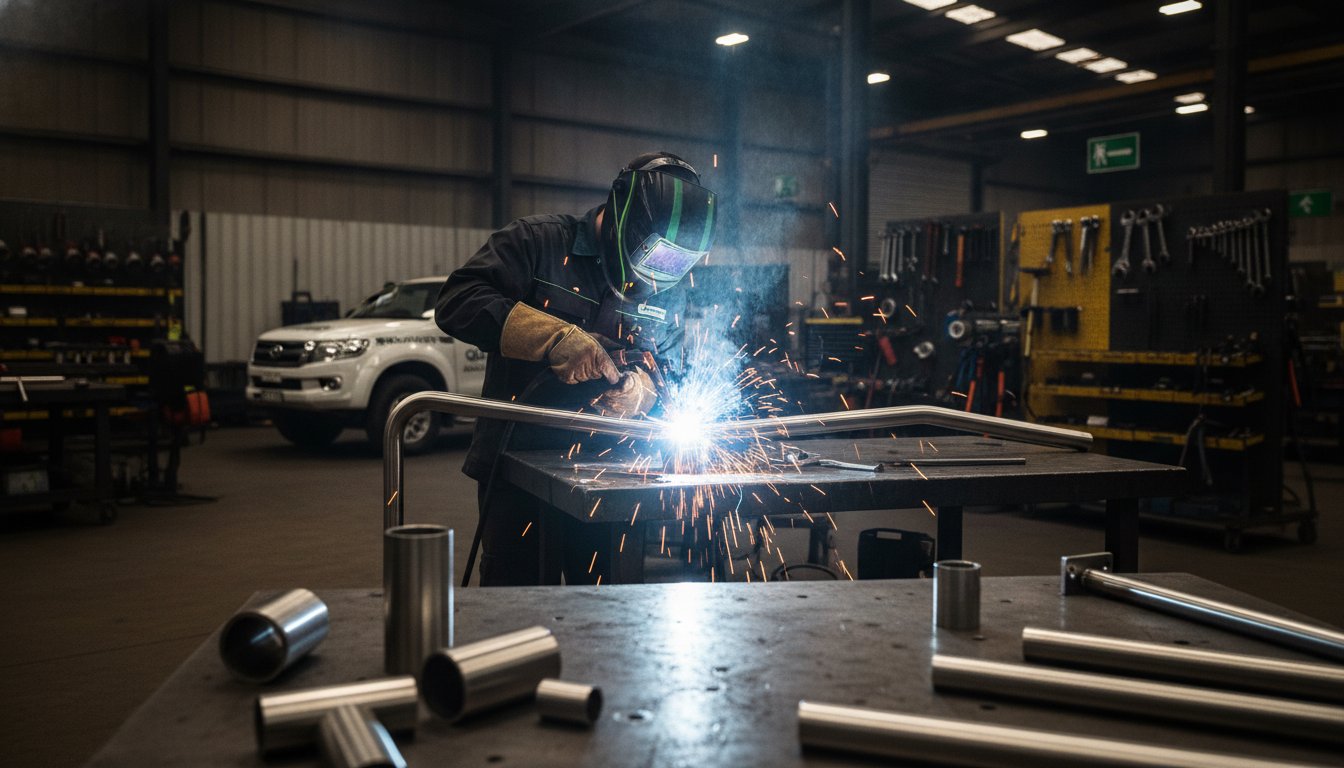
Off-the-shelf metalwork doesn’t belong on a compliant industrial site. When your facility operates under strict hygiene protocols, handles heavy foot traffic, or sits squarely in South East Queensland’s humid coastal climate, a standard catalogue solution simply won’t hold up to the demands of the job. Bespoke stainless steel fabrication isn’t a premium upgrade reserved for large-scale operations; it’s a practical engineering necessity for any facility that takes safety, compliance, and longevity seriously.
If you’ve ever faced a failed safety audit over non-compliant handrails, watched corrosion eat through generic metalwork within a season, or lost production time waiting on components fabricated interstate, you already know the cost of getting this wrong. Those aren’t minor inconveniences; they’re operational risks with real consequences.
This guide is built for facility managers, project engineers, and procurement leads across Brisbane and South East Queensland who need custom metalwork that actually fits their site, meets Australian Standards, and gets installed without disrupting operations. You’ll find a clear breakdown of what bespoke fabrication involves, where it matters most, and how to choose a local partner who can deliver on all of it.
Key Takeaways
- Bespoke stainless steel fabrication is an engineering necessity for SEQ facilities, not a luxury — learn why off-the-shelf metalwork consistently fails compliance audits and harsh coastal conditions.
- Choosing the right stainless steel grade (304 vs. 316) can be the difference between a decade of reliable service and premature corrosion — this guide explains how to make the right call for your site.
- From aged care handrails to food-grade bench tops, discover which common industrial applications demand custom fabrication over catalogue solutions.
- A fully equipped mobile workshop changes the economics of on-site work — find out how local fabricators can complete final fit-outs and emergency repairs without costly transport delays.
- Not all fabricators are equal; you’ll learn the specific questions to ask when vetting a Brisbane partner for industry compliance, material traceability, and knowledge of Australian Standards.
What is Bespoke Stainless Steel Fabrication and Why Does it Matter?
At its core, bespoke stainless steel fabrication is the intersection of precision engineering and site-specific customisation: every component is designed, manufactured, and finished to exact dimensional and functional requirements, rather than selected from a standard catalogue and forced to fit. That distinction matters far more than it might first appear.
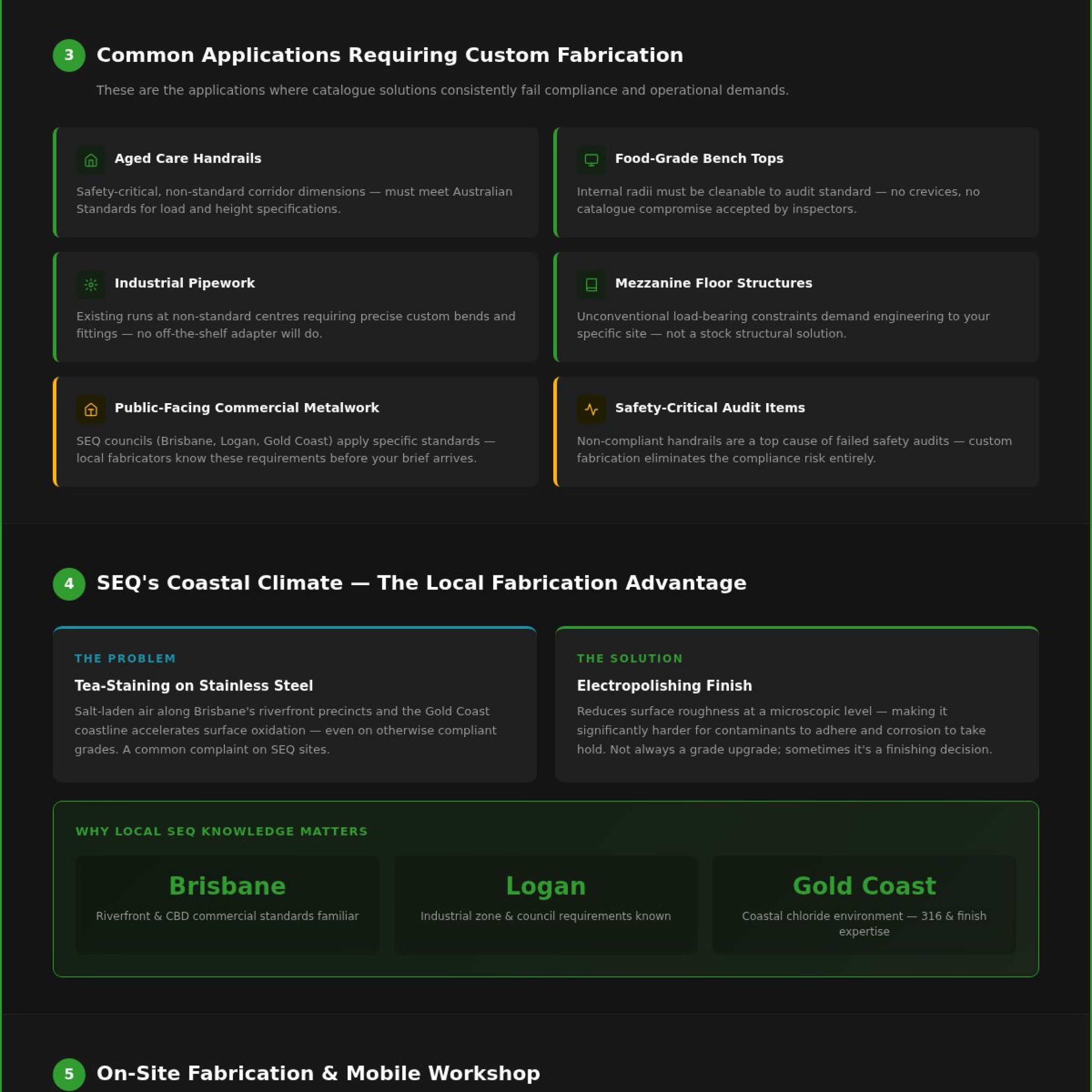
Unlike modular or off-the-shelf systems, a bespoke approach accounts for the irregularities that exist on every real industrial site. Existing pipework that runs at non-standard centres, mezzanine floors with unconventional load-bearing constraints, food processing areas where every internal radius must be cleanable to audit standard — these are the conditions that catalogue metalwork simply wasn’t designed to handle. When hygiene compliance or personnel safety is non-negotiable, the tolerance for a “close enough” solution drops to zero.
The Advantages of Custom Over Off-the-Shelf
Perfect fitment is the most immediate benefit, but it’s rarely the most valuable one over a facility’s lifetime. Custom fabrication allows engineers and procurement leads to specify the exact material grade suited to the operating environment. Understanding stainless steel grades and properties is critical here: Grade 304 performs reliably in low-chloride interior environments, while Grade 316 is the correct specification for coastal sites, chemical exposure, or anywhere chloride concentration is elevated. Getting that call wrong at the procurement stage leads to premature corrosion, unplanned maintenance, and eventual replacement — costs that dwarf the original price difference between grades.
- Exact fitment: Components built to your site’s actual dimensions, not adapted from a standard size.
- Grade selection: Material specified for your environment, not the average-use case.
- Reduced lifecycle costs: Fewer modifications, fewer repairs, and a longer service interval.
Bespoke Solutions for Brisbane’s Unique Climate
South East Queensland presents a specific set of challenges that local fabricators understand in a way that interstate suppliers simply don’t. Tea-staining on stainless steel is a common complaint along Brisbane’s riverfront precincts and the Gold Coast coastline, where salt-laden air accelerates surface oxidation even on otherwise compliant grades. The solution isn’t always upgrading to a higher-grade alloy; sometimes it’s a finishing decision. Electropolishing, for example, reduces surface roughness at a microscopic level, making it significantly harder for contaminants to adhere and corrosion to take hold.
Local knowledge also extends to council and regulatory requirements. SEQ councils apply specific standards to public-facing metalwork in commercial and mixed-use developments, and a fabricator who works regularly across Brisbane, Logan, and the Gold Coast will already be familiar with those requirements before your project brief lands on their desk.
The Engineering Behind Bespoke Stainless: Grades and Standards
Material selection is where a bespoke stainless steel fabrication project either earns its longevity or quietly sets itself up for failure. The decision between Grade 304 and Grade 316 isn’t a matter of preference; it’s an engineering call that should be driven by the specific operating environment, not by what happens to be in stock.
Grade 304 is the workhorse of interior industrial applications. It performs reliably in controlled environments with low chloride exposure: internal food preparation areas, dry plant rooms, and general workshop fixtures. Grade 316, by contrast, contains molybdenum, which significantly improves its resistance to chloride-induced pitting corrosion. For any facility within proximity of Brisbane’s coastline, or any site where cleaning chemicals, brine solutions, or marine air are present, 316 is the correct specification. Using 304 in those conditions isn’t a cost saving; it’s a deferred replacement cost.
Why Material Traceability Matters on Industrial Sites
Beyond grade selection, material traceability is a non-negotiable requirement on any site subject to safety audits or regulatory inspection. Mill certificates confirm that the steel supplied matches the grade specified at procurement. Without documented traceability, a facility manager has no verifiable proof that a handrail, bench frame, or structural bracket is what it claims to be. During a safety audit, that gap in documentation can be just as costly as the wrong material itself. A reputable fabricator maintains full traceability records from raw material through to final installation.
Precision Welding: TIG, MIG, and Structural Integrity
Welding method directly affects both structural performance and hygiene compliance. TIG (Tungsten Inert Gas) welding produces clean, precise joins with minimal spatter, making it the preferred method for food-grade applications and any seam that must be smooth enough to pass a hygiene inspection. MIG welding offers higher deposition rates and suits structural applications where weld volume matters more than surface finish. Choosing the wrong process for the application introduces risk; choosing the right one, executed by a skilled tradesperson who understands welding safety standards and regulations, is what separates compliant metalwork from a liability.
Bespoke fabrication also allows for the intelligent integration of mild steel and aluminium where stainless isn’t structurally or economically necessary. A mezzanine support frame fabricated in mild steel with a hot-dip galvanised finish, paired with stainless handrails and grating, is a common and entirely appropriate hybrid approach for industrial platforms.
Compliance with Australian Standards (AS 1657)
AS 1657 sets the minimum requirements for fixed platforms, walkways, stairways, and ladders in industrial settings. Compliance isn’t optional; it covers load-bearing capacity, rail height, baluster spacing, and non-slip surface treatments. Custom fabrication to AS 1657 handrail fabrication standards means every dimension is engineered to the standard from the outset, not retrofitted to approximate it. Ergonomic rail heights, textured grip surfaces, and correct post spacing are built into the design brief, not added as afterthoughts.
Food-Grade Stainless and Sanitary Standards
Food processing and commercial kitchen environments require fabrication to AS 4674, which governs the construction and fitout of food premises. The critical details here are often invisible to the untrained eye: eliminating “dead legs” in pipework where liquid can pool and bacteria can colonise, ensuring all internal welds are fully penetrated and dressed to a crevice-free finish, and designing custom benches and trolleys with radiused corners and sloped drain channels that survive rigorous wash-down procedures without trapping contamination. These aren’t aesthetic choices; they’re the difference between passing and failing a food safety audit. If your facility’s metalwork needs to meet these standards, talk to a fabricator with documented food-grade experience before committing to a design brief.
Common Applications for Bespoke Fabrication in SEQ
The range of industries across South East Queensland that depend on custom metalwork is broader than most people expect. Food manufacturing, aged care, logistics, commercial construction, pharmaceutical production: each sector carries its own compliance obligations, spatial constraints, and performance requirements. What they share is a consistent need for components that catalogue suppliers simply can’t provide. This is where bespoke stainless steel fabrication earns its place on the project specification.
Commercial and Architectural Handrails
Stainless steel handrails in Brisbane must balance two demands that are often in tension: visual appeal and strict compliance. Aged care facilities, in particular, face this challenge acutely. Handrails in those environments need to meet AS 1657 load requirements and ergonomic grip standards while integrating cleanly into interiors designed to feel welcoming rather than clinical. A modular system can’t accommodate the curved corridors, non-standard wall offsets, and custom transitions that aged care fit-outs routinely require. Bespoke fabrication handles those details as a matter of course.
Commercial and mixed-use developments present a different set of demands. Architects specifying glass balustrade systems with stainless top rails, or timber handrails with stainless post bases, need fabricated components that align precisely with the design intent. A poorly fitted post base or an inconsistent weld bead on a visible rail doesn’t just look unprofessional; it raises questions about structural integrity during a building inspection. Custom fabrication removes that ambiguity.
Industrial Maintenance and Custom Equipment
Replacement parts for ageing industrial machinery represent one of the most practical arguments for local bespoke fabrication. When a critical component fails and the original manufacturer no longer stocks the part, or quotes a lead time that halts production, a fabricator with the right capability can reverse-engineer and reproduce that component to the original specification. That’s not a workaround; it’s a legitimate engineering solution.
Custom stainless benches and specialised trolleys are another area where off-the-shelf products consistently fall short. A bench designed for chemical resistance in a laboratory environment needs to be fabricated from the correct grade with fully sealed edges and appropriate drainage. A trolley used in a pharmaceutical cleanroom must meet surface finish standards that standard workshop equipment doesn’t approach. These aren’t edge cases; they’re everyday requirements for SEQ facilities operating under strict quality management systems.
Industrial pipework and drainage solutions for processing plants round out the picture. Drainage channels, sump covers, and process pipework all need to be fabricated to the exact dimensions of the installation environment, with surface finishes and joint configurations that match the hygiene or chemical resistance requirements of the process. Getting those details right from the fabrication stage avoids costly remediation work after installation.
On-Site Fabrication and Mobile Welding: The Donewright Advantage
Workshop fabrication solves half the problem. The other half is getting precision metalwork installed correctly, in a live industrial environment, without disrupting the operation around it. That’s where a fully equipped mobile workshop changes the equation entirely. Rather than fabricating components offsite and hoping they fit on arrival, mobile welding services in Brisbane allow site-specific adjustments to happen in real-time, with a qualified tradesperson on the ground who can measure, modify, and fit in a single continuous process.
For facilities undertaking on-site industrial pipework repair in Brisbane, the mobile workshop capability isn’t a convenience; it’s a core part of the service. Pipework that runs through confined plant rooms, across non-standard centres, or through areas that can’t be shut down for extended periods demands a fabricator who can work around the site rather than requiring the site to work around them.
Minimising Downtime for Industrial Facilities
Every hour a production line sits idle carries a cost that compounds quickly. On-site welding and repair capability means that a failed weld on a processing line, a cracked bracket on a mezzanine platform, or a damaged drainage channel doesn’t automatically trigger a plant shutdown. Emergency welding services across Logan, Gold Coast, and Ipswich industrial hubs allow critical repairs to be assessed and executed at the source, not after a component has been removed, transported, and queued at a workshop. The “measure, make, and fit” approach is particularly effective for complex pipework: dimensions are taken from the actual installation, the component is fabricated on-site, and it’s fitted in the same visit.
Precision Installation of Custom Metalwork
Bespoke stainless steel fabrication only delivers its full value when the installation is executed with the same rigour as the fabrication itself. Handrails and safety barriers anchored to existing structures require careful assessment of the substrate: concrete embedment depths, existing steel connections, and load-path continuity all need to be verified before a post base is welded or bolted in place. On-site finishing and polishing ensure that new sections blend seamlessly with existing metalwork, eliminating the visible inconsistencies that flag poorly managed fit-outs during building inspections.
Welding in active commercial or industrial environments also demands strict safety protocols: gas containment, fire watch procedures, and coordination with site supervisors to manage hot-work permits and isolate adjacent processes. These aren’t optional steps; they’re standard practice for any competent mobile welding team operating on a compliant site.
If your facility needs on-site metalwork that gets done right the first time, speak with Donewright Stainless about mobile workshop services for your site.
Choosing the Right Bespoke Fabricator in Brisbane
Not every fabricator who works with stainless steel is equipped to deliver genuine bespoke stainless steel fabrication at an industrial standard. The gap between a general metalworker and a specialist with documented experience in your sector can show up in a failed audit, a rejected installation, or a component that simply doesn’t perform as specified. Choosing correctly from the outset is a procurement decision with long-term consequences.
Industry-specific experience is the first filter to apply. A fabricator who regularly works in food processing environments understands the hygiene compliance requirements that govern surface finishes, weld profiles, and drainage design. One whose primary background is in commercial construction may not. Those aren’t interchangeable skill sets. Ask for examples of completed projects in your sector before any other conversation takes place.
Familiarity with Australian Standards and local Brisbane building codes is equally non-negotiable. A fabricator who can speak confidently about AS 1657 load requirements, AS 4674 food premises standards, and the specific council requirements that apply to commercial metalwork in SEQ is one who’s already done this work. That knowledge shouldn’t need to be explained to them; it should be part of how they frame their initial advice to you.
Workshop capacity and on-site installation capability need to sit within the same business. A fabricator who can manufacture to a high standard but relies on third-party contractors for installation introduces coordination risk and dilutes accountability. The most reliable arrangement is a single operator who controls both stages.
Owner-operated businesses carry a distinct advantage here. When the person quoting your job is the same person overseeing fabrication and installation, accountability is direct. There’s no account manager buffering the conversation between you and the tradesperson. You get honest advice about what’s feasible, realistic lead times, and a point of contact who has a personal stake in the outcome.
Key Questions to Ask Your Fabricator
- Do you provide material certificates for Grade 316 stainless steel? Mill certificates should be standard practice, not an optional extra. If a fabricator hesitates on this, that hesitation tells you something important.
- Can you handle mild steel fabrication in Brisbane alongside stainless projects? Hybrid structures are common in industrial environments. A fabricator who works across both materials gives you a single point of responsibility for the whole scope.
- What is your process for ensuring AS 1657 compliance on-site? The answer should include how they verify dimensions, confirm substrate integrity, and document the completed installation.
Getting an Accurate Quote for Bespoke Work
A site measure before final pricing isn’t a courtesy; it’s the only way to price bespoke work accurately. Quotes based on approximate dimensions or rough sketches carry risk for both parties. A thorough site measure captures the actual conditions, identifies potential installation constraints, and produces a scope of work that reflects reality rather than assumptions.
Lead times for custom materials and specialised finishes vary, and a reputable fabricator will be upfront about them from the start. Electropolished components, non-standard section sizes, and specialist alloy grades all have longer procurement windows than standard stock. Building that into the project programme early avoids the downstream pressure that leads to corners being cut.
Ready to discuss your next project? Contact the team at Donewright Stainless for straightforward advice from a local specialist who knows Brisbane’s industrial landscape and can deliver from design through to final installation.
Your Next Custom Fabrication Project Starts Here
Bespoke stainless steel fabrication isn’t a premium option for facilities with generous budgets; it’s the practical choice for any site where compliance, hygiene, and longevity are non-negotiable. Getting the material grade right, specifying to Australian Standards from the outset, and working with a fabricator who can deliver on-site as well as in the workshop are the decisions that separate metalwork that performs for a decade from metalwork that creates problems within a season.
Donewright Stainless is owner-operated by Ian “Wrighty” Wright, with a fully equipped mobile workshop serving Brisbane, Gold Coast, and Logan. Whether your project involves AS 1657 compliant handrails, food-grade bench fabrication to AS 4674, or industrial pipework that needs to be measured and fitted in a live environment, the team brings the same standard of precision and accountability to every scope of work.
Don’t leave compliance to chance. Request a custom fabrication quote from Donewright Stainless and get straightforward advice from a local specialist who’s ready to get the job done right.
Frequently Asked Questions About Bespoke Stainless Steel Fabrication
What is the difference between Grade 304 and Grade 316 stainless steel?
Grade 304 is suited to controlled interior environments with low chloride exposure, such as dry plant rooms and internal food preparation areas. Grade 316 contains molybdenum, which gives it significantly better resistance to chloride-induced pitting corrosion. For any facility near Brisbane’s coastline, or any site exposed to salt air, brine solutions, or harsh cleaning chemicals, 316 is the correct specification. Choosing 304 in those conditions doesn’t save money; it defers a replacement cost.
How long does bespoke stainless steel fabrication take?
Lead times depend on project complexity, material grade, and whether specialist finishes like electropolishing are required. Standard stainless components fabricated from stock material can often be turned around more quickly than items requiring non-standard section sizes or specialist alloys, which carry longer procurement windows. A site measure is completed before final pricing and scheduling, which gives you an accurate programme rather than an estimate that shifts later. Discuss your timeline requirements upfront so material procurement doesn’t compress your installation window.
Do your custom handrails meet Australian Standards (AS 1657)?
Yes. Every handrail and safety barrier fabricated by Donewright Stainless is designed to AS 1657 requirements from the outset, covering load-bearing capacity, rail height, baluster spacing, and non-slip surface treatments. Compliance is built into the design brief, not retrofitted after fabrication. If your project involves aged care, industrial platforms, or commercial fit-outs where a building inspection will assess the installation, that documentation and dimensional accuracy matter as much as the metalwork itself.
Can you perform on-site welding for existing industrial structures?
Yes. Donewright Stainless operates a fully equipped mobile workshop that services Brisbane, Gold Coast, and Logan. On-site welding is available for repairs to existing structures, modifications to live industrial equipment, and final fit-out work that can’t be completed in a workshop environment. Hot-work permits, fire watch procedures, and coordination with site supervisors are standard practice on every job. For pipework and structural repairs in particular, the mobile capability means components are measured, fabricated, and fitted in a single continuous process.
What areas do you service for bespoke fabrication?
Donewright Stainless services Brisbane, the Gold Coast, and Logan, with mobile workshop capability extending across South East Queensland’s industrial hubs including Ipswich. Workshop fabrication is completed locally, and on-site installation and mobile welding services are available across the same coverage area. If you’re unsure whether your site falls within the service region, contact the team directly to confirm before progressing your project brief.
Is bespoke fabrication significantly more expensive than modular systems?
The upfront cost of bespoke stainless steel fabrication is typically higher than a catalogue solution, but the comparison doesn’t hold over a facility’s full lifecycle. Modular systems require modification to fit non-standard sites, often fail compliance audits, and are frequently fabricated from grades unsuited to the operating environment. The cost of remediation, replacement, and unplanned downtime routinely exceeds the original price difference. Custom fabrication built to the correct grade and standard from the outset is the more economical choice across a realistic service interval.
Can you work with metals other than stainless steel?
Yes. Donewright Stainless fabricates in mild steel and aluminium alongside stainless work. Hybrid structures are common and often the most practical approach; a mezzanine platform with a hot-dip galvanised mild steel support frame paired with stainless handrails and grating is a legitimate engineering solution, not a compromise. Having a single fabricator who works across all three materials means one point of accountability for the full scope, which simplifies both project management and quality oversight.
How do I maintain my bespoke stainless steel products to prevent tea-staining?
Tea-staining is a surface discolouration caused by airborne chlorides adhering to the steel, and it’s particularly common in SEQ’s coastal and riverfront environments. Regular cleaning with a mild detergent and fresh water, followed by thorough rinsing, removes the contaminants before they can initiate corrosion. Avoid abrasive pads that scratch the surface finish, as surface roughness makes adhesion easier. For installations in high-exposure locations, an electropolished finish specified at the fabrication stage significantly reduces the rate at which contaminants take hold.