
Preventing Corrosion in Mild Steel Fabrication: The Brisbane Industrial Guide
In the salt-laden air of South East Queensland, a standard coat of paint isn’t a protection strategy; it’s a countdown to structural failure. You likely understand that preventing corrosion in mild steel fabrication is the only way to safeguard the backbone of your industrial plant. Watching your investment succumb to rust is both frustrating and expensive, leading to budget-draining replacements, safety risks for your team, and the aesthetic failure of public-facing steelwork.
This guide provides the professional strategies you need to defend your assets against Brisbane’s harsh humidity through intelligent design and high-performance coatings. We’ll examine the latest updates to the Building Code of Australia, help you navigate AS/NZS 2312 standards for protective systems, and establish a maintenance schedule that ensures your steelwork remains compliant and secure for the long term. By moving from reactive repairs to a proactive protection model, you can extend the life of your equipment and maintain the integrity of your facility without unnecessary fuss.
Key Takeaways
- Understand why South East Queensland’s unique climate, from Moreton Bay salt spray to high humidity, requires a specialised approach to metal protection.
- Learn how to eliminate rust traps at the drawing board by using smart design principles and smooth weld finishes that prevent moisture buildup.
- Compare the performance of galvanising, industrial paint, and powder coating to choose the most cost-effective shield for your specific environment.
- Discover how a structured maintenance routine and mobile workshop services can stop structural degradation before it becomes a major safety risk.
- Gain professional insights into preventing corrosion in mild steel fabrication to ensure your industrial assets comply with current Australian Standards.
Understanding Why Mild Steel Corrodes in South East Queensland
Mild steel is a staple of industrial infrastructure, but its chemical composition makes it inherently vulnerable to the environment. At its core, rust is an electrochemical phenomenon where iron atoms lose electrons to oxygen in the presence of water. While this oxidation occurs everywhere, the speed of degradation in Brisbane is significantly higher than in drier, inland regions. Effectively preventing corrosion in mild steel fabrication begins with acknowledging that South East Queensland is one of the most aggressive environments for metal in Australia.
Local conditions create a perfect storm for metal decay. The proximity to Moreton Bay means that salt-laden air is carried kilometres inland by prevailing winds, depositing chlorides onto steel surfaces. These chlorides break down protective oxide layers and accelerate the flow of electricity between the steel’s surface and the atmosphere. In industrial corridors like Logan or the Port of Brisbane, airborne pollutants from manufacturing and transport add acidic compounds to the mix, creating a highly corrosive “chemical soup” that attacks unprotected welds and joints.
The Role of Humidity and Salt in Brisbane
Brisbane’s subtropical climate ensures that humidity levels often sit above the critical 60% threshold required for rapid oxidation. This moisture forms a microscopic, persistent film on the steel, acting as a bridge for the corrosive process. For fabrications on the Gold Coast or in the Redlands, the constant salt spray makes high-tier protection mandatory rather than optional. Even inland fabrications near the Brisbane River face a specific micro-climate; the river increases local ambient moisture, meaning steel stays wet for longer periods after dew or rain, which drastically reduces the lifespan of standard shop primers.
Recognising the Early Signs of Steel Degradation
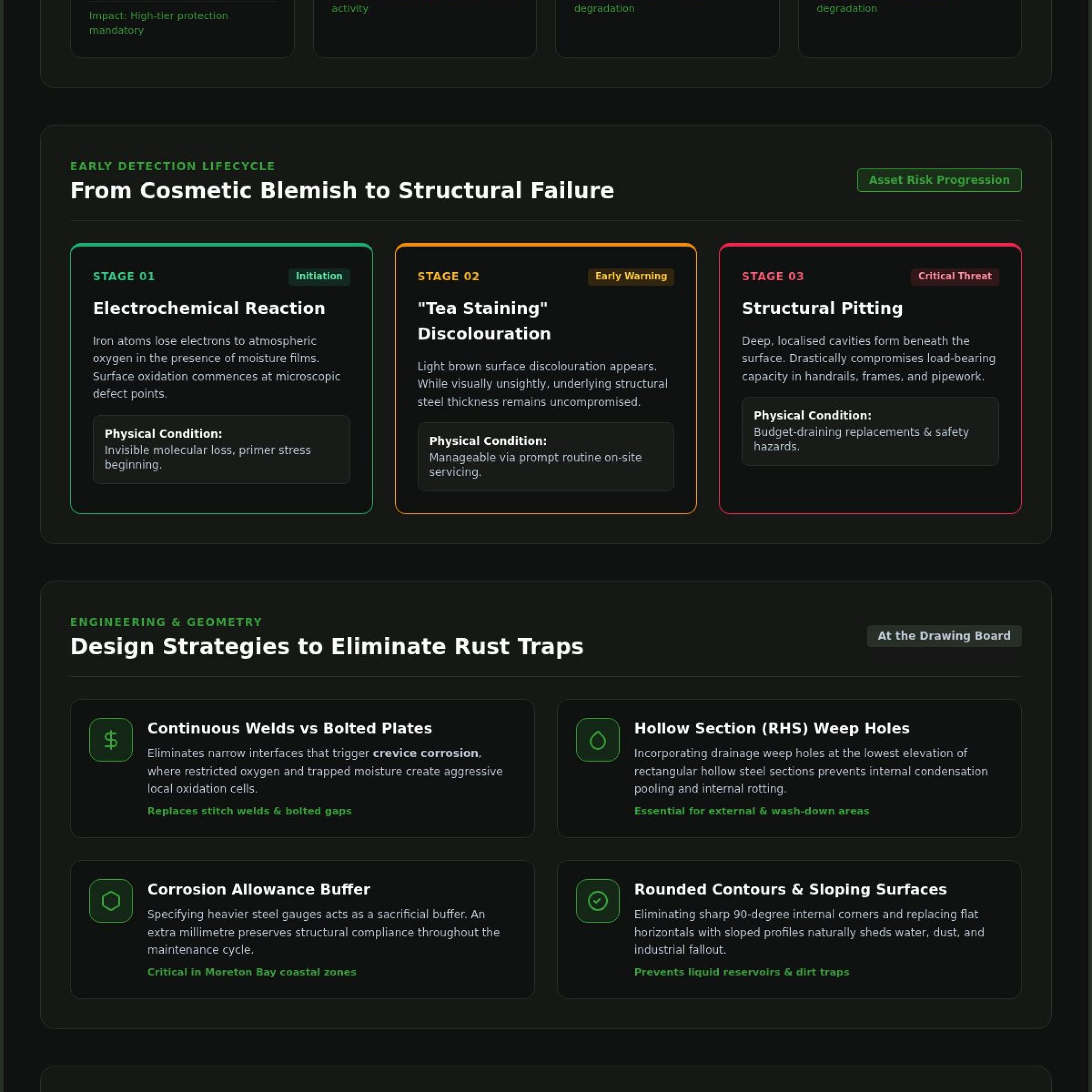
Identifying the transition from cosmetic issues to structural failure is vital for maintaining site safety. Initial degradation often appears as “tea staining,” a light brown discolouration that looks unsightly but hasn’t yet compromised the metal’s thickness. However, if left unchecked, this progresses into deep structural pitting. Pitting is particularly dangerous because it creates small, deep holes that can hide beneath the surface, significantly weakening the load-bearing capacity of items like safety handrails or industrial pipework. Early detection through regular inspections is the only way to ensure preventing corrosion in mild steel fabrication remains a manageable maintenance task rather than a full-scale replacement project.
Design Strategies to Minimise Rust Traps in Fabrication
The most effective way to manage rust is to design it out before the first spark is struck. While many focus solely on coatings, the geometry of a structure often determines how long those coatings actually last. Crevice corrosion is a major threat in South East Queensland’s humid climate. It occurs in narrow gaps where oxygen is restricted but moisture remains trapped, such as the interface between two bolted plates. In these industrial scenarios, a continuous welded joint is usually superior because it eliminates the physical gap where oxidation begins.
Material thickness also plays a vital role in the structural lifespan of a project. Engineers often specify a “corrosion allowance,” which involves using a slightly heavier gauge of steel than structural loads require. In high-risk zones near Moreton Bay, this extra millimetre of steel acts as a sacrificial buffer. It ensures the asset remains safe and compliant even if minor surface oxidation occurs before the next maintenance cycle.
Eliminating Moisture Collection Points
Rust traps are specific areas where water, dust, and industrial pollutants settle. For hollow sections like rectangular hollow steel (RHS), designers must include weep holes at the lowest points to allow internal condensation to escape. Without these, water pools inside the section and rots the steel from the inside out. Sharp internal corners also act as reservoirs for moisture. Opting for custom mild steel fabrication Brisbane allows for the use of rounded profiles and sloping surfaces that shed water naturally rather than letting it sit.
Welding Best Practices for Corrosion Resistance
Welding technique is a critical component of preventing corrosion in mild steel fabrication. In outdoor or wash-down environments, stitch welding should be avoided wherever possible. While stitch welding is faster, it leaves open gaps that invite moisture to penetrate the joint. Full-seal welds are the industry standard for industrial durability. Following professional corrosion prevention strategies, fabricators must also be meticulous about post-weld cleaning. All slag and weld spatter must be removed; spatter creates tiny peaks that a protective coating might not fully encapsulate, leading to premature “pinhole” rusting. If you’re concerned about the integrity of existing structures, the team at Donewright Stainless can provide on-site assessments to identify and rectify these design flaws.
Comparing Protective Coatings for Industrial Mild Steel
Selecting a protective coating is the final, critical step in preventing corrosion in mild steel fabrication. While design choices reduce moisture traps, the coating acts as the primary barrier between the steel and Brisbane’s aggressive atmosphere. The success of any coating system relies heavily on surface preparation. Abrasive blasting to a Class 2.5 finish is the industrial standard, as it removes mill scale and contaminants while creating a mechanical profile for the coating to grip. Without this preparation, even high-grade industrial systems will eventually delaminate.
Zinc-rich primers play a vital role in this process by providing sacrificial protection. Because zinc is more reactive than iron, it corrodes in place of the steel, effectively “healing” minor scratches in the coating. For assets in high-corrosivity zones, a duplex system is the ultimate solution. By applying a powder coating or industrial paint over a hot-dip galvanised base, you create a synergistic effect where the life of the combined system is significantly longer than the sum of its parts.
Hot-Dip Galvanising vs. Cold Galvanising
Hot-dip galvanising involves dipping the fabricated steel into a bath of molten zinc at approximately 450 degrees Celsius. This creates a metallurgical bond where the zinc becomes part of the steel surface, providing unmatched durability for industrial structures. However, zinc can be sensitive to highly acidic environments found in some chemical processing plants. In these cases, alternative coatings may be required. Cold galvanising, typically applied via spray or brush, is an excellent tool for on-site maintenance. It’s the primary method used by mobile workshop services to protect fresh welds or repair damaged sections of galvanised steel, ensuring the cathodic protection remains intact.
Industrial Powder Coating and Wet Paint Systems
Powder coating is a popular choice for high-traffic assets, such as those produced during safety handrail fabrication Brisbane projects. The process creates a hard, durable finish that resists both impact and abrasion. For heavy-duty industrial pipework or large-scale machinery, two-pack epoxy wet paint systems are often preferred. These epoxies offer superior chemical resistance and can be applied to items too large for a powder coating oven. Regardless of the system chosen, a UV-stable topcoat, such as a polyurethane, is essential for any outdoor fabrication in Queensland. This prevents the sun from degrading the protective layers and ensures the steel remains secure for its intended service life.
How to Maintain and Repair Corroded Steel On-Site
Effective industrial management requires moving beyond the “set and forget” mindset. Even the most robust coatings eventually face degradation in Brisbane’s humid environment. Establishing a proactive inspection schedule, typically every six to twelve months, allows for the identification of minor tea staining before it evolves into structural pitting. By catching these issues early, the cost of preventing corrosion in mild steel fabrication remains a fraction of the expense required for a full structural replacement. When rust is detected, the priority shifts to stabilising the metal and restoring its protective barrier without removing the asset from service.
On-site repairs are often more efficient than dismantling equipment for workshop treatment. Mobile engineering allows for the immediate reinforcement of weakened sections using on-site welding, ensuring that load-bearing structures like gantries or support frames remain safe. This approach is particularly valuable for assets that are integrated into a facility’s primary workflow, where downtime translates directly to lost revenue.
A Step-by-Step On-Site Repair Guide
Restoring a corroded fabrication follows a precise technical sequence to ensure the new coating adheres correctly. First, technicians perform mechanical removal of loose rust and failing paint using power tools to reach a clean, sound surface. Second, chemical neutralisation is applied to treat microscopic oxidation remaining in the metal’s pores. Third, if the corrosion has compromised the metal’s thickness, structural repair is carried out. This often involves on-site industrial pipework repair Brisbane services to patch or replace sections of pipe while maintaining system integrity. Finally, the area is re-primed with a high-zinc coating and top-coated to match the existing finish, effectively resetting the corrosion clock.
Minimising Downtime with Mobile Engineering
A fully equipped mobile workshop is a game-changer for industrial maintenance in South East Queensland. These units carry the specialized welding and grinding equipment necessary to handle complex repairs in situ, avoiding the logistical nightmare of plant shutdowns. For example, maintaining stainless steel safety bollards Brisbane or mild steel barriers often requires quick, precision welding to fix impact damage or coastal wear. By coordinating these repairs during scheduled maintenance windows, plant managers can ensure safety compliance without interrupting production cycles. If your facility requires an immediate structural assessment, you can book a mobile workshop service to address corrosion issues before they escalate.
Expert Mild Steel Fabrication and Maintenance in Brisbane
Industrial durability in South East Queensland isn’t achieved by accident. It’s the result of a methodical, integrated lifecycle that balances engineering precision with environmental reality. By combining smart design, high-performance coatings, and proactive maintenance, plant managers can ensure their assets outlast the projected 15 year maintenance cycle mandated by recent building code updates. Donewright Stainless approaches every project with this comprehensive mindset, ensuring that preventing corrosion in mild steel fabrication is built into the very fabric of the asset from the initial drawing to the final weld.
Our team focuses on delivering results that align with current Australian Standards, such as AS/NZS 2312.1 and 2312.2. This provides the technical assurance required for safety-critical infrastructure. Whether you’re managing a facility in the industrial heart of Logan or a coastal plant on the Gold Coast, our fabrications are engineered to withstand the specific corrosive pressures of your location. We don’t rely on guesswork; we apply established facts and proven metallurgical principles to every bespoke project we undertake.
Custom Solutions for Industrial and Commercial Assets
Every facility has unique requirements that off the shelf solutions can’t meet. Our expertise extends from manufacturing custom stainless benches for food processing to complex industrial pipework for heavy manufacturing. We tailor material and coating choices to your specific Brisbane location, acknowledging that a site near the Brisbane River requires different protection levels than one in inland Ipswich. Working with a local specialist means you gain a partner who understands the nuances of the South East Queensland climate and can provide the quiet confidence that your infrastructure is built to last.
Contact Donewright Stainless for On-Site Support
Maintaining the integrity of your steel infrastructure requires a steady, experienced hand. We offer comprehensive site assessments to identify early signs of degradation and provide honest advice on the most efficient path forward. Our service area covers the entire region, including Brisbane, the Gold Coast, Ipswich, and Logan. Our mobile workshop is ready to deploy for on-site industrial maintenance, ensuring your operations continue with minimal disruption. Don’t wait for structural failure to address your rust concerns. Request a consultation for your mild steel fabrication needs today.
Securing the Longevity of Your Industrial Infrastructure
Managing mild steel assets in South East Queensland’s aggressive climate requires a transition from reactive repairs to a lifecycle-based strategy. Success lies in the combination of moisture-shedding design, high-performance coatings, and regular inspections. Adhering to standards like AS 1657 and AS 1170 isn’t just a regulatory requirement; it’s a fundamental step in ensuring the safety and structural integrity of your plant for decades to come.
Donewright Stainless brings over 20 years of experience in Brisbane industrial fabrication to every challenge. We understand that preventing corrosion in mild steel fabrication is a professional discipline that demands precision. With our fully equipped mobile workshop, we provide on-site repairs and maintenance across Brisbane, the Gold Coast, Logan, and Ipswich, ensuring your facility remains compliant without suffering unnecessary downtime. Our team is ready to help you navigate these technical requirements with quiet confidence and reliable results.
Get a Professional Quote for Mild Steel Fabrication and Maintenance
Protecting your investment today ensures a safer, more efficient workplace tomorrow.
Frequently Asked Questions
How long does mild steel last in a coastal environment like the Gold Coast?
The lifespan of mild steel in coastal zones like the Gold Coast varies significantly based on the protective system applied. Without treatment, oxidation begins almost immediately. However, current building codes now target a minimum design life of 15 years to first maintenance. Achieving this requires high-performance coatings, such as hot-dip galvanising or duplex systems, which are specifically engineered to withstand the high chloride levels found in South East Queensland’s salt-laden air.
Is powder coating better than galvanising for preventing rust?
Galvanising is technically superior to powder coating for pure corrosion resistance because it creates a metallurgical bond with the steel. While powder coating provides a hard, aesthetic barrier, it doesn’t offer the sacrificial protection that zinc provides. For industrial assets, the most robust approach to preventing corrosion in mild steel fabrication is a duplex system. This involves applying powder coating over a galvanised base, combining the durability of zinc with the impact resistance of the coating.
Can you weld mild steel that has already started to corrode?
You can weld corroded mild steel, but the surface must be meticulously prepared first. Welding directly over rust compromises the joint’s structural integrity and leads to porosity or slag inclusions. Technicians must mechanically grind the area back to sound, bright metal before beginning any repair work. Once the weld is complete, it’s vital to immediately apply a cold-galvanising spray or zinc-rich primer to protect the heat-affected zone from rapid re-oxidation.
What Australian Standards govern corrosion protection for steelwork?
The primary standards are AS/NZS 2312.1:2014 for paint coatings and AS/NZS 2312.2:2014 for hot-dip galvanising. These documents categorise environmental corrosivity from C1 to C5, which is essential for determining the correct protection level in Brisbane. Additionally, fabrications must meet AS 1657 for safety handrails and AS 1170 for structural design. Following these standards ensures that your industrial infrastructure remains compliant and safe for its intended service life.
How often should I inspect my industrial steel handrails for rust?
Industrial steel handrails in South East Queensland should be inspected every six to twelve months. Proximity to Moreton Bay or industrial zones in Logan can accelerate degradation, so more frequent checks may be necessary for coastal assets. During these inspections, look for signs of tea staining or bubbling under the paint, which indicate that the protective barrier has failed. Early intervention via mobile workshop services prevents minor surface issues from becoming expensive structural failures.
What is the best way to clean mild steel to prevent corrosion?
The most effective way to clean mild steel is to remove salt deposits and industrial pollutants using low-pressure fresh water and pH-neutral detergents. For fabrications that are being prepared for a new coating, abrasive blasting to a Class 2.5 finish is the professional standard. This process removes mill scale and provides a clean, roughened profile that ensures maximum adhesion. Consistent cleaning prevents the buildup of corrosive films that trap moisture against the metal surface.
Does Donewright Stainless offer on-site welding for rust repairs in Brisbane?
Donewright Stainless provides comprehensive mobile welding and on-site maintenance services throughout Brisbane, Gold Coast, Logan, and Ipswich. Our fully equipped mobile workshop allows us to perform structural repairs and rust remediation directly at your facility, which significantly reduces operational downtime. We specialise in preventing corrosion in mild steel fabrication by identifying rust traps and reinforcing weakened sections, ensuring your industrial plant remains secure and compliant without the need to transport heavy equipment off-site.
Can I paint over galvanised steel to improve its rust resistance?
Painting over galvanised steel is a highly effective way to increase its service life, provided the surface is correctly prepared. Freshly galvanised steel is too smooth for most paints to grip, so it requires a specific etch primer or a “T-wash” to create a suitable bond. When executed correctly, this duplex system offers synergistic protection, where the paint shields the zinc from environmental wear, while the zinc prevents rust from spreading if the paint is scratched.
