
Disability Access Handrails QLD: The Essential Compliance & Fabrication Guide
A single millimetre of deviation in your handrail height can be the difference between a passed audit and a costly, forced retrofit. If you’re managing a commercial project or public space in Brisbane or the Gold Coast, you’re likely already aware that navigating the strict standards for disability access handrails QLD is a high-stakes task. It’s incredibly frustrating when off-the-shelf modular kits fail to fit the unique geometry of your site or begin to tea-stain after just one humid summer in our coastal environment.
You deserve the peace of mind that comes with a system built to last and guaranteed to comply. This guide will help you master the complexities of AS 1428.1 compliance and demonstrate why custom-welded stainless steel is the gold standard for accessibility in Queensland. We’ll explore the technical nuances of the latest Australian Standards, the critical importance of material selection for our local climate, and how professional on-site fabrication eliminates the common points of failure found in inferior systems. By the end, you’ll have a clear roadmap for achieving a maintenance-free, fully compliant installation that fits your site perfectly.
Key Takeaways
- Understand how the Disability Discrimination Act and the National Construction Code work together to govern building approvals across Queensland.
- Master the specific technical requirements for disability access handrails QLD, including the mandatory 865mm to 1000mm height range and grip diameter specifications.
- Learn why seamless, custom-welded stainless steel is the preferred choice for aged care and coastal facilities due to its superior hygiene and corrosion resistance.
- Discover how mobile workshop services and precise site surveys ensure your handrails fit perfectly, avoiding the joints and gaps common in modular systems.
- Realise the value of bespoke fabrication in creating safety solutions that meet rigorous audit standards while enhancing your property’s architectural appeal.
Navigating Disability Access Requirements in Queensland
Building a commercial space in South East Queensland requires more than just following a blueprint. You have to meet a rigorous set of legal obligations. When installing disability access handrails QLD, the primary goal is ensuring that every person, regardless of physical ability, can navigate your property safely and independently. The National Construction Code (NCC) dictates these requirements during the building approval process, but the baseline for these rules is set by the Disability Discrimination Act (DDA).
One of the most common pitfalls for property owners is relying on off-the-shelf modular systems. While these kits might seem cost-effective, they often fail certifier inspections because they don’t provide a truly continuous, smooth surface. Any slight lip or joint at a connection point can catch the hand of a user with limited mobility, creating a safety hazard. Custom fabrication ensures a seamless finish that meets the strict handrail design and safety standards required for modern accessibility.
The Legal Necessity of Compliance
In Brisbane, non-compliance isn’t just a matter of failing an audit; it’s a significant legal liability. If a commercial fit-out doesn’t meet the required accessibility rating, the building owner may face legal challenges under federal law. The DDA requires that people with disabilities have equal access to premises, including all public and commercial spaces, ensuring no individual is disadvantaged by the built environment. Properly engineered handrails are a foundational part of this accessibility rating, acting as the primary support for individuals transitioning between floor levels.
QLD Specific Building Codes
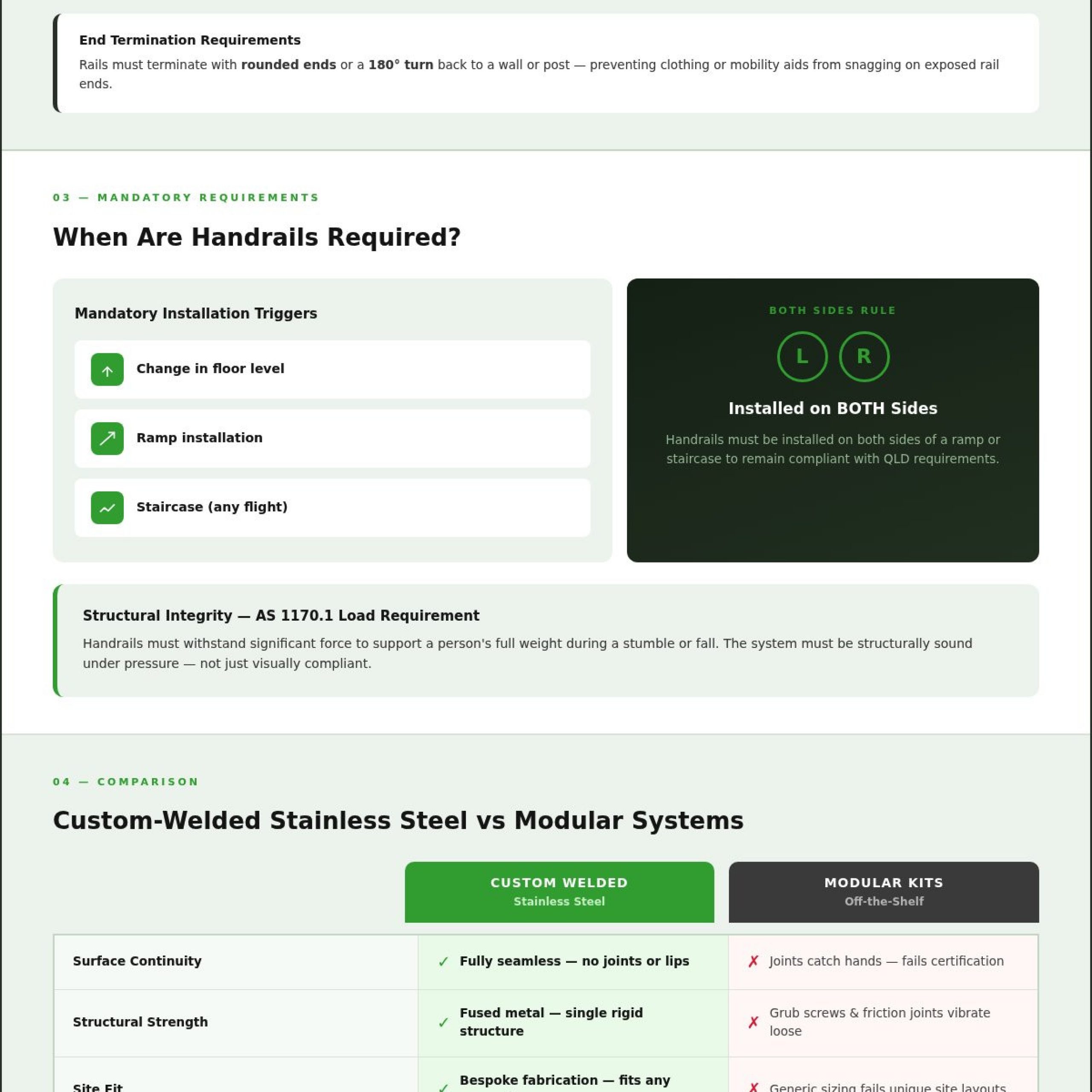
Queensland’s unique climate adds another layer of complexity to the building code. In coastal areas like the Gold Coast or Redlands, standard materials can corrode quickly, leading to structural failure and safety risks. AS 1428.1 specifies the geometry and placement of rails, but local council safety mandates often require specific material grades, such as 316 stainless steel, to ensure longevity. A handrail becomes a mandatory safety requirement whenever there is a change in floor level, a ramp, or a staircase, and it must be installed on both sides to remain compliant.
Key Standards for AS 1428.1 Compliant Handrails
Adhering to the technical specifications for disability access handrails QLD is a precise task that begins with the Disability (Access to Premises – Buildings) Standards 2010. The most fundamental requirement is the installation height. Every compliant rail must sit between 865mm and 1000mm above the finished floor level or the nosing of a stair tread. This specific range ensures the rail remains accessible for wheelchair users while providing stable support for ambulant users. Consistency is vital; any sudden change in height along a ramp or staircase can compromise the user’s balance and lead to a failed certification.
The physical profile of the rail is equally important for safety. To ensure an effective power grip, the diameter must be between 30mm and 50mm. A rail that’s too thin is difficult to squeeze, while one that’s too thick prevents the hand from wrapping around securely. You must also maintain a consistent 50mm clearance between the rail and the wall or any adjacent obstruction. This gap prevents knuckles from being scraped and ensures the hand can glide smoothly along the entire length of the installation without being obstructed by brackets or uneven surfaces.
Load Bearing and Structural Integrity
A handrail must do more than just look compliant; it must be structurally sound under pressure. According to AS 1170.1, these systems must withstand significant force to support a person’s full weight during a stumble or fall. While modular systems often rely on small grub screws and friction joints that can vibrate loose, custom-welded stainless steel handrails provide far superior lateral support. By fusing the metal together, you create a single, rigid structure that won’t rattle or fail in high-traffic commercial environments in Logan or Brisbane.
End Terminations and Extensions
Safety standards also dictate how a rail begins and ends. To prevent clothing or mobility aids from snagging, rails must have rounded ends or a 180-degree turn that leads back to a wall or post. At the top and bottom of any staircase, the rail must extend a minimum of 300mm past the last riser. This extension is a critical tactile indicator for vision-impaired users, signalling that they’ve reached a flat transition before their feet actually leave the stairs. Ensuring these extensions are smooth and free of “catch points” is a hallmark of professional fabrication.
Why Custom Welded Stainless Steel Outperforms Modular Systems
While modular handrail kits are often marketed as a fast and cheap alternative, they rarely meet the long-term functional requirements of high-traffic environments. For disability access handrails QLD, the superiority of custom-welded stainless steel lies in its structural continuity. Modular systems rely on key-clamp joints that create small but noticeable bumps along the rail. For a user with limited grip or someone sliding their hand for balance, these interruptions are more than just an eyesore; they’re a physical obstruction. A custom-fabricated rail is ground and polished at every join. This results in a single, unbroken surface that feels as smooth as it looks.
In sensitive environments like aged care facilities, these gaps present a significant hygiene risk. The joints in modular systems provide perfect breeding grounds for bacteria and grime. These areas are nearly impossible to clean thoroughly. Welded stainless steel eliminates these crevices entirely. It’s the preferred choice for healthcare and high-end Brisbane commercial developments where both sanitary standards and architectural aesthetics are paramount. Additionally, welded joints offer superior vandal resistance. Unlike modular components that can be loosened with a basic hex key, a fully welded system is permanent and tamper-proof.
Grade 304 vs 316 Stainless Steel
Choosing the right material grade is essential for the longevity of your installation. For internal fit-outs in the Brisbane CBD, Grade 304 stainless steel provides excellent durability and a premium finish. However, for any project on the Gold Coast or in bayside suburbs, Grade 316 “Marine Grade” is a non-negotiable requirement. It contains molybdenum, which provides critical resistance to the salt-induced tea-staining common in Queensland’s coastal air. While the initial cost of stainless steel is higher than galvanised mild steel, the lack of rust and the absence of recurring painting costs make it the more economical choice over the building’s lifecycle.
Maintenance and Long-Term Value
The true value of stainless steel is found in its low total cost of ownership. It possesses a unique self-healing property thanks to its chromium oxide layer, which reforms if the surface is scratched or scuffed. This doesn’t mean it’s entirely set and forget, especially in harsh environments. Periodic cleaning ensures the protective layer remains intact and the finish stays bright. Investing in professional stainless steel maintenance services can further extend the life of your safety systems, ensuring they remain audit-ready and structurally sound for decades.
Professional Installation and Site Surveys in South East QLD
The transition from a compliant design to a physical installation is where many projects encounter hurdles. A successful installation of disability access handrails QLD begins long before the first weld is made. It starts with a comprehensive site survey. In South East Queensland, especially in older Brisbane precincts, ramp gradients and floor levels are rarely perfect. A millimetre of error in the concrete pour can throw out the entire geometry of a pre-fabricated rail. By conducting precise on-site measurements, we identify these discrepancies early, ensuring the final product meets AS 1428.1 standards without compromise.
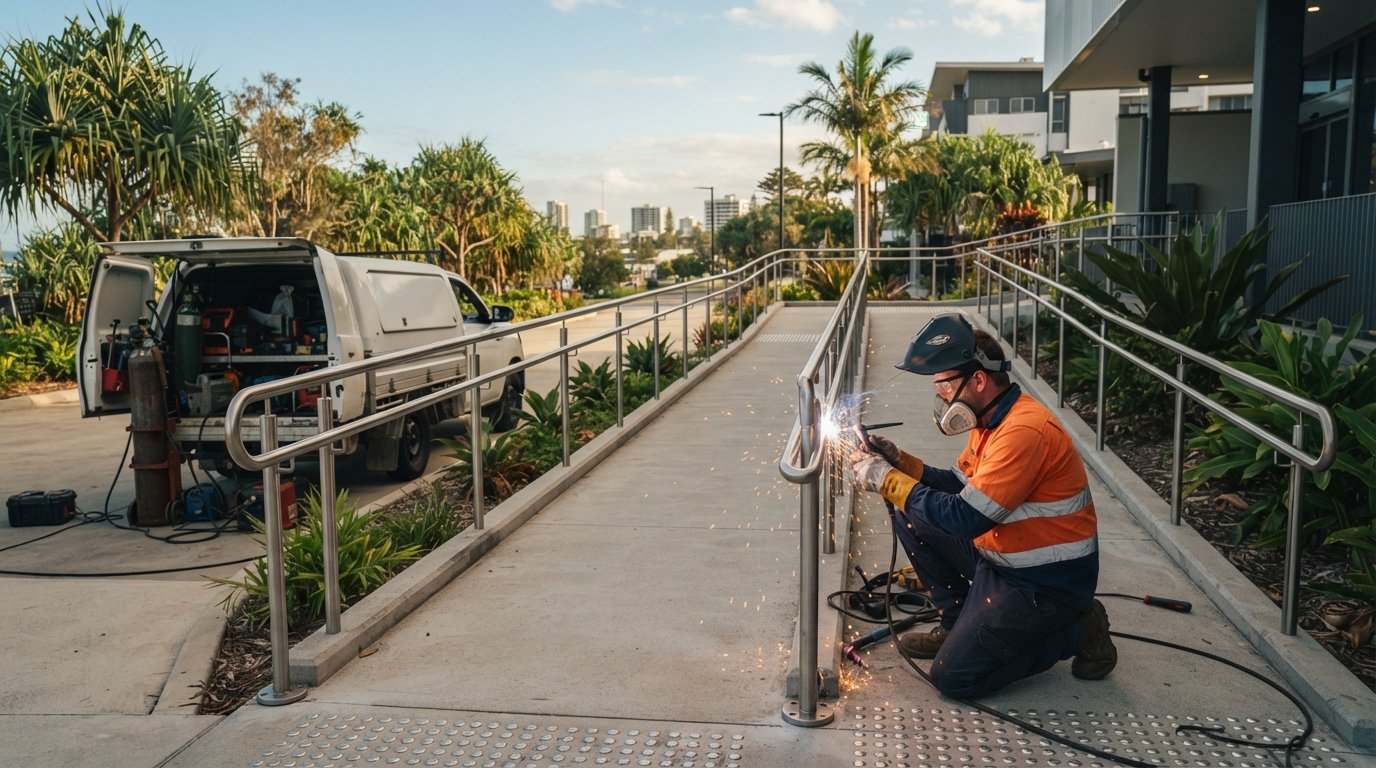
Our approach centres on the use of a fully equipped mobile workshop. This capability is essential for minimising disruption, particularly in active healthcare facilities or high-traffic commercial centres. Instead of measuring, leaving to fabricate elsewhere, and returning to find a poor fit, we perform the final engineering on-site. This method is particularly effective for retrofitting older buildings in Brisbane and the Gold Coast where original architectural plans may no longer be accurate. We ensure every bracket and termination aligns perfectly with the existing structure, providing an audit-proof result that looks integrated rather than bolted on.
On-Site Fabrication and Mobile Welding
One of the greatest challenges in the field is “un-level” concrete. Even in new builds, slight variances in the slab can make standard modular systems impossible to install correctly. Our mobile workshop welding Brisbane service allows our team to make real-time adjustments. We can trim, angle, and fuse components on the spot to compensate for site-specific irregularities. This flexibility is also vital for urgent safety repairs where a damaged rail creates an immediate liability and needs to be restored to full compliance without delay.
Project Management from Brisbane to the Gold Coast
Executing a project in busy areas like Logan, Ipswich, or the Brisbane CBD requires disciplined project management. We coordinate closely with other trades, such as landscapers and concreters, to ensure our mounting points are prepared correctly. Managing site access in high-traffic zones is a priority; we schedule our work to maintain public safety while keeping the project on track. Once the installation is complete, we provide the necessary documentation and compliance sign-off. This paperwork is crucial for building certifiers to finalise the occupancy permit. If you need a team that understands the logistical demands of South East Queensland, contact Donewright Stainless to discuss your project requirements.
Custom Fabrication with Donewright Stainless
Choosing the right partner for your project means looking beyond the quote to the level of expertise on the tools. Ian ‘Wrighty’ Wright provides personal oversight on every project involving disability access handrails QLD, ensuring the ‘Done Right’ philosophy is applied to every weld and mounting point. This hands-on approach is what separates a generic installation from a bespoke safety system. We understand that while compliance with AS 1428.1 is the mandatory baseline, the final result should also complement the architectural style of your building. Whether it’s a sleek CBD office or a heritage refurbishment, our custom fabrication ensures your handrails look like an intentional design choice rather than an afterthought.
Our commitment extends across the full spectrum of safety standards, including AS 1657 for fixed platforms and walkways. By managing the process from the initial site survey through to the final polish, we eliminate the communication gaps that often lead to compliance failures. Our team doesn’t just build to code; we build to last. We’re proud to serve the wider South East Queensland region, including Brisbane, Gold Coast, Logan, and Ipswich, providing high-quality solutions that withstand both heavy use and our demanding local climate.
Specialised Solutions for Aged Care and Schools
Designing for aged care facilities and schools requires a nuanced approach that balances rigorous safety with a sense of place. In aged care, the goal is to provide reliable support that feels ‘homely’ rather than institutional. For those looking to further enhance these facilities, Find Memory Care offers specialised products to create more supportive, dementia-friendly environments. We achieve this through meticulous finishing and ergonomic designs that are comfortable to the touch. Conversely, school environments demand heavy-duty safety handrail fabrication Brisbane to survive the constant wear and tear of high-volume student traffic. Our welded stainless steel systems provide the necessary durability to ensure these public spaces remain safe and accessible for years without the need for constant repairs.
Navigating a building audit can be a stressful experience if your accessibility systems aren’t up to scratch. We’ve built a strong track record with local QLD councils and private developers by delivering disability access handrails QLD that pass inspection the first time. Our deep understanding of the current AS 1428.1:2021 revision details allows us to provide honest advice and precision engineering that certifiers trust. If you’re preparing for a new build or retrofitting an existing property, don’t leave your compliance to chance. Contact Ian and the team today for a custom stainless steel fabrication Brisbane quote and ensure your project is completed to the highest professional standard.
Securing Compliance for Your Next Project
Achieving full compliance for your property doesn’t have to be a source of stress. By prioritising custom-welded stainless steel over modular alternatives, you ensure a seamless, hygienic, and audit-proof finish that stands up to the Queensland climate. Whether you’re retrofitting a commercial building in Brisbane or developing a new facility on the Gold Coast, the precision of a site-specific installation makes all the difference. Precise engineering ensures that your safety systems remain functional and visually appealing for the long term.
Donewright Stainless brings expert knowledge of AS 1428.1 to every job, backed by a fully mobile on-site welding workshop that handles adjustments in real-time. We’re proud to serve communities across Brisbane, Gold Coast, Logan, and Ipswich with safety systems that are built to last. If you’re ready to ensure your disability access handrails QLD are done right the first time, our team is here to help you navigate the technical requirements with ease. We look forward to helping you create a space that’s safe and accessible for everyone.
Request a Quote for Compliant Disability Handrails and take the first step toward a safer, more accessible property today.
Frequently Asked Questions
What is the difference between DDA and AS 1428.1 handrails?
The Disability Discrimination Act (DDA) is federal legislation that mandates equal access for people with disabilities. It sets the legal requirement, while AS 1428.1 is the specific Australian Standard providing the technical design criteria to meet those obligations. While the DDA requires access, AS 1428.1 provides the dimensions for the physical installation of disability access handrails QLD. Following the standard ensures your property satisfies the legal mandates of the Act.
Do I need a disability handrail for a small business entrance in QLD?
Under the DDA, all commercial premises must provide non-discriminatory access to the public. If your entrance includes a ramp or stairs, compliant handrails are generally mandatory to satisfy the National Construction Code. Small businesses in Brisbane or Logan aren’t exempt from these accessibility requirements. Failing to provide a safe, compliant entry can lead to legal liability and forced retrofits. Ensuring your entrance meets current standards from the start is the most cost-effective approach.
Which stainless steel grade is best for Gold Coast handrails?
For any project on the Gold Coast or near the Moreton Bay region, Grade 316 stainless steel is the only reliable choice. Often called “Marine Grade”, it contains molybdenum to resist the pitting and tea-staining caused by salt-laden air. Grade 304 is suitable for inland Brisbane CBD offices, but it will quickly corrode in coastal environments. Using 316 ensures your safety systems retain their structural integrity and polished appearance despite Queensland’s harsh, humid conditions.
Can you retrofit disability handrails to existing concrete ramps?
Yes, we frequently retrofit disability access handrails QLD to existing concrete ramps and stairs across South East Queensland. Our mobile workshop allows us to core-drill into the concrete for a secure subterranean mount or use heavy-duty base plates for surface mounting. This process is ideal for bringing older commercial buildings in Ipswich or the Gold Coast up to modern compliance standards. We adjust the fabrication on-site to ensure the rails follow the existing gradient perfectly.
How much clearance is required between a handrail and the wall?
AS 1428.1 requires a minimum clear gap of 50mm between the handrail and the wall or any other obstruction. This clearance ensures that a person’s hand can glide along the rail without being interrupted or injured by the mounting surface. The gap must be maintained along the entire length of the rail. Additionally, the mounting brackets shouldn’t obstruct the top 270 degrees of the rail’s diameter to allow for a continuous, secure power grip for all users.
Are modular handrails as strong as welded stainless steel ones?
Modular handrails rely on mechanical fixings like grub screws, which can vibrate loose over time in high-traffic commercial areas. Custom-welded stainless steel provides significantly higher lateral strength because the components are fused into a single, rigid structure. This is particularly important for meeting the load-bearing requirements of AS 1170.1. A welded system won’t rattle or fail under sudden pressure, providing a much higher level of long-term safety and security for your facility.
How often should commercial handrails be inspected for safety?
Commercial handrails should be inspected at least every twelve months as part of your building’s preventative maintenance schedule. In high-use public spaces or harsh coastal environments like the Gold Coast, bi-annual checks are often better. These inspections ensure that fixings remain tight, the surface is free of burrs, and the structural integrity hasn’t been compromised. Regular maintenance helps you identify minor issues before they become significant safety hazards or lead to a failed accessibility audit.
Does Donewright Stainless provide compliance documentation after installation?
Yes, Donewright Stainless provides the necessary compliance documentation and sign-off once the installation is finished. This paperwork is essential for your building certifier and provides a formal record that your safety systems meet AS 1428.1 and NCC requirements. Having this documentation ready is a critical part of the “Done Right” philosophy. It gives property owners in Brisbane and the Gold Coast peace of mind that their accessibility project will stand up to any official scrutiny.
