
Custom Fabrication Mild Steel Aluminium Brisbane: The Industrial Guide
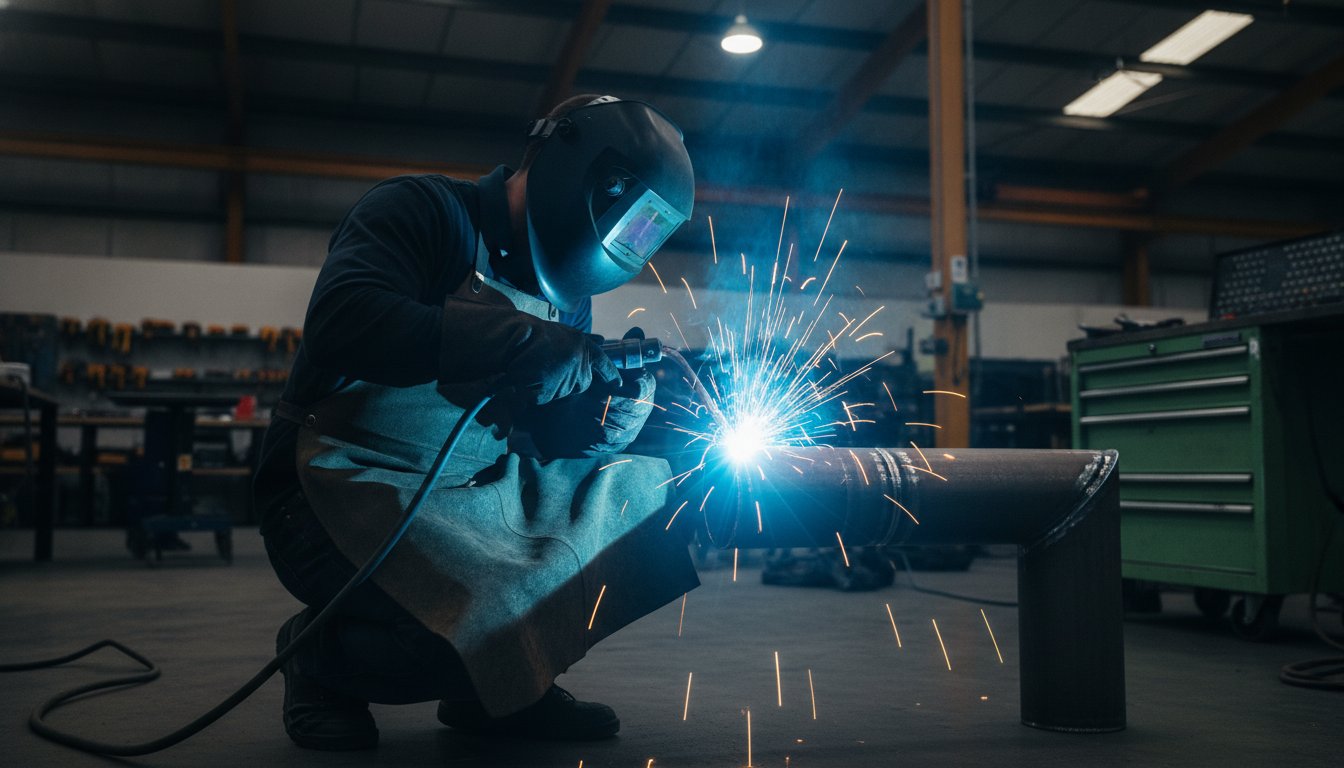
In the salt-heavy air of Brisbane and the Gold Coast, the most expensive metalwork isn’t the one with the highest quote; it’s the one that fails two years early because the material couldn’t handle the humidity. Whether you are upgrading a processing plant or installing safety handrails, you understand that durability is non-negotiable. Getting custom fabrication mild steel aluminium right requires more than just a welder. It demands a strategic approach to material selection and engineering that accounts for the specific rigours of the South East Queensland climate.
You need results that are compliant with Australian safety standards like AS 1657, yet you can’t afford the operational downtime often caused by off-site fabrication delays. This guide provides the essential knowledge required to master custom metalwork for industrial and commercial projects. We will examine how to choose between the strength of mild steel and the corrosion resistance of aluminium, the advantages of utilising a mobile workshop for on-site precision, and how to ensure every bench, trolley, or handrail remains a long-term asset rather than a maintenance liability.
Key Takeaways
- Understand why South East Queensland’s coastal environment necessitates specific material choices to prevent corrosion and long-term degradation.
- Learn how to balance structural strength and weight by selecting the right custom fabrication mild steel aluminium options for your specific industrial application.
- Discover how mobile workshop services eliminate the risks of off-site transport and measurement errors by delivering precision engineering directly to your facility.
- Ensure your project remains fully compliant with Australian Standards, including AS 1657, for all safety handrails, platforms, and custom trolleys.
- Explore bespoke solutions for Brisbane industry, ranging from custom benches for commercial kitchens to specialised industrial pipework for plant upgrades.
The Essentials of Custom Metal Fabrication in South East Queensland
In Brisbane and the surrounding regions, industrial operations rarely fit into a standard box. Standardised components often fall short when integrated into complex plant layouts or specialised commercial kitchens. This is where the value of bespoke engineering becomes clear. Understanding What is Metal Fabrication? is the first step in seeing how raw materials are transformed into functional assets. It involves a systematic approach to designing and manufacturing metal solutions that are built for a specific purpose rather than a general category. This process ensures that every bracket, bench, or pipework system is tailored to the exact dimensions and operational needs of the site.
The South East Queensland climate presents unique challenges that are often overlooked by national suppliers. High humidity and salt-laden air from the coast accelerate corrosion, making material selection a critical decision for any project manager. A skilled fabricator acts as a problem-solver, identifying potential points of failure before the first weld is even struck. For local industrial plants, custom fabrication mild steel aluminium provides the versatility needed to address specific site challenges. These two materials form the backbone of local industry, providing a balance of cost-effectiveness and structural integrity that can withstand the local environment when treated and finished correctly.
The Fabrication Lifecycle: From Concept to Installation
The process begins with a precise site measurement. Relying on blueprints alone is a risk; physical site conditions often change during construction or facility upgrades. Once measurements are confirmed, material selection is based on the specific load requirements and the level of environmental exposure. Precision welding and finishing are the final steps that ensure longevity. A poorly finished joint is an invitation for rust, whereas a meticulous weld ensures the structure remains safe and compliant for years, particularly when dealing with safety-critical items like handrails and platforms.
Why Local Brisbane Expertise Matters
Choosing a local partner goes beyond supporting the SEQ economy. It’s about practical logistics and regulatory compliance. Brisbane-based fabricators understand the specific council regulations and industrial zone requirements that apply to Logan, Ipswich, and the Gold Coast. When a critical piece of equipment fails, a local team can provide quick response times for urgent repairs. Securing long-term results through custom fabrication mild steel aluminium involves more than just a quick fix; it requires a deep understanding of local standards and environmental demands. This proximity reduces downtime and ensures that maintenance is handled by professionals who are familiar with the specific rigours of the Queensland industrial landscape.
Mild Steel vs Aluminium: Choosing the Right Material for Your Project
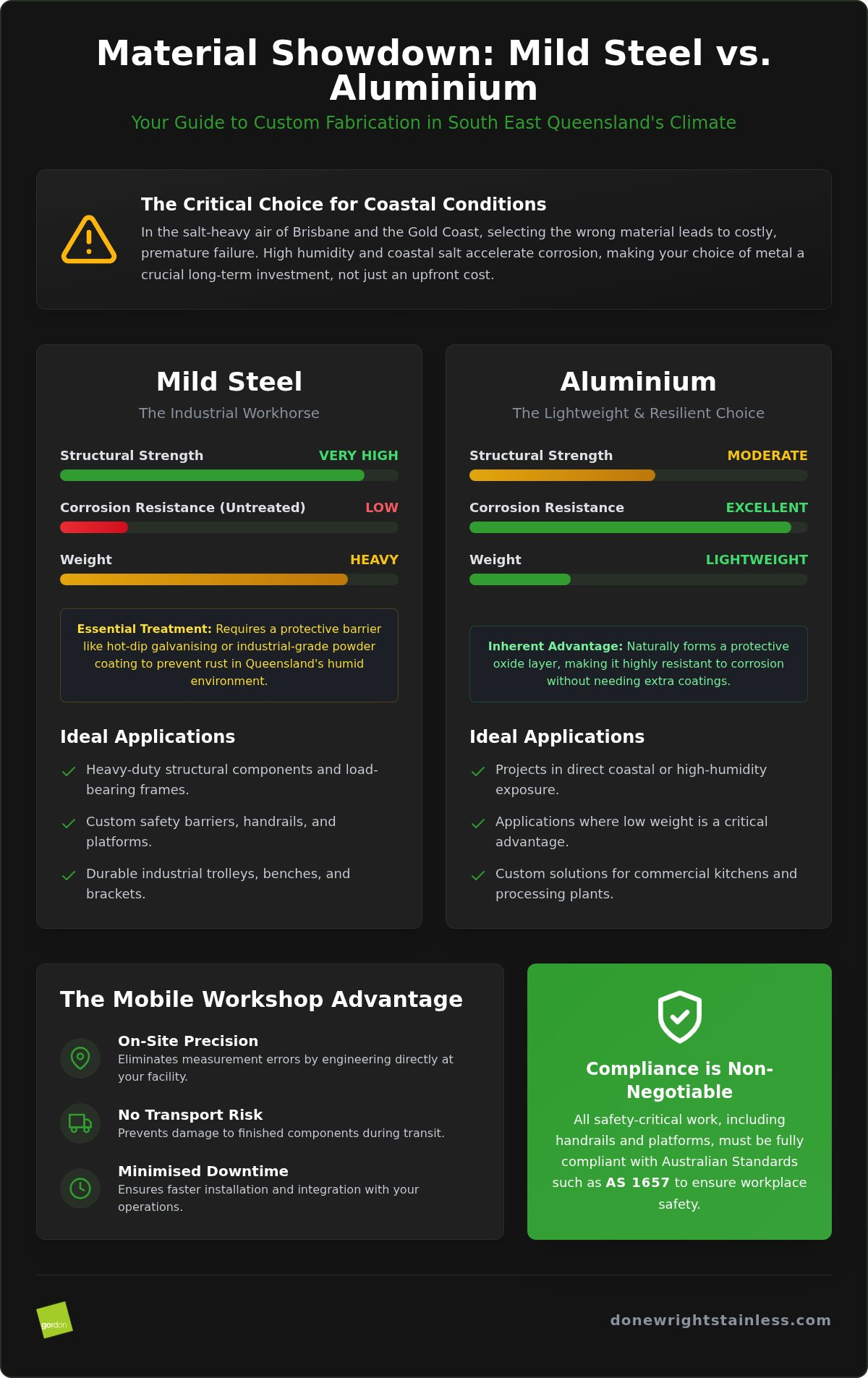
Selecting the right metal for an industrial project in Brisbane involves a strategic trade-off between structural demand and environmental exposure. While both materials are central to custom fabrication mild steel aluminium workflows, their performance profiles differ significantly. The decision typically hinges on whether the priority is raw load-bearing capacity or long-term resistance to the elements. Understanding these nuances prevents premature equipment failure and ensures the investment remains viable for its intended lifespan.
Mild Steel: The Industrial Workhorse
Mild steel serves as the backbone for heavy-duty applications where structural integrity is the primary requirement. Its high tensile strength makes it the ideal choice for custom brackets, safety barriers, and trolleys designed to carry significant weight in a warehouse or plant environment. Because mild steel is susceptible to oxidation, particularly in the humid Queensland climate, the finishing process is just as important as the fabrication itself. Utilising hot-dip galvanising or industrial-grade powder coating creates a robust barrier against rust. Adhering to Australian standards for welding ensures that these high-stress joints maintain their safety margins under constant operational use.
Aluminium: Lightweight Precision
Aluminium provides a superior strength-to-weight ratio, which is a critical factor for transport equipment and mobile industrial assets. Along the Gold Coast, where salt air is a constant corrosive threat, aluminium’s natural oxide layer offers a level of protection that untreated steel cannot provide. This material is also non-magnetic and non-sparking, making it a mandatory requirement in sensitive industrial zones or facilities handling flammable materials. Achieving a clean, strong finish on aluminium requires specialised welding techniques to manage its high thermal conductivity and prevent porosity. This precision ensures that components like custom walkways or marine-grade fittings remain durable without the need for heavy protective coatings.
Balancing the initial investment against long-term maintenance needs is the final step in the selection process. Mild steel often presents a lower upfront cost for materials but requires diligent monitoring of its protective finishes to prevent structural decay. Aluminium typically carries a higher initial price point, yet it often pays for itself through reduced weight and minimal maintenance requirements in corrosive environments. If you are weighing up these options for your next facility upgrade, consulting an expert in Mild Steel Fabrication can provide the technical clarity needed to make an informed choice based on your specific site conditions.
On-Site Mobile Fabrication: Solving the Logistics of Custom Industrial Installs
Traditional fabrication often involves a cycle of measurement, off-site manufacturing, and heavy transport. This gap between the workshop and the site creates a window for measurement errors or transport damage that can derail a project’s timeline. In complex industrial environments, even a five-millimetre discrepancy can halt an entire installation. A fully equipped mobile workshop eliminates these variables by bringing the factory directly to the facility. This approach allows for custom fabrication mild steel aluminium projects to be adjusted in real-time, ensuring a perfect fit within existing infrastructure without the need for multiple site visits or costly rework.
For industrial plants in Brisbane and the surrounding regions, the primary goal is reducing downtime. When a critical component requires replacement, waiting for a part to be fabricated off-site and delivered is often not an option. Fabricating in-situ allows for a level of precision that blueprints alone cannot provide. It enables the fabricator to account for floor levels, existing pipework, and structural obstacles as they appear. This results in a more integrated finished product that functions exactly as intended within the specific constraints of the site.
Mobile Welding and Engineering Capabilities
Having the capacity to perform on-site TIG and MIG welding is essential for maintaining industrial pipework and structural assets. Whether it’s a mild steel bracket or an aluminium safety guard, performing the work in-situ means repairs can be executed without dismantling entire production lines. This is particularly vital for emergency maintenance. If a safety protection system is damaged, a mobile unit can restore compliance immediately, preventing extended shutdowns. The ability to switch between welding processes allows the team to handle diverse materials with the precision typically reserved for a controlled workshop environment.
Minimising Operational Disruption
Productivity is the lifeblood of Brisbane’s industrial sector. We organise our fabrication schedules around your plant operating hours to ensure minimal interference with daily workflows. This requires strict adherence to safety protocols, including flash screening and fume extraction, to protect your staff while work is underway. For instance, when integrating custom stainless steel fabrication Brisbane components into a larger project, the coordination between the mobile workshop and the site manager ensures a seamless transition. By fabricating in-situ, we remove the transport risks that often plague large-scale installations, delivering a finished product that is both durable and perfectly aligned with the facility’s specific layout.
Design and Compliance: Navigating Australian Standards for Custom Metalwork
In the industrial sectors of Brisbane and South East Queensland, “near enough” is a phrase that carries significant legal and safety risks. Compliance with Australian Standards is not a suggestion; it’s a mandatory requirement that protects both the workforce and the business owner. When commissioning bespoke metalwork, the design must account for specific load ratings and structural integrity from the outset. This is especially true for safety-critical infrastructure where a failure could result in catastrophic operational disruption or workplace injury. Ensuring that custom fabrication mild steel aluminium projects meet these benchmarks requires a disciplined approach to engineering and a deep understanding of the regulatory landscape.
The primary standard governing industrial access is AS 1657, which covers the design and installation of fixed platforms, walkways, stairways, and ladders. Any custom-built mezzanine or access bridge must adhere to these specifications to pass a safety audit. Beyond structural access, custom trolleys and benches must be designed with workplace health and safety (WHS) in mind, focusing on ergonomic heights and weight capacities. Load rating and structural certification provide the documented proof that your assets are fit for purpose, giving you the confidence that your facility remains fully compliant under current Queensland safety legislation.
5 Steps to Compliant Custom Fabrication
Achieving a compliant result is a systematic process that begins long before the first piece of metal is cut. We follow a rigorous workflow to ensure every project stands up to scrutiny:
- 1. Detailed site audit: Identifying specific hazards and spatial constraints that influence the design.
- 2. Engineering design check: Verifying the concept against relevant Australian Standards to ensure structural stability.
- 3. Precise material specification: Selecting the correct grade, such as 316 stainless steel for chemical resistance or 6061 aluminium for structural frames.
- 4. Qualified welding: Assembly performed by experienced tradesmen who understand the nuances of different metal alloys.
- 5. Final inspection: Providing the necessary compliance documentation required for your facility’s safety records.
Specialist Standards for Food and Sanitary Environments
For Brisbane food processing plants and laboratories, compliance extends into the realm of hygiene and sanitation. Fabricating to HACCP requirements involves more than just using the right material; it requires a design that eliminates bacterial traps. This means ensuring custom benches and equipment feature smooth, continuous welds and crevice-free joins that can be easily sanitised. For those requiring compliant access solutions in these sensitive areas, Safety handrail fabrication Brisbane provides the framework for systems that are both safe and sanitary. If you need to upgrade your facility to meet modern safety benchmarks, you can consult with our compliance experts to ensure your next project is built to last and fully certified.
Bespoke Solutions for Brisbane Industry: From Custom Benches to Industrial Pipework
Industrial facilities in South East Queensland require more than just off-the-shelf hardware to maintain peak efficiency. Whether it’s the precise routing of industrial pipework for fluid and gas transport or the installation of custom safety barriers, the physical layout of your site dictates the engineering requirements. When investing in custom fabrication mild steel aluminium, the goal is to create assets that integrate seamlessly into your existing workflow. This includes safety protection systems such as bollards and guard rails that are designed to protect both your staff and your infrastructure from accidental damage in high-traffic zones.
Beyond structural items, specialised environments like commercial kitchens and laboratories require bespoke workbenches and bench tops. These items must be more than just durable; they must be designed for the specific chemical exposures or sanitary requirements of the facility. By tailoring the dimensions and finishes to the available space, you eliminate the awkward gaps and inefficient layouts that often plague standard installations. This bespoke approach ensures that every square metre of your facility is utilised effectively.
Custom Industrial Trolleys and Benches
This level of bespoke engineering is also required for specialised equipment like high-performance motion simulators; for instance, Race@Home uses custom metalwork to ensure their rigs can withstand the forces of professional-grade racing components.
Designing effective industrial trolleys and benches is an exercise in ergonomics. A bench that is ten centimetres too low or a trolley that is difficult to steer can lead to workplace fatigue and reduced productivity. Choosing between aluminium for easy manoeuvrability and mild steel for heavy-duty load capacities depends entirely on the application. We integrate site-specific features such as heavy-duty locking mechanisms, specialised handles, and high-quality castors to ensure that every piece of equipment performs reliably under the specific conditions of your plant.
The Donewright Advantage: Quality Without the Fuss
The “Wrighty” approach is built on a foundation of honest advice and meticulous craftsmanship. Ian Wright and the team understand that industrial clients value results over flashy marketing. This philosophy is evident across all our work, particularly in mild steel fabrication Brisbane, where we provide industrial-strength solutions tailored to diverse local needs. From the initial sketch to the final mobile on-site installation, we manage every detail to ensure your project is completed with minimal operational disruption.
Every weld and every joint is a reflection of our commitment to longevity and precision. We don’t just deliver a product; we provide a reliable engineering partnership that supports the ongoing maintenance and growth of your business. If you are ready to upgrade your facility with metalwork that is built to last, Enquire about your custom fabrication project today.
Securing Your Industrial Infrastructure for the Long Term
Successful industrial projects in South East Queensland depend on more than just high-quality welds. They require a strategic approach to material selection and a commitment to strict regulatory compliance. By choosing the right material for the specific environmental demands of your site, you ensure that your investment remains a durable asset rather than a maintenance burden. Expertise in custom fabrication mild steel aluminium ensures that every component, from heavy-duty trolleys to bespoke benches, is engineered for the rigours of the Brisbane climate.
Donewright Stainless simplifies the process by providing a mobile workshop for on-site engineering, reducing operational downtime and ensuring a perfect fit every time. As a Brisbane-owned and operated business, we’re AS 1657 compliance specialists who deliver results without the fuss. When you need reliable metalwork that meets the highest Australian standards, we’re ready to assist with your next facility upgrade. Take the first step toward a more efficient and compliant workspace by reaching out to our team of experts.
Get a Quote for Your Custom Fabrication Project
Frequently Asked Questions
Is aluminium or mild steel better for outdoor use in Brisbane?
Aluminium is generally superior for Brisbane’s coastal environments because it forms a natural oxide layer that resists corrosion. While mild steel provides immense structural strength, it requires hot-dip galvanising or industrial powder coating to survive the local humidity. The choice often depends on whether your priority is the lightweight, rust-resistant properties of aluminium or the heavy-duty load capacity of treated steel for structural frames.
What industries do you provide custom fabrication for in South East Queensland?
We serve a broad range of sectors across the region, including food processing, commercial hospitality, and pharmaceutical laboratories. Our work often involves creating sanitary solutions for kitchens or heavy-duty infrastructure for manufacturing plants. By providing custom fabrication mild steel aluminium, we support logistics hubs in Logan and industrial facilities in Ipswich with tailored equipment that standard suppliers cannot provide for specialised plant layouts.
Do you offer on-site mobile welding for custom projects?
Yes, our fully equipped mobile workshop is designed specifically for on-site engineering and welding. We provide both TIG and MIG welding services directly at your facility to ensure a perfect fit and eliminate transport risks. This mobile workshop service is a core part of our commitment to reducing operational downtime for our clients, allowing repairs and installations to happen without removing existing infrastructure.
Can you fabricate custom trolleys and benches to specific load ratings?
Every trolley and bench we manufacture is engineered to meet your specific load-bearing requirements and ergonomic needs. We don’t believe in a one-size-fits-all approach; instead, we calculate weight capacities based on your intended use. Whether you need a lightweight aluminium trolley for a laboratory or a heavy-duty mild steel workbench for a workshop, we ensure the design remains safe and functional under constant daily use.
What Australian Standards do your custom handrails and safety systems follow?
All our safety systems, including handrails and access platforms, are fabricated to strictly follow AS 1657. This Australian Standard governs the design and installation of walkways and ladders to ensure they provide safe passage for workers. Adhering to these regulations is essential for workplace health and safety (WHS) compliance, providing you with documented proof that your custom infrastructure meets the necessary legal safety benchmarks.
How do you prevent corrosion in mild steel projects near the coast?
Preventing corrosion in coastal areas like the Gold Coast requires high-quality protective finishes. For mild steel, we typically recommend hot-dip galvanising or a multi-stage powder coating process to create a durable moisture barrier. In some cases, we might suggest switching to custom fabrication mild steel aluminium or stainless steel for components that are in direct contact with salt spray to ensure the longest possible service life for your assets.
Do you handle industrial pipework repairs for existing systems?
We specialise in industrial pipework maintenance and repairs for both fluid and gas transport systems. Our team can perform on-site modifications to existing infrastructure, ensuring that your systems remain leak-free and compliant with current standards. Using our mobile workshop, we handle everything from minor repairs to significant system upgrades, helping you maintain the efficiency and safety of your plant’s essential services without extended shutdowns.
How quickly can your mobile workshop respond to an urgent repair in Logan or Ipswich?
Being based in Brisbane allows us to provide rapid response times for urgent repairs across Logan, Ipswich, and the Gold Coast. While specific arrival times depend on current scheduling, our mobile workshop is designed to move quickly to site to address safety-critical failures or production-halting issues. We prioritise industrial maintenance calls to help local businesses resume their operations as fast as possible with minimal disruption to their productivity.
