
AS 1657 Handrail Repair Brisbane: Ensuring Compliance and Industrial Safety
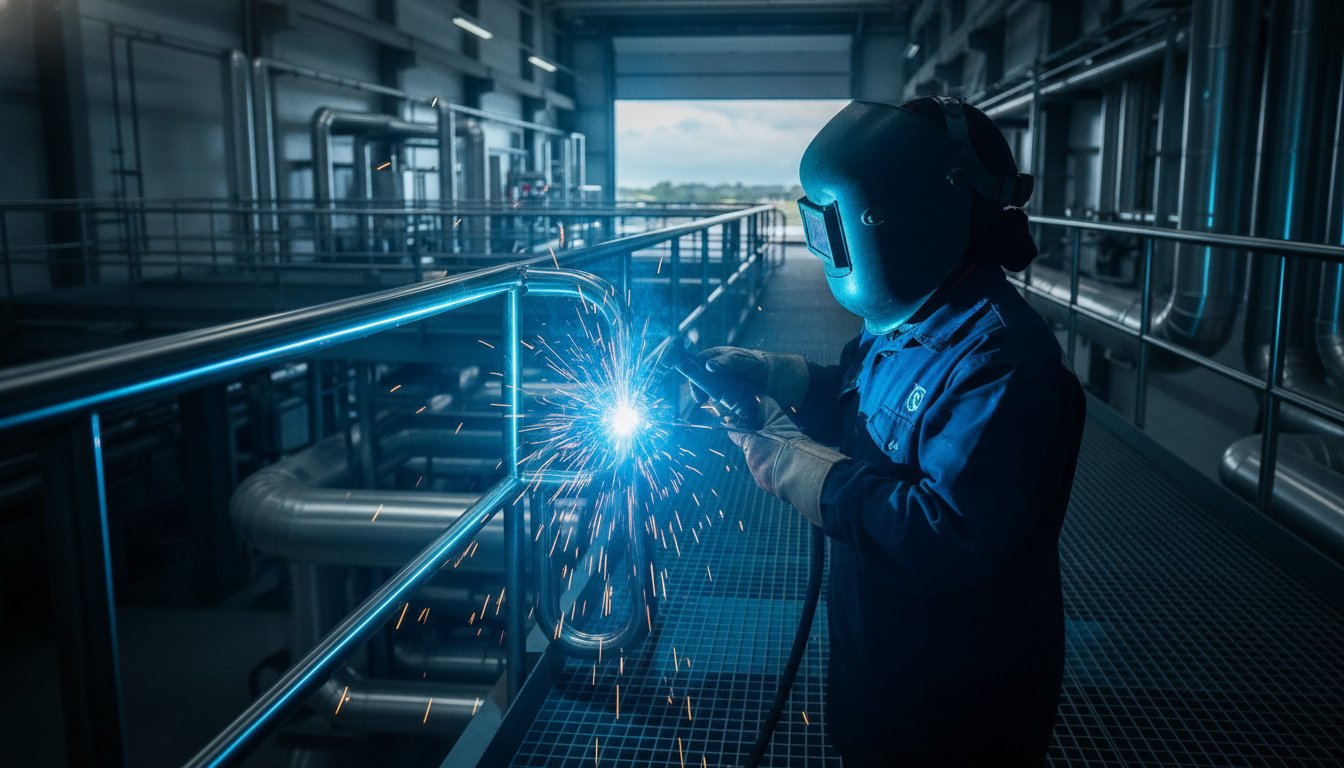
A single non-compliant handrail isn’t just a minor maintenance oversight; it’s a significant legal liability that can halt your entire operation during a WHS audit. You likely already know that keeping your team safe is the top priority, but the 2018 updates to the Australian Standard have left many facility managers feeling uncertain about their existing infrastructure. Between the strict 10mm kickplate clearance rules and the specific height requirements for walking surfaces, ensuring a precise AS 1657 handrail repair Brisbane project is completed correctly requires more than just a temporary patch.
We understand the pressure of maintaining a compliant site while battling the corrosive humidity of coastal Brisbane or the heavy wear of a food processing plant. This article will help you master the technical requirements for AS 1657 compliance and demonstrate why custom-welded repairs are the most reliable way to guarantee industrial safety. You’ll gain a clear understanding of mandatory measurements and learn how a mobile workshop approach provides a “Done Right” solution that meets Australian law while ensuring minimal downtime for your facility.
Key Takeaways
- Understand why AS 1657:2018 is the non-negotiable benchmark for industrial safety and how it dictates every aspect of your site’s handrail maintenance.
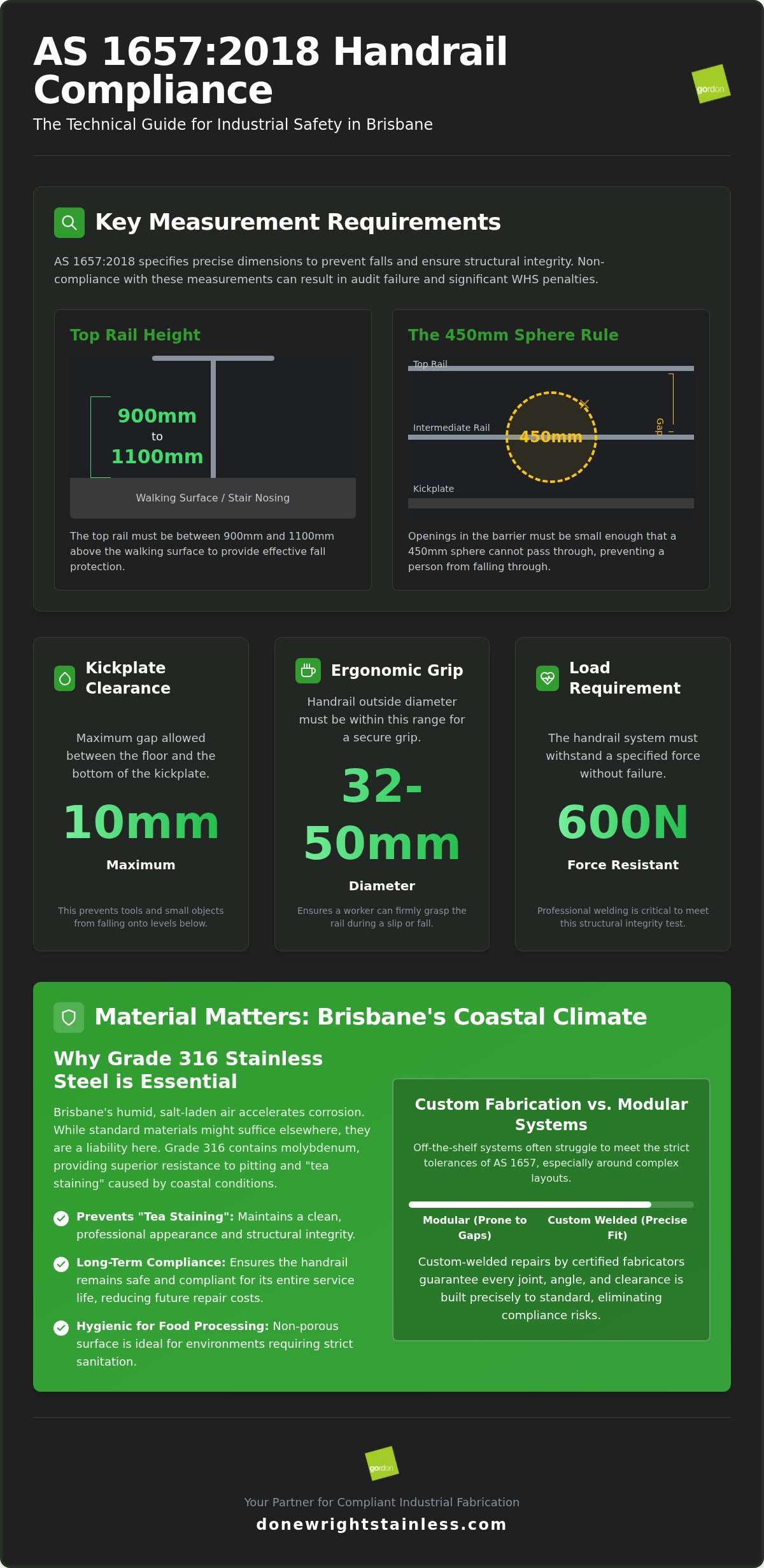
- Learn the critical measurements for compliance, including the mandatory 900mm to 1100mm height range and the 450mm “sphere rule” for intermediate rails.
- Discover why custom-welded AS 1657 handrail repair Brisbane services offer superior structural integrity and corrosion resistance compared to standard modular systems.
- Identify the importance of selecting Grade 316 stainless steel to prevent “tea staining” and structural degradation in Brisbane’s humid coastal environment.
- Minimise operational downtime by utilising mobile workshop services that allow for precise, on-site fabrication and immediate compliance adjustments.
What is AS 1657 and Why Does it Govern Brisbane Handrail Repair?
AS 1657:2018 is the definitive Australian Standard for the design, construction, and installation of fixed platforms, walkways, stairways, and ladders. Developed by Standards Australia, it serves as the technical benchmark for industrial safety across the country. For facility managers, a compliant AS 1657 handrail repair Brisbane project isn’t just about ticking a box; it’s about fulfilling a legal Duty of Care under the Work Health and Safety (WHS) Act. The primary objective is simple: ensure every worker has safe access to their station and prevent catastrophic falls in high-risk zones.
The 2018 update introduced several critical shifts that facility managers must understand. These changes weren’t merely cosmetic; they focused on improving structural integrity and reducing the risk of falling objects. For instance, the standard now mandates specific clearances for kickplates and tighter tolerances for rail heights. If your infrastructure was installed under the 1992 or 2013 versions, it may no longer meet current safety audit requirements, potentially exposing your business to significant WHS penalties.
Where AS 1657 Applies in Your Facility
Industrial environments differ significantly from commercial office blocks. While the National Construction Code (NCC) governs public access areas, AS 1657 is the authority for boiler rooms, mezzanine storage levels, and rooftop plant equipment. In South East Queensland, these areas often face unique challenges. Food processing plants require strict hygiene, while coastal facilities deal with salt-laden air. We recommend Grade 316 stainless steel for these environments to prevent “tea staining” and structural pitting, ensuring the railing remains compliant for its entire service life.
The Role of the Fabricator in Compliance
Safety isn’t a matter of “close enough.” A handrail that looks sturdy might fail when subjected to the mandatory 600N force requirement specified in the standard. Professional fabrication ensures every joint is fully welded and every post is spaced to meet the 2018 update’s requirements, such as the 10mm maximum clearance for kickplates. Using non-compliant imports or uncertified materials creates a legal liability. We focus on material traceability and high-grade Australian Standard stainless steel to ensure your AS 1657 handrail repair Brisbane stands up to both physical stress and regulatory scrutiny. Meticulous craftsmanship isn’t just a point of pride; it’s your best defence against workplace accidents.
Technical Fabrication Requirements for AS 1657 Compliance
Meeting the technical specifications of AS 1657:2018 requires more than just a tape measure. It demands a deep understanding of how metal behaves under load and how workers interact with infrastructure. For any AS 1657 handrail repair Brisbane project, the height of the top rail must sit between 900mm and 1100mm from the walking surface or stair nosing. If it’s too low, it becomes a trip hazard; too high, and it’s impossible to reach during a slip. This precision is vital because it aligns with the Code of Practice for managing the risk of falls, which provides the framework for all industrial safety installations in Australia.
The “Sphere Rule” is another non-negotiable fabrication requirement that we see missed in DIY or substandard repairs. The gap between the top rail and the intermediate rail, or the intermediate rail and the kickplate, must be small enough that a 450mm diameter sphere cannot pass through. While modular systems often struggle with this in tight corners or steep stairways, custom fabrication allows us to adjust stanchion spacing and rail placement to ensure compliance regardless of the site layout. Balancing structural rigidity with these constraints is where the expertise of a master fabricator becomes essential.
Handrail Diameters and Ergonomic Grip
A handrail is only effective if a worker can actually grip it during an emergency. The standard specifies an outside diameter between 32mm and 50mm. This range is the “sweet spot” for a power grip, allowing a person to wrap their hand fully around the rail. We ensure all rails are continuous, with no sharp edges or snag points that could cause injury. There must also be sufficient clearance behind the rail to ensure a proper grip isn’t obstructed by the wall or the stanchions themselves.
Kickplates and Safety Barriers
Kickplates, or toe boards, serve a dual purpose. They must have a minimum height of 100mm and a maximum gap of 10mm from the floor to prevent tools or equipment from falling onto workers below. In high-vibration environments, like those found in local manufacturing plants, we use specific welding techniques to ensure these plates don’t rattle loose or create noise pollution. Where the risk of falling objects is particularly high, we often recommend mesh infill instead of a single mid-rail to provide an enhanced safety barrier. If you’re unsure if your current setup meets these strict specs, our mobile workshop services can provide a precise site assessment and immediate on-site adjustments.
Custom Fabrication vs. Modular Handrail Systems
Choosing between a modular kit and custom fabrication often comes down to a choice between temporary convenience and long-term structural integrity. Modular systems rely on mechanical fasteners, such as grub screws and sleeve connectors, to hold the assembly together. In a high-vibration Brisbane manufacturing plant, these fasteners inevitably loosen over time, leading to rattles and compromised safety. A fully welded joint, by contrast, creates a monolithic structure that can withstand the heavy-duty demands of industrial platforms without the need for constant retightening. This is why a professional AS 1657 handrail repair Brisbane project should prioritise site-specific fabrication over off-the-shelf components.
The difference in longevity is particularly evident in corrosive environments. Modular fittings create tiny crevices where moisture, salt, and chemicals can collect. This leads to crevice corrosion and “tea-staining,” a common issue in humid South East Queensland. Custom-fabricated stainless steel allows for smooth, passivated welds that eliminate these corrosion traps entirely. While the initial investment in custom work may be higher, the reduction in long-term maintenance and the avoidance of premature replacement make it the more cost-effective choice for serious industrial operations. The “Done Right” look of custom-contoured steel also provides a professional finish that reflects a commitment to site safety.
The Hidden Risks of Modular Fittings
Beyond structural concerns, modular systems often struggle with the precise geometry of established industrial sites. Achieving the exact angles required for AS 1657 compliance is difficult when you’re limited by pre-set 90-degree or 45-degree connectors. This often results in “close enough” installations that may fail a strict safety audit. In coastal Logan or Gold Coast facilities, the humid air accelerates degradation in these fittings. When a mechanical joint fails, the entire section of railing can become a hazard, whereas a welded system maintains its protective capacity even under extreme stress.
The Custom Advantage for Complex Layouts
Industrial environments are rarely straightforward. New safety rails often need to be tailored to fit around existing industrial pipework Brisbane, electrical conduits, or structural columns. Our mobile workshop allows us to perform on-site welding, ensuring a perfect fitment in even the most awkward spaces. This bespoke approach ensures seamless transitions between stairways and level walkways, maintaining the required continuity and grip clearance without the clumsy transitions typical of modular setups. By investing in custom fabrication, you’re choosing a permanent solution that integrates perfectly with your facility’s unique layout.
The Repair and Installation Process: A Step-by-Step Guide
Executing a compliant AS 1657 handrail repair Brisbane project requires a methodical, multi-stage approach. We don’t believe in guesswork. The process begins with a detailed site measure that accounts for every floor variance and structural nuance. We verify existing heights and gaps against the 2018 standard before the first cut is made. This initial precision ensures that the final fabrication doesn’t just look right but actually meets the mandatory 900mm to 1100mm height range and the 450mm sphere rule once installed.
Material Selection: 304 vs. 316 Stainless Steel
Brisbane’s climate is a major factor in material longevity. Grade 304 stainless steel is a reliable choice for dry, indoor industrial settings, but Grade 316 is the “gold standard” for any site near the Brisbane River or the coast. Grade 316 contains molybdenum, which provides the essential resistance needed to combat “tea staining” and pitting in humid environments. For weight-sensitive height safety applications, we also utilise aluminium fabrication. In industries where structural solutions must be complemented by high-performance personal protective equipment, Fusion Climb provides specialised gear designed to meet rigorous safety standards. Regardless of the metal, we focus on high-quality surface finishes. Processes like electropolishing can be used to provide maximum corrosion resistance, ensuring the railing remains structurally sound and visually professional for years.
Precision shop fabrication using TIG welding ensures clean, high-strength joints, but the final fitment is where the real work happens. Every industrial floor in Logan or Ipswich has slight variances that can throw off a pre-fabricated rail. Our mobile workshop allows us to perform on-site welding to account for these discrepancies in real time. We don’t rely on shims or forced connections; we weld and adjust on-site to ensure the system is perfectly plumb and level.
Crucially, we passivate every weld on-site. This chemical treatment restores the protective chromium oxide layer that welding can disturb, preventing future rusting at the joints. This level of detail ensures the final installation meets the specific 600N load-bearing requirements of AS 1657. If your facility requires immediate compliance adjustments, our mobile workshop services are fully equipped to handle complex repairs without disrupting your operations.
The final step is a comprehensive compliance audit. We check the 10mm maximum kickplate clearance and verify all rail spacings. Ian “Wrighty” Wright provides the final quality sign-off on every job. This personal accountability ensures that the “Done Right” philosophy is upheld, protecting your business from WHS penalties and ensuring a safe environment for your team.
Partnering with Donewright for AS 1657 Compliant Solutions
Choosing a partner for your AS 1657 handrail repair Brisbane needs isn’t just about finding a welder; it’s about securing a specialist who understands the intersection of engineering standards and practical site application. At Donewright Stainless, we bridge the gap between technical compliance and master craftsmanship. Our team brings deep local expertise to facilities across Brisbane, the Gold Coast, and Ipswich, ensuring that every modification or repair is built to withstand the rigours of heavy industry. We don’t just provide a service; we offer a guarantee that your infrastructure will meet the scrutiny of any WHS safety audit.
Our “Done Right” philosophy is rooted in personal accountability. Owned and operated by Ian “Wrighty” Wright, the business prioritises long-term reliability over quick, non-compliant fixes. By choosing a local partner with a fully equipped mobile workshop, you eliminate the logistical headaches of transporting large components and the rework costs associated with cheap, non-compliant imports. We provide a comprehensive range of services, from initial safety handrail fabrication Brisbane to complex, on-site maintenance that keeps your plant running safely.
Specialised Industrial Maintenance
Industrial sites are dynamic environments where safety requirements evolve alongside plant upgrades. We work closely with facility managers to identify potential risks before they lead to incidents. This is particularly critical in food-grade and pharmaceutical environments, where we apply our specialised knowledge of Grade 316 stainless steel and sanitary welding techniques. Our maintenance services focus on creating zero-harm environments by ensuring all handrails, platforms, and walkways remain structurally sound and fully compliant with the 2018 standards.
Get a Compliant Quote Today
Starting a AS 1657 handrail repair Brisbane project can feel complex, but our process is straightforward. We provide detailed site measures and quotes that help you manage your internal safety budgeting with precision. Each quote outlines the specific materials, fabrication techniques, and compliance checks involved, giving you a clear roadmap for your facility’s safety upgrades. Contact Wrighty and the team for your AS 1657 project today to ensure your site is secure, compliant, and built to last.
Securing Your Facility with Compliant Industrial Infrastructure
Maintaining a safe industrial site requires a proactive approach to infrastructure maintenance. By prioritising custom-welded repairs over modular alternatives, you ensure that your facility meets the rigorous 600N load requirements and the strict 10mm kickplate tolerances of the current standard. A professional AS 1657 handrail repair Brisbane project doesn’t just prevent accidents; it protects your business from the legal and financial fallout of a failed WHS audit. Choosing Grade 316 stainless steel ensures your investment withstands the humid South East Queensland climate without the risk of structural corrosion or tea staining.
Donewright Stainless brings decades of experience in industrial maintenance and safety compliance directly to your site. Our fully equipped mobile workshop allows us to handle precise on-site adjustments across Brisbane and the Gold Coast, ensuring every weld is passivated and every rail is secure. We take pride in delivering results that stand up to both physical stress and regulatory scrutiny. Take the first step toward a safer, more reliable workplace today.
Get a Quote for AS 1657 Compliant Handrail Repairs and let our team provide the technical expertise your facility deserves.
Frequently Asked Questions
Does AS 1657 require a kickplate on all handrails?
AS 1657:2018 mandates kickplates specifically in areas where a fall from height could result in objects dropping onto persons or machinery below. They must have a minimum height of 100mm and a gap no larger than 10mm from the floor. While not every rail needs one, they are essential for platforms and walkways positioned above work zones or thoroughfares to maintain site safety and meet legal compliance.
What is the maximum gap allowed between stanchions under AS 1657?
The standard does not prescribe a universal maximum distance between stanchions, but the spacing must ensure the entire assembly meets the mandatory load-bearing requirements. For most industrial applications, stanchions are typically spaced between 1.5 and 2 metres. The exact interval depends on the material used and the specific layout of your facility. We calculate this during our site measure to ensure structural rigidity and safety audit success.
Can I use aluminium handrails for AS 1657 compliance in a chemical plant?
Aluminium fabrication is a valid option for AS 1657 compliance, provided the specific alloy chosen is resistant to the chemicals used on-site. While aluminium is lightweight and corrosion-resistant in many settings, some chemical environments may require high-grade stainless steel instead. It’s important to match the material to the specific corrosive agents present in your plant to ensure the railing doesn’t degrade prematurely and fail a safety audit.
What is the difference between AS 1657 and the BCA for handrails?
AS 1657 governs fixed platforms, walkways, and ladders used primarily for maintenance and operational access in industrial environments. In contrast, the Building Code of Australia (BCA) or National Construction Code (NCC) applies to public and residential areas where children or high volumes of people might be present. Industrial standards focus on worker safety and fall prevention, often allowing for different rail heights and gaps than those required in public spaces.
How often should AS 1657 compliant handrails be inspected?
Australian WHS regulations require you to maintain a safe work environment through regular inspections. We recommend a formal review of your industrial railing every 12 to 24 months, especially in high-vibration or corrosive Brisbane environments. Regular checks help identify loose fasteners, “tea staining,” or structural damage before they become a liability, ensuring your AS 1657 handrail repair Brisbane needs are addressed promptly and your site remains fully compliant with the 2018 updates.
Is welding required for AS 1657, or can I use modular fittings?
Both fully welded systems and modular fittings can meet AS 1657 requirements, but their suitability depends on the environment. Modular systems are often faster to install but can loosen over time due to machinery vibration. We prefer custom-welded joints for heavy-duty industrial platforms because they provide superior structural integrity and eliminate the crevices where corrosion starts. A welded finish is generally the most reliable way to guarantee long-term compliance in a busy plant.
What grade of stainless steel is best for outdoor handrails in Brisbane?
Grade 316 stainless steel is the superior choice for outdoor handrails in Brisbane and the Gold Coast. Its high molybdenum content provides essential resistance to chloride-induced pitting and the common issue of “tea staining” caused by our humid, salt-laden air. While Grade 304 is suitable for controlled indoor environments, Grade 316 is the “gold standard” for ensuring your safety infrastructure remains structurally sound and visually professional in our local coastal climate.
What are the load-bearing requirements for an AS 1657 compliant rail?
An AS 1657 compliant handrail must be able to withstand a concentrated load of 600 Newtons (600N) applied in any direction at any point on the top rail. This ensures the structure can support the weight of a person leaning or falling against it. During a AS 1657 handrail repair Brisbane project, we ensure that every stanchion and weld is designed to meet this physical stress test, providing a secure barrier for your workforce.
