
Food Grade Welding Services Logan: Specialist Sanitary Fabrication
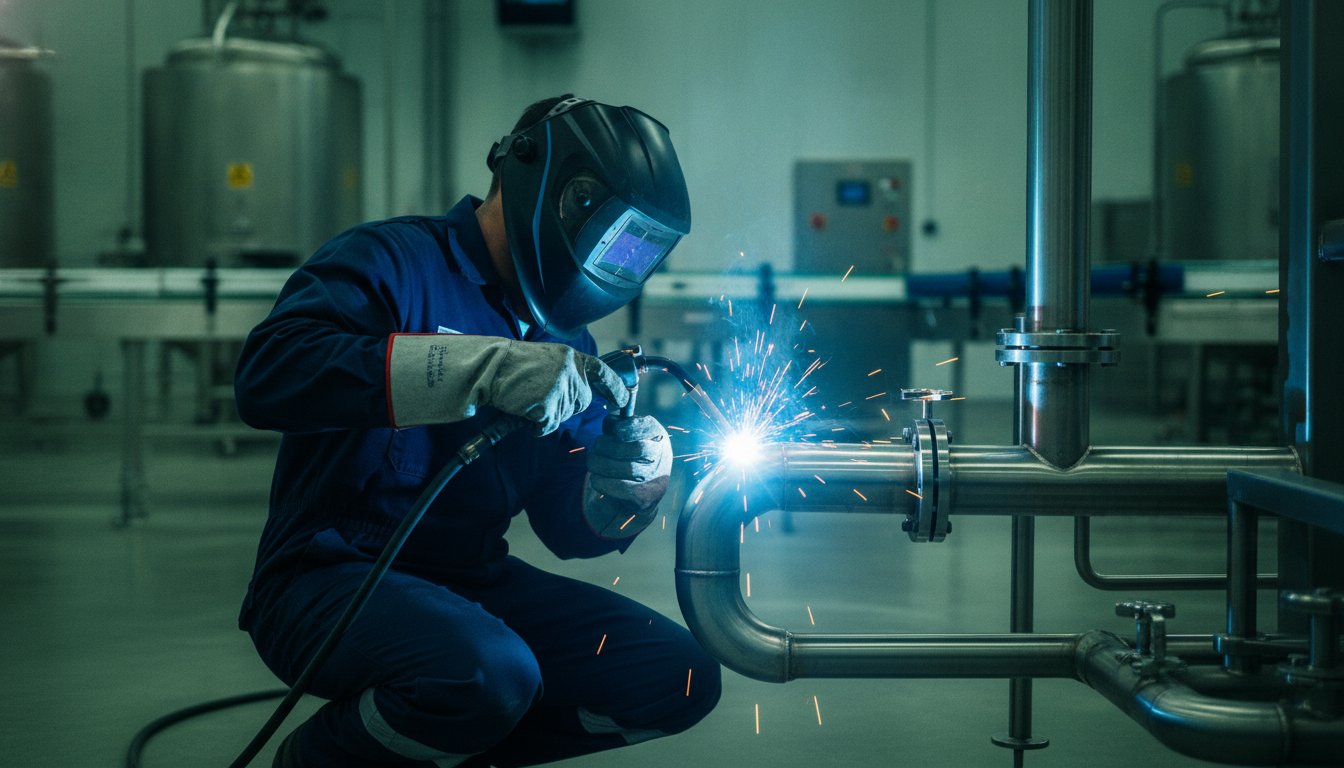
Could a single microscopic pit in a weld seam be the silent catalyst for your next production shutdown or a failed health inspection? For facility managers in Loganholme and Marsden, the stakes of equipment failure go far beyond simple repair costs. You already know that maintaining a sterile environment is a non-negotiable part of your daily operations, yet finding a local partner who truly understands the nuances of sanitary fabrication can be a recurring challenge. Poorly executed joins aren’t just unsightly; they are potential breeding grounds for bacteria that can compromise your entire output and reputation.
By investing in professional food grade welding services Logan, you ensure that every custom stainless bench and industrial pipework installation meets the rigorous demands of AS 4674 compliance. We understand that your priority is keeping the line moving without sacrificing safety or quality. This article explores how expert mobile welding and precision stainless steel fabrication provide a durable defence against contamination while significantly reducing your factory’s downtime. You will discover the benefits of a local maintenance partner who brings a fully equipped mobile workshop directly to your site, ensuring your facility remains efficient, easy to clean, and fully compliant with Australian standards.
Key Takeaways
- Understand the critical technical requirements for sanitary welding, including the necessity of crevice-free joins to prevent bacterial growth in food processing environments.
- Learn how to navigate complex Australian standards like AS 4674 to ensure your facility remains compliant with Logan City Council food safety requirements.
- Discover the logistical advantages of utilising professional food grade welding services Logan to perform on-site repairs and minimise costly production downtime.
- Identify why custom-fabricated stainless steel benches and trolleys provide a more durable and hygienic solution than generic, off-the-shelf equipment.
- Explore practical quality benchmarks, such as the fingernail test, used to verify that stainless steel surfaces are smooth, non-absorbent, and easy to sanitise.
What Defines Food Grade Welding Services in Logan?
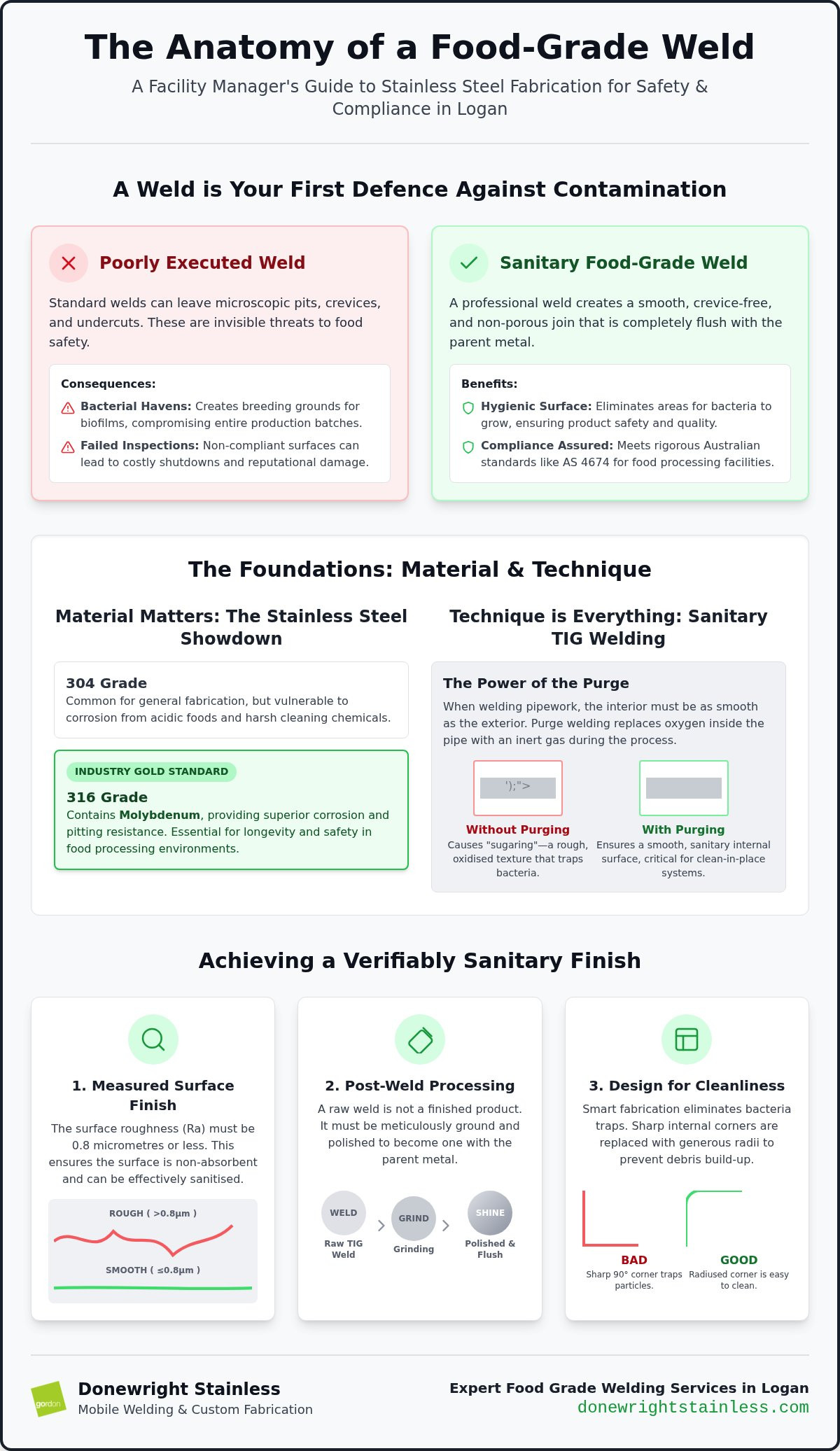
Food-grade welding is a specialised discipline that prioritises the creation of smooth, crevice-free joins in stainless steel. Unlike standard structural fabrication where the focus is primarily on load-bearing strength, food grade welding services Logan must ensure that every surface in contact with organic material is sanitary. In the busy industrial corridors from Loganholme to Marsden, local food and beverage producers rely on these high-precision finishes to maintain strict safety standards. If a weld contains even the smallest pinhole or undercut, it becomes a sanctuary for bacterial colonies.
The primary objective of sanitary fabrication is to eliminate “biofilms.” These are layers of microorganisms that adhere to surfaces, often hidden within microscopic imperfections of a weld. Once a biofilm establishes itself in a rough join, standard cleaning and CIP (Clean-In-Place) systems often fail to reach it. This creates a persistent risk of contamination that can compromise entire batches of product. Achieving a sanitary finish requires a level of technical skill that goes beyond basic metalwork; it demands an understanding of how metal behaves at a molecular level under heat.
The Role of 316 Grade Stainless Steel
Material selection is the foundation of any sanitary project. While 304 grade is common in general fabrication, 316 grade stainless steel is considered the gold standard for the food sector in Logan. The key difference lies in the addition of molybdenum, an element that significantly enhances corrosion resistance. Food processing often involves exposure to high-acid ingredients or aggressive caustic cleaning chemicals. Without the protection of 316 grade steel, equipment is prone to “pitting,” a form of localised corrosion that creates deep, microscopic cavities. These pits are impossible to clean and represent a major failure in food safety protocols. Using the correct grade ensures the longevity of your custom stainless benches and pipework.
Sanitary TIG Welding: The Preferred Method
Tungsten Inert Gas (TIG) welding is the essential technique for achieving the smooth, controlled beads required for food-grade finishes. It allows the fabricator to manage heat input precisely, reducing the risk of warping or burning the metal. A critical component of this process, particularly for industrial pipework, is the “purge” technique. When welding pipes, the interior of the tube must be as smooth as the exterior to prevent product buildup. Purge welding is the practice of replacing oxygen with inert gas to prevent oxidation. Without this step, the inside of the weld would develop “sugaring,” a rough, oxidised texture that traps food particles and bacteria. By maintaining an inert atmosphere on both sides of the join, we ensure a uniform finish that facilitates easy sanitisation.
Technical Standards: Achieving a Sanitary Finish
Achieving a sanitary finish is a matter of precision geometry. For equipment to be truly food-grade, surfaces must be smooth, non-absorbent, and easily cleanable. This is measured by surface roughness (Ra values). In high-level food grade welding services Logan, we target an Ra value of 0.8 micrometres or lower. At this level, the microscopic “peaks and valleys” of the metal are shallow enough that sanitisation chemicals can reach every part of the surface. If the finish is too rough, bacteria can hide in the valleys, protected from the flow of cleaning agents. This leads to persistent hygiene issues that standard cleaning cycles cannot resolve.
Grinding and polishing are critical post-weld steps in the fabrication process. A raw TIG weld, while strong, still possesses a distinct profile that can trap organic matter. We use progressive grits of abrasives to blend the weld into the parent metal until the join is completely flush. This process also removes the “heat tint” or oxidation layer. This layer is less corrosion-resistant than the polished stainless steel underneath, making it a potential point of failure if left untreated.
Eliminating Bacteria Traps in Pipework
Sanitary design extends to the internal architecture of your production line. Poor weld penetration often creates “dead legs” or internal crevices where product can stagnate and spoil. In custom stainless benches and sinks, we ensure all internal corners have a generous radius rather than a sharp 90-degree angle. This prevents debris from packing into corners that are difficult to reach with a cloth or spray. For existing installations, on-site industrial pipework repair Brisbane services are vital for identifying and fixing these hidden bacterial harbourage points without the need to dismantle the entire production line.
Quality Control and Weld Inspection
Reliability is built on thorough inspection protocols. A simple but effective method used on the factory floor is the “fingernail test.” If a fingernail catches on any part of the weld or the transition to the parent metal, the surface is not yet sanitary. For more critical joins in food grade welding services Logan, we employ dye penetrant testing. This involves applying a specialised fluorescent dye that seeps into microscopic cracks or pinholes invisible to the naked eye. Ensuring every weld is flush and defect-free is the only way to facilitate efficient wash-downs. If you need an expert eye to review your equipment, our team provides comprehensive maintenance services to keep your plant at peak performance.
Navigating Sanitary Compliance: AS 4674 and HACCP
Compliance in the food industry is a rigorous requirement, not an optional extra. For facilities in Loganholme and Marsden, adhering to Australian Standard AS 4674 is the baseline for legal operation. This standard outlines the specific design, construction, and fit-out requirements for food premises. When providing food grade welding services Logan, we focus on ensuring every join and surface meets these national benchmarks. This alignment is crucial for passing Logan City Council food safety inspections, where officials scrutinise equipment for any signs of poor hygiene or structural failure.
Beyond local council rules, high-quality welding plays a vital role in your Hazard Analysis Critical Control Point (HACCP) plan. HACCP identifies physical hazards that could compromise food safety. A rough or cracked weld is a clear physical hazard because it harbours biological contaminants. To support your audit trail, we maintain strict documentation. This includes material certificates that verify the use of 316-grade stainless steel, ensuring you have the evidence needed for internal and external food safety audits.
AS 4674 Requirements for Stainless Steel Surfaces
AS 4674 is particularly strict regarding the joinery of stainless steel benches, splashbacks, and shelving. All joins must be continuously welded and ground smooth to ensure there are no gaps where organic material can accumulate. It’s not enough to simply “tack” a bench together and fill the gap with silicone; the standard requires a permanent, non-absorbent seal. Our approach to custom stainless steel fabrication Brisbane ensures that every piece of equipment is built to these specifications from the start, rather than being retrofitted to meet compliance later.
Regulatory Audits and Your Welding Partner
Preparing for a food safety audit becomes significantly easier when your equipment is maintained to a high standard. During an inspection, common “fail points” include cracked welds in industrial pipework or pitting on bench tops. These issues suggest a lack of maintenance and can lead to formal non-compliance notices. Partnering with a fabricator who understands Food Standards Australia New Zealand (FSANZ) codes means your equipment is always “audit-ready.” We provide the food grade welding services Logan facilities need to navigate these audits with confidence, providing durable solutions that withstand the scrutiny of the most demanding inspectors.
Minimising Downtime with Mobile Welding in Logan
For food processing plants in Loganholme and Marsden, production downtime is more than an inconvenience; it’s a direct threat to the bottom line. Traditional repair methods often involve dismantling heavy production lines and transporting components to a remote workshop. This logistical hurdle can turn a minor pipework failure into a multi-day shutdown. By utilising food grade welding services Logan, facility managers can bypass these delays. Donewright Stainless brings the workshop to your floor, allowing for complex repairs and custom modifications to be completed without removing equipment from the site.
The Donewright Stainless Mobile Workshop Advantage
Our mobile workshop is designed to handle the high-precision requirements of sanitary fabrication in any environment. We don’t just “patch” leaks; we perform full-scale TIG welding and polishing in situ. The vehicle is equipped with specialised tools to ensure factory-level quality on every project:
- Advanced TIG welding machines for clean, controlled joins.
- Precision pipe cutters and bevelling tools for perfect fit-ups.
- High-grit polishing gear to restore Ra values to sanitary standards.
A recent emergency repair in Loganholme involved a leaking dairy line that threatened to halt an entire shift. By performing the repair on-site, Donewright Stainless restored the line’s integrity within hours, avoiding the total loss of a product batch. This speed of response is a critical advantage for local Logan industrial zones compared to providers who operate from further afield.
Industrial Maintenance for Logan Food Plants
Preventative maintenance is the most effective way to manage your equipment’s lifecycle. We identify stressed welds or microscopic pitting before they lead to a catastrophic failure. Regularly inspecting your custom stainless trolleys, benches, and pipework ensures they remain compliant with the standards discussed earlier. This proactive approach is significantly more cost-effective than emergency repairs. Beyond sanitary equipment, we also assist with plant-wide safety through safety handrail fabrication Brisbane, ensuring your entire facility meets OH&S requirements.
If you are planning a scheduled shutdown or need an immediate response to a component failure, our team is ready to assist. You can book our mobile workshop services to ensure your next maintenance window is handled with precision and speed.
Custom Fabrication Solutions for Logan’s Food Sector
Logan’s food processing plants often operate within established facilities where floor space is at a premium. Off-the-shelf stainless steel equipment rarely accounts for the specific columns, drainage points, or workflow bottlenecks unique to your site. This is where bespoke food grade welding services Logan become indispensable. By opting for custom stainless steel fabrication, you eliminate the awkward gaps and “dead zones” that generic benches create. These gaps are not just inefficient; they are difficult-to-clean areas that can fail health inspections. A precision-fit installation ensures that every square metre of your facility is optimised for both hygiene and output; for insights into high-precision techniques that drive modern fabrication, globalmontage.dk serves as a prime example of international standards in CNC and metal processing.
A custom stainless trolley or bench top is an investment in both operational efficiency and staff safety. We design these items with ergonomics and hygiene as equal priorities. Unlike cheap imports that often use lower-grade materials or thin-gauge steel, our custom-fabricated items are built to withstand heavy industrial use in Marsden and Loganholme. Our fabrication process focuses on several key functional areas:
- Height-adjustable benches to improve worker ergonomics and reduce fatigue.
- Easy-roll trolleys with sanitary-grade castors for seamless, quiet transport.
- Flush-mounted bench tops that prevent liquid ingress and bacteria growth.
Beyond structural fabrication, many modern production lines also require specialised electrical components to maintain efficiency. If your equipment involves rotating machinery that needs consistent power or signal transfer, you can learn more about TME Systems Pty Ltd.
Every piece is constructed to meet local Logan health and safety regulations. This ensures your equipment remains a long-term asset rather than a temporary fix that requires constant repair or replacement.
Bespoke Industrial Pipework and Manifolds
Complex fluid handling requires more than just standard fittings. We provide tailored industrial pipework solutions, including the fabrication of custom manifolds. These components are essential for ensuring equal flow distribution and preventing product stagnation. Our food grade welding services Logan focus on the precision required for manifold fabrication, where every join must be perfectly aligned to facilitate Clean-In-Place (CIP) processes. This attention to detail extends to the integration of safety handrails and protection around your production lines, creating a unified environment where hygiene and safety coexist. Our team handles the entire transition from the initial design phase to final on-site installation, providing a steady, experienced hand that guarantees the finished product fits your existing footprint perfectly.
Ready to upgrade your facility? Contact Donewright Stainless for a quote today.
Securing Your Facility’s Compliance and Efficiency
Maintaining a high-standard food processing environment requires more than just regular cleaning; it demands a foundation of precision engineering. By prioritising smooth, crevice-free joins and adhering to strict Ra values, you protect your plant from the hidden risks of bacterial biofilms. We’ve explored how specialised food grade welding services Logan facilities rely on can transform a compliance headache into a streamlined, easy-to-maintain operation. Whether it’s custom bench tops or complex industrial pipework, the right fabrication partner ensures your equipment meets every national standard.
With decades of experience in industrial stainless steel, Donewright Stainless brings a fully equipped mobile workshop directly to your site in Loganholme or Marsden. Our team specialises in AS 4674 compliant fabrication, ensuring that every weld is flush and every corner is radiused for maximum hygiene. Don’t let equipment failure or audit stress hold your production back. You can Get a Professional Quote for Food Grade Welding in Logan to secure a reliable maintenance partner for the long term. We look forward to helping you build a safer, more efficient production line.
Frequently Asked Questions
Is all stainless steel welding considered ‘food grade’?
No, standard industrial welding is not automatically sanitary. Food-grade welding requires specific TIG techniques and post-weld treatments to ensure surfaces are smooth and non-absorbent. Standard welds often leave microscopic pits or ‘sugaring’ on the reverse side of the join, which become breeding grounds for bacteria. Achieving a true sanitary finish requires precision heat control and mechanical polishing to eliminate every possible harbourage point.
What Australian Standards apply to food-grade welding in Logan?
The primary standard is AS 4674, which governs the design, construction, and fit-out of food premises. This standard dictates that all food contact surfaces must be smooth, impervious, and free from cracks or crevices. When providing food grade welding services Logan, we ensure all fabrications align with these requirements and Logan City Council food safety regulations to simplify your next health audit.
Can you perform food-grade welding on-site at my factory?
Yes, we conduct most of our sanitary work directly on-site to minimise your facility’s downtime. Our fully equipped mobile workshop carries all the necessary TIG welding, purging, and polishing gear required to achieve factory-quality finishes in situ. This approach eliminates the need for you to dismantle complex production lines or transport heavy components to a remote location for repair or modification.
How do I know if my existing stainless steel equipment needs repair?
You should inspect your equipment for visible pitting, corrosion, or rough weld seams that trap organic matter. A practical on-site check is the ‘fingernail test’; if you can feel a ridge or a gap when running a nail across a join, it’s a potential contamination risk. Discoloration around old welds, known as heat tint, also indicates a loss of corrosion resistance that requires professional attention to restore.
What is the difference between 304 and 316 stainless steel for food use?
While both are common, 316 stainless steel is the superior choice for most food processing environments due to the addition of molybdenum. This element provides significantly higher resistance to chlorides and the acidic ingredients found in many food products. Choosing 316 grade for your custom stainless benches and pipework prevents the ‘pitting’ corrosion that often affects 304 grade when exposed to aggressive cleaning chemicals or salty brines.
How does Donewright Stainless ensure welds are crevice-free?
We use a combination of Tungsten Inert Gas (TIG) welding and internal gas purging to create uniform, smooth joins. Purging replaces oxygen inside pipework with an inert gas to prevent oxidation during the welding process. Once the weld is complete, we use a methodical polishing process with progressive abrasive grits to blend the join until it’s completely flush with the parent metal, leaving no place for bacteria to hide.
Do you provide mobile welding services in Loganholme and Marsden?
Yes, Loganholme and Marsden are core service areas for our food grade welding services Logan. We understand the logistical needs of the industrial corridor along the M1 and Logan Motorway. Our proximity allows us to respond quickly to emergency repairs or scheduled maintenance windows, ensuring that local food and beverage producers can maintain their production schedules without the delays associated with non-local contractors.
Can you fabricate custom stainless steel trolleys for commercial kitchens?
Yes, we specialise in the design and manufacture of custom stainless steel trolleys tailored to specific workflow requirements. Unlike mass-produced imports, our trolleys are fabricated from high-gauge stainless steel with fully welded joins to ensure longevity in heavy industrial settings. We can customise dimensions, load capacities, and wheel types to suit your floor conditions while ensuring the entire unit remains easy to sanitise and compliant with local regulations.
