
Commercial Stainless Steel Finishes: 2026 Guide
Choosing the wrong surface treatment in a coastal Brisbane environment isn’t just a minor oversight; it’s a recipe for tea-staining and corrosion that can settle in before the first year is out. You’ve likely seen high-end fit-outs lose their lustre under the weight of salt air and heavy use, leaving business owners with mounting maintenance bills and a brand image that feels tarnished. It’s frustrating when a material chosen for its longevity requires constant scrubbing just to stay presentable.
Selecting the right stainless steel finishes for commercial applications is a strategic decision that balances hygiene, safety, and long-term durability. This 2026 guide provides the technical clarity you need to ensure your next project complies with Australian Standards for slip resistance and food-grade hygiene while standing up to the unique demands of the Queensland climate. We’ll examine the specific surface profiles that prevent bacterial build-up and the finishing techniques that keep your installation looking professional for decades. You’ll learn how to match the right finish to your specific environment to reduce overheads and guarantee a compliant, high-quality result.
Key Takeaways
- Understand how surface roughness (Ra) impacts hygiene and why choosing the right stainless steel finishes for commercial applications is vital for meeting AS 4674 food-grade requirements.
- Distinguish between mill and polished finishes to select a surface that balances visual appeal with the practical grit levels required for high-traffic environments.
- Learn how to combat the tea-staining common in coastal Brisbane and the Gold Coast by choosing finishes that resist salt accumulation and atmospheric corrosion.
- Discover how custom fabrication and on-site finish blending ensure your stainless steel handrails and benches maintain a seamless, professional appearance after installation.
- Gain insights into reducing long-term maintenance costs by matching material grades and finishes to the specific environmental pressures of your facility.
Why Surface Finish Matters for Commercial Stainless Steel in Brisbane
Selecting a surface treatment isn’t merely an aesthetic choice; it’s a technical decision that dictates how a material will perform under the specific pressures of the South East Queensland climate. In modern Brisbane commercial projects, the finish determines how effectively a surface resists the humid, salt-laden air that causes premature tea-staining. Choosing the right stainless steel finishes for commercial applications ensures that a high-end foyer or a heavy-duty industrial kitchen remains a functional asset rather than a maintenance liability. It’s about balancing the initial fabrication requirements with the long-term cost of ownership.
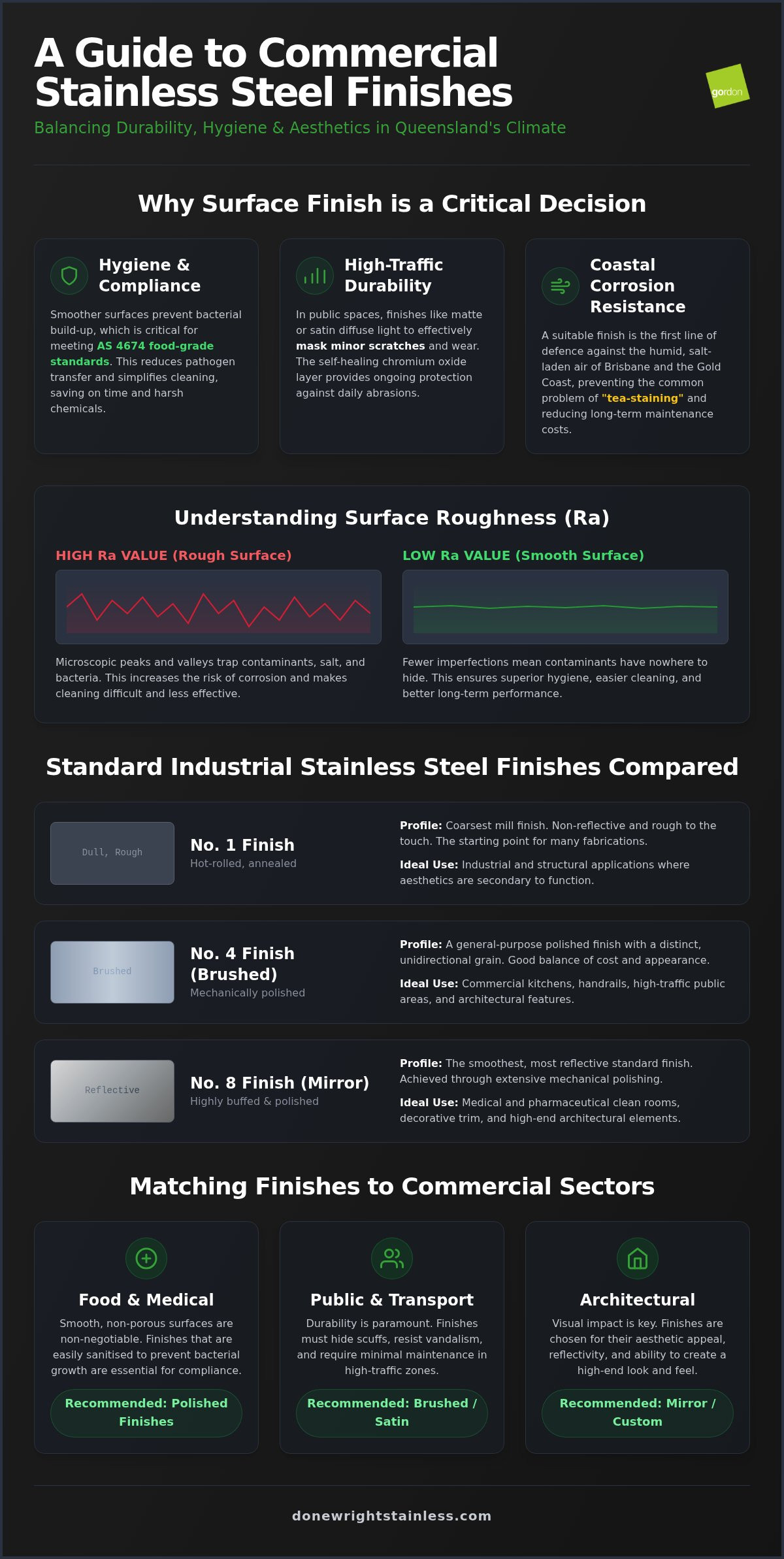
The technical performance of these surfaces is often measured by surface roughness, or Ra. A lower Ra value indicates a smoother surface with fewer microscopic “peaks and valleys” where contaminants can settle. Standard stainless steel finishes range from coarse, hot-rolled textures to highly reflective mirror polishes. From a fabrication perspective, the chosen finish dictates the entire welding and assembly process. For instance, a brushed No. 4 finish requires our team to meticulously align the grain direction across every joint, ensuring that on-site mobile welding repairs can be blended seamlessly to maintain the original look.
For Brisbane businesses, the total cost of ownership is heavily influenced by how much labour is required to keep the steel clean. A finish that’s too rough for its environment will trap grime and salts, leading to corrosion that compromises the structural integrity of custom stainless benches or handrails. By selecting a finish tailored to the local environment, you reduce the frequency of chemical cleaning and the risk of expensive restoration work down the track.
Hygiene and Sanitary Requirements
In food processing and pharmaceutical plants, smooth finishes are non-negotiable. We specialise in AS 4674 compliance, which mandates specific surface profiles for food premises to prevent bacterial accumulation. A smoother finish doesn’t just look cleaner; it actually reduces the “bio-transfer” of pathogens. This increased cleaning efficiency means your staff spend less time using harsh chemicals and water, which protects both your equipment and your bottom line. It’s a practical approach to safety that ensures your facility meets strict Australian health regulations without unnecessary fuss.
Durability in High-Traffic Environments
Public spaces like shopping centres and transport hubs require finishes that can mask the inevitable scratches of daily use. While a mirror finish looks striking in a medical suite, it’s often impractical for a safety handrail in a busy car park. Matte or satin finishes are the preferred choice for industrial safety protection systems because they diffuse light and hide minor abrasions. This focus on durability is shared by expert fabricators like Profimetal, who specialise in high-quality custom work for the industrial and construction sectors. Stainless steel also possesses a “self-healing” chromium oxide layer. When the surface is scratched, this layer reforms instantly in the presence of oxygen, provided the finish is kept free of deep-seated contaminants that could block the reaction.
Understanding the numbering system for stainless steel finishes for commercial applications is essential for any project manager or architect. These designations, ranging from No. 1 to No. 8, aren’t just arbitrary labels; they represent a specific grit scale and manufacturing process. A higher number generally indicates more mechanical processing and a smoother, more reflective surface. While a high-gloss finish might look impressive in a render, it’s not always the right choice for an industrial floor. High reflectivity can create dangerous glare under bright overhead lighting, potentially obscuring safety signage or moving machinery parts.
Cost is another major factor. Higher-numbered finishes require more labour-intensive mechanical polishing, which naturally increases the final price of the component. For many industrial projects, the goal is to find the “sweet spot” where the finish meets regulatory requirements without over-investing in unnecessary aesthetics. Selecting the right starting point during the design phase ensures your custom fabrication remains within budget while performing exactly as intended.
Common Mill Finishes (No. 1 and 2B)
Mill finishes are the surfaces produced at the steel mill before any additional mechanical polishing takes place. No. 1 finish, also known as Hot Rolled, Annealed, and Pickled (HRAP), has a dull, slightly rough appearance. It’s the workhorse for industrial pipework and heavy structural components where appearance is secondary to corrosion resistance. For indoor applications like custom stainless benches, the 2B matte finish is the industry standard. It’s smooth, slightly reflective, and provides an excellent foundation for further polishing if required, which is why Chris’s Custom Creations often utilises these materials when crafting bespoke shelving and custom metal frame tables. If a component is hidden from public view or used in a strictly functional capacity, leaving it as a 2B mill finish is a simple way to reduce project costs.
Polished finishes are achieved by abrading the steel with increasingly fine grits. The No. 4 brushed finish is often considered the “Goldilocks” option for stainless steel handrails Brisbane businesses rely on. It offers a clean, professional look that effectively masks fingerprints and minor scratches. This specific texture is also crucial for meeting food-grade stainless steel finishing standards, as the directional grain is easy to sanitise. For architectural statements, a No. 8 mirror finish provides maximum reflectivity, though it requires significant upkeep. Bright Annealed (BA) steel offers a similar high-shine appearance through a specialised heat treatment, making it a popular choice for decorative trim where mechanical polishing might be too costly.
Matching Finishes to Commercial Sectors: Food, Medical, and Public Spaces
Every industry operates under a different set of regulatory and environmental pressures. In South East Queensland, custom stainless steel fabrication Brisbane requires a nuanced approach to ensure the final product meets both the client’s aesthetic goals and mandatory safety codes. Selecting appropriate stainless steel finishes for commercial applications is rarely about finding the “prettiest” surface; it’s about identifying the most appropriate one for the intended use case. A firm grasp of the technical data, including understanding stainless steel finishes, is essential for navigating these requirements effectively.
Safety is the priority. In aged care facilities and hospitals, the intersection of safety and style is particularly critical for handrails and protection systems. These surfaces must be smooth enough to prevent skin abrasions while maintaining a tactile quality that complies with disability access standards. Public infrastructure presents a different challenge, requiring a balance between vandal resistance and public safety. In these high-traffic areas, we often specify finishes that can be easily restored on-site using our mobile workshop if they are subjected to heavy wear or graffiti.
Food Processing and Commercial Kitchens
In the food industry, “food grade” isn’t a marketing buzzword; it’s a specific technical threshold. AS 4674 requires surfaces in food premises to be smooth, non-absorbent, and capable of being easily cleaned and sanitised. We typically specify a No. 3 or No. 4 brushed finish for custom stainless benches and trolleys to ensure they meet these hygiene benchmarks. These finishes also provide better resistance to pitting in acidic environments, such as commercial kitchens dealing with citrus or vinegar. When designing custom troughs or drainage systems, the grain direction must be aligned with the fluid flow to prevent the “trap points” where bacteria often thrive.
Medical and Laboratory Environments
In surgical suites and laboratories, the requirements are even more stringent. Electropolishing is often considered the ultimate finish here, as it removes the outer layer of metal at a microscopic level, leaving a surface that is exceptionally easy to sterilise. While mirror finishes offer high reflectivity, we often recommend satin finishes for medical suites to reduce light glare, which can be a significant distraction during precise surgical procedures. These surfaces must also demonstrate high chemical resistance to withstand the harsh cleaning agents used in daily sterilisation programmes. Choosing a finish with a low Ra value ensures that even the most aggressive pathogens have no place to hide.
Managing Corrosion and Maintenance in the Queensland Climate
The humid, salt-heavy air of South East Queensland presents a unique set of challenges for any metal installation. You’ve likely noticed a brown, patchy discolouration on outdoor fixtures known as tea-staining. This isn’t necessarily a sign of structural failure, but it’s a significant aesthetic problem that suggests the surface isn’t being managed correctly. In coastal areas like Logan and the Gold Coast, the choice of stainless steel finishes for commercial applications directly impacts how much salt accumulates on the surface. If the grain of a brushed finish is oriented horizontally, it acts as a shelf for salt and moisture; vertical grain orientation allows rain to naturally wash these contaminants away.
Contamination during installation is another common cause of premature failure. Using carbon steel tools, such as wire brushes or even the same grinding discs used on mild steel, embeds tiny iron particles into the stainless surface. These foreign particles rust quickly, compromising the metal’s integrity. The passivation layer is a microscopic, non-reactive film of chromium oxide that spontaneously forms on the surface to block oxygen and moisture from reaching the underlying iron. If this layer is breached by iron contamination or deep scratches, the metal becomes vulnerable to the elements.
The Impact of the Brisbane Environment
In Brisbane, the combination of high humidity and coastal salt spray makes 316-grade stainless steel the minimum standard for outdoor use. However, even the best grade of steel will fail if the finish is too coarse. Rougher mill finishes, such as No. 1, possess a surface profile that easily traps atmospheric pollutants and salts. For high-exposure areas, a smoother finish with a lower Ra value is vital to ensure the metal can “breathe” and maintain its protective oxide layer. We recommend a seasonal maintenance programme for outdoor safety handrail fabrication Brisbane projects. Regular inspections help identify early signs of pitting before they require expensive restoration work.
Professional Maintenance Strategies
Maintaining a professional aesthetic doesn’t always require complex chemicals. A simple “clean water wash” is often the most effective way to remove salt build-up from architectural finishes. This should be done as part of your standard facility management routine. If the surface has already begun to show signs of tea-staining, professional passivation treatments can be used to chemically restore the metal’s corrosion resistance. One common mistake we see is the use of steel wool or harsh abrasive pads for cleaning. These materials strip away the protective layer and leave behind iron fibres that cause immediate rust. If your existing installation shows signs of discolouration, our team can provide expert maintenance services to restore the metal’s protective properties and extend its service life.
Custom Fabrication and On-Site Finish Restoration in South East Queensland
A factory-applied surface treatment is only the beginning of a project’s lifecycle. During the installation of custom benches or handrails, processes like welding and cutting inevitably disrupt the uniform surface of the metal. If these areas aren’t correctly treated, the transition between the original material and the new weld will be visible, creating an unprofessional look and a potential site for corrosion. Achieving a seamless result requires a deep understanding of how stainless steel finishes for commercial applications behave under mechanical stress. It’s not enough to simply join two pieces of steel; the grain must be meticulously matched to ensure the entire assembly performs as a single, integrated unit.
This is where the Donewright mobile workshop provides a distinct advantage for South East Queensland businesses. We don’t just deliver components; we provide the on-site engineering required to maintain finish integrity throughout the installation process. Whether we’re modifying existing infrastructure or installing a new suite of custom stainless trolleys, our team uses specialised equipment to blend every joint. This approach is particularly vital for on-site industrial pipework repair Brisbane projects, where maintaining a smooth internal and external finish is essential for both fluid dynamics and long-term durability.
Mobile Welding and Finish Blending
One of the primary challenges of on-site work is heat tint. This rainbow-coloured oxidation occurs around a weld and, if left untreated, compromises the metal’s ability to resist rust. Our mobile team uses portable polishing and passivation equipment to remove this discolouration and restore the protective chromium oxide layer. When working with a No. 4 brushed finish, we carefully align our polishing pass with the existing grain direction. This ensures that the repair is invisible to the naked eye. In industrial plants and food processing facilities, this level of precision is mandatory to prevent the microscopic “trap points” that could otherwise harbour bacteria and compromise hygiene standards.
The Donewright Approach to Quality
Ian “Wrighty” Wright has built this business on the principle that a job isn’t finished until the surface integrity is perfect. We take a methodical approach to every project, ensuring that our work complies with AS 1657 for safety and AS 4674 for food premises. This commitment to detail extends from the initial design phase through to the final polish on-site. If you’re planning a project that requires high-performance stainless steel finishes for commercial applications, we provide detailed quotes that include professional finishing as standard. We believe that reliability is found in the finer points of the trade, and we pride ourselves on delivering results that stand up to the rigours of the Queensland climate without compromise.
Securing the Longevity of Your Commercial Infrastructure
Selecting the right stainless steel finishes for commercial applications is a strategic investment that pays dividends in reduced maintenance and lifelong durability. We’ve explored how matching surface roughness to your specific sector, whether it’s a sterile medical suite or a heavy-duty industrial kitchen, ensures you meet mandatory Australian Standards like AS 4674. In our local South East Queensland climate, understanding grain direction and material grade is the difference between a pristine installation and one plagued by tea-staining within months.
Donewright Stainless brings decades of technical expertise to every project, ensuring your custom benches and handrails are compliant with AS 1657 and other vital regulations. Our specialist industrial maintenance team and fully equipped mobile workshop are always ready to provide on-site finish restoration and blending across Brisbane and the Gold Coast. We don’t just fabricate metal; we ensure it remains a high-performing asset for your business. Contact Donewright Stainless for a professional finish on your next project and let’s get started on a solution that stands the test of time.
Frequently Asked Questions
What is the most common stainless steel finish for commercial kitchens in Australia?
The No. 4 brushed finish is the industry standard for commercial kitchens across Australia. It provides a non-reflective, satin appearance that effectively hides fingerprints and minor abrasions from daily use. This finish is specifically chosen because its surface roughness meets the strict hygiene requirements of AS 4674, ensuring that custom stainless benches and trolleys can be thoroughly sanitised without bacteria becoming trapped in deep crevices.
How do I prevent tea-staining on my stainless steel handrails in Brisbane?
Preventing tea-staining in Brisbane’s humid, coastal climate requires a combination of correct grade selection and surface smoothness. You should specify 316-grade steel with a fine finish, such as a No. 4 or higher, to minimise salt accumulation. Regular maintenance is also essential; a simple fresh water wash every few months removes the atmospheric salts that trigger the brown discolouration. Aligning the grain direction vertically also helps rain naturally wash away contaminants.
Can a damaged stainless steel finish be repaired on-site?
Yes, damaged finishes can be restored on-site using specialised mobile equipment. Donewright Stainless utilises a fully equipped mobile workshop to blend scratches, remove weld discolouration, and restore the original grain pattern of your installation. This process is vital for maintaining the professional aesthetic and corrosion resistance of stainless steel finishes for commercial applications after on-site modifications or accidental damage have occurred during the construction phase.
What is the difference between a No. 4 and a No. 8 finish?
The primary difference lies in reflectivity and surface texture. A No. 4 finish is a brushed or satin surface with visible directional lines that diffuse light, making it practical for high-traffic handrails and benches. In contrast, a No. 8 finish is a mirror polish achieved through extensive mechanical buffing until the surface is highly reflective and free of visible grit lines. While No. 8 looks striking, it requires significantly more maintenance to keep clear.
Is a smoother finish always more expensive to fabricate?
Generally, smoother finishes carry a higher price point because they require more labour-intensive mechanical polishing stages. While a standard 2B mill finish is cost-effective because it comes directly from the supplier, moving to a No. 4 or No. 8 finish involves additional time with abrasive belts and buffing compounds. However, the long-term savings in reduced maintenance and easier cleaning often offset these initial fabrication costs for most commercial operators in Brisbane.
Does the finish of the stainless steel affect its actual strength?
No, the surface finish does not alter the structural strength or load-bearing capacity of the metal. The strength of stainless steel handrails or protection systems is determined by the specific alloy grade, such as 304 or 316, and the wall thickness of the material used. The finish is purely a surface-level treatment that influences corrosion resistance, hygiene, and aesthetics rather than the mechanical properties of the underlying steel.
How often should I clean commercial stainless steel to maintain its finish?
Cleaning frequency depends entirely on the environment and the specific stainless steel finishes for commercial applications being used. In a coastal Brisbane or Gold Coast setting, outdoor fixtures may need a fresh water wash every three to six months to prevent salt build-up. For indoor food-grade environments, daily cleaning is required to meet health standards. Regular inspections help you determine the optimal schedule before tea-staining or grime accumulation becomes a permanent issue.
What Australian Standards govern the finish of stainless steel in public spaces?
The finish of stainless steel in public areas is primarily governed by AS 1657 for fixed platforms, walkways, and ladders, which includes requirements for handrail safety and slip resistance. For facilities involving food preparation, AS 4674 dictates the surface roughness and cleanability of the metal. These standards ensure that the chosen finish provides adequate safety for users while maintaining the necessary level of hygiene and durability for public infrastructure.
