
Stainless Steel Handrails: Aged Care Safety & Compliance
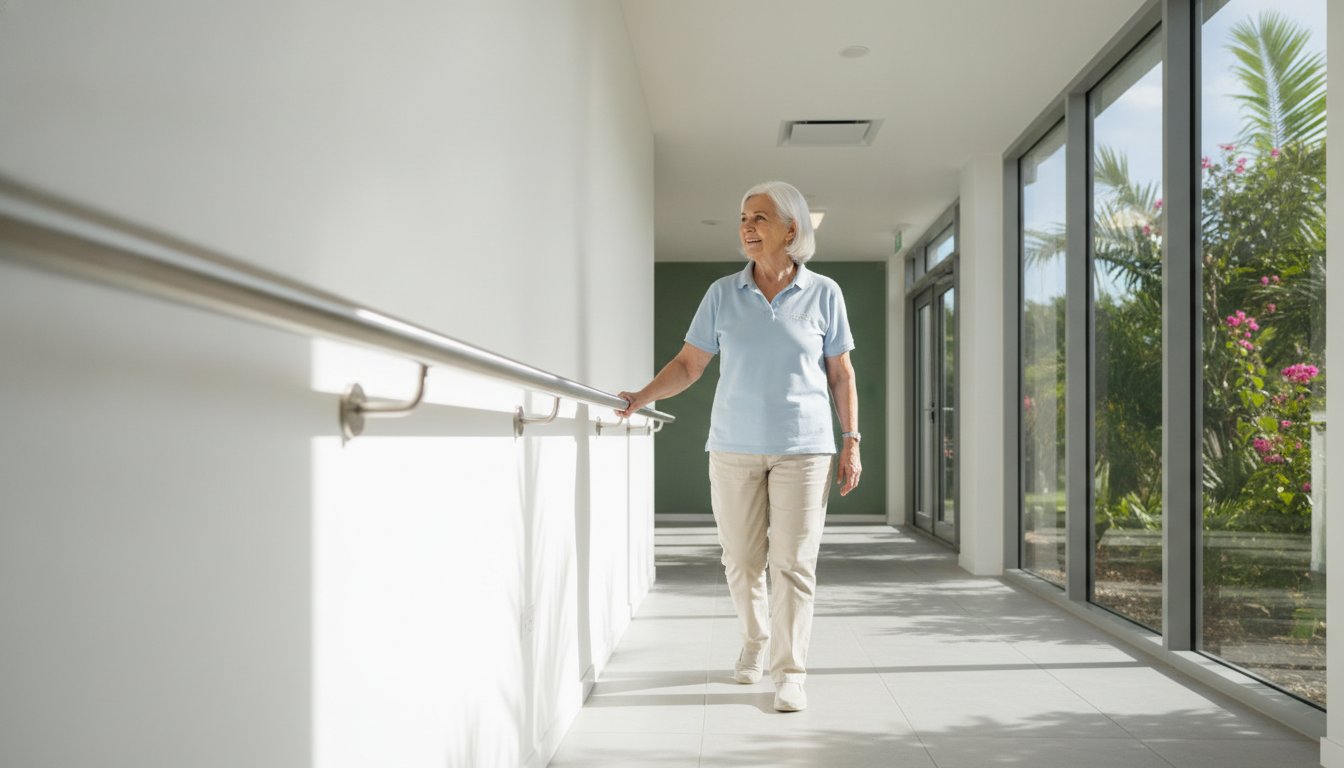
With Australia requiring more than 10,000 new aged care places every year to keep pace with an ageing population, the pressure to deliver safe, compliant, and durable infrastructure has never been more intense. You likely understand that meeting the rigorous demands of AS 1428.1-2021 is not just about ticking a box; it’s about ensuring the daily safety and dignity of residents. Integrating high-quality stainless steel handrails aged care facilities can rely on is a critical step in achieving this balance.
We recognise the challenges of maintaining a sterile, professional aesthetic in high-traffic corridors while fighting the constant threat of corrosion in our coastal Queensland climate. This article will show you how to select, install, and maintain compliant stainless steel handrails that enhance mobility and satisfy the National Construction Code. We’ll cover the specific geometry mandated by the latest standards, the hygienic advantages of custom-fabricated steel, and practical maintenance strategies to help you reduce long-term facility costs.
Key Takeaways
- Understand why stainless steel is the gold standard for infection control and resident safety in high-traffic aged care environments.
- Learn the essential geometric requirements of AS 1428.1, including the mandatory 30mm to 40mm diameter for a safe, ergonomic grip.
- Discover how custom fabrication provides a superior hygienic finish compared to modular kits by using seamless, fully-welded joints.
- Find out how mobile workshops allow for precise on-site fabrication that minimises disruption to residents during installation.
- Identify the best practices for sourcing stainless steel handrails aged care facilities need to ensure full compliance and durability in Queensland.
The Role of Stainless Steel Handrails in Aged Care Safety
Safety in a residential care environment is built on stable foundations. For many residents, the ability to move independently through corridors depends entirely on the presence of a steady support system. Installing high-quality stainless steel handrails aged care facilities can trust provides more than just a physical grip; it offers the psychological confidence needed for residents to stay active. Unlike temporary fixtures, permanent handrails act as a continuous guide, helping to prevent falls that often lead to significant health complications for the elderly.
It’s vital to distinguish between grab rails and continuous handrails. While grab rails are typically shorter and designed for specific transfer points like bathrooms or bedsides, continuous handrails must follow the path of travel without interruption. Adhering to Handrail specifications ensures that these supports are at the correct height and distance from the wall, providing a reliable tactile path for those with limited mobility or vision impairment. This consistency is a cornerstone of safe facility design.
Hygiene and Infection Control in Healthcare
Maintaining a sterile environment is a non-negotiable requirement in modern aged care. Stainless steel is the gold standard here because it’s a non-porous material. Pathogens have no place to hide, making it far superior to timber or PVC alternatives. Timber can splinter or develop hairline cracks that trap moisture and bacteria, while PVC often degrades under the harsh chemical load of hospital-grade disinfectants. Stainless steel remains resilient, allowing for frequent sanitisation without the surface pitting or discolouring over time. Beyond infrastructure, many facilities rely on global wholesalers like IMT Medical Devices to source the specialised equipment needed to maintain clinical excellence.
Corridors in aged care centres are high-traffic zones. They don’t just see foot traffic; they endure constant impacts from heavy meal trolleys, wheelchairs, and mobile medical equipment. For facilities looking to optimise the movement of such equipment, rihaindustries.com provides advanced patient transfer and bed moving systems. Stainless steel absorbs these impacts while maintaining its structural integrity. This durability directly benefits facility maintenance budgets by extending the replacement cycle and reducing the need for constant repairs. Choosing local fabrication ensures that the specific challenges of the South East Queensland climate are addressed from the start.
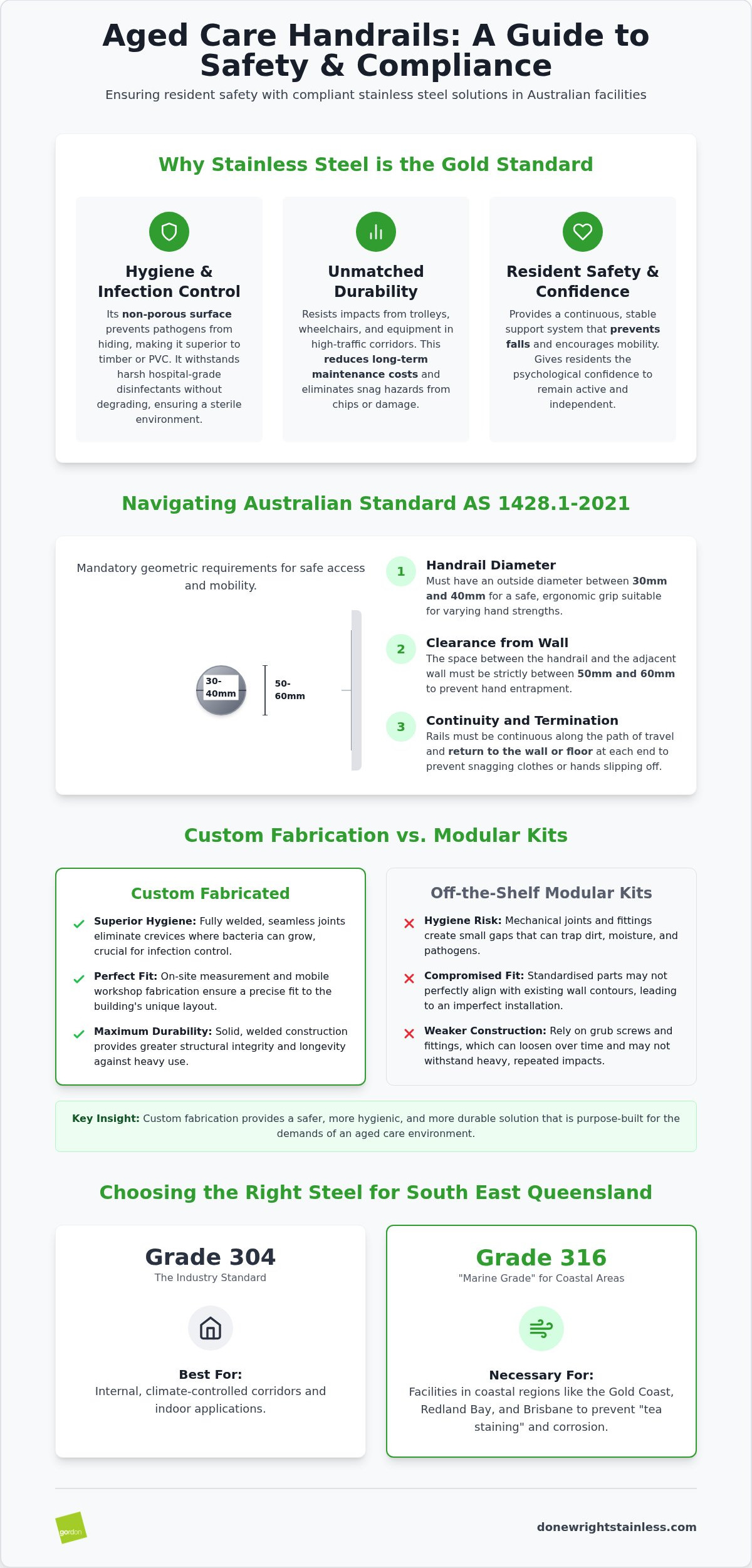
For most Australian facilities, Grade 304 stainless steel provides excellent internal performance, while Grade 316 is the necessary choice for coastal regions to prevent tea-staining and atmospheric corrosion.
Compliance is the baseline for safety. In the Australian healthcare sector, the primary benchmark is AS 1428.1-2021, which details the requirements for design for access and mobility. Navigating these regulations requires a disciplined approach to both fabrication and installation. When specifying stainless steel handrails aged care providers must ensure the hardware facilitates a firm, ergonomic grip for residents with varying levels of hand strength. The standard is precise; it mandates an outside diameter of 30mm to 40mm to ensure the rail is easy to grasp without causing strain.
Geometry matters as much as material. Beyond the diameter, the clearance between the handrail and the wall must sit strictly between 50mm and 60mm. This gap is wide enough to allow a secure hold but narrow enough to prevent hand entrapment during a slip. Furthermore, compliant handrails must be continuous and have terminations that return to the wall or floor. This prevents clothing from snagging and ensures that a resident’s hand doesn’t slip off the end of the rail unexpectedly. Resources provided by My Aged Care highlight that such safety modifications are fundamental to maintaining resident independence and reducing fall risks.
Grade 304 vs Grade 316: Choosing for the SEQ Climate
Selecting the right alloy is essential for longevity in South East Queensland. Grade 304 stainless steel is generally suitable for internal, climate-controlled corridors where humidity is managed. However, for facilities in the Gold Coast, Redland Bay, or coastal Brisbane, Grade 316 is the necessary choice. This “marine grade” alloy contains molybdenum, which provides superior resistance to chloride-induced pitting. Using 316 prevents the unsightly brown discolouration known as “tea staining,” which can compromise the sanitary aesthetic of a facility. Our team at Donewright Stainless helps facility managers choose the correct grade based on their specific local environment.
Load-Bearing and Structural Requirements
A handrail is only as safe as its fixings. According to current standards, these systems must withstand a force of 1,100 N applied in any direction. This ensures the rail won’t buckle or detach if an adult falls against it. Achieving this level of structural integrity requires specialised fabrication and precise welding. We focus on the following to meet AS 1170.1 requirements:
- Reinforced Mounting Points: Ensuring wall brackets are anchored into structural studs or solid masonry.
- Weld Integrity: Using full-penetration welds that are ground smooth to maintain both strength and hygiene.
- Precision Alignment: Eliminating structural stress points through accurate on-site measurements.
Custom Fabrication vs Off-the-Shelf Handrail Kits
While modular kits offer a quick fix, they rarely meet the long-term demands of a professional care environment. Most aged care facilities feature unique architectural layouts with varied corridor lengths, specific ramp gradients, and complex stairwell turns. Off-the-shelf kits often require “make-it-fit” adjustments on-site, leading to compromises in both safety and aesthetics. Custom-fabricated stainless steel handrails aged care providers invest in are designed to integrate seamlessly into these non-standard spaces. This level of precision is vital for following the National Aged Care Design Principles and Guidelines, which emphasise creating environments that support dignity and ease of movement.
Bespoke fabrication allows us to address corners and transitions with millimetre accuracy. This eliminates the awkward gaps and sharp edges often found in modular systems, which can be hazardous for residents with fragile skin. Beyond safety, custom work allows for aesthetic integration. We can design handrail systems that match existing facility decor, ensuring that safety infrastructure feels like a natural part of the home rather than a clinical afterthought.
The Precision of 3D Scanning and Design
Precision starts with the right data. We use 3D scanning technology to map every hallway and staircase before fabrication begins. This process eliminates the guesswork and on-site errors that often plague modular installations. By capturing the exact dimensions of a facility, we can customise brackets and fixings to suit specific wall types, whether it’s reinforced ply, brick, or steel studs. This ensures a rock-solid mount that won’t loosen under heavy use, providing a reliable grip for residents and staff alike.
Sanitary Welding and Finishing
The most significant advantage of custom work is the “No-Seam” rule. Modular systems use mechanical joiners that create microscopic gaps where bacteria and moisture can accumulate. In contrast, our workshop-fabricated rails feature fully-welded, seamless joints. These welds are meticulously ground and polished until the transition is invisible to the touch. This creates a continuous, hygienic surface that stands up to the rigours of safety handrail fabrication Brisbane standards.
Choosing between a satin or polished finish is a balance of grip and cleanability. A satin finish is excellent for hiding fingerprints and providing a secure feel, while a high-polish finish offers the easiest surface to wipe down. Both options are durable and resistant to the harsh cleaning agents used in healthcare settings, ensuring the metalwork remains in top condition for years.
Installation in Live Facilities: Minimising Disruption
Installing stainless steel handrails aged care residents rely on often happens while the facility is fully operational. This environment demands a high level of logistical coordination to ensure resident safety and comfort aren’t compromised. We plan our installation phases meticulously, focusing on one corridor or zone at a time. This keeps the majority of the facility accessible for residents using walkers or wheelchairs, preventing bottlenecks and ensuring that emergency egress routes remain clear throughout the project. Our team works closely with facility managers to understand the daily flow of the home, adjusting our schedule to suit the specific needs of the residents.
Managing the physical environment is equally critical. Hot work, such as on-site welding, is performed behind protective screens with dedicated fume extraction to protect the air quality for residents with respiratory sensitivities. We also schedule high-noise activities, like drilling into masonry for bracket fixings, during hours that don’t clash with resident rest periods or meal times. By using HEPA-filtered vacuums at the point of drilling, we maintain a clean environment that protects the health of everyone in the building. This methodical approach ensures that the facility remains a home first and a construction site second.
Mobile Welding and On-Site Fabrication
Our mobile workshop, led by Wrighty and the team, is a key differentiator for projects across Brisbane and the Gold Coast. Instead of transporting components back to a factory for minor adjustments, we perform precision engineering on-site. This capability streamlines the entire process, allowing for immediate corrections if we encounter unexpected wall obstacles or structural variations. This approach is similar to our on-site industrial pipework repair Brisbane service, where the goal is always to reduce downtime and deliver a perfect fit the first time without multiple return visits.
Safety and Compliance Documentation
Once the physical work is complete, the administrative side of compliance begins. We provide all necessary safety and compliance documentation, including Form 15 and Form 16 certificates required for building approval in Queensland. These documents confirm that the installation meets both the design specifications and the structural requirements of the National Construction Code. Our installers are fully licensed and follow strict OHS protocols, including site-specific risk assessments. Before we sign off, we provide facility managers with a comprehensive final inspection checklist. This covers everything from the smoothness of the welds to the rigidity of the wall fixings, ensuring the system is ready for immediate use.
If you’re planning an upgrade or a new build, contact the experts at Donewright Stainless to discuss a disruption-free installation strategy.
Expert Aged Care Handrail Solutions by Donewright Stainless
Choosing a local partner for the stainless steel handrails aged care facilities require is about more than proximity. It’s about working with a team that understands the specific environmental and regulatory landscape of South East Queensland. We’ve spent years refining our fabrication processes to meet the highest industrial standards while maintaining the delicate balance required for residential care settings. From the salt-heavy air of the Gold Coast to the humid corridors of inland Brisbane, our material choices and finishes are tailored to last.
The “Wrighty” guarantee is our commitment to personalised service. You aren’t dealing with a faceless national supplier; you’re collaborating with meticulous craftsmen who take pride in every weld. We manage the entire lifecycle of your safety infrastructure, including initial site assessments, 3D scanning for precision, workshop fabrication, and final site sign-off. This end-to-end oversight ensures that no detail is lost between the design phase and the physical installation.
Our relationship with a facility doesn’t end once the Form 16 is handed over. We provide ongoing maintenance and repair services for existing handrail systems to ensure they remain structurally sound and hygienic. Whether you need a small section replaced or a full facility audit, our mobile workshop is equipped to handle on-site engineering tasks with minimal fuss. We’re here to ensure your safety systems remain as dependable as the day they were installed.
Serving Brisbane, Gold Coast, and Beyond
We operate across the entire SEQ region, providing fast response times for facilities in Logan, Ipswich, and the surrounding regions. Our local knowledge of building codes and council requirements means we can anticipate potential compliance hurdles before they become costly delays. If you’re looking for a partner with deep roots in the local industry, our expertise in stainless steel handrails Brisbane projects ensures your facility meets every necessary standard.
Start Your Compliance Upgrade Today
Upgrading your safety protection systems is a straightforward process when you have the right guide. We often collaborate with Occupational Therapists to ensure our bespoke handrail designs meet the specific accessibility needs of your resident profile. This collaborative approach ensures that every bracket placement and rail termination serves a functional purpose. To begin your facility’s safety transformation, you can request a comprehensive site measure and quote from our engineering team. We’ll provide an honest assessment of your current infrastructure and a clear path toward full compliance.
Contact the Donewright team for a compliant handrail quote today and ensure your facility is equipped for the future.
Securing the Future of Resident Mobility
Providing a safe environment for residents requires a disciplined approach to facility infrastructure. By prioritising materials that offer superior hygiene and durability, you can reduce long-term maintenance costs while ensuring full compliance with AS 1428.1 and AS 1170.1. Custom-fabricated stainless steel handrails aged care facilities depend on provide a seamless, ergonomic solution that modular kits simply cannot match. This level of precision is essential for maintaining the high-sanitisation standards required in modern healthcare settings.
Donewright Stainless brings industrial-grade quality directly to your site. Our fully equipped mobile workshop allows us to manage installations across Brisbane, the Gold Coast, and the surrounding regions with minimal disruption to daily operations. We’re committed to delivering safety protection systems that empower residents and provide facility managers with peace of mind. If you’re ready to upgrade your facility’s safety infrastructure, Request a Quote for Compliant Aged Care Handrails from our experienced team. We look forward to helping you create a safer, more accessible home for your residents.
Frequently Asked Questions
What is the required height for handrails in Australian aged care facilities?
Handrails must be installed at a height between 865mm and 1000mm above the finished floor level or the nosing of a stair tread. This specific range ensures that residents of varying heights and mobility levels can maintain a secure and comfortable grip. Adhering to these measurements is a core requirement of AS 1428.1-2021. Our team ensures every installation is measured with millimetre precision to guarantee full compliance with Australian Standards for aged care safety.
Is Grade 304 stainless steel sufficient for indoor handrails in Brisbane?
Grade 304 stainless steel is often sufficient for internal, climate-controlled corridors within Brisbane facilities. It provides excellent durability and hygiene for standard indoor environments. However, for facilities located near the coast in the Gold Coast or Redland Bay, we recommend Grade 316. This marine-grade alloy offers superior resistance to chloride-induced corrosion and tea staining in humid Queensland conditions. We assess each site to ensure the material matches the specific environmental challenges of the location.
How do you clean and maintain stainless steel handrails to prevent tea staining?
To prevent tea staining, clean the surfaces regularly with warm, soapy water followed by a clear water rinse. It’s essential to use a soft cloth and avoid abrasive pads or harsh chemicals that can scratch the protective chromium oxide layer. In humid South East Queensland, a monthly cleaning schedule is usually enough to maintain the sanitary aesthetic. If staining does occur, specialised stainless steel cleaners can be used to restore the finish without damaging the structural integrity of the metal.
Do handrails in aged care facilities need to be continuous?
Yes, handrails in aged care settings must be continuous to provide uninterrupted support for residents moving through the facility. According to AS 1428.1, the rail should follow the path of travel without breaks that could cause a resident to lose their balance. When we design stainless steel handrails aged care providers can trust, we also ensure that ends return to the wall or floor to prevent clothing from snagging on the rail end.
Can Donewright Stainless install handrails in a live facility without moving residents?
Donewright Stainless specialises in live facility installations by using a phased approach and our fully equipped mobile workshop. We coordinate with facility managers to work in specific zones, keeping the rest of the building accessible for residents and staff. Our team follows strict safety protocols for hot work and noise management to ensure a comfortable environment. This method allows us to install stainless steel handrails aged care facilities need without requiring residents to move from their rooms.
What is the difference between AS 1428.1 and AS 1657 for handrails?
The primary difference lies in the application and user profile. AS 1428.1 focuses on “Design for access and mobility,” which is the mandatory standard for aged care facilities and public buildings to ensure accessibility for people with disabilities. AS 1657 applies to “Fixed platforms, walkways, stairways and ladders” in industrial and workplace environments. While both standards ensure safety, AS 1428.1 has stricter requirements for handrail diameters and clearances to accommodate elderly residents with limited grip strength.
How long does the fabrication and installation process typically take?
The timeline depends on the scale of the facility and the complexity of the corridor layouts. The process begins with a detailed site measure, often utilising 3D scanning to ensure accuracy. Following this, custom fabrication takes place in our workshop before the final installation. Our mobile workshop services help streamline the on-site phase by allowing for immediate adjustments. We provide a clear project schedule during the quoting stage to help facility managers plan for a smooth, efficient upgrade.