
Stainless Steel Handrail Cost Brisbane: 2026 Pricing and Compliance Guide
Choosing the wrong material for a Brisbane handrail isn’t just a cosmetic mistake; it’s a safety risk that can lead to expensive legal headaches and failed inspections. You’ve likely found that the stainless steel handrail cost Brisbane market is a confusing mix of cheap DIY kits and high-end industrial quotes that don’t seem to compare like-for-like. It’s frustrating when you’re trying to secure a site in Logan or the Gold Coast and need a straight answer on what a reliable, compliant installation actually involves.
We’re here to help you understand the real-world factors that influence custom fabrication pricing so you can make an informed decision for your project. This guide breaks down the essential variables, from the durability of Grade 316 stainless steel in our humid climate to the strict requirements of AS 1657 and AS 1428.1. You’ll learn why on-site precision matters and how a mobile workshop approach ensures your handrails are built to last and pass every safety check without the fuss.
Key Takeaways
- Identify the specific material and site variables that determine the total stainless steel handrail cost Brisbane businesses should budget for in 2026.
- Understand why Grade 316 stainless steel is the essential choice for our coastal environment and how it impacts your initial investment.
- Learn the critical distinctions between AS 1657 and AS 1428.1 to guarantee your installation meets all Australian safety standards.
- Discover how mobile fabrication services can streamline the installation process and ensure a precise fit for complex industrial sites.
- Recognise the long-term structural benefits of bespoke fabrication compared to generic off-the-shelf retail alternatives.
Major Factors Influencing Stainless Steel Handrail Cost in Brisbane
Estimating the stainless steel handrail cost Brisbane projects require involves more than just checking the price of metal tubes at a retail hardware store. While off-the-shelf components might seem affordable on paper, they don’t account for the specialized fabrication, welding, and finishing labour required to create a safe, compliant system. The final investment is a balance between material volume, the complexity of the design, and the precision of the installation on your specific site.
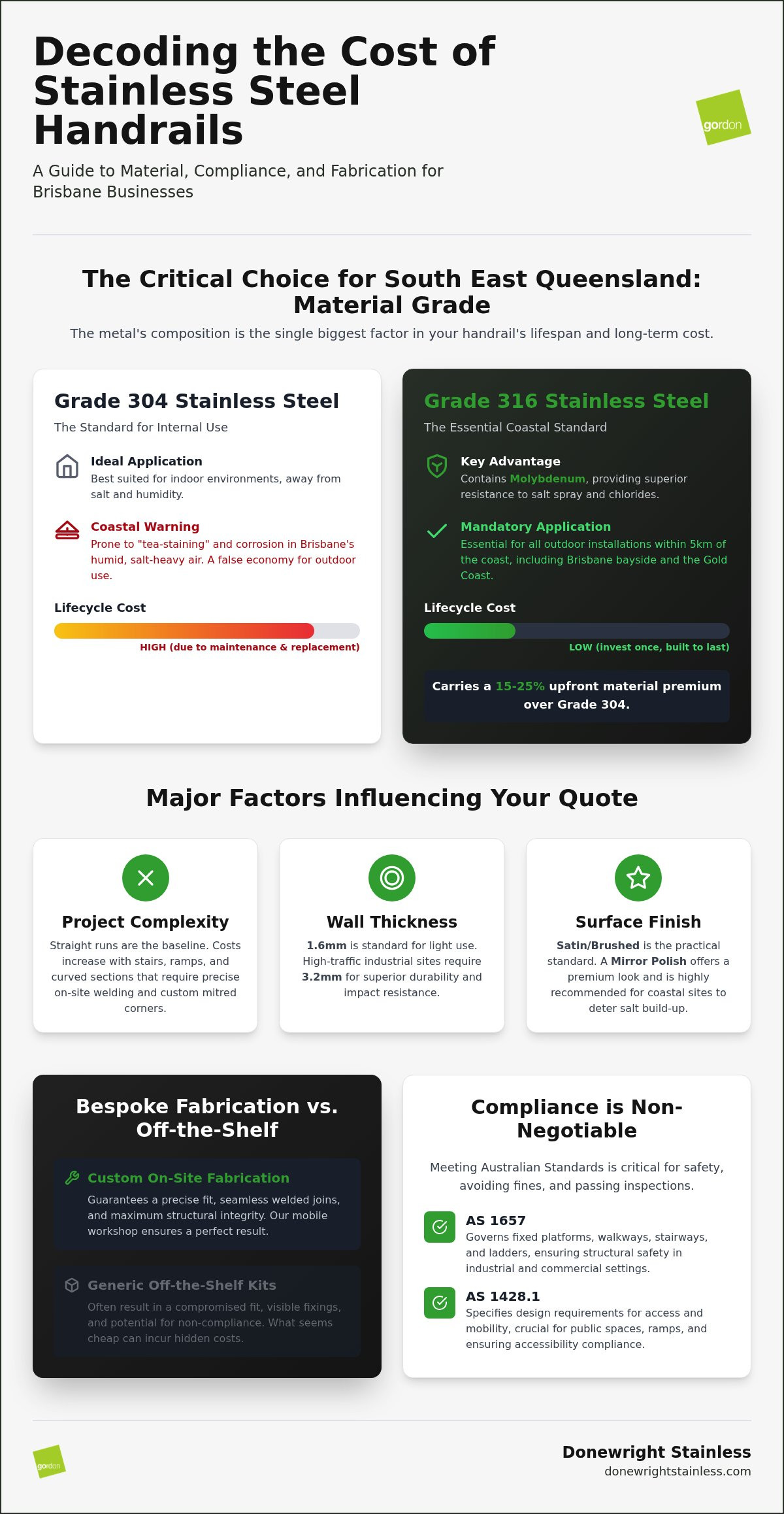
The grade and thickness of the stainless steel selected are fundamental to the project’s longevity. Most commercial applications rely on a satin or brushed finish because it’s practical and hides fingerprints. However, if your project requires a mirror polish for a premium architectural look, the additional polishing stages will increase the labour hours. Every custom mitre, bend, and join adds a layer of manual work that a generic kit simply can’t replicate.
Linear Metres vs. Project Complexity
A straight run on a flat surface is the most straightforward configuration to quote and install. Costs shift upward when you introduce multi-level stairs, ramps, or curved balconies. These designs require custom mitred corners and precise joins that must be welded and polished on-site to ensure a seamless finish. Side-mounted or fascia-fixed rails often demand more complex bracketry and longer installation times compared to standard top-mounted posts. If your site has restricted access or requires work at height, these logistical challenges will naturally influence the total labour component of your project.
Material Volume and Wall Thickness
The physical properties of the steel itself play a major role in the budget. Standard residential handrails typically use a 1.6mm wall thickness, which is sufficient for light use. Industrial environments or high-traffic commercial zones frequently require a 3.2mm wall thickness for added durability and impact resistance. While thicker material increases the initial cost, it’s a necessary investment to prevent denting and structural fatigue over time.
In 2026, global supply chain trends continue to influence local material pricing in South East Queensland. We’ve seen that well-planned commercial projects can often achieve better value through bulk material procurement. Choosing the right material grade from the start, whether it’s Grade 304 for internal use or Grade 316 for our humid coastal air, ensures you aren’t paying for a replacement in five years’ time. Precision in the initial design phase remains the most effective way to control costs; a well-considered run reduces material waste and minimises the time spent on complex on-site adjustments.
Grade 304 vs. Grade 316: Choosing the Right Material for South East Queensland
The chemical composition of your metal is the single biggest factor in determining the long-term stainless steel handrail cost Brisbane businesses face. While Grade 304 and Grade 316 look identical to the naked eye, their performance in our subtropical environment is vastly different. Grade 316 contains molybdenum, an alloying element that provides essential resistance to chlorides and salt spray. In a city where the salt air travels far inland, this chemical difference isn’t just a technicality; it’s the barrier between a pristine finish and a corroded eyesore.
Opting for Grade 316 typically carries a 15-25% price premium over Grade 304. However, choosing the cheaper 304 grade for outdoor use in South East Queensland is often a false economy. The humid, salt-heavy air causes 304 to degrade rapidly, leading to significantly higher maintenance costs or even total replacement within a few years. When you factor in the labour for cleaning and eventual repairs, the lifecycle cost of Grade 316 is much lower. If you’re unsure which grade suits your specific site, our team provides expert advice on stainless steel fabrication tailored to local conditions.
The Gold Coast and Coastal Brisbane Factor
Proximity to the ocean dictates your material requirements. Any installation within 5km of the coast, including much of the Gold Coast and Brisbane’s bayside suburbs, must utilise Grade 316. Without it, your handrails will likely fall victim to “tea-staining,” a brown surface discolouration that mimics rust. To further protect your investment, we often recommend a mirror-polished finish for coastal sites. This ultra-smooth surface gives salt particles fewer places to settle, making it much harder for corrosion to take hold compared to a standard brushed finish.
Internal Applications and Grade 304
Grade 304 remains a cost-effective choice for internal handrails where the environment is strictly controlled. In air-conditioned office blocks or residential interiors far from the coast, 304 provides the strength and aesthetic appeal of stainless steel at a more accessible price point. However, high-traffic commercial areas or internal stairs near industrial kitchens may still require the added durability of 316. Even with internal 304 installations, a regular maintenance schedule is vital. A simple wipe-down with appropriate cleaners will preserve the original finish and prevent the buildup of oils and grime that can dull the metal over time.
The Cost of Compliance: AS 1657 and AS 1428.1 Standards
Compliance with Australian Standards is a non-negotiable factor in the final stainless steel handrail cost Brisbane projects incur. While it’s tempting to look at purely aesthetic designs, industrial and commercial installations must adhere to AS 1657 and AS 1428.1. These aren’t just suggestions. They’re legal requirements under the Work Health and Safety Act. Failing to meet these standards often leads to failed building inspections, expensive re-works, and significant legal liability if an accident occurs on-site.
The true price of a handrail includes its ability to pass inspection. In 2023-24, falls, trips, and slips accounted for 21.8% of serious workers’ compensation claims in Australia, according to Safe Work Australia. Investing in a compliant, professionally fabricated system isn’t just about following rules. It’s about protecting the people using your facility and ensuring your investment stands up to legal and safety scrutiny.
Industrial Safety and AS 1657 Requirements
AS 1657 governs fixed platforms, walkways, stairways, and ladders. One of the most significant cost drivers here is the requirement for continuous, smooth handrails that don’t catch clothing or hands. This means every transition between levels or around corners requires meticulous on-site welding and polishing rather than simple push-fit components. The standard also dictates specific height ranges and minimum clearances between the rail and adjacent structures. These rules often require more material and higher fabrication labour hours than a basic decorative rail. You can learn more about our safety handrail fabrication Brisbane services to see how these standards are applied in practice.
Disability Access (NDIS/AS 1428.1) Handrails
For public-facing Brisbane businesses, AS 1428.1 compliance is mandatory. This standard focuses on access and mobility, introducing specific requirements for handrail diameters (usually between 30mm and 50mm) and ergonomic grip profiles. A major cost factor here involves the terminations of the rails. They can’t just end abruptly; they must return to a wall or turn 180 degrees to prevent catching. Additionally, the installation of tactile ground surface indicators at the top and bottom of ramps or stairs adds another layer of complexity. Businesses focusing on accessibility often find that pairing compliant handrails with clear, durable signage from Signarama ensures a professional and fully navigable environment for all visitors. Integrating these requirements into the initial design phase is the most effective way to avoid the hidden costs of site modifications later.
The physical environment of your site is a major variable in the final stainless steel handrail cost Brisbane businesses must account for. It is one thing to fabricate a rail in a factory; it is quite another to transport and install it in a restricted industrial mezzanine or a busy commercial kitchen. If your project involves high-rise access, remote locations, or restricted zones requiring specialised safety permits, the labour component of the quote will naturally increase to reflect these logistical challenges.
Mounting methods also play a significant role in the installation budget. Core drilling into concrete provides a clean, incredibly strong finish, but it requires specialised machinery and more time on-site. Base plate mounting is often faster and more cost-effective for certain surfaces, though it leaves the fixings visible. We assess the structural integrity of your floor or wall to determine which method provides the best long-term stability. If you are looking for a precise quote that accounts for these site-specific factors, you can contact our team for a professional assessment.
Mobile Welding Services in Brisbane and Logan
On-site welding is essential for achieving the seamless, continuous joins required by Australian Standards. Bringing a fully equipped mobile workshop to your facility in Logan or the Gold Coast allows our team to make precise adjustments that factory-only fabricators simply cannot manage. This capability is particularly vital for industrial plants where minimising downtime is a priority. By performing the final assembly and welding on-site, we ensure the handrail fits the existing structure perfectly without the need for multiple site visits. This efficiency is a core part of our service, much like our work in on-site industrial pipework repair Brisbane, where rapid, precise engineering saves our clients significant money by keeping operations running.
Preparing Your Site for Installation
You can help manage the labour costs of your installation by ensuring the site is ready for our arrival. Clearing the work area and providing easy access for our mobile workshop reduces the time our technicians spend on logistics. If your project involves replacing old, damaged barriers, the cost of removal and disposal of the existing structures should be discussed upfront. We operate with strict safety protocols, especially when welding in public spaces or food-grade environments. This includes using specialized screens and fume extraction to protect your staff and customers. Being prepared for these safety requirements from day one prevents delays and ensures the installation process is as smooth as the final stainless steel finish.
Why Donewright Stainless is Brisbane’s Choice for Custom Handrails
Donewright Stainless has established its reputation through a commitment to precision and a deep understanding of South East Queensland’s industrial landscape. Led by “Wrighty,” our team brings decades of collective experience to every project, ensuring that the stainless steel handrail cost Brisbane businesses pay translates into a high-performance, long-term asset. We don’t rely on flashy marketing or hyperbole. Instead, we present our capabilities through the quality of our bespoke fabrication and our unwavering adherence to Australian Standards. Every handrail we produce is designed to withstand the specific environmental pressures of our humid, coastal climate while providing the structural security your site demands.
Transparency is a core value of our operations. We provide detailed quotes that account for all local variables, including material grade, site complexity, and the specific compliance requirements of your industry. This methodical approach ensures there are no surprises during the installation phase. Whether you are upgrading a safety system in a Logan warehouse or installing architectural rails on the Gold Coast, you can trust our team to provide honest advice and a finished product that meets every safety benchmark.
From Design to Installation: Our Process
Our process begins with a thorough assessment of your site requirements. We don’t believe in one-size-fits-all solutions because every commercial and industrial facility has unique challenges. We translate these needs into a durable handrail system that prioritises both safety and efficiency. By focusing on precision fabrication, we ensure that every component fits perfectly, reducing the need for extensive on-site modifications. For a deeper look at our technical capabilities, you can view our guide on custom stainless steel fabrication Brisbane, which details our approach to quality and compliance in the industrial sector.
Industrial Maintenance and Long-Term Support
Safety Handrails and Protection systems are only effective if they remain in top condition. Our handrails are built to withstand heavy industrial use, but we also provide ongoing maintenance services to ensure your facility continues to meet AS 1657 and AS 1428.1 standards over time. This service-oriented mindset is why many of our clients view us as a long-term partner rather than just a one-off contractor. We understand the importance of reliability in industrial maintenance, and our mobile workshop is always ready to handle repairs or adjustments as your site evolves. If you’re ready to secure your facility with a compliant, professionally built system, contact us for a fair dinkum quote on your next Brisbane project.
Secure Your Facility with Compliant Stainless Steel Solutions
Investing in high-quality fabrication ensures your site remains safe, durable, and fully compliant with the latest Australian Standards. We’ve explored how the stainless steel handrail cost Brisbane projects require is shaped by material choice, specifically the need for Grade 316 in our coastal air, and the technical demands of AS 1657. By prioritising professional installation over generic hardware, you avoid the long-term risks of corrosion and safety failures that lead to costly re-works.
Donewright Stainless is a Brisbane-owned and operated business led by Ian “Wrighty” Wright. We specialise in AS 1657 industrial compliance and use a fully equipped mobile workshop to deliver precision results across South East Queensland. Our team is ready to help you navigate the complexities of design and installation with honest advice and reliable workmanship. If you’re ready to move forward with a system built to last, request a custom quote for your Brisbane handrail project today. We look forward to delivering a safe, compliant result for your facility.
Frequently Asked Questions
What is the average cost per metre for stainless steel handrails in Brisbane?
Industry data from ServiceSeeking in August 2026 suggests the average cost for stainless steel handrails sits around $287 per metre, though premium installations range from $350 to $600. These figures fluctuate based on material grade and site complexity. When calculating your total stainless steel handrail cost Brisbane, factor in that 53% of quotes in the current market are priced by the hour rather than a fixed linear metre rate.
Does a handrail need to be Grade 316 for an outdoor pool area in Brisbane?
Does a handrail need to be Grade 316 for an outdoor pool area in Brisbane?
Yes, Grade 316 is the mandatory standard for outdoor pool areas in South East Queensland. Brisbane’s subtropical humidity and the presence of pool chemicals create a highly corrosive environment. Grade 304 lacks the molybdenum required to resist pitting and tea-staining in these conditions. Using 316 grade ensures your handrails maintain their structural integrity and aesthetic finish, preventing the premature deterioration often seen with lower-grade alternatives in coastal climates. If you are also looking for specialized safety barriers for your project, you can check out Outlook Fencing for high-quality glass and tubular pool fencing solutions.
The timeline for custom fabrication usually spans two to four weeks from the final site measure to installation. This period allows for precise workshop engineering, including cutting, welding, and polishing to your specific requirements. The on-site installation phase typically takes one to two days depending on the linear metres and mounting method. Large industrial projects or those requiring complex mitres may extend these lead times to ensure compliance with relevant safety standards.
Is it cheaper to buy a DIY handrail kit from a hardware store?
While DIY kits have a lower upfront purchase price, they often prove more expensive in the long run. These retail products typically use thinner 1.6mm walls and push-fit joins that lack the strength of fully welded systems. Professional fabrication ensures a seamless finish that meets AS 1657 safety requirements. When you factor in the labour for on-site adjustments and the risk of non-compliance, custom-built handrails provide far superior lifecycle value and durability.
What are the main differences between AS 1657 and AS 1428.1 for handrails?
AS 1657 focuses on industrial safety for platforms, walkways, and stairways, prioritising continuous rails that prevent falls in workplaces. In contrast, AS 1428.1 governs design for access and mobility in public spaces. It mandates specific rail diameters, tactile indicators, and returns to ensure accessibility for people with disabilities. Many Brisbane commercial projects must comply with both standards, requiring a high level of technical precision during the fabrication and installation phases.
Do you provide mobile welding services for handrail repairs in Logan or Gold Coast?
We operate a fully equipped mobile workshop that services Brisbane, Logan, the Gold Coast, and Ipswich. This allows us to perform precision welding and repairs directly at your facility, which is essential for industrial clients who cannot afford significant downtime. Our mobile capabilities ensure that on-site modifications or safety repairs are completed with the same level of accuracy as factory work, maintaining the structural integrity of your existing protection systems.
Can you install handrails in food processing plants with strict sanitary requirements?
We specialise in high-grade stainless steel fabrication for the food and beverage industry. Our team understands the strict sanitary requirements of food processing plants, where smooth, crevice-free welds are essential to prevent bacterial growth. We use specialised welding techniques and high-polish finishes to ensure your handrails and safety barriers are easy to sanitise. This level of precision ensures your facility remains compliant with both safety standards and health regulations.
Will a stainless steel handrail rust in the Brisbane humidity?
High-quality stainless steel won’t rust in the traditional sense, but it can suffer from “tea-staining” if the wrong grade is used. Brisbane’s humidity and salt air can cause brown surface discolouration on Grade 304 steel. By using Grade 316 and applying the correct surface finish, such as a mirror polish for coastal sites, you can prevent this oxidation. Regular maintenance and choosing the right material for our climate are the keys to longevity.