
AS 1657 Handrail Fabrication: The Industrial Guide to Compliance in 2026
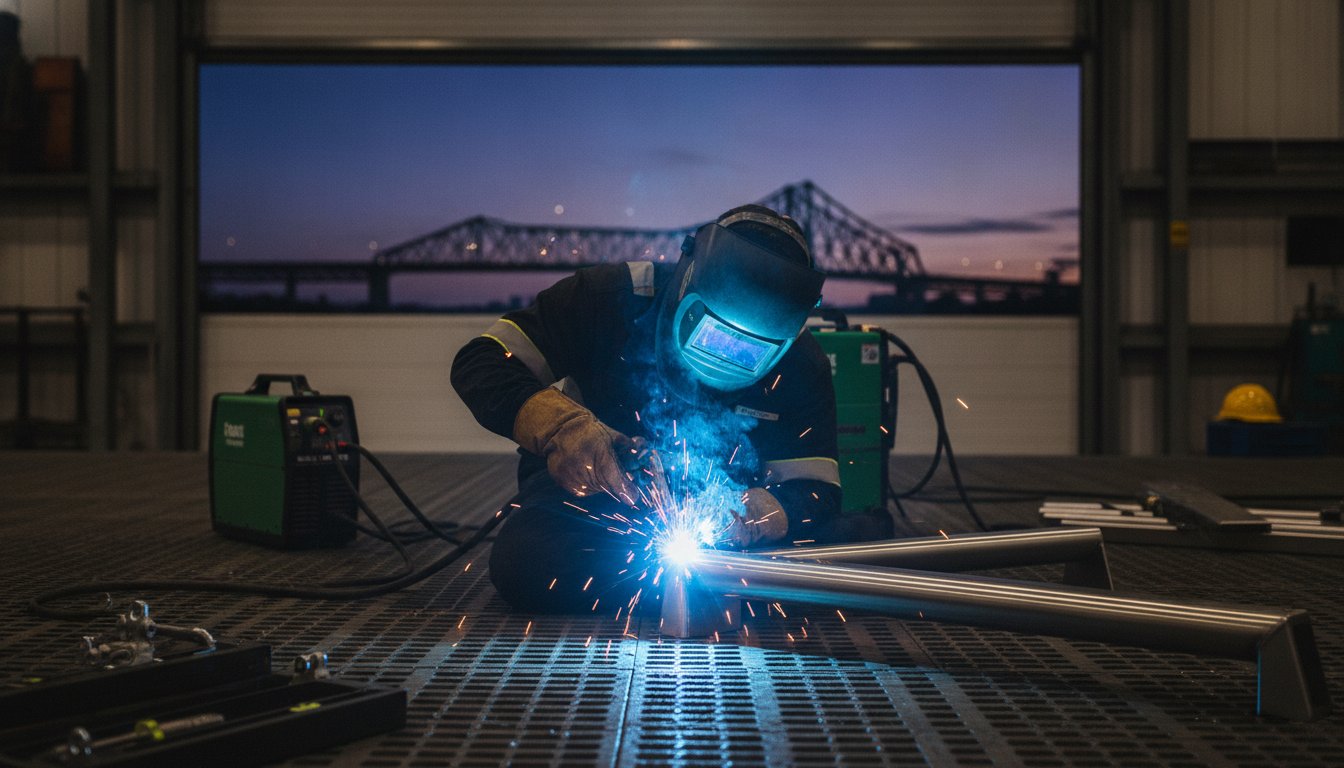
A single millimetre of deviation in your AS 1657 handrail fabrication can be the difference between a passed safety audit and a costly site shutdown. You’ve likely felt the pressure of interpreting the 2018 standards while managing a high-output Brisbane facility. It’s a high-stakes environment where the relentless humidity of South East Queensland can be just as unforgiving as the regulatory inspectors.
We understand that rework isn’t just an expense; it’s a disruption you can’t afford. This guide will show you how to master the essentials of compliant safety rail systems to ensure your site remains safe and durable for the long haul. We’ll examine the specific 2026 requirements for Grade 316 stainless steel in our local climate, the 630N point load benchmarks you must meet, and how a methodical approach to installation keeps your team moving without delay. Precision is the baseline, but choosing the right materials for the Brisbane River’s salt-laden air is what prevents tea staining and structural failure down the road.
Key Takeaways
- Understand how AS 1657:2018 compliance protects your operation and aligns with the Work Health and Safety Act 2011.
- Master the precise geometry of AS 1657 handrail fabrication, ensuring all rails sit strictly within the 900mm to 1100mm height range.
- Discover why Grade 316 stainless steel is the non-negotiable choice for resisting corrosion in Brisbane’s subtropical humidity.
- Learn to spot common design failures, such as missing 100mm kickplates or rail gaps that exceed the 450mm safety limit.
- Compare the structural durability of fully welded custom systems against modular kits to ensure long-term site safety and minimal maintenance.
What is AS 1657 and Why Does Your Brisbane Site Need It?
AS 1657:2018 is the definitive Australian Standard for fixed platforms, walkways, stairways, and ladders. It provides the technical blueprint that ensures every worker who steps onto an elevated surface in your facility returns home safely. For Brisbane industrial operators, adhering to these rules isn’t a choice; it’s a direct requirement under the Work Health and Safety Act 2011 and the Managing the risk of falls at workplaces Code of Practice 2021. This framework ensures that safety is engineered into the structure from the very first weld.
The scope of this standard is highly specific. It covers access to machinery and parts of buildings that aren’t intended for general public use. While the National Construction Code (NCC) might govern a public Australian definition of footpath or a commercial office stairwell, AS 1657 is the boots-on-the-ground standard for factories, warehouses, and processing plants. Knowing exactly where AS 1657 applies versus where the NCC takes over is vital for your project’s compliance and long-term legal standing.
Failing to meet these benchmarks carries heavy consequences. Beyond the obvious physical danger to staff, non-compliant AS 1657 handrail fabrication can lead to immediate site shutdowns during safety audits. It also complicates insurance claims. If a fall occurs on a rail system that doesn’t meet the load-bearing or height requirements, insurers often have grounds to deny coverage. This leaves the business owner personally liable for damages and legal costs that far outweigh the price of a compliant installation.
The Difference Between Handrails and Guardrails
Precision in terminology matters during the design phase. A handrail is specifically designed as a handhold to provide support and stability during movement, such as walking up a set of industrial stairs. A guardrail is a protective barrier intended to prevent a person from falling from one level to another. In many industrial applications, the AS 1657 handrail fabrication process must result in a system where a single rail performs both functions. It must be at the correct height for a handhold while providing the structural strength of a fall barrier.
Industrial vs Residential Standards in Queensland
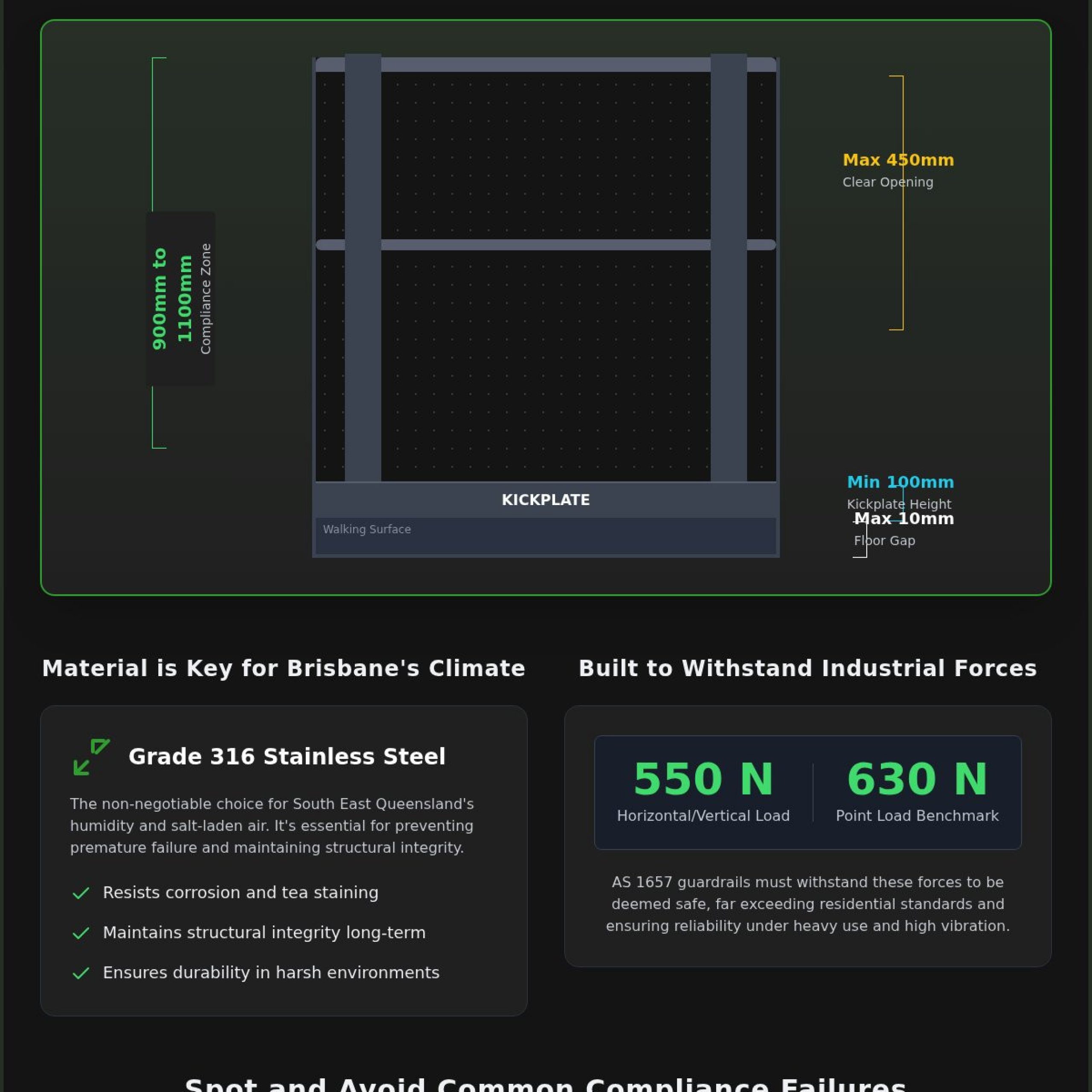
Domestic balustrades are rarely fit for a Brisbane industrial environment. Residential standards focus on preventing small children from climbing or falling through gaps, whereas industrial standards prioritise structural integrity under heavy use. AS 1657 requires guardrail systems to withstand a 550N load applied horizontally or vertically. This level of durability is essential in environments with high vibration or heavy foot traffic, making domestic-grade alternatives a liability in any factory or warehouse safety audit.
Key Requirements for AS 1657 Handrail Fabrication
Achieving compliance starts with a tape measure. The AS 1657:2018 official standard mandates that the top rail of a guardrail must sit between 900mm and 1100mm above the walking surface. This height range is critical. If it’s too low, it becomes a trip hazard; too high, and it fails as a stable handhold for shorter personnel. During the AS 1657 handrail fabrication process, we ensure every post is cut to account for the specific floor finish of your site to keep this “goldilocks zone” consistent across the entire platform.
A top rail alone isn’t enough to secure a dangerous edge. You must include a mid-rail to prevent people or equipment from sliding through the gap. The clear opening between the rails, or between the bottom rail and the kickplate, must not exceed 450mm. For elevated platforms, a kickplate is non-negotiable. It must stand at least 100mm high and be positioned no more than 10mm above the floor level. These toe-boards prevent tools from being accidentally kicked off the edge, protecting staff working on the levels below from falling objects.
Stanchion spacing is the final pillar of structural design. While it’s tempting to spread posts further apart to save on material, this often compromises the system’s ability to withstand industrial forces. We calculate spacing based on the specific load requirements of your facility, ensuring the handrail remains rigid under pressure. If you’re unsure about your current layout, our team can provide specialist safety handrail advice to identify potential weak points in your design.
Clearances and Ergonomics
Ergonomics are often overlooked but are vital for passing a safety audit. A handrail must provide a continuous grab surface without sharp edges or sudden “stops and starts” that could cause a worker to lose their grip. There must be a minimum clearance of 50mm behind the rail to prevent fingers from being trapped against walls or machinery. We also design end treatments as “returns” or “D-ends.” This prevents the rail from snagging on clothing or equipment, which is a common cause of workplace stumbles and equipment damage.
Load Testing and Structural Integrity
Every connection must be built to last. Connections must withstand a 630N point load applied in any direction, while guardrail systems must resist a 550N load applied horizontally or vertically to the top rail. High-quality welds are the only way to meet these Australian Standard ratings consistently. In South East Queensland, the dead load represents the permanent weight of the handrail assembly itself, while the live load accounts for the temporary forces exerted by workers and their equipment during daily operations.
Choosing the Right Material: Why Stainless Steel Wins in SEQ
Brisbane’s subtropical climate is notoriously hard on industrial infrastructure. The combination of high humidity and salt-laden air, particularly for sites within 5km of the coast or the Brisbane River, creates a highly corrosive environment. While galvanised mild steel is often chosen for its lower initial price, it frequently falls victim to “white rust” and eventual structural failure in these conditions. In contrast, AS 1657 handrail fabrication using stainless steel offers a superior return on investment. By eliminating the need for periodic sandblasting and repainting, facility managers in Logan and the Gold Coast can reduce their long-term maintenance budgets significantly.
Beyond durability, stainless steel provides critical hygienic advantages. For food processing plants and pharmaceutical facilities, the non-porous surface of stainless steel prevents bacterial growth and withstands rigorous chemical cleaning. This material choice ensures your facility maintains a professional “centre-of-excellence” appearance that reflects your commitment to quality and safety standards. It’s about building something that looks as good in ten years as it does on the day of installation.
Grade 304 vs Grade 316: The Fabricator’s Choice
Selecting the correct grade of stainless steel is a technical decision that impacts the lifespan of your installation. Grade 304 is often sufficient for inland industrial settings where exposure to corrosive elements is minimal. However, Grade 316, or “Marine Grade,” is non-negotiable for projects at the Port of Brisbane or along the Gold Coast. Grade 316 contains molybdenum, which provides essential resistance to pitting and “tea staining,” the brown surface discolouration that plagues inferior metals. Our AS 1657 handrail fabrication process prioritises the correct grade to ensure your safety rails remain structurally sound and visually clean for decades.
Surface Finishes and Safety
The finish of your handrail affects both its safety and its longevity. While a mirror-polished finish looks impressive, a brushed or “satin” finish is typically preferred for industrial grip and to hide minor scratches from daily use. For specialised environments, we provide stainless steel handrails food processing facilities require, where surface roughness must be strictly controlled to meet sanitary standards. A regular maintenance schedule, involving simple cleaning with fresh water and mild detergents, is usually all that’s required to keep these systems performing at their peak without the need for harsh chemicals.
Avoiding Common Compliance Failures in Industrial Handrail Design
Even the most well-intended projects can fall into the “Gap Trap” during AS 1657 handrail fabrication. While the 450mm maximum opening between rails seems straightforward, installers often forget to account for the space between the bottom rail and the kickplate. If this gap exceeds 450mm, the entire system is non-compliant. Similarly, kickplates must be at least 100mm high. A common blunder is leaving a gap of more than 10mm between the kickplate and the floor, which allows small tools to slide underneath and endanger workers on lower levels.
Poor terminations are another frequent audit failure. Handrails that end abruptly without returning to a wall or post create a snagging hazard for clothing and equipment. On stairways, “stepping” the handrail to match the treads rather than maintaining a continuous pitch is a major error. The rail must follow the angle of the stair nosing precisely to provide a safe, uninterrupted handhold for the user throughout their entire ascent or descent.
Sanitary Design Mistakes in Food and Beverage Plants
In food and beverage plants, compliance goes beyond structural safety. Designing out “dead legs” and crevices where bacteria can thrive is essential. We avoid “tack and caulk” methods, which are common in cheaper modular systems, in favour of fully sealed, ground-flush welds. This custom approach ensures there are no hidden pockets for moisture or organic matter to collect, making the system easier to sanitise during high-pressure washdowns. It’s this “fabricator’s eye” during AS 1657 handrail fabrication that prevents long-term hygiene risks that standard safety guides often overlook.
Installation Blunders on Brisbane Sites
Installation on Brisbane sites often reveals critical issues with baseplate anchoring. A handrail is only as strong as its connection to the substrate. If the anchors are incorrectly spaced or the baseplate is too thin, the system will fail the “deflection” rule. A compliant rail shouldn’t feel flimsy or exhibit excessive movement when a 550N load is applied. We often see “off-the-shelf” solutions struggle with this because they aren’t tailored to the specific floor conditions of the site. For a comprehensive look at the process, you can contact us for expert stainless steel fabrication or review our safety handrail fabrication Brisbane guide for a full installation checklist.
Custom Fabrication vs. Modular: Getting a Perfect Fit for Your Facility
Modular systems often market themselves as a quick fix, yet they frequently fall short in complex industrial environments. The “one size fits all” promise usually results in on-site hacking where components are cut and forced to fit. This compromises the protective coating and can lead to structural weak points. In contrast, custom AS 1657 handrail fabrication ensures the system is built to the exact millimetre of your facility’s layout. A fully welded system offers superior structural integrity because it doesn’t rely on mechanical fixings that can vibrate loose over time.
The “Wrighty” approach focuses on bespoke solutions that respect your site’s unique geometry. Whether you’re navigating around existing industrial pipework or fitting a rail to a non-standard platform, custom fabrication provides a seamless finish. To keep your operation running, our mobile workshop welding Brisbane service brings factory-level precision directly to your floor. This eliminates the need for shipping parts back and forth, which significantly reduces project lead times and keeps your production schedule on track.
The Donewright Mobile Advantage
Our mobile workshop is more than just a van with a welder; it’s a fully equipped engineering hub. We can perform on-site modifications that ensure a perfect fit around complex plant machinery, which is something a modular kit simply can’t achieve. This agility is particularly valuable for emergency repairs. If a safety rail is damaged in a Logan or Gold Coast facility, we can respond rapidly to restore compliance and protect your workers without halting production for days. We bring the reliability of a workshop to your doorstep.
Long-term Maintenance and Support
Choosing custom-welded rails is a strategic move for long-term plant longevity. Bolted modular systems require periodic inspections to tighten fixings that naturally loosen under industrial vibrations. Our welded systems are essentially maintenance-free once installed, saving your team hours of routine checks. We also offer ongoing safety audits to ensure your infrastructure continues to meet evolving standards. Ready to secure your site? Contact Donewright Stainless for an AS 1657 compliant quote and experience the reliability of a system that’s built right the first time.
Secure Your Facility with Precision Engineering
Maintaining a compliant industrial site in Brisbane requires a disciplined approach to safety infrastructure. You’ve seen how precise geometry, from the 900mm rail height to the 100mm kickplate, forms the foundation of a passed audit. Selecting high-grade materials like Grade 316 stainless steel ensures your investment survives the subtropical humidity without falling victim to tea staining or structural decay. It’s a choice that pays dividends in reduced maintenance and long-term reliability.
Professional AS 1657 handrail fabrication is about more than just meeting a legal baseline; it’s about protecting your team and your production schedule. Our fully equipped mobile workshop brings factory precision directly to your SEQ site, allowing for bespoke adjustments that modular systems simply can’t match. We’re specialists in high-grade industrial stainless steel with an expert knowledge of the AS 1657:2018 standards. We take pride in delivering results that stand up to the rigours of the Brisbane industrial landscape.
If you’re ready to upgrade your safety systems with a local partner who values precision as much as you do, we’re ready to get to work. Get a Compliant Handrail Quote from Wrighty Today and ensure your facility remains a safe, productive environment for years to come.
Frequently Asked Questions
What is the standard height for an AS 1657 handrail?
The standard height for an AS 1657 handrail must sit between 900mm and 1100mm above the walking surface. This specific range applies to both walkways and stairways, measured vertically from the floor or the stair nosing. Maintaining these precise dimensions ensures the rail provides a secure handhold while acting as a reliable fall barrier for personnel of various heights across your facility.
Does AS 1657:2018 apply to residential stairs in Brisbane?
AS 1657:2018 does not apply to residential stairs; it’s strictly for industrial and commercial access areas like factories, warehouses, and plant rooms. Residential balustrades are governed by the National Construction Code and separate Australian Standards focused on domestic safety. It’s vital to use the correct standard for your site type to ensure legal compliance and avoid costly rework during safety audits.
What is the difference between a handrail and a guardrail under the standard?
A handrail is designed to provide a continuous handhold for support during movement, while a guardrail acts as a protective barrier to prevent falls from heights. In many AS 1657 handrail fabrication projects, a single rail often performs both functions simultaneously. The standard specifies different load requirements for each to ensure the system remains structurally sound when workers exert force against it.
Can I use aluminium for AS 1657 compliant handrails?
You can use aluminium for AS 1657 compliant handrails, provided the system meets the mandatory load-bearing requirements set out in the standard. Aluminium is lightweight and naturally corrosion-resistant; however, it often lacks the extreme structural rigidity of stainless steel in high-vibration industrial environments. We typically recommend stainless steel for its superior longevity and lower maintenance profile in heavy-duty Brisbane processing facilities.
How often should industrial handrails be inspected for safety compliance?
Industrial handrails should be inspected at least once every 12 months as part of a standard workplace safety audit. High-traffic areas or corrosive environments near the Brisbane River may require more frequent checks to identify issues like weld decay or loose fixings. Regular maintenance ensures your AS 1657 handrail fabrication remains compliant with the Work Health and Safety Act 2011 and remains safe.
Is a kickplate always required on AS 1657 walkways?
A kickplate is mandatory on any elevated walkway where a person or object could fall to a lower level. The plate must be at least 100mm high and positioned no more than 10mm above the floor surface. This safety feature is essential for preventing tools or debris from being kicked over the edge, which protects staff and equipment on the levels below from injury.
Why is Grade 316 stainless steel recommended for Brisbane coastal sites?
Grade 316 stainless steel contains molybdenum, which provides significantly higher resistance to pitting and “tea staining” caused by salt-laden air. In Brisbane coastal areas or sites near the river, Grade 304 often suffers from surface corrosion within months of installation. Using Grade 316 ensures your safety rails maintain their structural integrity and professional appearance in our humid, subtropical climate over the long term.
Can Donewright Stainless perform on-site welding for handrail repairs?
Yes, we provide a fully equipped mobile workshop to perform on-site welding and handrail repairs across Brisbane and South East Queensland. This service allows us to fix damaged safety rails or modify existing systems without the need to transport materials back to a factory. It’s a practical solution for minimising site downtime while ensuring all repairs meet the current Australian Standards for industrial safety.