
Stainless Steel vs Aluminium Handrails Brisbane: The 2026 Industrial Comparison Guide
Choosing the lower-priced aluminium option for your facility’s safety barriers might seem like a win for the budget, but in South East Queensland, it often proves to be a costly miscalculation. When you’re weighing up stainless steel vs aluminium handrails Brisbane, the initial price tag is only part of the story. Brisbane’s high humidity and salt-laden air are notoriously aggressive, often leading to premature pitting and structural degradation in lesser materials. We understand that as a facility manager or owner, your priority is maintaining a site that is both safe and compliant without facing constant maintenance downtime for repairs.
In this 2026 comparison guide, you’ll discover why Grade 316 stainless steel is the superior choice for longevity and how it ensures your facility remains AS 1657:2018 compliant. With falls and trips accounting for over 21 per cent of serious workers’ compensation claims in Australia, cutting corners on safety infrastructure is a risk you can’t afford. Wrighty and the team have seen how the wrong material choice leads to failed audits, so we will break down the lifecycle costs and technical performance of these materials to help you achieve a “set and forget” handrail system that protects your team and your long-term budget.
Key Takeaways
- Understand the chemical and structural reasons why Grade 316 stainless steel prevents the pitting and “tea-staining” common in Brisbane’s coastal environments.
- Access a practical 5-step checklist for AS 1657:2018 compliance, covering everything from rail heights to mandatory toeboard requirements.
- Compare the industrial impact resistance and Vickers hardness of stainless steel vs aluminium handrails Brisbane to choose the right protection for high-traffic zones.
- Learn how professional on-site welding and custom fabrication eliminate the safety gaps and compliance risks found in standard off-the-shelf kits.
- Evaluate the true lifecycle value of your safety systems by accounting for the reduced maintenance and downtime associated with high-grade alloys.
The Battle Against Brisbane’s Salt Air: Stainless vs Aluminium
Brisbane’s industrial landscape isn’t uniform. A facility located near the Port of Brisbane or Lytton faces a much higher salt load than a plant in Ipswich, yet both must contend with high humidity that accelerates metal fatigue. When you’re evaluating stainless steel vs aluminium handrails Brisbane, the local microclimate dictates the lifespan of your infrastructure. Salt-laden air from the Moreton Bay breeze settles on surfaces, creating a corrosive film that works into every weld and joint. Without the right material choice, what looks like a sturdy safety rail today can become a liability within just a few years.
The chemical distinction between these metals is vital for long-term planning. Grade 316 stainless steel contains molybdenum, which provides specific resistance to chlorides found in sea air. Industrial aluminium, conversely, relies on a thin oxide layer for protection. In the heavy industrial corridors of South East Queensland, airborne pollutants and constant moisture can strip this layer away. This leads to deep structural pitting. It’s a critical difference; while stainless steel may develop “tea-staining”, a brownish surface discolouration that is purely aesthetic, pitting in aluminium actually eats into the metal and compromises its structural integrity.
Corrosion Resistance in South East Queensland
Grade 316 is widely considered the gold standard for coastal industrial sites across the region. This material thrives where others fail because the properties of stainless steel allow it to self-heal its protective chromium oxide layer when scratched or exposed to harsh conditions. Aluminium often struggles in high-alkaline or high-acid environments, which are common near chemical processing plants or heavy manufacturing hubs. Without a rigorous cleaning schedule, salt buildup on aluminium handrails leads to rapid degradation. In contrast, 316 stainless steel maintains its core strength even when maintenance intervals are stretched.
Material Properties: Steel vs Aluminium
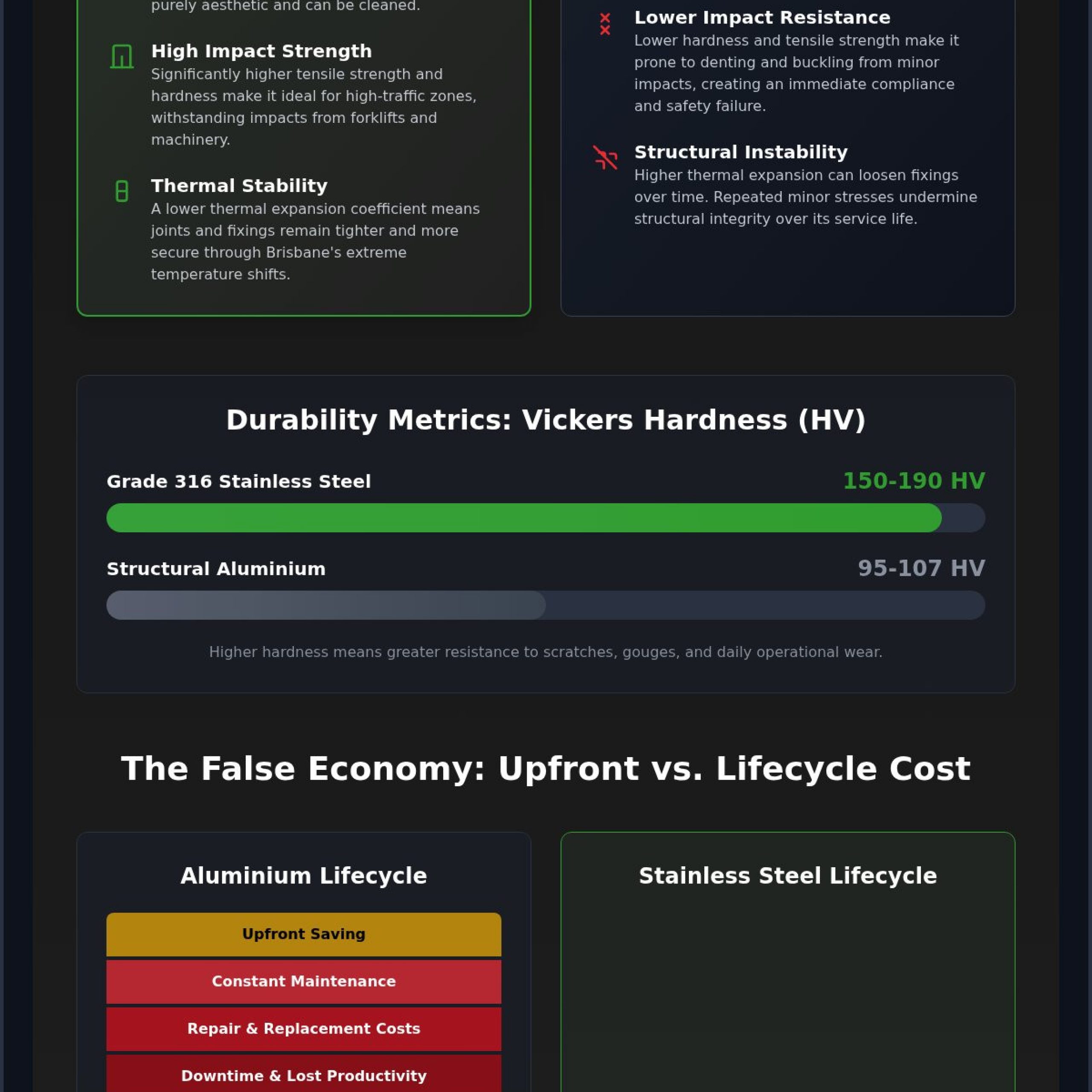
The physical demands of a busy warehouse or processing plant require materials that can withstand more than just the weather. Stainless steel offers significantly higher tensile strength, making it the superior choice for high-impact zones where trolleys, forklifts, or heavy machinery might strike a barrier. Stability in the heat is another factor. Brisbane’s extreme summer temperatures cause metals to expand and contract. Steel has a lower thermal expansion coefficient than aluminium, which means joints and fixings stay tighter and more secure over the long term. Grade 316 stainless steel is the primary choice for SEQ industrial longevity. This same engineering logic applies to marine accessories; for example, Tower Flags manufactures custom flag poles and brackets designed to withstand the same salt-laden winds that challenge industrial handrails.
Performance Under Pressure: Strength and Durability Metrics
In a high-intensity Brisbane workshop or processing plant, the physical toughness of your barrier system is just as vital as its ability to resist the weather. When comparing stainless steel vs aluminium handrails Brisbane, the mechanical hardness of the material determines how well it stands up to daily operational abuse. Stainless steel, particularly Grade 316, typically registers a Vickers hardness between 150 and 190 HV. In contrast, common structural aluminium alloys often sit between 95 and 107 HV. This gap in surface hardness means steel is far less likely to suffer from the deep scratches and gouges that can compromise a handrail’s safety and hygiene.
The durability of the material also dictates how often you will need to commission a structural replacement. While aluminium is lightweight and easy to install, it lacks the inherent density of steel. Over a decade of service, the structural integrity of aluminium can be undermined by repeated minor stresses, whereas a well-fabricated stainless steel system remains rigid and dependable. This long-term stability is a key reason why many facility managers in South East Queensland view steel as a permanent fixture rather than a temporary solution.
Impact Resistance in Industrial Zones
Handrails in industrial settings aren’t just for guidance; they’re often the last line of defence against runaway trolleys or heavy equipment. When struck by moving machinery, aluminium’s lower tensile strength makes it prone to denting and buckling. A buckled rail is a non-compliant rail, often requiring the entire section to be cut out and replaced. The team at Donewright Stainless focus on heavy-duty custom fabrication because we know that a “one size fits all” kit rarely survives a high-traffic environment. Our safety handrails and protection systems are designed to absorb these impacts without losing their structural form.
Maintenance Schedules and Surface Integrity
The longevity of a handrail’s finish is directly tied to its material composition. Grade 316 stainless steel relies on a “self-healing” chromium oxide layer. If the surface is scratched, this layer reforms almost instantly when exposed to oxygen, maintaining its protection. This process is detailed in this state-of-the-art report on marine corrosion, which highlights how alloys perform under constant environmental stress. Aluminium handrails are often powder-coated to provide a similar level of protection, but this coating is vulnerable. In the harsh Queensland sun, powder coatings can suffer from “chalking”, where the finish fades and becomes brittle. Once the coating chips, the underlying aluminium is exposed to the air, leading to the structural pitting mentioned previously. Over a 15-year lifecycle, the cost of repainting or replacing degraded aluminium far outweighs the simple cleaning required to keep stainless steel in peak condition.
Navigating Australian Standards: AS 1657 Compliance in 2026
Maintaining a safe facility in South East Queensland requires strict adherence to AS 1657:2018. When you’re evaluating stainless steel vs aluminium handrails Brisbane, compliance often hinges on the material’s ability to maintain structural integrity under load without excessive deflection. The 2018 standard remains the definitive guide for industrial walkways, platforms, and stairways in 2026. Failing an audit due to a non-compliant rail height or a missing toeboard can lead to significant operational downtime and increased liability.
To ensure your site meets current regulations, use this 5-step AS 1657 checklist during your next safety walkthrough:
- Rail Height: Ensure the top rail height is between 900mm and 1100mm above the walking surface.
- Mid-rail Gaps: Verify that mid-rails are installed so that no clear gap between rails exceeds 450mm.
- Toeboard Integrity: Install toeboards (kickplates) at least 100mm high where falling objects pose a risk to people below.
- Handrail Clearance: Maintain a minimum 50mm clearance between the handrail and any adjacent structure to allow for a continuous grip.
- Object Dimensions: Check that circular metal handrails have an external diameter between 30mm and 65mm.
Structural Integrity and Load Requirements
Grade 316 stainless steel naturally meets these load requirements with a slimmer profile than aluminium. Because steel is denser and has a higher modulus of elasticity, it handles the required service loads with significantly less deflection over longer spans. Aluminium systems often rely on mechanical fasteners and modular joints which are susceptible to movement. In the humid Brisbane climate, using stainless steel bolts in aluminium rails can also trigger galvanic corrosion, weakening the connection points over time. Our custom welding creates a single, rigid structure that offers a “set and forget” level of compliance that mechanical joints simply can’t match.
Safety Handrail Geometry and Ergonomics
Geometry is a critical factor for both safety and compliance. Handrails must be continuous and free of sharp edges or snag points that could cause injury during a fall. This is where bespoke fabrication excels over off-the-shelf aluminium kits. At Donewright, our mobile workshop allows us to ensure smooth, seamless transitions at every corner and landing. Public-facing industrial sites in Brisbane often face the dual challenge of meeting AS 1657 for workers and AS 1428.1 (DDA) for disability access. By using Grade 316 stainless steel, we can achieve the necessary ergonomic profiles while providing the heavy-duty protection needed in a high-traffic industrial environment.
The False Economy of Upfront Savings: Lifecycle Cost Analysis
When reviewing quotes for a new installation, the initial price gap between stainless steel vs aluminium handrails Brisbane often leads decision-makers toward the lighter metal. Aluminium typically carries a lower upfront material cost, which looks attractive on a quarterly budget. However, a true lifecycle cost analysis reveals that this is often a false economy. In the aggressive South East Queensland climate, the total cost of ownership (TCO) over a ten-year period frequently tips in favour of Grade 316 stainless steel. While the initial investment is higher, you aren’t just paying for metal; you’re paying for the absence of future headaches.
Downtime is perhaps the most overlooked factor in industrial budgeting. If a handrail system degrades or fails a safety audit, the resulting repairs often require cordoning off work zones or halting production lines. These hidden costs quickly eclipse any savings made during the procurement phase. Additionally, stainless steel retains a significantly higher scrap and resale value. While you likely aren’t planning to sell your handrails for scrap today, the intrinsic value of the alloy remains a tangible asset on your facility’s balance sheet for decades.
Initial Outlay vs Long-Term Repair Cycles
In coastal industrial zones, aluminium handrails often require significant remediation or full replacement twice as often as their stainless counterparts. Off-the-shelf aluminium kits are particularly prone to failure because their mechanical joints loosen under the vibration of heavy machinery. If these systems fail a compliance check, the cost of emergency retrofitting is steep. We often see facilities struggling with ageing infrastructure that was chosen for its low price but now requires constant attention. Our team provides on-site industrial pipework repair Brisbane to help managers keep their plants running, but starting with a fully welded stainless system is the best way to avoid these cycles entirely.
Application Matrix: When to Choose Which Material
The right material choice depends heavily on your specific application and location within the Brisbane region. For food processing plants and pharmaceutical facilities, Grade 316 stainless steel is the only viable choice due to its hygienic properties and resistance to caustic cleaning agents. In commercial CBD office fit-outs, the decision often balances aesthetics with durability; however, the high humidity of the riverfront still makes a strong case for steel. Geography plays a massive role; a site at the Port of Brisbane faces a much shorter replacement cycle for aluminium than one in Ipswich. If you’re looking for a “set and forget” solution that protects your long-term bottom line, investing in high-quality stainless steel fabrication is the most reliable path forward.
Custom Fabrication and Mobile Installation in South East Queensland
Industrial sites in Brisbane are rarely level or square. Standardised, off-the-shelf kits might save time during procurement, but they often lead to compliance failures during the final inspection. When debating stainless steel vs aluminium handrails Brisbane, the method of assembly is just as important as the metal itself. Custom fabrication allows for a level of precision that modular systems cannot match, particularly when navigating existing pipework, irregular mezzanine heights, or complex drainage runs. Every plant has its own unique geometry, and a bespoke approach ensures that the handrail fits the site, rather than forcing the site to fit the rail.
Why Precision On-Site Welding Matters
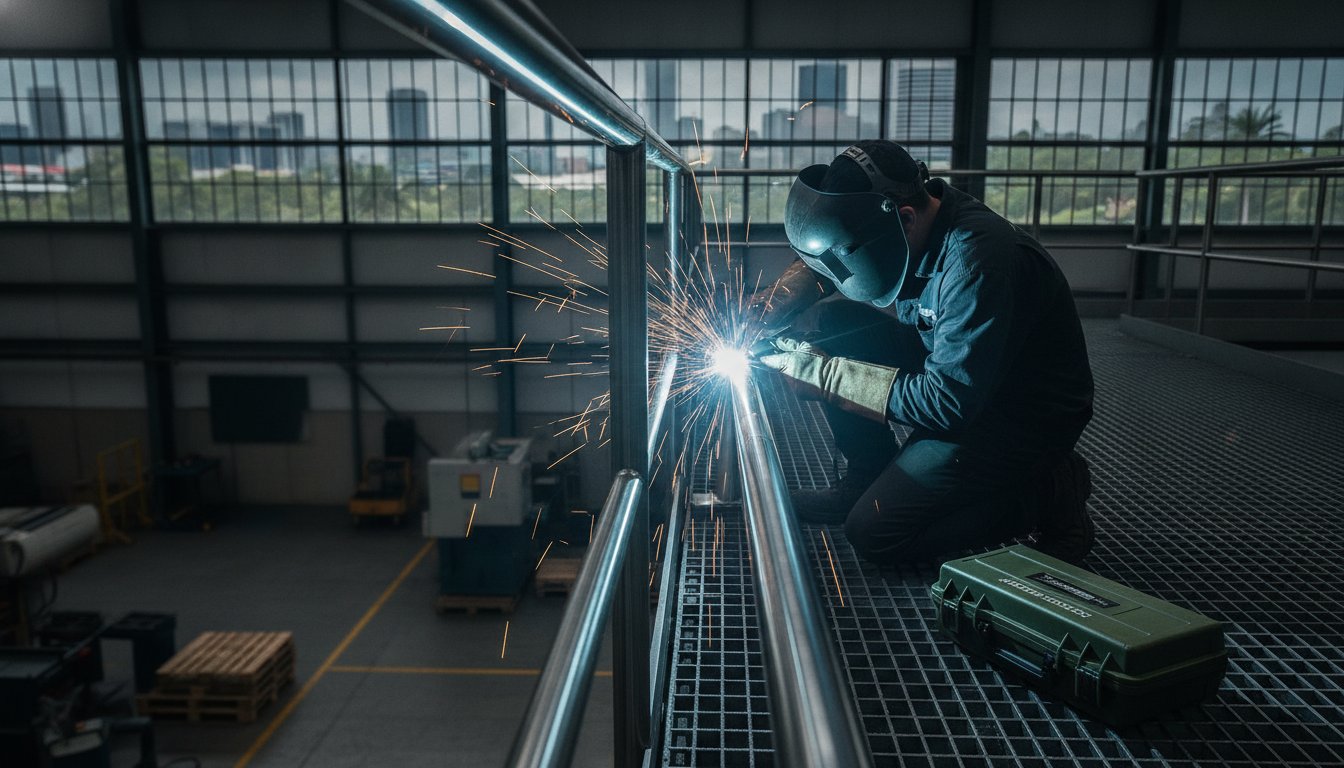
Bolted or riveted aluminium systems introduce hundreds of potential fail points into a safety barrier. Over time, industrial vibrations from heavy plant machinery and thermal expansion from the Queensland sun cause these mechanical joints to loosen. This creates a “rattle” that signals structural weakness and eventual non-compliance. By choosing custom stainless steel fabrication, you’re opting for a fully fused, monolithic structure. On-site welding ensures that every transition is smooth and every post is perfectly vertical, even on uneven industrial slabs or sloped walkways. This approach significantly reduces lead times and installation errors, as we make precise adjustments in real-time rather than waiting for replacement modular components.
The Donewright Stainless Mobile Workshop Advantage
Our commitment to precision is backed by a fully equipped mobile workshop that brings the factory to your door. We service the entire corridor from the Port of Brisbane through to Logan, the Gold Coast, and Ipswich with zero fuss. This mobile capability means we can fabricate and repair in situ, minimising your facility’s downtime and ensuring that work areas are handed back in a safe, compliant state as quickly as possible. We understand that your operations can’t stop for weeks while waiting for an off-site workshop to finish a batch. For a deeper look at the technical requirements of these systems, our Safety Handrail Fabrication Brisbane pillar provides an exhaustive guide to industrial quality and standards.
Precision isn’t just about the tools; it’s about the experienced hands using them. Wrighty and the team at Donewright Stainless take pride in delivering a “set and forget” finish that stands up to the harshest Brisbane conditions. We don’t just drop off parts; we provide a steady hand for complex industrial maintenance. We invite you to consult with Wrighty for a bespoke site assessment to ensure your next handrail project is both compliant and built for the long haul.
Securing Your Facility’s Future with Precision
Choosing between stainless steel vs aluminium handrails Brisbane is a decision that impacts your facility’s safety and budget for decades. While aluminium offers a lower entry price, Grade 316 stainless steel provides the durability required to withstand South East Queensland’s aggressive coastal humidity without structural pitting. Ensuring your site remains AS 1657:2018 compliant requires more than just off-the-shelf parts; it demands the precision of custom fabrication and the structural integrity of seamless on-site welding.
Wrighty and the team are here to help you move from constant maintenance cycles to a reliable, “set and forget” safety system. As specialists in Grade 316 industrial fabrication and AS 1657 compliance, we bring our fully equipped mobile workshop directly to your site across Brisbane, Logan, and the Gold Coast. We focus on the technical details so you can maintain a safe, compliant environment without the fuss of frequent repairs or failed audits.
Ready to upgrade your infrastructure with a system built for the long haul? Get a custom quote for your Brisbane handrail project from Donewright Stainless today. We look forward to providing the steady, experienced hand your facility needs to stay safe and efficient.
Frequently Asked Questions
Is aluminium or stainless steel better for Brisbane’s coastal conditions?
Grade 316 stainless steel is the superior choice for coastal Brisbane environments. It contains molybdenum, which provides specific resistance to chloride-induced corrosion from sea air. Aluminium relies on a thin oxide layer that often fails in high-salt environments, leading to deep structural pitting. For sites within five kilometres of the coast, Grade 316 provides a reliable solution that significantly outlasts aluminium by several years while maintaining its structural form.
Does aluminium rust in Brisbane’s humidity?
Aluminium doesn’t rust like iron, but it undergoes severe oxidation and pitting in high humidity. In Brisbane’s subtropical climate, moisture trapped against the metal surface triggers a chemical reaction that creates white, powdery deposits. This oxidation eats into the metal, compromising the structural integrity of the handrail over time. Unlike the surface-level “tea-staining” sometimes seen on stainless steel, aluminium pitting is often structural and requires a full replacement of the affected section.
What is the price difference between stainless steel and aluminium handrails?
Aluminium handrails usually have a lower upfront cost, but stainless steel offers better lifecycle value for industrial facilities. The initial investment for Grade 316 is higher due to the material density and the specialised fabrication required. However, when you factor in that aluminium often requires replacement or significant repairs twice as frequently in South East Queensland, the long-term cost of stainless steel is lower. It’s a choice between a cheaper initial outlay and a durable asset.
Are aluminium handrails AS 1657 compliant for industrial use?
Aluminium handrails can be AS 1657:2018 compliant if they meet specific load-bearing and geometric requirements. However, maintaining compliance often becomes an issue as mechanical joints in modular aluminium systems loosen or corrode. When comparing stainless steel vs aluminium handrails Brisbane, fully welded stainless systems are generally more reliable for long-term compliance. They don’t suffer from the fastener fatigue or galvanic corrosion that often plagues lightweight aluminium installations in high-traffic industrial zones.
How often do stainless steel handrails need maintenance in SEQ?
Grade 316 stainless steel requires minimal maintenance, typically involving a simple wash with fresh water and mild detergent every three to six months. This frequency depends on your facility’s proximity to the coast or heavy industrial pollutants. Regular cleaning prevents salt buildup and maintains the “self-healing” chromium oxide layer. This routine is far less intensive and costly than the structural remediation often required for powder-coated aluminium systems that have begun to chalk, peel, or fade.
Can you install stainless steel handrails on-site in Logan or the Gold Coast?
Yes, we provide full on-site installation and mobile welding services throughout Logan, the Gold Coast, and the greater Brisbane area. Our fully equipped mobile workshop allows us to perform precision fitting and custom fabrication directly at your facility. This approach ensures that every joint is seamless and every rail is perfectly aligned to your site’s specific geometry, eliminating the errors and weak points often found in pre-fabricated or modular aluminium kits.
What is Grade 316 stainless steel and why is it used for handrails?
Grade 316 is an austenitic stainless steel alloy that includes molybdenum, making it highly resistant to corrosion and pitting. It’s often referred to as “marine grade” because of its exceptional performance in high-chloride environments like the Port of Brisbane. We use it for industrial handrails because it combines high tensile strength with a surface that is easy to sanitise. It’s the industry standard for facilities that prioritise longevity, hygiene, and worker safety.
Can old aluminium handrails be repaired with welding?
Repairing old aluminium through welding is often difficult if the metal has suffered extensive structural pitting or oxidation. Aluminium oxidation creates a layer that must be meticulously cleaned before welding, and the heat can further weaken already degraded sections. In most industrial cases, it’s more cost-effective and safer to replace failing aluminium with a custom stainless steel system. This provides a permanent, compliant solution that removes the risk of ongoing repair costs and safety failures.
