
Hygienic Handrails for Food Plants: A Safety Guide
A single microscopic crack in a poorly finished weld can harbour enough bacteria to compromise an entire production run during a HACCP audit. In the high-pressure environment of Australian food production, your safety infrastructure needs to do more than just prevent falls. It must also resist the relentless cycle of chemical washdowns and bacterial growth. You likely understand that non-compliant materials or rough joints aren’t just safety risks; they’re significant liabilities that can lead to costly plant shutdowns and compliance failures.
This guide explains how to specify and install stainless steel handrails food processing facilities require to stay compliant with AS 1657:2018 and the Food Standards Code. You’ll learn how to select the right grade of stainless steel, such as 304 or 316, and why a meticulous approach to precision fabrication is essential for eliminating harbourage points. We’ll walk through the technical requirements for hygienic design, ensuring your next facility upgrade provides long-term durability and passes every inspection without any fuss.
Key Takeaways
- Understand how hygienic handrails serve a dual purpose by ensuring worker safety while eliminating bacterial harbourage points that threaten food security.
- Learn why Grade 316 stainless steel handrails food processing plants use are the gold standard for resisting corrosion during intensive chemical washdown cycles.
- Navigate the latest compliance requirements, including AS 1657 standards and the NCC 2025 updates, to ensure your facility remains audit-ready.
- Discover how mobile workshop services and 3D laser scanning can provide a precision fit while significantly reducing plant downtime during installation.
- Gain insights into specifying bespoke fabrication details that prevent contamination and withstand the demanding conditions of Australian food production environments.
Why Food-Grade Stainless Steel Handrails are Critical for Processing Safety
Handrails in a production environment are often overlooked as mere safety barriers. However, when specifying stainless steel handrails food processing facilities require, they must be viewed as critical safety infrastructure. Their design serves a dual purpose: they provide essential fall protection for staff navigating elevated platforms while simultaneously acting as a primary line of defence against cross-contamination. Unlike standard industrial railings, food-grade versions are engineered to be part of the facility’s sanitary shield.
High-risk zones, such as those involving raw meat, dairy, or ready-to-eat products, are particularly susceptible to bacterial growth. In regions like South East Queensland, Brisbane’s high humidity creates a challenging atmosphere for metal infrastructure. Standard mild steel or poorly treated alloys can quickly succumb to surface rust or “tea staining.” This isn’t just an aesthetic issue. These oxidised surfaces provide a porous texture where biofilms take hold. Proper food-grade fabrication ensures that these structures remain inert and easy to sanitise, even in the dampest processing zones.
The Risk of Bacterial Harbourage in Safety Rails
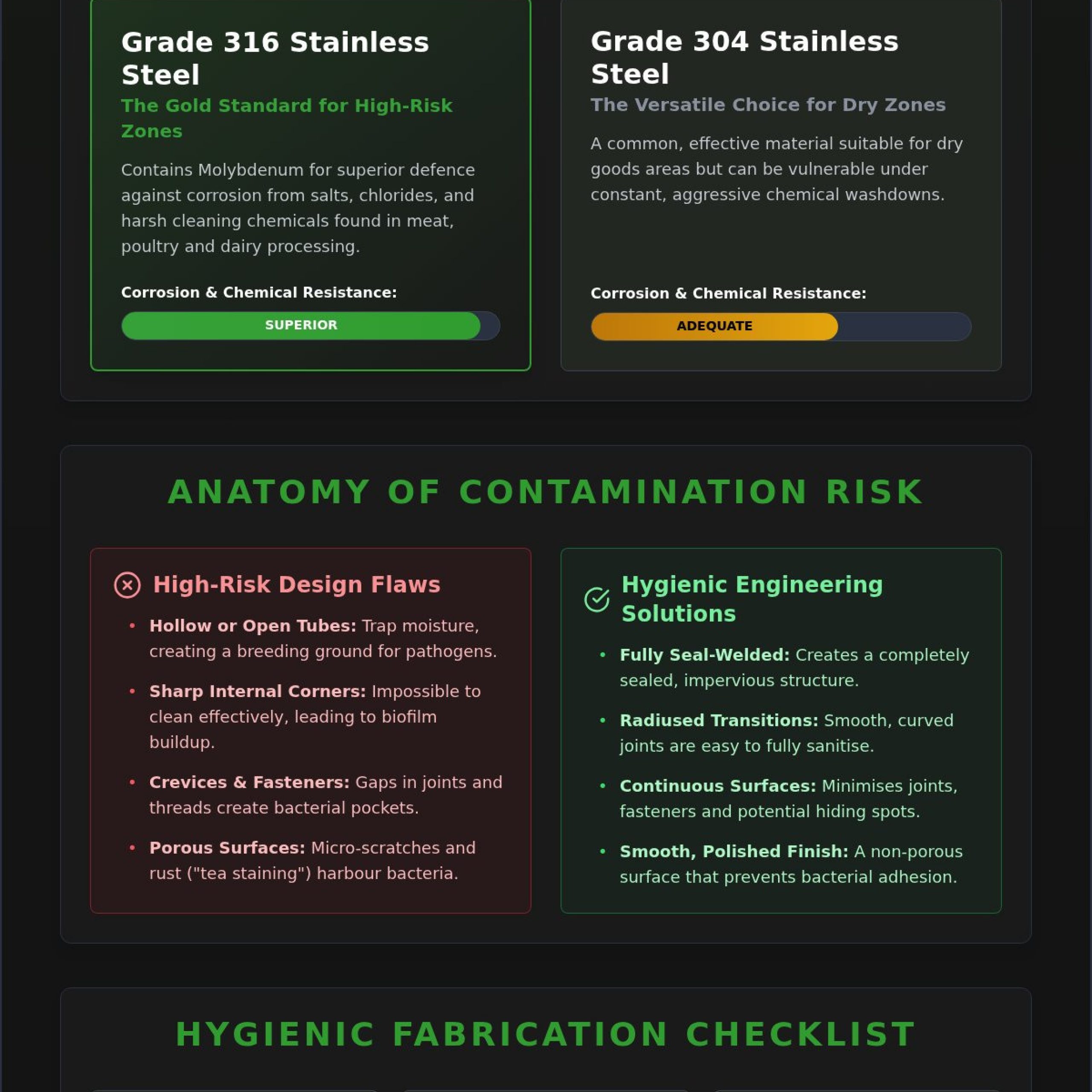
Contamination often hides where the eye cannot see. In standard industrial handrails, hollow sections and “dead legs” are common. If these sections aren’t fully seal-welded, moisture and organic matter can seep inside, creating a stagnant breeding ground for pathogens. Maintaining rigorous food processing hygiene standards requires every surface to be non-porous and accessible for cleaning. This is why we avoid any design that allows internal moisture accumulation.
Pitting corrosion is another significant risk. Microscopic cracks in low-quality welds or scratches in the metal surface can trap bacteria that survive even the most intensive chemical washdowns. We frequently see open-ended tubes in older facilities, which are a major non-compliance during audits. Every transition and end-cap must be smooth, radiused, and continuous to eliminate these micro-pockets of risk.
Balancing Worker Protection and Food Safety
Designing a handrail that meets AS 1657 requirements for load-bearing strength while satisfying food safety audits is a precision task. A handrail must be robust enough to support a worker’s weight, yet its geometry shouldn’t provide a ledge where dust, flour, or debris can accumulate. If a rail is too difficult to clean, it simply won’t be cleaned properly, leading to a breakdown in plant hygiene.
Sanitary safety relies on “easy-clean” geometries. This means avoiding flat horizontal surfaces where liquids can pool. Instead, we utilise rounded profiles and sloped transitions that allow water and sanitising agents to shed naturally. Continuous, smooth surfaces are the gold standard. By removing fasteners, crevices, and overlapping joints, you ensure that the safety rail protects your people without ever endangering your product.
The Science of Hygienic Design: Material Selection and Surface Finish
Selecting the correct material is the first step in ensuring your safety infrastructure doesn’t become a liability. While Grade 304 stainless steel is a versatile standard for many industrial applications, Grade 316 is the preferred choice for stainless steel handrails food processing facilities use in high-risk areas. This is particularly true in meat, poultry, and dairy plants where the environment is naturally corrosive. Grade 316 contains molybdenum, which provides superior resistance to pitting and crevice corrosion caused by chloride-heavy sanitising agents and the high salt content often found in food production.
The choice between Grade 304 and 316 often comes down to the intensity of your cleaning protocols. Grade 304 may suffice in dry zones, but it can struggle with the aggressive chemical washdowns required in “wet” processing areas. In Brisbane’s humid climate, the combination of moisture and harsh chemicals can accelerate surface degradation. Using Grade 316 ensures that the handrails maintain their structural integrity and hygienic properties for decades, rather than years. Beyond the alloy itself, the principles of hygienic design dictate that the metal must be passivated. This chemical process removes free iron from the surface and restores the protective chromium oxide layer, which is essential after any cutting or welding has taken place.
Specifying the Right Finish for Your Plant
Surface roughness, measured as an Ra value, determines how easily bacteria can be removed during cleaning. A standard #4 brushed finish is common for many industrial rails, providing a good balance between aesthetics and cleanability. However, in high-care zones, an electropolished or mirror finish might be necessary. These processes smooth out the microscopic peaks and valleys of the metal, reducing the surface area where pathogens can cling. Ian “Wrighty” Wright often recommends matching the finish to the specific processing stage; a coarser finish might be acceptable in a packaging hall, but a high-polish finish is vital near open product lines. For expert advice on selecting the right material for your facility, our team provides specialised stainless steel fabrication services tailored to local industry needs.
Hygienic Welding Techniques
The quality of the weld is just as important as the steel itself. We utilise TIG (Tungsten Inert Gas) welding for all food-grade applications because it offers superior control and a cleaner finish compared to MIG welding. In a sanitary environment, every joint must be a full-penetration weld to ensure there are no internal gaps where liquids can stagnate. A sanitary weld is defined as a weld that is ground flush and polished to match the parent material, ensuring a continuous, crevice-free surface. This level of precision prevents the “dead spots” that often lead to audit failures and contamination risks.
Navigating Australian Standards and Food Safety Compliance
Compliance in the Australian food industry isn’t a suggestion; it’s a legal necessity. We operate under a strict regulatory framework that demands a precise intersection between Work Health and Safety (WHS) and food hygiene. When specifying stainless steel handrails food processing facilities must adhere to the National Construction Code (NCC) 2025, which provides the overarching rules for new plant builds. Failure to align with these updates can lead to costly rework or a failed safety audit before the plant even opens its doors. It’s about ensuring the safety of your people without compromising the integrity of your product.
The Australian Standard AS 4674, which covers the design, construction, and fit-out of food premises, further complicates the landscape. It requires all surfaces to be non-absorbent and easy to clean. This means your safety infrastructure cannot simply be “bolted on” using standard industrial methods. It requires a bespoke approach where every bracket and mounting point is designed to prevent the accumulation of organic matter. Integrating HACCP principles into the initial design phase allows you to identify potential contamination points before the steel is even cut.
AS 1657 Compliance for Industrial Access
AS 1657:2018 is the definitive standard for fixed platforms, walkways, and stairways in industrial settings. It dictates specific height requirements for handrails, typically between 900mm and 1100mm, and requires sufficient clearance to prevent hand entrapment. In a heavy-duty food plant, these barriers must also meet rigorous load-bearing specifications to ensure they can withstand accidental impacts from trolleys or equipment. For a deeper look at these technical requirements, you can refer to our guide on Safety Handrail Fabrication Brisbane.
HACCP and FSANZ Requirements
While AS 1657 focuses on the worker, the Food Standards Australia New Zealand (FSANZ) Code and AS 4674 focus on the consumer. Standard 3.2.3 of the Food Standards Code requires equipment to be made of materials that are smooth and easy to sanitise. Your handrails should support efficient “clean-in-place” (CIP) or “clean-out-of-place” (COP) methods, ensuring that washdown water and sanitising agents shed naturally rather than pooling in crevices.
Audit-ready documentation is just as important as the physical install. Brisbane site managers must maintain records of material certificates and weld maps to prove compliance during inspections. Local expertise is vital here. We understand the specific pressures of the South East Queensland market and the expectations of local auditors. Prioritising a fabricator who understands the nuances of both safety and sanitary law ensures your facility remains operational and compliant without any fuss.
Strategic Installation: Minimising Contamination and Downtime
Efficiency in installation is as critical as the quality of the steel itself. For a busy production facility, every hour of downtime translates to lost revenue. We use custom 3D laser scanning to map your facility with millimetre precision before a single piece of metal is cut. This technology ensures a “first-time fit” for the stainless steel handrails food processing managers need to install during tight maintenance windows. By doing the heavy lifting in our workshop, we spend less time on your production floor, ensuring a swift and clean integration.
When on-site welding is unavoidable, managing “hot work” requires a disciplined approach. We implement strict containment strategies, using physical barriers and specialised airflow management to prevent sparks, fumes, or metal filings from reaching sensitive production lines. Our team coordinates logistics across Logan, Ipswich, and the Gold Coast to align with your scheduled shutdowns. This local presence allows us to be responsive and reliable, providing a steady hand when the pressure of a plant restart is looming.
On-Site Mobile Welding and Fabrication
Our mobile workshop brings the precision of a fixed facility directly to your plant. This is particularly valuable when we are coordinating the installation of safety rails alongside complex industrial pipework Brisbane plants rely on for daily operations. Maintaining sanitary boundaries is our priority. We follow a rigorous post-installation protocol, which includes the thorough removal of all construction debris and a detailed clean of the work zone to ensure the area is audit-ready before we leave the site.
Integrating with Existing Infrastructure
Often, the challenge lies in retrofitting new hygienic handrails to existing platforms or custom stainless benches. We design bespoke mounting solutions that eliminate traditional floor-level bacteria traps. This might involve using raised plinths or wall-hung designs that allow for unobstructed floor cleaning. We also ensure seamless transitions between different material types, such as stainless steel and aluminium, preventing galvanic corrosion while maintaining a continuous, easy-to-sanitise surface. For a reliable partner who understands these technical nuances, reach out to Donewright Stainless to discuss your next facility upgrade.
Custom Sanitary Solutions: The Donewright Fabrication Advantage
The Donewright approach is built on a foundation of local accountability and technical precision. When you’re managing a high-stakes production environment, off-the-shelf hardware rarely meets the mark. Mass-produced components often feature exposed threads, hollow cavities, or rough finishes that simply won’t pass a rigorous HACCP audit. Ian “Wrighty” Wright and the team believe that true safety infrastructure should be a permanent, zero-fuss asset. By choosing bespoke stainless steel handrails food processing facilities in South East Queensland gain a partner who understands the specific operational pressures of the local industry. This isn’t just about bending tube; it’s about delivering a solution that fits perfectly and performs reliably under the harshest washdown conditions.
Our philosophy centres on being a reliable guide for plant managers. We don’t just supply metal; we provide a pathway to total compliance. This involves a meticulous attention to detail that begins at the design phase and continues through to the final polish. Whether we are working in a boutique facility or a large-scale processing plant, our goal is to provide a steady, experienced hand that ensures every project is completed to the highest standard without any unnecessary complications.
Bespoke Design for Complex Processing Lines
Every plant has its own unique layout, often with established machinery that leaves little room for error. We use custom 3D laser scanning to navigate these tight spaces, ensuring our handrails integrate seamlessly with your existing operator workflows. This level of detail prevents the common issue of safety rails obstructing maintenance access or creating ergonomic hazards. Because we fabricate locally in Brisbane, our lead times are significantly shorter than those of international suppliers. You deal directly with the craftsmen responsible for the work, ensuring that every weld and every polish meets our exacting standards before it arrives on your site.
Long-Term Maintenance and Support
Our relationship with a facility doesn’t end once the last weld is polished. We provide comprehensive maintenance services to ensure your safety infrastructure remains compliant as your plant evolves. It’s important to keep an eye out for early signs of stress or surface degradation, which can occur if cleaning chemicals aren’t thoroughly rinsed or if the protective oxide layer is compromised. Regular inspections can identify these issues before they lead to structural failure or audit non-compliance. If you’re unsure whether your current setup meets the latest standards, we invite you to secure a site audit for handrail compliance in Brisbane or the Gold Coast. Contact Donewright Stainless for a quote on your food-grade handrail project.
Future-Proof Your Plant with Hygienic Safety Infrastructure
Specifying the correct stainless steel handrails food processing facilities require is a critical balance of engineering precision and regulatory knowledge. We’ve discussed how selecting Grade 316 stainless steel and maintaining specific surface finishes prevents bacterial harbourage while keeping your facility audit-ready. By adhering to AS 1657 and HACCP principles, you ensure your safety infrastructure serves your team and your consumers with equal reliability.
Donewright Stainless brings AS 1657 compliant fabrication and deep expertise in HACCP-grade design directly to your facility. Our fully equipped mobile workshop allows us to provide on-site SEQ service that respects your production timelines. You don’t have to choose between worker protection and plant hygiene when you have a local partner who understands the technical nuances of food-grade environments. We’re ready to help you upgrade your facility with zero fuss and maximum durability. We look forward to helping you maintain a safe, compliant, and efficient processing environment.
Get a Professional Quote for Your Sanitary Handrail Project
Frequently Asked Questions
What is the best grade of stainless steel for food processing handrails?
Grade 316 is the superior choice for stainless steel handrails food processing environments, particularly in wet or high-salt areas like meat and dairy. It contains molybdenum, which provides the necessary resistance to pitting corrosion from aggressive chemical cleaners. While Grade 304 might be suitable for dry packaging areas, it often fails prematurely when exposed to the daily washdown cycles common in high-risk zones.
Do food-grade handrails need to be polished to a mirror finish?
No, a mirror finish isn’t always mandatory, but the surface roughness must meet specific Ra values to prevent bacterial harbourage. A standard #4 brushed finish is often sufficient for general processing areas. However, for high-care zones or equipment near open product lines, an electropolished or mirror finish is recommended. These smoother surfaces reduce the surface area where biofilms can form and make daily sanitisation more effective.
Are off-the-shelf handrail kits compliant with Australian food safety standards?
Off-the-shelf handrail kits are rarely compliant with strict Australian food safety standards like HACCP or AS 4674. These kits often rely on mechanical fasteners and overlapping joints that create crevices where bacteria can thrive. Bespoke fabrication ensures that every joint is fully seal-welded and ground flush, eliminating the contamination risks and audit failures associated with modular hardware systems.
How does AS 1657 affect the design of handrails in food plants?
AS 1657:2018 dictates the structural safety requirements, including handrail heights between 900mm and 1100mm and specific load-bearing capacities. In a food plant, this standard must be balanced with hygienic design principles. This means mounting brackets and rails must meet safety clearances while avoiding horizontal ledges or pooling points where washdown water could stagnate and breed pathogens during production.
Can you perform on-site welding in a live food processing environment?
On-site welding can be performed in a live plant, provided strict containment and safety protocols are in place. We use mobile welding units equipped with spark containment and airflow management to prevent contamination of production lines. This allows for essential repairs or upgrades to stainless steel handrails food processing infrastructure without the need for a total facility shutdown or significant loss of production time.
What is the difference between commercial and sanitary stainless steel fabrication?
Sanitary fabrication prioritises the elimination of crevices through full-penetration welds that are ground flush and polished to match the parent metal. Commercial fabrication focuses primarily on structural strength and may leave exposed welds, threads, or gaps. In food processing, these gaps are unacceptable as they harbour bacteria that survive standard cleaning procedures, leading to potential cross-contamination and audit failures.
How often should stainless steel handrails in a food plant be inspected for compliance?
Handrails should be inspected daily by cleaning crews for visible organic build-up and quarterly for signs of pitting or weld stress. A formal compliance audit should be conducted annually to ensure the structures still meet AS 1657 safety requirements and HACCP hygiene standards. Regular maintenance prevents small surface issues from becoming major contamination risks that could compromise your food safety certifications.
Does Donewright Stainless provide 3D scanning for existing plant upgrades?
Yes, we utilise custom 3D laser scanning to map existing facility layouts with millimetre precision. This technology is essential for retrofitting handrails in established plants where space is limited and machinery is already in place. It ensures a first-time fit for every component, which significantly reduces the amount of time our team needs to spend on your production floor during the installation process.