
Aged Care Handrails: Brisbane Compliance & Design 2026
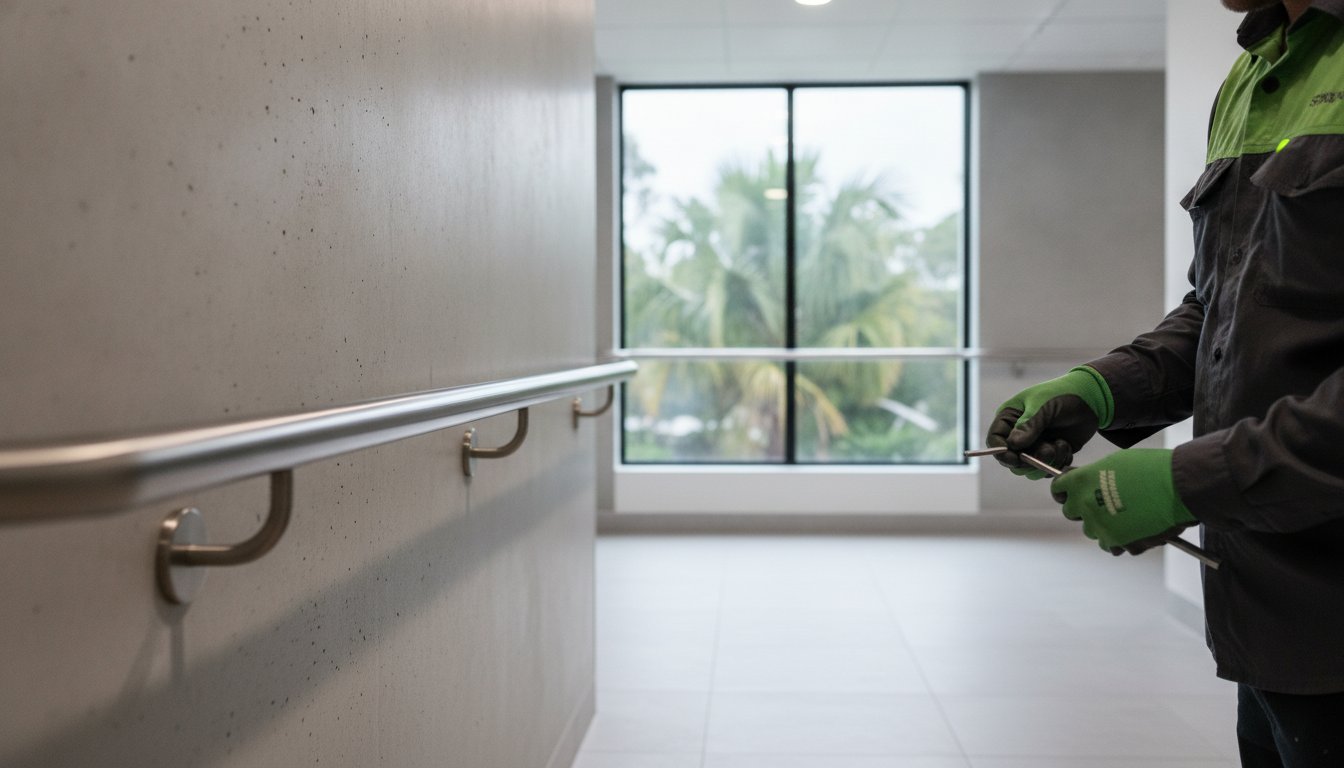
A handrail in a modern aged care facility isn’t just a piece of hardware; it’s a critical medical-grade safety tool that determines whether your building passes its next accreditation. Achieving the perfect fit for AS 1428.1 compliant handrails Brisbane facility managers require often feels like a moving target, particularly when balancing the strict 2021 standards against the reality of complex, existing corridor layouts. You likely understand the frustration of seeing standard off-the-shelf rails suffer from tea-staining in our humid Bayside climate or failing hygiene audits because of poor finish quality.
This article explains how custom-fabricated stainless steel provides a permanent solution for long-term safety and compliance in South East Queensland. We’ll examine the essential technical specifications of AS 1428.1:2021, including the mandatory 50mm wall clearances and 30mm to 50mm diameter requirements. You’ll also discover how mobile workshop services allow for precise on-site adjustments that ensure a perfect fit with minimal disruption to your residents’ daily routines.
Key Takeaways
- Learn the critical 2026 technical requirements for AS 1428.1 compliant handrails Brisbane facility managers must follow to pass mandatory safety and accessibility audits.
- Understand why high-grade stainless steel is the essential choice for infection control, offering non-porous surfaces that withstand rigorous sanitisation protocols.
- Identify the “off-the-shelf trap” and why bespoke fabrication is necessary to navigate complex wall angles and transitional spaces without leaving non-compliant gaps.
- Discover how mobile workshop services provide precise on-site adjustments and welding, ensuring a perfect fit with minimal disruption to your residents’ daily routines.
The Critical Role of Stainless Steel Handrails in Australian Aged Care
In a residential care setting, a handrail serves as more than just a convenience. It’s a fundamental piece of safety infrastructure that provides continuous support for residents with varying degrees of mobility. While a standard residential grab rail might suffice for a private ensuite, commercial facility systems must meet much higher load-bearing and endurance standards. For facility managers, ensuring they install AS 1428.1 compliant handrails Brisbane wide is the first step in creating a secure environment that prevents falls and assists with daily navigation. These systems act as both a physical barrier and a psychological aid, giving residents the confidence to move independently through common areas.
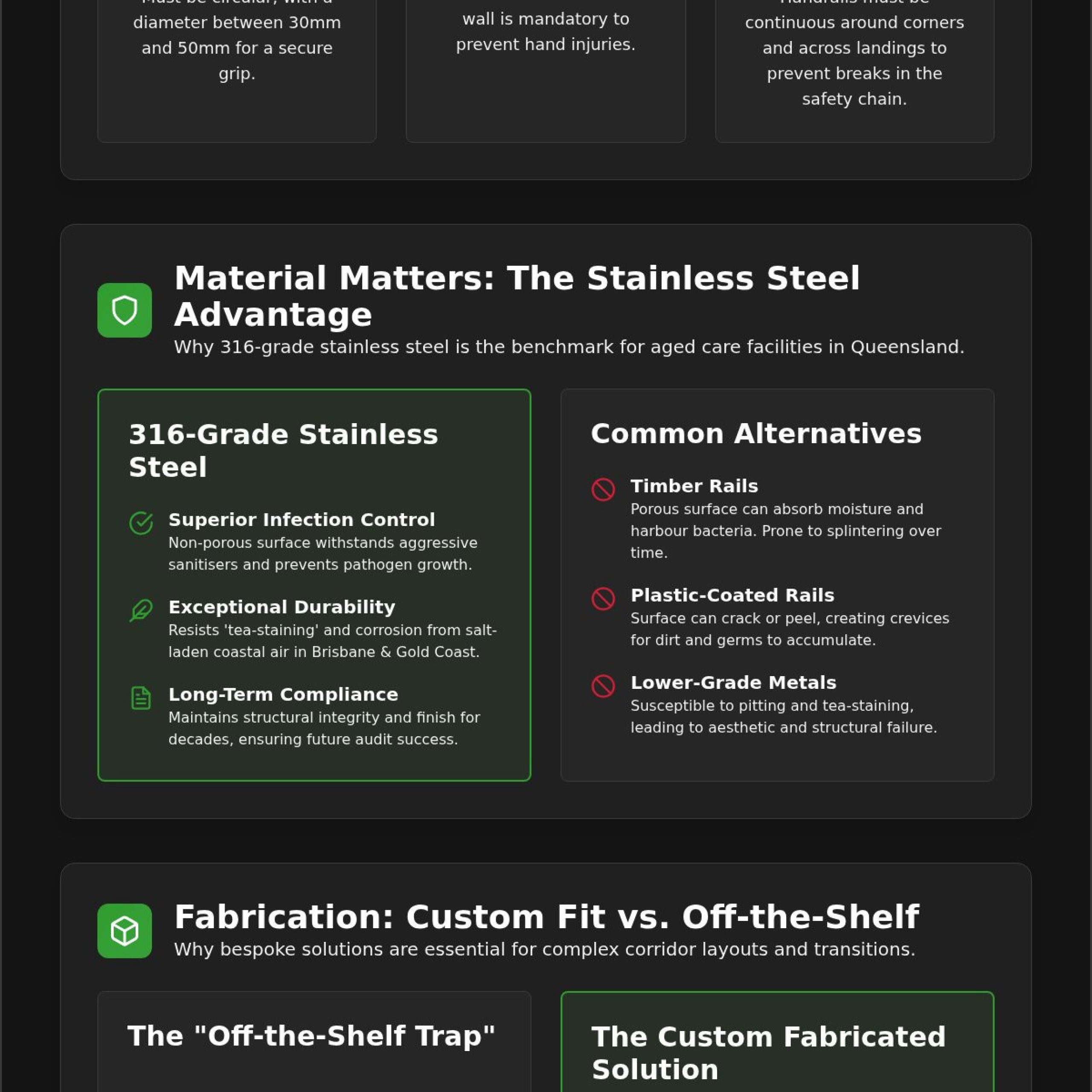
When we discuss handrail safety and design principles, the material choice is central to the conversation. Stainless steel remains the gold standard because its non-porous surface doesn’t harbour pathogens, making it ideal for clinical environments. In the context of 2026 facility standards, 316-grade stainless steel is the non-negotiable benchmark for longevity, providing superior resistance to the harsh atmospheric conditions found across South East Queensland.
Hygiene and Infection Control in High-Traffic Zones
High-traffic corridors and communal lounges are hotspots for bacterial transfer. Stainless steel is uniquely capable of withstanding the aggressive, hospital-grade cleaners required for daily sanitisation without degrading or pitting. Our fabrication process focuses on seamless welds and smooth transitions, which are critical for infection control. Unlike timber, which can splinter and absorb moisture, or plastic-coated rails that may crack over time, stainless steel offers a perfectly smooth finish that eliminates the crevices where bacteria often hide.
Durability and Maintenance in South East Queensland
Brisbane and the Gold Coast present a specific challenge: salt-laden air that causes ‘tea-staining’ on lower-quality metals. This brown discolouration isn’t just an aesthetic issue; it can lead to structural pitting if left unaddressed. Choosing 316-grade stainless steel significantly reduces this risk, ensuring your investment looks as good in ten years as it does on day one. To protect this investment, we provide specialised stainless steel maintenance services that keep your facility’s hardware in peak condition. While the initial cost of custom-fabricated stainless steel may be higher than off-the-shelf alternatives, the long-term ROI is found in the lack of replacement costs and the reduced maintenance burden over decades of service.
Navigating Australian Standards for Aged Care Handrail Fabrication
Compliance with AS 1428.1:2021 isn’t just about ticking a box; it’s about life safety. For those managing facilities in South East Queensland, installing AS 1428.1 compliant handrails Brisbane wide means understanding specific geometry. The current standard mandates a circular handrail diameter between 30mm and 50mm. This range ensures that residents, particularly those with reduced grip strength, can maintain a secure hold. Beyond the rail itself, a minimum clearance of 50mm must exist between the handrail and the adjacent wall. This gap prevents knuckles from scraping and allows enough room for arthritic hands to wrap fully around the support. These measurements are precise and leave no room for error during the fabrication phase.
Continuity is another non-negotiable factor in modern facility design. A handrail must remain unbroken around corners and across landings to provide constant tactile feedback and physical support. If a resident loses contact with the rail during a transition, the risk of a fall increases significantly. These requirements align with the National Aged Care Design Principles, which emphasise creating predictable, safe pathways for all users. A break in the rail is a break in the safety chain.
AS 1428.1 vs. AS 1657: Which Standard Applies?
It’s vital to distinguish between public access areas and back-of-house zones. While AS 1428.1 governs resident corridors and ramps, industrial zones like plant rooms or loading docks may require AS 1657 handrail fabrication. The latter focuses on industrial safety rather than accessibility. Custom fabrication allows us to transition between these standards seamlessly within a single facility layout, ensuring every zone meets its specific regulatory burden without compromise.
Load-Bearing and Structural Integrity
A handrail is only as strong as its fixings. In aged care, rails must withstand significant force from sudden falls or heavy use. We assess wall substrates carefully, whether they’re timber studs, masonry, or light-gauge steel. Standard off-the-shelf brackets often fail to align with internal wall supports, which is where bespoke engineering becomes essential. Ensuring the structural integrity of your safety systems is a core part of the service provided by Donewright Stainless, as we match every installation to the specific building fabric of your facility. Professional engineering is often required for high-risk fall areas to guarantee the system won’t detach under peak loads.
Custom Fabrication vs. Pre-Fabricated Rails: Choosing the Right Fit
While retail hardware stores offer pre-made grab rails, these off-the-shelf products are rarely suitable for the large-scale, high-traffic corridors of a professional care facility. The most common issue with pre-fabricated options is the “off-the-shelf trap.” When standard lengths don’t align with your specific wall dimensions, installers are often forced to leave non-compliant gaps or awkward transitions. Achieving AS 1428.1 compliant handrails Brisbane facilities can rely on requires a level of precision that modular kits simply cannot provide. Custom fabrication ensures that every centimetre of the rail path is supported, eliminating the dead zones that pose a risk to residents.
Bespoke design also allows for the seamless integration of safety features across different functional zones. In loading docks or ambulance bays, for example, we can align handrail systems with stainless steel safety bollards to protect both pedestrians and the building’s infrastructure. This holistic approach ensures that compliance isn’t just a patchwork of individual parts but a unified safety system that works in harmony with the facility’s decor and structural requirements.
The Problem with Modular Systems in Commercial Care
Modular systems rely on mechanical joints and set-screws that can loosen over time due to constant use. This creates snagging hazards and unstable sections that fail to meet the rigorous Australian Standard AS 1428.1 for accessibility. A one-size-fits-all approach inevitably fails an audit when it encounters non-standard wall angles or structural pillars. We advocate for fully welded, continuous rail systems. These provide a smooth, tactile surface for the entire length of the hallway, ensuring resident safety through consistency and structural permanence.
Bespoke Solutions for Complex Corridor Layouts
Mapping a safe path through curved hallways or multi-level ramps requires more than just a measuring tape. Our custom stainless steel fabrication Brisbane process involves detailed site mapping to ensure every bend and termination is perfectly executed. We pay particular attention to end-terminations; these must be curved back to the wall or turned down to prevent residents’ clothing from snagging as they pass. This meticulous attention to detail is what separates a compliant installation from a potential liability. By tailoring the hardware to the building’s unique architecture, we ensure the safety infrastructure is as unobtrusive as it is effective; to achieve a similarly bespoke finish for your window treatments and security screens, check out Taylor & Stirling.
Planning and Installing Handrails in Residential Care Facilities
The transition from design to physical installation is the most critical phase in securing a facility’s accreditation. For AS 1428.1 compliant handrails Brisbane facility managers must ensure that the planning stage accounts for the specific structural realities of the building. We begin with a comprehensive site audit, identifying high-risk zones such as transitional ramps and stairwells. During this audit, we evaluate wall types, whether they are reinforced masonry or timber studs, to determine the exact load-bearing requirements for fixings. This preparation prevents the structural failures that often lead to non-compliance during safety audits.
Precision on-site is non-negotiable. Using a mobile workshop allows for immediate adjustments that standard off-site fabrication cannot match. If a wall isn’t perfectly plumb or a corridor angle is slightly off-square, we modify the rail in real-time. This ensures a millimetre-perfect fit that eliminates gaps where residents’ fingers could get trapped. Once installed, we perform rigorous load-capacity testing and verify that the finish meets hospital-grade standards for smooth, burr-free surfaces. This methodical approach respects resident routines by completing the work efficiently and reducing the need for multiple return visits.
On-Site Welding and Mobile Engineering
Retrofitting older Brisbane facilities often reveals architectural quirks that pre-fabricated kits simply can’t handle. Our mobile workshop welding Brisbane service brings industrial-grade precision directly to your door. By welding joints on-site, we create a continuous, seamless support system that is far superior to modular alternatives. We also use mobile polishing equipment to ensure every weld is buffed to a high-sanitation finish. This process removes microscopic pits and bacterial traps, maintaining the hygiene standards required in high-traffic aged care environments while significantly reducing overall project lead times.
Coordinating with Occupational Therapists and Builders
Successful installations require a bridge between clinical assessment and structural engineering. We work closely with Occupational Therapists to translate their mobility assessments into technical fabrication drawings. This collaboration ensures that the final product doesn’t just meet the letter of the law but actually serves the specific needs of the residents. Whether we’re working alongside builders on a new wing or coordinating with facility managers during an upgrade, our local knowledge of South East Queensland building codes is invaluable. To ensure your facility meets every safety benchmark, contact Donewright Stainless for a professional site audit and compliance consultation.
Bespoke Handrail Solutions by Donewright Stainless Brisbane
Donewright Stainless brings a specialised approach to healthcare infrastructure across South East Queensland. We understand that for facility managers, the primary objective is a combination of absolute resident safety and long-term durability. Our commitment to “Done Wright” quality ensures that every installation of AS 1428.1 compliant handrails Brisbane facility managers commission is built to withstand decades of rigorous use. From Logan to the Gold Coast, we support local aged care providers with more than just handrails. Our team provides custom stainless benches, trolleys, and safety protection systems designed specifically for high-sanitisation environments.
Facility managers across the region trust Ian “Wrighty” Wright for complex metalwork because he brings a practical, “on-the-job” perspective to every project. We don’t just sell hardware; we provide a steady, experienced hand to guide you through the technical requirements of the 2021 standards. This personal touch, combined with our technical specialist capabilities, ensures that every project is handled with precision and a focus on long-term relationships rather than quick sales.
Full-Service Fabrication and On-Site Installation
Our end-to-end process covers every stage from initial design through to manufacture and mobile installation. While our primary focus in clinical aged care areas is medical-grade stainless steel, we also provide aluminium fabrication Brisbane services and mild steel solutions for non-sanitary areas like basement storage or maintenance rooms. This versatility allows us to handle entire facility upgrades under one point of contact. If you are planning a new build or a refurbishment, requesting a technical consultation early in the process can prevent costly compliance errors and ensure a seamless fit with your building’s architecture.
The Donewright Difference: Precision and Reliability
What sets us apart is an extensive industrial background. We apply the same level of rigour to aged care corridors that we do to heavy industrial pipework and safety systems. This means we don’t shy away from complex compliance challenges or non-standard architectural layouts that would baffle a retail hardware provider. Our no-fuss approach ensures that your facility passes its safety audits without the stress of dealing with unreliable contractors or modular kits that fail to meet the standard. We pride ourselves on workmanship that is personal, precise, and reliable. To secure your facility’s future and ensure resident safety, Contact Donewright Stainless for a compliant handrail quote today.
Securing the Future of Your Facility’s Safety Infrastructure
Ensuring your aged care facility meets the rigorous 2021 standards requires more than just installing hardware. It’s about a commitment to permanent safety and hygiene through precision engineering. By choosing 316-grade stainless steel and bespoke fabrication over modular kits, you eliminate the “off-the-shelf trap” and provide residents with continuous, reliable support. Our industrial background ensures that every project we undertake meets the highest load-bearing and finish requirements, specifically for AS 1428.1 compliant handrails Brisbane facility managers can trust for decades.
Get a Quote for Compliant Aged Care Handrails and take the first step toward a safer, fully compliant facility today.
Frequently Asked Questions
What is the required height for handrails in Australian aged care facilities?
Handrails must be installed at a height between 865mm and 1000mm above the floor surface or the nosing of stair treads. This measurement is taken from the top of the rail to the finished floor level to ensure ergonomic support for residents. Consistency in height across the facility is a key requirement for achieving AS 1428.1 compliant handrails Brisbane facility managers should verify during the design phase.
Does AS 1428.1 require handrails on both sides of a corridor?
Yes, handrails are typically required on both sides of an accessible corridor or ramp to provide continuous support regardless of which hand a resident uses. This design ensures that individuals with hemiplegia or single-sided weakness can always access a support rail. Providing dual-sided rails also facilitates easier passing in high-traffic hallways and maintains a clear, safe path for those using mobility aids.
Is 304 or 316 stainless steel better for aged care handrails in Brisbane?
Grade 316 stainless steel is the superior choice for South East Queensland environments due to its high resistance to corrosion and tea-staining. While 304 is suitable for some interior applications, Brisbane’s humid, salt-laden air can cause 304 to discolour over time. We recommend 316-grade for aged care infrastructure to ensure the hardware remains hygienic and structurally sound for decades without requiring frequent restoration or replacement.
Can Donewright Stainless install handrails in an active facility without disturbing residents?
We specialise in installing safety systems within active residential care environments with minimal disruption to daily routines. Our mobile workshop allows us to perform precise adjustments and welding outside the main resident zones before a rapid final fit. We coordinate closely with facility managers to schedule high-noise activities during times that respect the residents’ rest and meal schedules, ensuring a safe and quiet installation process.
What is the maximum diameter allowed for an accessible handrail?
The maximum allowed diameter for a circular handrail under AS 1428.1 is 50mm, while the minimum is 30mm. This specific range is non-negotiable because it ensures the rail can be easily gripped by residents with varying hand sizes or limited dexterity. We typically fabricate 38mm or 40mm rails as they offer the most comfortable and secure grip for elderly residents in commercial care settings.
How often should stainless steel handrails be inspected for safety compliance?
We recommend that facility managers conduct formal safety inspections of all handrail systems at least once every twelve months. These audits should check for loose fixings, structural movement, or any surface degradation that could compromise hygiene. Regular maintenance ensures that your AS 1428.1 compliant handrails Brisbane systems continue to meet the load-bearing requirements mandated by the National Construction Code and remain safe for resident use.
Do you provide mobile welding services for handrail repairs on the Gold Coast?
Yes, we provide mobile welding and fabrication services across the entire Gold Coast, Logan, and Ipswich regions. Our fully equipped mobile workshop allows us to perform on-site repairs and custom adjustments for aged care facilities, industrial sites, and commercial properties. This service is essential for retrofitting safety rails or repairing damaged infrastructure without the need to transport large sections of metalwork back to a central workshop.
Are your handrails suitable for NDIS-funded commercial facility modifications?
Our custom-fabricated handrails and safety systems are designed to meet the strict accessibility standards required for NDIS-funded commercial modifications. We work with builders and project managers to ensure that every installation adheres to the specific mobility requirements outlined in a participant’s plan or a facility’s upgrade brief. Our focus on bespoke fabrication ensures that even non-standard layouts can be made fully accessible and compliant with national safety regulations.