
316 vs 304 Stainless Steel: Australian Outdoor Guide
The most expensive marine-grade alloy will still develop tea staining along an Australian shoreline if the surface finish is specified incorrectly. Few issues frustrate builders, fabricators, and asset owners more than watching supposedly rust-proof steel develop unsightly brown discolouration shortly after handover. When evaluating 316 vs 304 stainless steel for outdoor use, you’ve likely encountered conflicting supplier advice, leaving you uncertain whether the price premium of Grade 316 is technically justified. It’s a costly dilemma, especially when non-compliance or premature surface pitting puts commercial assets at risk.
This guide cuts through the confusion, helping you determine whether 304 or 316 stainless steel suits your outdoor project to prevent corrosion, tea staining, and premature structural failure. You’ll gain a clear understanding of the metallurgical differences between these alloys, learn practical distance-to-coast guidelines tailored to Australian atmospheric conditions, and discover why surface roughness and post-weld treatments ultimately dictate how long your metalwork survives outside.
Key Takeaways
- Understand the metallurgical differences between grades, specifically how the 2% to 3% molybdenum in Grade 316 halts aggressive chloride pitting.
- Evaluate 316 vs 304 stainless steel for outdoor use based on ASSDA coastal proximity thresholds, from ocean surf zones to sheltered inland suburbs.
- Recognise the unwashed area trap, where covered alfresco installations often suffer severe corrosion faster than rain-exposed outdoor assemblies.
- Learn why surface roughness specifications ($R_a le 0.5 mutext{m}$) and post-weld chemical passivation are just as critical as alloy selection for preventing tea staining.
- Establish practical maintenance and cleaning routines designed to preserve the passive chromium oxide layer across harsh Australian climates.
What Is the Difference Between 304 and 316 Stainless Steel?
Austenitic stainless steels rely on a microscopic, invisible surface layer of chromium oxide to resist environmental attack. When exposed to atmospheric oxygen, this self-healing passive film forms naturally, shielding the underlying iron from oxidising. Even so, when comparing 316 vs 304 stainless steel for outdoor use, atmospheric conditions determine how effectively that passive barrier holds up over time.
Chemical Composition and the Role of Molybdenum
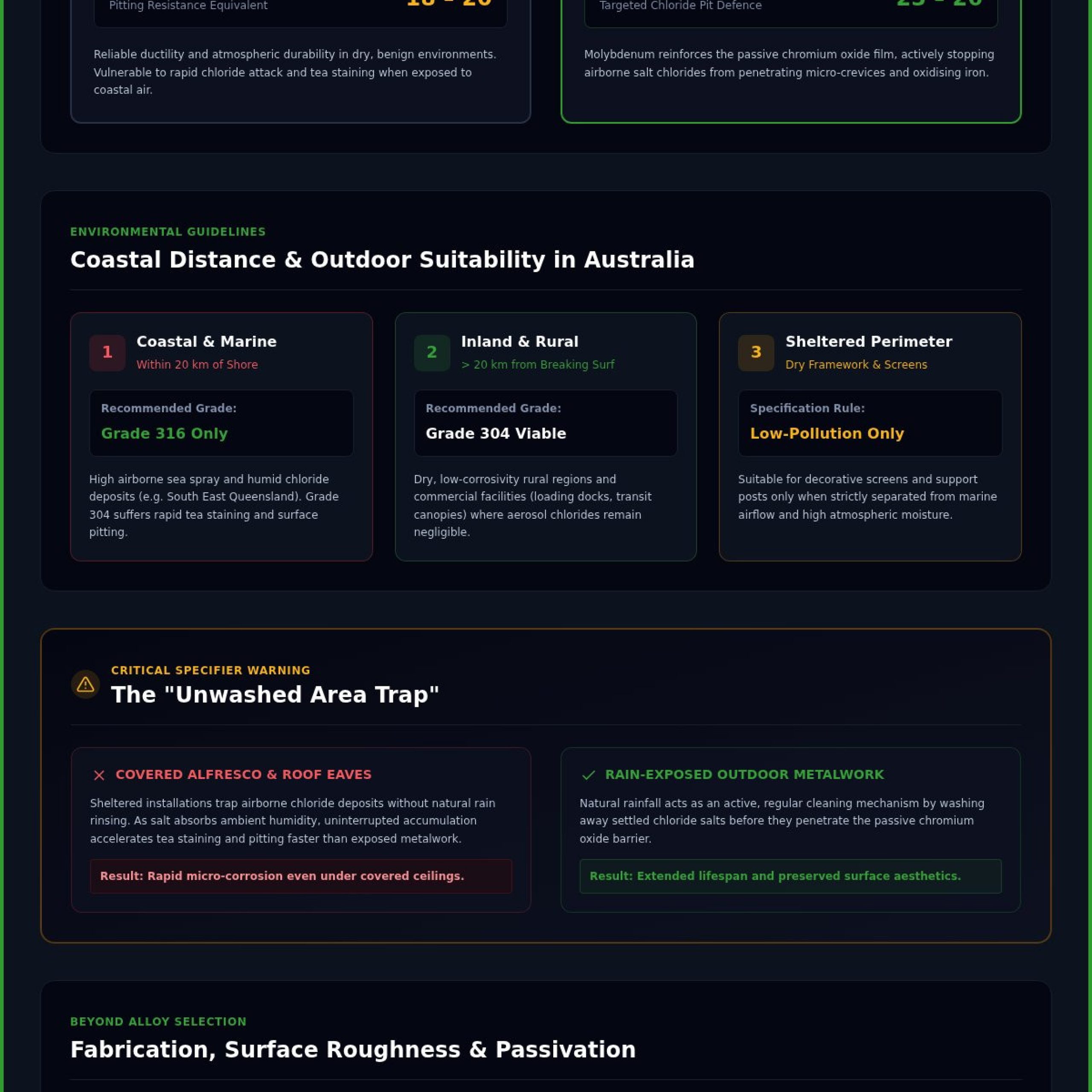
Grade 304 contains roughly 18% to 20% chromium and 8% to 10.5% nickel. This elemental mix delivers reliable structural ductility and general-purpose durability across dry, benign environments. It handles atmospheric moisture well until airborne salts enter the equation.
Grade 316 alters this baseline by reducing chromium slightly to 16% to 18%, increasing nickel to 10% to 14%, and introducing 2% to 3% molybdenum. Often specified as marine grade stainless steel, Grade 316 relies on molybdenum to reinforce weak points in the passive chromium oxide layer. In humid coastal regions like South East Queensland, airborne sea spray leaves heavy chloride deposits on exposed metal. Without molybdenum, these chlorides break down the protective film, creating micro-crevices where rust begins. Higher nickel levels support structural ductility and weld formability, but it’s molybdenum that actively stops chloride ions from penetrating the surface.
Understanding Pitting Resistance Equivalent Number (PREN)
Metallurgists evaluate an alloy’s resistance to chloride-induced pitting using the Pitting Resistance Equivalent Number (PREN). Calculated using the standard formula PREN = %Cr + 3.3(%Mo) + 16(%N), this metric provides a direct benchmark for real-world corrosion resistance:
- Grade 304: Evaluates at a PREN of 18 to 20 because it contains 0% molybdenum.
- Grade 316: Achieves a PREN of 23 to 26, with the added molybdenum providing a targeted defence against localised pit formation.
That numerical variance represents a significant performance gap in humid outdoor air. While Grade 304 often suffers rapid pitting under marine airflow, the higher PREN of Grade 316 prevents micro-corrosion from taking hold, ensuring structural installations preserve their integrity in harsh climates.
Can Grade 304 Stainless Steel Be Used Outdoors in Australia?
Grade 304 remains structurally viable for outdoor projects across Australia, but only under clearly defined environmental conditions. Because roughly 85% of Australians live within 50 km of the coast, prevailing winds regularly carry aerosol salts deep into residential and industrial corridors. In genuinely inland, low-pollution areas, Grade 304 delivers dependable structural performance without unnecessary expense.
Ideal Applications for Grade 304 in Exterior Spaces
For rural installations and regional centres situated well beyond coastal wind corridors, Grade 304 handles ambient weather with ease. It functions reliably in applications such as dry architectural framework, decorative privacy screens, external support posts, and sheltered perimeter fixtures located more than 20 km from breaking surf. Commercial facilities also utilise 304 effectively within enclosed outdoor loading docks and transit canopies where atmospheric chloride levels stay negligible. When evaluating 316 vs 304 stainless steel for outdoor use across these dry, low-corrosivity zones, specifying 304 provides a durable, functional result.
The Reality of Tea Staining and Atmospheric Pitting
Outside dry inland regions, deploying Grade 304 outdoors introduces major aesthetic and maintenance challenges. The most immediate problem is tea staining, a localized, brown iron oxide discolouration that coats the metal. While industry authorities confirm that tea staining does not cause immediate structural failure, it severely disfigures clean architectural surfaces within months.
Sheltered installations often suffer the quickest degradation. Many specifiers place Grade 304 under covered alfresco areas or roof eaves, assuming roof cover shields the steel. In reality, this creates an unwashed microclimate. Natural rainfall acts as a regular cleaning mechanism; without it, airborne chlorides settle onto the metal, absorb ambient humidity, and pit the steel. As outlined in the ASSDA coastal corrosion guidelines, uninterrupted salt accumulation rapidly degrades the passive chromium layer. Rectifying this damage requires ongoing chemical polishing and labour-intensive washdowns. Engaging an expert in bespoke stainless steel fabrication helps ensure your metalwork is matched precisely to site-specific atmospheric exposure before installation begins.
Why Grade 316 Is the Benchmark for Outdoor and Marine Environments
Specifying 316 vs 304 stainless steel for outdoor use comes down to atmospheric resilience. Grade 316 earned its marine-grade reputation because its chemical structure directly counters airborne salt attack. In harsh coastal and industrial belts, that alloy stability protects public assets from early deterioration.
Performance in Salt Spray, Swimming Pools, and Coastal Air
Across coastal South East Queensland, breaking surf propels microscopic salt aerosols deep into surrounding infrastructure. These salt particles settle directly into metal surface crevices. Under heavy sun, evaporation concentrates these chlorides, which rapidly dissolve the protective passive film on lower-grade steels.
Outdoor swimming pool surrounds present an even harsher chemical environment. Saltwater chlorinators release volatile chlorine compounds that hang in humid air layers near ground level. When subjected to this combination of sustained dampness and heavy chlorides, standard alloys face rapid stress-corrosion cracking. Grade 316 handles this through its molybdenum content, which stops pitting before it breaches the parent metal. This metallurgical resilience proves critical during safety handrail fabrication Brisbane projects, where structural compliance under AS 1657 requires permanent metal integrity without dangerous cross-sectional thinning.
Head-to-Head Comparison: 304 vs 316 for Outdoor Projects
Global standards such as the external architectural stainless steel selection guidelines categorise urban, industrial, and marine exposures to match alloy performance against specific environmental stresses:
| Performance Factor | Grade 304 Stainless Steel | Grade 316 Stainless Steel |
|---|---|---|
| Atmospheric Chloride Resistance | Limited; tolerates up to 200 ppm chlorides before pitting begins. | High; resists up to 1,000 ppm chlorides and heavy sea spray. |
| ASTM B117 Salt Fog Threshold | Exhibits pitting corrosion within 100 to 500 hours. | Maintains passive layer integrity for 500 to 1,000+ hours. |
| Tea Staining Vulnerability | High within coastal, unwashed, or industrial wind paths. | Low, provided smooth surface finishes are maintained. |
| Lifecycle Maintenance Demand | High; requires regular chemical washing to clear iron oxide build-up. | Low; standard freshwater rinsing preserves visual finish. |
Comparing 316 vs 304 stainless steel for outdoor use requires evaluating whole-of-life expenditure. Upfront procurement savings on Grade 304 disappear rapidly when recurring maintenance teams must chemically treat stubborn surface browning every three months. Investing in Grade 316 secures stable aesthetic appeal and eliminates costly remediation cycles on exposed sites.
How to Choose the Right Grade for Your Outdoor Location
Specifying the correct metalwork for exterior projects requires balancing geographic exposure against site geometry. Deciding on 316 vs 304 stainless steel for outdoor use involves a practical four-step evaluation process: measure distance to salt water, map prevailing winds, assess overhead shelter, and calculate maintenance accessibility. Following this hierarchy prevents premature surface failure on exposed assets.
The Australian Distance-to-Coast Decision Framework
The Australian Stainless Steel Development Association establishes geographic boundaries that align with standard AS 4312 atmospheric corrosivity categories. These zones dictate where each alloy belongs:
- Zone 1 (Under 5 km from open surf / under 1 km from calm bays): Severe marine corrosivity (C5/CX). Daily salt aerosol deposition routinely exceeds 3 g/m²/day. Grade 316 is the non-negotiable minimum baseline here. Grade 304 will pit and discolour within months.
- Zone 2 (5 km to 20 km coastal corridor): Moderate corrosivity (C3/C4). Persistent sea breezes still drive airborne chlorides well inland across low-lying terrain. Grade 316 remains the professional choice for exposed framework, architectural screens, and high-visibility balustrades.
- Zone 3 (Greater than 20 km inland): Benign to low corrosivity (C1/C2). Standard Grade 304 performs reliably here, provided the site avoids heavy industrial emissions and benefits from natural rainwater washing.
Meeting statutory load and safety criteria for exterior access stairs demands strict alignment between material selection and site environment, as detailed in our guide to stainless steel handrails Brisbane compliance.
Surface Finishes and Their Impact on Exterior Corrosion
Alloy chemistry only solves half the corrosion equation; surface roughness governs actual site performance. Standard directional finishes, such as a coarse #4 linish with a surface roughness exceeding $R_a 0.5 mutext{m}$, feature microscopic peaks and valleys. These microscopic grooves trap airborne salt crystals, holding damp chlorides against the steel and accelerating localized crevice corrosion.
Specifying a smooth finish ($R_a le 0.5 mutext{m}$) or electropolishing creates a mirror-level surface that strips away microscopic peaks. Electropolishing chemically removes surface ferrite while enriching the protective chromium layer, making it far harder for hygroscopic salts to adhere. Designing with proper fall and drainage orientation is equally vital. Ensuring water drains freely rather than pooling on flat joints stops stagnant salt crusts from compromising the assembly. When you require dependable advice on specification and alloy compliance for your next project, consult Donewright Stainless to get your detailing right before work begins.
Fabrication, Welding, and Maintenance: Maximising Outdoor Lifespan
Specifying the right alloy solves only part of the durability equation. Even premium marine materials will rust if workshop fabrication and post-weld treatments are handled carelessly. When assessing 316 vs 304 stainless steel for outdoor use, the methods used to cut, join, and finish the metalwork ultimately determine how long it survives in open weather.
The Critical Importance of Weld Quality and Chemical Passivation
Intense heat during welding alters the steel’s internal structure. In the heat-affected zone, temperatures between 450°C and 850°C cause carbon to bind with chromium, forming chromium carbides along the grain boundaries. This precipitation strips free chromium away from the surface, leaving heat-tinted regions vulnerable to accelerated corrosion known as weld decay.
Under AS/NZS 1554.6, structural outdoor stainless requires comprehensive surface restoration. Fabricators use pickling pastes containing hydrofluoric and nitric acids to strip away this heat tint and dissolve the underlying chromium-depleted layer. Following pickling, chemical passivation accelerates the growth of a uniform, oxygen-rich chromium oxide film. On-site modifications introduce additional hazards; using grinding discs previously exposed to mild steel embeds microscopic free-iron particles directly into the stainless surface, causing immediate galvanic rusting. Utilising specialist custom stainless steel fabrication Brisbane teams equipped with dedicated clean-room bays and self-contained mobile welding rigs prevents this cross-contamination entirely during site modifications.
Realistic Outdoor Maintenance Schedules for South East Queensland
All exterior stainless steel requires routine maintenance to remove accumulated salt crusts. The frequency depends on location, environmental exposure, and the presence of overhead shelter:
- Coastal (within 5 km of surf): Wash down monthly. For sheltered under-eave areas, rinse fortnightly to prevent trapped chloride accumulation.
- Suburban coastal corridors (5 km to 20 km inland): Wash down quarterly using warm water and a neutral, phosphate-free detergent.
- Inland (>20 km): Wash down twice yearly, relying on natural rainfall to clear exposed vertical surfaces.
Never clean stainless steel using abrasive scouring pads, wire brushes, or industrial hydrochloric acid brick washes. If minor brown discolouration appears, act immediately with a phosphoric-acid-based surface cleaner. Catching superficial tea staining early restores the passive film before localized salt deposits eat into the parent metal and initiate structural pitting.
Securing Long-Term Performance for Exterior Metalwork
Selecting 316 vs 304 stainless steel for outdoor use requires looking past raw material price tags. Grade 316 delivers the critical molybdenum needed to halt coastal chloride attack, but real longevity depends on the complete fabrication package. Specifying smooth surface finishes, eliminating unwashed salt traps, and carrying out rigorous post-weld acid pickling are what truly keep exterior architectural assets free from tea staining.
Donewright Stainless brings decades of proven expertise delivering AS 1657 compliant outdoor handrails, safety barriers, and bespoke commercial metalwork. From our specialist Brisbane workshop to our mobile welding fleet operating across South East Queensland, we apply comprehensive chemical pickling, passivation, and surface optimisation to every build. Speak with our Brisbane fabrication team about your outdoor project to guarantee metalwork engineered to thrive under the demanding Australian sun.
Frequently Asked Questions
Will 304 stainless steel rust if left outdoors in Australia?
Yes, Grade 304 will rust outdoors if placed in coastal or humid corridors across Australia. Lacking molybdenum, its protective chromium layer breaks down quickly when exposed to airborne chlorides. While structural collapse is rare in the short term, the metal develops brown tea staining and surface pitting within months. Only dry, inland regional areas located well away from ocean winds remain suitable for raw 304 exterior installations.
Is 316 stainless steel 100% rust-proof in coastal environments?
No stainless steel is completely rust-proof in severe marine settings. While Grade 316 contains 2% to 3% molybdenum to resist aggressive chloride attack, it can still tea stain if surface salt deposits sit undisturbed. Achieving true corrosion resistance requires combining the 316 alloy with an ultra-smooth surface finish ($R_a le 0.5 mutext{m}$) and regular freshwater washing to clear away accumulating coastal salts.
What is the primary visual difference between 304 and 316 grades?
There is no visible difference between uncorroded 304 and 316 stainless steel to the naked eye. Both alloys share the same silvery metallic luster, density, and general grain structure. The difference appears only over time after outdoor exposure, where 304 develops brown tea staining while 316 remains clean. Positive material identification requires laboratory chemical analysis, an XRF handheld analyser, or verified mill test certificates.
How far from the ocean can I safely use grade 304 stainless steel?
The Australian Stainless Steel Development Association advises placing Grade 304 at least 20 km away from open breaking surf. Strong sea breezes routinely drive airborne salt aerosols inland across low-lying coastal terrain, including Brisbane and Gold Coast river plains. For projects positioned inside that 20 km coastal boundary, choosing 316 vs 304 stainless steel for outdoor use ensures you avoid rapid surface degradation and heavy cleaning cycles.
What causes tea staining on outdoor stainless steel handrails and fixtures?
Tea staining happens when airborne marine salts settle on the metal surface and absorb atmospheric humidity. This trapped chloride moisture creates a concentrated corrosive solution that breaks through the microscopic chromium oxide film. It occurs most aggressively in sheltered outdoor positions, such as under awnings or soffits, where natural rainfall cannot wash away the accumulating mineral salts.
Can a brushed or satin finish be used on outdoor coastal installations?
Standard coarse brushed finishes should be avoided within coastal corridors. Directional linishing creates tiny microscopic crevices that trap salt particles and moisture, accelerating localized pitting. If your design requires a satin look near the coast, specify an ultra-fine grain with a surface roughness of $R_a le 0.5 mutext{m}$, or opt for electropolishing to chemically smooth the micro-peaks.
Does welding weaken the corrosion resistance of 316 stainless steel outdoors?
Welding weakens local corrosion resistance if the heat tint is left untreated. High weld temperatures cause chromium carbide precipitation, stripping protective chromium away from the heat-affected zone. When evaluating 316 vs 304 stainless steel for outdoor use, ensure your fabricator applies pickling and chemical passivation under AS/NZS 1554.6. This process strips the heat tint and restores a uniform chromium oxide shield across every joint.
