
Stainless Steel Safety Barriers: A Comprehensive Buying Guide for Brisbane
Not all stainless steel safety barriers are built equal, and choosing the wrong one for your commercial property can mean costly replacements, compliance headaches, and safety risks that no business owner wants to face. It’s a decision that deserves more than a quick online search.
If you’ve found yourself overwhelmed by the sheer variety of barrier configurations, unsure which Australian Standards apply to your site, or simply wondering whether stainless steel is worth the investment over cheaper alternatives, you’re not alone. These are exactly the questions that commercial decision-makers in Brisbane grapple with every day.
This guide is here to cut through the confusion. By the time you’ve finished reading, you’ll have a clear understanding of the different types of stainless steel safety barriers available, the compliance standards that govern their use in commercial and industrial settings, and what to look for in a local fabrication and installation partner who genuinely knows the Brisbane market. Whether you’re outfitting a new facility or upgrading an existing one, the right knowledge makes all the difference.
Key Takeaways
- Not all stainless steel safety barriers are created equal – understanding the differences in materials, construction quality, and configuration will help you make a sound investment for your commercial or industrial site.
- Australian compliance standards, including AS 1657, set specific requirements for safety barriers that Brisbane businesses must meet – knowing these benchmarks before you buy protects you from costly non-compliance issues down the track.
- A side-by-side comparison of barrier types reveals important differences in height, load capacity, and suitability for different environments, making it easier to match the right solution to your site’s specific demands.
- Professional installation and ongoing maintenance are not optional extras – they are critical to the long-term performance and compliance of your safety barriers.
- Choosing a local Brisbane fabrication partner with proven expertise in stainless steel work can make the difference between a barrier that merely meets the minimum standard and one that delivers lasting value.
Understanding Stainless Steel Safety Barriers
Stainless steel safety barriers are engineered structures designed to protect people, equipment, and property by creating defined physical boundaries within commercial and industrial environments. At their core, they serve three primary functions: separating pedestrian and vehicle traffic, preventing falls from elevated surfaces, and guiding movement through controlled access points. The material and construction quality behind each barrier determines whether it will perform reliably under real-world conditions or become a liability over time.
Not every barrier that looks the part is built to last. The grade of stainless steel used, the quality of welds, the thickness of tubing, and the integrity of fixing points all contribute directly to a barrier’s load-bearing capacity and service life. A well-fabricated barrier is a precision product, not simply a length of metal tubing bolted to a floor plate.
Types of Stainless Steel Safety Barriers
Commercial and industrial sites typically draw on three main barrier configurations, each suited to specific applications:
- Bollards: Freestanding posts installed to protect storefronts, loading docks, plant and machinery, and pedestrian zones from vehicle impact. They can be fixed, removable, or retractable depending on access requirements, and are commonly specified in grades 304 and 316 stainless steel.
- Railings and handrails: Continuous barrier systems used along stairways, mezzanine edges, walkways, and elevated platforms. These are critical fall-prevention structures and must meet specific height and load requirements under Australian Standards.
- Retractable and modular barriers: Flexible systems suited to environments where access points change regularly, such as warehouses, car parks, and public venues. They allow site managers to reconfigure boundaries without permanent structural changes.
Aesthetic considerations matter in commercial settings. Stainless steel lends itself well to custom finishes, including brushed, satin, and mirror polished surfaces, making it a practical choice for environments where appearance is as important as function, such as retail precincts, hospitality venues, and corporate facilities.
In these high-traffic environments, physical barriers are often just one part of a total security plan. For businesses looking to complement their safety infrastructure with professional onsite presence, Tupper Security Services provides expert security solutions across Queensland.
Key Benefits of Using Stainless Steel
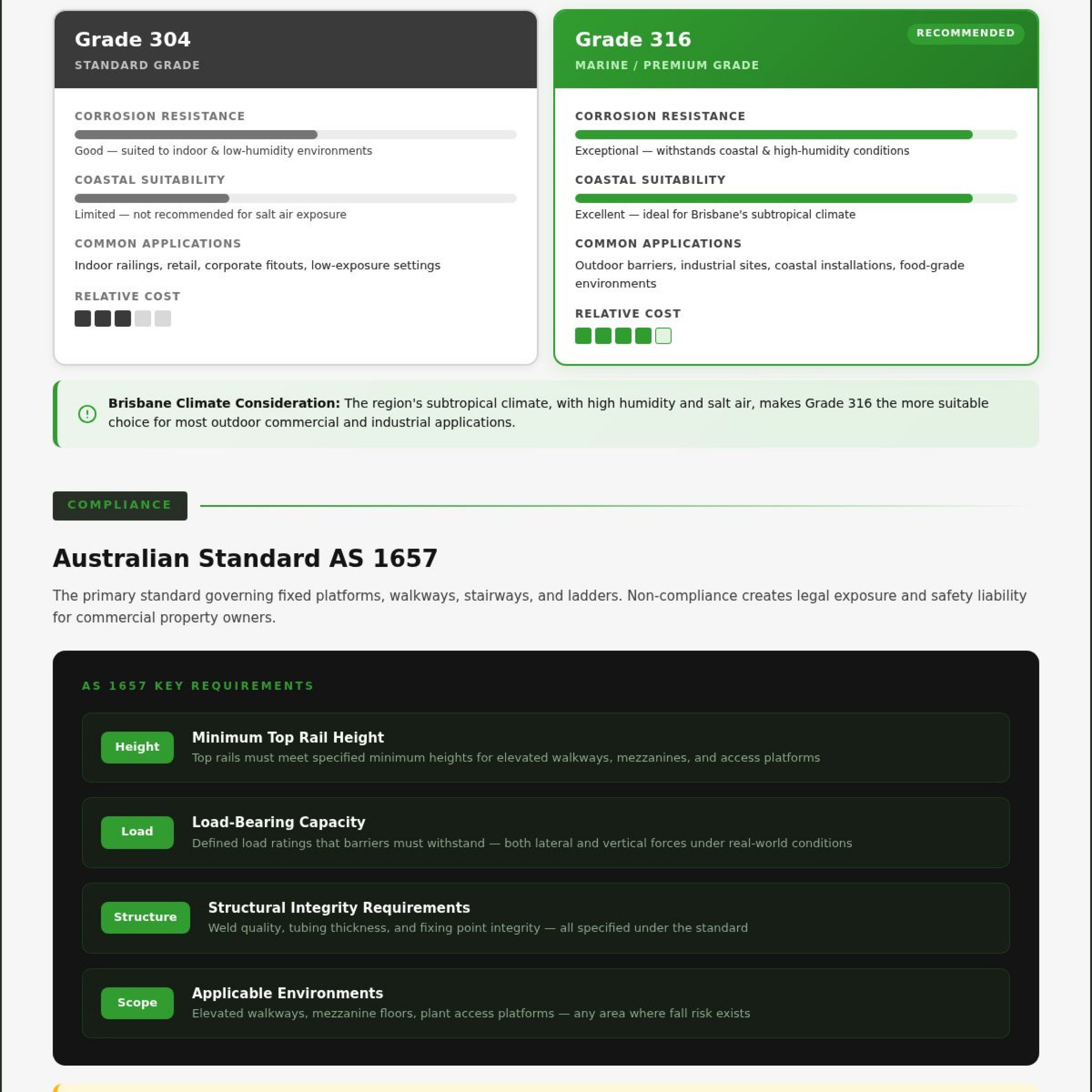
The case for stainless steel safety barriers over alternatives like mild steel, aluminium, or powder-coated products is straightforward when you look at long-term performance. Grade 316 stainless steel, in particular, offers exceptional resistance to corrosion in coastal and high-humidity environments, which is a genuine consideration for Brisbane businesses given the region’s subtropical climate.
Maintenance requirements are minimal compared to painted or galvanised alternatives, which are prone to chipping, rust, and degradation over time. A stainless barrier cleaned periodically with appropriate products will retain both its structural integrity and its appearance for decades. That translates directly into lower lifecycle costs and fewer compliance concerns as the years pass.
Safety performance is the non-negotiable element. Properly fabricated stainless steel safety barriers deliver consistent load resistance and dimensional stability, which is exactly what compliance with Australian Standards demands.
Compliance Standards for Stainless Steel Safety Barriers
Understanding which standards govern your safety barriers isn’t optional reading for commercial property owners. It’s the foundation of every sound purchasing and installation decision. Australia has clear regulatory requirements that apply to safety barriers across commercial and industrial environments, and getting across these requirements before you specify or procure anything will save you considerable time, money, and legal exposure.
Understanding AS 1657 Compliance
AS 1657 is the primary Australian Standard governing fixed platforms, walkways, stairways, and ladders, and it sets the benchmark that most commercial stainless steel safety barriers must meet. The standard specifies minimum heights, load-bearing capacities, and structural requirements for barriers installed along elevated walkways, mezzanine floors, plant access platforms, and similar areas where fall risk exists.
Key requirements under AS 1657 include:
- Minimum handrail height: Top rails must generally be installed at a height of between 900mm and 1100mm above the walking surface, depending on the application.
- Load capacity: Barriers must withstand a horizontal force of at least 750 newtons applied at the top rail, ensuring structural integrity under real-world pressure.
- Intermediate rails or infill: Openings within the barrier system must not allow a 125mm sphere to pass through, reducing the risk of falls and entrapment.
- Fixing and anchorage: All posts and base plates must be fixed to a substrate capable of transferring the required loads without failure.
It’s worth understanding that AS 1657 doesn’t operate in isolation. Depending on your site type, additional standards such as AS/NZS 4600 for cold-formed steel structures or the relevant provisions of the National Construction Code may also apply. A fabricator who genuinely understands the Brisbane commercial environment will know which combination of standards governs your specific application.
Continuous Compliance and Safety Checks
Installing compliant barriers is the starting point, not the finish line. Compliance is an ongoing obligation. Barriers can degrade over time through impact, corrosion, or inadequate maintenance, and a barrier that passed inspection at installation may no longer meet standard after years of operational wear.
Regular inspections should assess weld integrity, fixing point security, dimensional stability, and surface condition. In high-traffic or chemically active environments, the inspection frequency should increase accordingly. Businesses that neglect this step expose themselves to WorkSafe Queensland enforcement action, civil liability, and the very real risk of a preventable workplace injury.
Working with a certified fabrication and installation professional removes much of this uncertainty. A qualified installer can document compliance at the point of installation and advise on a practical inspection schedule suited to your site’s specific conditions. If you’re reviewing your current safety infrastructure, speaking with a specialist in stainless steel fabrication and safety handrails is a sensible first step toward confirming your barriers remain fit for purpose.
Comparing Stainless Steel Safety Barriers
Choosing between barrier configurations isn’t simply a matter of picking what looks right on paper. Each type carries distinct specifications, practical trade-offs, and ideal use cases that only become clear when you put them side by side. The table below provides a working reference for the three main stainless steel safety barrier categories used across commercial and industrial sites.
| Barrier Type | Typical Height | Load Capacity | Primary Application | Key Advantage | Key Limitation |
|---|---|---|---|---|---|
| Fixed Bollards | 600mm – 1200mm | High vehicle impact resistance | Storefronts, loading docks, plant protection | Robust, low maintenance, permanent protection | No flexibility once installed; access points are fixed |
| Removable/Retractable Bollards | 600mm – 1000mm | Moderate vehicle impact resistance | Car parks, controlled access zones, event spaces | Allows managed vehicle access without structural changes | Requires disciplined management to maintain effectiveness |
| Railings and Handrails | 900mm – 1100mm (AS 1657) | Minimum 750N horizontal load at top rail | Mezzanines, stairways, elevated walkways | AS 1657 compliant fall prevention; suits custom configurations | Fixed perimeter; reconfiguration requires reinstallation |
| Modular Barriers | Variable | Lower than fixed systems | Warehouses, public venues, temporary zones | Highly flexible; reconfigurable without structural work | Not suited to high-impact or permanent fall-protection requirements |
The pattern is clear. Fixed systems deliver maximum structural performance but sacrifice adaptability. Modular and retractable options trade some load capacity for operational flexibility. Neither approach is universally superior; the right choice depends entirely on your site’s specific demands.
Selection Criteria for Safety Barriers
Three factors consistently drive sound barrier selection: durability, aesthetics, and cost over the full service life rather than just the upfront purchase price. Grade 316 stainless steel outperforms grade 304 in corrosive or coastal environments, which matters considerably for Brisbane sites exposed to humidity and salt air. Aesthetics carry genuine commercial weight in retail and hospitality settings, where a brushed or satin finish contributes to the overall presentation of a space. Local supplier support is equally important; a fabricator who can respond quickly to site-specific modifications, compliance queries, or maintenance needs adds measurable value that an interstate or offshore supplier simply cannot match.
Feedback from Industry Professionals
Facility managers and site engineers consistently identify professional installation as the factor that separates a compliant, long-performing barrier from one that creates ongoing problems. A common observation from those who’ve managed both outcomes is that barriers fabricated and installed by specialists who understand local compliance requirements tend to hold up without issue across years of regular inspection, while cheaper alternatives often require remediation work within the first few years of service.
For Brisbane businesses evaluating their stainless steel safety barriers, working with a fabrication partner who brings direct knowledge of AS 1657 requirements and local site conditions removes a significant layer of risk from the decision. This focus on local expertise is equally important for other types of property protection; for instance, those in Victoria often rely on Colorbond fencing Melbourne for high-quality perimeter installations.
Installation and Maintenance of Stainless Steel Safety Barriers
Even the highest-quality stainless steel safety barriers will underperform if they’re poorly installed or left without a structured maintenance programme. The fabrication and the installation are two halves of the same equation, and neither can compensate for shortcomings in the other.
The Installation Process Explained
A professional installation follows a clear sequence, and skipping any stage introduces risk that compounds over time. Here’s how a properly managed installation unfolds:
- Site assessment and planning: Before any fabrication begins, the installer surveys the site to confirm substrate conditions, identify load transfer requirements, and map out fixing point locations. This stage determines whether concrete anchoring, chemical anchoring, or surface-mounted base plates are appropriate for your specific floor or structure.
- Custom fabrication: Barriers are fabricated to the precise dimensions and specifications confirmed during the site assessment. This includes cutting, bending, and welding tube sections, grinding welds to a consistent finish, and preparing base plates to the required tolerances.
- Substrate preparation: Fixing locations are marked, drilled, and cleaned before any anchor hardware is set. Getting this right is critical; undersized or improperly positioned anchors are one of the most common causes of barrier failure under load.
- Installation and alignment: Posts are set, levelled, and anchored before rails or infill panels are fitted. Alignment is checked at each stage rather than corrected at the end.
- Final inspection and documentation: A compliant installation includes a documented check against the relevant standard, confirming height, load capacity, and fixing integrity before the site is handed back.
The tools required are specific: rotary hammers, torque wrenches calibrated to manufacturer specifications, spirit levels, and in some cases, pull-out testing equipment to verify anchor performance. This isn’t work that benefits from improvisation.
Ongoing Maintenance Considerations
Stainless steel is low-maintenance, not zero-maintenance. A consistent inspection routine keeps barriers performing as intended and catches problems before they become compliance issues.
Routine checks should cover weld integrity at post bases and rail joins, fixing point security, any surface damage from impact or chemical exposure, and dimensional stability of the overall structure. In Brisbane’s subtropical climate, even grade 316 stainless can develop surface staining in areas with poor airflow or chemical contamination, so periodic cleaning with appropriate stainless steel cleaners remains important.
Watch for these specific warning signs during inspections:
- Visible cracking or separation at weld points
- Movement or rocking at base plate fixings
- Pitting or discolouration on tube surfaces
- Deformation to rails or posts following vehicle or equipment impact
How frequently you inspect depends on the intensity of use and the environment. High-traffic industrial sites warrant quarterly checks at minimum; lower-traffic commercial settings may manage with biannual reviews. The key is consistency and documentation so you can demonstrate ongoing compliance if WorkSafe Queensland ever asks.
For Brisbane businesses that want professional support across both installation and ongoing maintenance, speak with the team at Donewright Stainless about a maintenance programme suited to your site’s specific conditions.
Why Choose Donewright Stainless for Your Safety Barrier Needs
There’s a meaningful difference between a fabricator who can produce stainless steel components and one who understands the compliance landscape, the site-specific demands of Brisbane’s commercial environment, and the long-term performance expectations that come with safety-critical infrastructure. Donewright Stainless sits firmly in the second category.
Specialising in custom stainless steel fabrication and installation for commercial and industrial applications, Donewright Stainless brings direct knowledge of AS 1657 requirements to every project. That means barriers are designed and built to meet the standard from the outset, not adjusted after the fact. The team’s local presence in Brisbane and surrounding areas also means site assessments, fabrication, and installation are handled by people who understand the region’s conditions, from subtropical humidity to the specific substrate challenges common in Queensland commercial construction.
The scope of work extends across the full range of stainless steel safety barriers, including handrails, safety handrails and protection systems, and custom fabrication suited to the precise dimensions and load requirements of your site. Where standard configurations don’t fit, bespoke solutions are designed from scratch. That capability matters when your site has non-standard geometry, unusual substrate conditions, or aesthetic requirements that off-the-shelf products simply can’t meet.
Testimonials from Satisfied Clients
Clients who’ve worked with Donewright Stainless consistently point to two things: the quality of the finished product and the straightforward, professional approach throughout the process. Facility managers overseeing mezzanine and elevated walkway installations have noted that barriers fabricated by the team hold up without issue across years of regular compliance inspections, with weld integrity and fixing points remaining solid well beyond the initial installation period. Others in hospitality and retail settings have highlighted the quality of custom finishes, where brushed and satin surfaces have maintained their appearance in high-traffic environments without the degradation that cheaper alternatives tend to show within a few years.
Custom solutions have included bespoke handrail configurations for stairways with non-standard pitch angles, modular barrier systems for warehouse environments requiring periodic reconfiguration, and safety handrails for industrial platforms where both load performance and surface finish were specified requirements. Each project reflects the same commitment: fabricate it properly the first time, install it to standard, and leave the client with infrastructure they won’t need to revisit.
Contact Donewright Stainless
If you’re ready to specify stainless steel safety barriers for a new build, an upgrade, or a compliance remediation project, the practical next step is a direct conversation with the Donewright Stainless team. They can assess your site’s requirements, confirm which standards apply, and provide a quote based on your actual specifications rather than a generic estimate.
Visit Donewright Stainless to learn more about their fabrication and installation services, or reach out directly to discuss your project. Getting the right advice early makes the entire process considerably more straightforward.
Make Your Next Safety Barrier Decision a Confident One
Selecting the right stainless steel safety barriers for a commercial or industrial site involves more than picking a product off a shelf. Material grade, configuration, compliance with AS 1657, professional installation, and ongoing maintenance all play a role in whether your barriers deliver lasting value or create ongoing headaches.
The core principles are straightforward: match the barrier type to your site’s specific demands, don’t treat compliance as a one-time checkbox, and work with a fabrication partner who understands both the technical requirements and the local conditions that Brisbane’s environment presents.
Donewright Stainless brings established expertise in stainless steel fabrication, a genuine local presence, and the capability to deliver custom solutions built to your exact specifications. Whether you’re starting a new project or reviewing existing infrastructure, getting the right advice early makes everything that follows considerably more straightforward.
Get a quote for your stainless steel safety barrier needs with Donewright Stainless and take the first step toward infrastructure you can rely on for years to come.
Frequently Asked Questions About Stainless Steel Safety Barriers
What are stainless steel safety barriers used for?
Stainless steel safety barriers serve three core purposes in commercial and industrial settings: separating pedestrian and vehicle traffic, preventing falls from elevated surfaces, and controlling access through defined entry points. You’ll find them installed along mezzanine edges, stairways, loading docks, machinery zones, and public walkways. Their application spans retail precincts, warehouses, hospitality venues, and industrial facilities where physical boundary control is a daily operational requirement.
How do I ensure that my safety barriers comply with Australian regulations?
Start by confirming which standards apply to your specific site. AS 1657 governs most fixed platforms, walkways, and elevated areas, setting requirements for rail height, load capacity, and infill spacing. Depending on your site type, the National Construction Code may also apply. The most reliable approach is to engage a fabricator with direct knowledge of these standards who can design, install, and document compliance from the outset rather than retrofitting a solution after the fact.
What maintenance is required for stainless steel safety barriers?
Stainless steel requires periodic rather than intensive maintenance. Routine inspections should check weld integrity at post bases and rail joins, anchor point security, and any surface damage from impact or chemical exposure. Cleaning with appropriate stainless steel products prevents surface staining, particularly in areas with limited airflow. High-traffic industrial sites benefit from quarterly inspections; lower-traffic commercial environments can typically manage with biannual reviews, provided findings are documented consistently.
Can I customise my stainless steel safety barriers?
Yes, and in many commercial and industrial applications, customisation is necessary rather than optional. Non-standard stairway pitch angles, unusual substrate conditions, and site-specific aesthetic requirements often can’t be addressed with off-the-shelf products. A qualified fabricator can design bespoke configurations to your exact dimensional and load specifications, including custom surface finishes such as brushed or satin, which matter considerably in hospitality and retail environments where appearance is part of the brief.
How do I choose the right type of safety barrier for my needs?
Match the barrier type to your site’s primary risk and operational demands. Fixed bollards suit permanent vehicle exclusion zones around storefronts and plant equipment. Railings and handrails are the correct choice for fall prevention along elevated walkways and mezzanines, where AS 1657 compliance is mandatory. Modular or retractable systems work well where access configurations change regularly. Grade 316 stainless steel is the appropriate material choice for Brisbane sites exposed to humidity or coastal conditions, given its superior corrosion resistance.
What are the costs associated with stainless steel safety barrier installation?
Costs vary considerably depending on barrier type, site complexity, substrate conditions, and the extent of custom fabrication required. Rather than working from a generic estimate, it’s worth requesting a quote based on your actual site specifications. This gives you an accurate figure that accounts for material grade, fixing requirements, and the compliance documentation that professional installation includes. Contact Donewright Stainless directly to discuss your project and receive pricing suited to your specific requirements.
Where can I find local suppliers for stainless steel safety barriers in Brisbane?
For Brisbane businesses, working with a local fabrication specialist offers clear advantages over sourcing from interstate or offshore suppliers. Local partners can conduct site assessments in person, understand Queensland’s climate conditions and substrate challenges, and respond quickly to modifications or compliance queries. Donewright Stainless provides custom stainless steel fabrication and installation across Brisbane and surrounding areas, with direct knowledge of the compliance standards that apply to commercial and industrial safety barrier installations in the region.