
Stainless Steel Food Safety: An Australian Guide
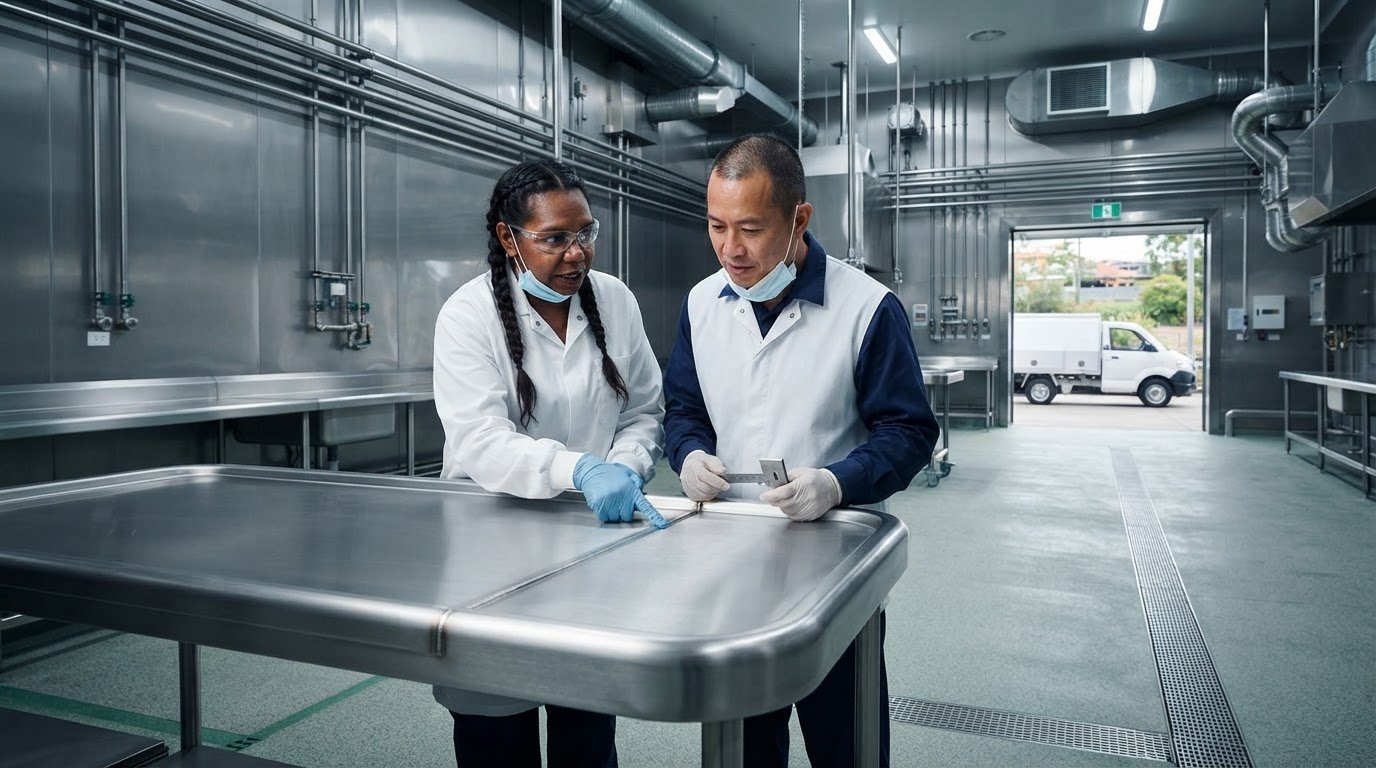
A stainless steel surface can be the right grade and still fall short of hygienic design. The food safety standards for stainless steel are not a single grade label: Australian requirements also concern whether equipment suits its use and can be cleaned effectively. Before specifying a bench, trolley or processing area, consider the material and the finished design together.
This guide explains how food safety obligations relate to stainless steel selection, fabrication and day-to-day cleaning. Grades such as 304 and 316 are not automatically “food safe” in every setting. The food product, cleaning chemicals and operating conditions all affect suitability. Joints, surface finish and hard-to-reach details can also influence how well equipment can be cleaned.
Use the guidance to prepare questions for a fabricator and identify when to confirm requirements with the relevant food safety authority. The aim is to help you review the whole hygienic system, not just a grade on a specification sheet, before making decisions for your project in Brisbane, the Gold Coast, Logan or Ipswich.
Key Takeaways
- Check which food safety obligations and references apply to your premises and project. There is no single stainless steel grade or certificate that settles every question.
- Assess stainless steel grades against intended use, food contact, cleaning regime and operating environment rather than relying on a “food grade” label alone.
- Review the complete design, including joints, finishes and access, to determine whether equipment can be cleaned effectively.
- Use a practical specification checklist to clarify requirements, review the design and identify who should verify compliance.
- When assessing a fabricator, ask about relevant experience, project communication, documentation and installation capability.
What food safety standards for stainless steel actually cover
The food safety standards for stainless steel are not a single grade or certificate. They sit within a wider set of food safety obligations and design decisions intended to support hygienic premises and equipment. To assess an item, consider what it will contact, how it will be cleaned and whether its construction leaves places where food residue can collect.
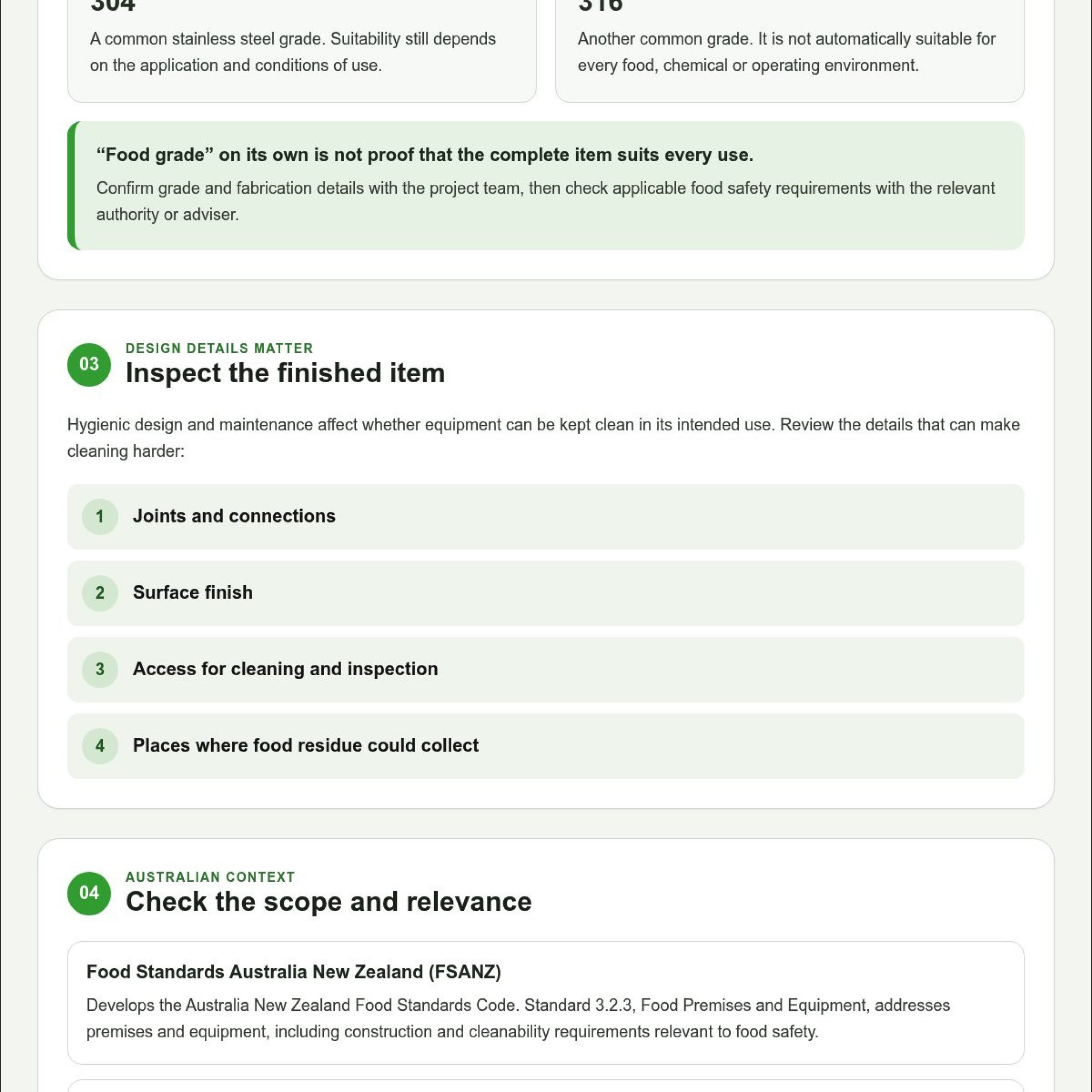
Material suitability concerns the stainless steel itself; hygienic design and maintenance determine whether the complete item can be kept clean in its intended use. A “food grade” label alone does not establish that a product suits every food, cleaning chemical or operating environment, or that the finished equipment meets applicable requirements.
Which Australian requirements may apply to food premises?
Food Standards Australia New Zealand (FSANZ) develops the Australia New Zealand Food Standards Code. Standard 3.2.3, Food Premises and Equipment, addresses food premises and equipment, including requirements relevant to construction and cleanability. Whether a particular provision applies depends on the premises, activity and equipment. Check the Code’s current wording and scope rather than relying on a general description.
AS 4674, Design, construction and fit-out of food premises, may also be a relevant reference when planning premises. A standard can inform design and fabrication, but confirm its legal status and relevance to the project rather than assuming they apply. In Queensland, check current state requirements and consult the relevant local council or a qualified food safety adviser about your specific premises. This information is general guidance, not legal advice.
Does a stainless steel grade guarantee food safety?
No single grade is universally suitable. Grades such as 304 and 316 are common examples, but choosing between them requires consideration of food contact, moisture, cleaning agents and conditions of use. Stainless steel properties vary by composition and grade. Stainless steel properties provides a general overview of the material, but project decisions should be checked against appropriate technical advice.
Keep four questions separate: will the material resist corrosion in this environment; can the equipment be cleaned effectively; is it suitable for its intended use; and does the proposed design meet the requirements that apply to the premises? A material choice alone cannot answer all four. Confirm grade and fabrication details with the project team, then verify applicable food safety requirements with the relevant authority or adviser before specifying or installing equipment.
How Australian standards connect stainless steel design with food hygiene
Standards help translate hygiene goals into design and construction decisions, but they do not replace the food safety obligations that apply to a business. Read the food safety standards for stainless steel in context: check the relevant food safety rules, the premises and equipment involved, and whether a particular standard has been adopted or referenced for the project.
FSANZ develops and administers the Australia New Zealand Food Standards Code; state and territory authorities are responsible for enforcement. The Code sets food safety requirements, while Australian Standards can provide technical guidance for premises design or fabrication. The existence of a standard alone does not establish that it is legally binding for every project. Confirm its status and applicability using current official documentation and the relevant authority.
When might AS 4674 be relevant?
AS 4674-2004, Design, construction and fit-out of food premises, may be a useful reference when a food premises is designed, built or fitted out. Before relying on it, check the current edition, scope and relevant clauses through Standards Australia and the project team. Its relevance to the premises does not mean every stainless steel component is covered by the same clause or standard.
For example, a custom bench in a food preparation area may need to be assessed alongside the room layout, cleaning access and the way the business will use it. That is a project-specific assessment, not a blanket conclusion based on the bench material or a standard number.
How do food safety duties relate to equipment design?
Food businesses need hygiene procedures that suit their operations. Equipment design can support those procedures by allowing staff to reach, inspect and clean surfaces effectively. A useful review considers both sides: what the business must do in practice, and whether the equipment’s dimensions, joints and placement make those tasks achievable.
For projects in Brisbane, the Gold Coast, Logan and Ipswich, confirm which Queensland requirements and local council processes apply to the premises and proposed work. Ask the project designer or food safety adviser to identify relevant provisions, then seek clarification from the appropriate authority if the interpretation is uncertain. Keep a record of the advice and documents used to make the decision.
A fabricator can contribute to the design discussion by reviewing practical details such as dimensions, joins and cleaning access. That input does not replace regulatory advice or the food business’s responsibility to meet its obligations. Donewright Stainless undertakes custom stainless steel fabrication and installation. Discussing a stainless steel fabrication project can help clarify fabrication details for the project team, with compliance confirmed against the requirements that apply.
How to assess stainless steel grades, finishes and fabrication
When considering food safety standards for stainless steel, material selection is only one part of the specification. Start with the equipment’s intended use: what food it may contact, how often it gets wet, which cleaning chemicals are used and the conditions in the surrounding environment. These details help the project team assess corrosion resistance and cleanability together.
How should a buyer compare stainless steel grades?
Grades 304 and 316 are common examples, not universal prescriptions. Grade 316 is often considered where exposure is more corrosive, but the right choice depends on the actual food, cleaning regime and operating conditions. Ask a qualified technical adviser to verify grade comparisons and corrosion resistance for your application. Where appropriate, request material identification or traceability documents and check that they match the project specification.
Which fabrication details can affect hygienic cleaning?
A suitable grade will not compensate for details that make equipment difficult to clean. Review welds and joints for crevices or uneven areas, and check that internal corners and edges are accessible. Consider whether water can drain away rather than pool, and whether staff can reach all relevant surfaces. For systems intended for clean-in-place methods, confirm that the layout and access support the proposed cleaning process. No finish or weld should be treated as automatic proof of compliance.
Use the table to guide a practical discussion with the designer, fabricator or food safety adviser. The evidence required depends on the project and applicable requirements.
| Application factor | Question to ask | Evidence to verify |
|---|---|---|
| Food contact and use | Which foods and processes will the equipment handle? | Written design brief and intended-use specification |
| Cleaning and moisture | Which chemicals, methods and wet conditions will it encounter? | Cleaning procedure and qualified advice on material suitability |
| Grade and material | Why is this grade proposed for the operating environment? | Material specification and traceability documents, where appropriate |
| Fabrication and finish | Can staff inspect, access and clean the joints, edges and surfaces? | Drawings, fabrication details and project review against applicable requirements |
| Drainage and layout | Can water drain, and can cleaning reach around and beneath the equipment? | Layout review and confirmation of access for the intended cleaning method |
Take these questions to the project team before fabrication begins. A fabricator can discuss dimensions, joints, finishes and access, while the food business and its advisers confirm the applicable hygiene requirements and operating procedures.
A practical checklist for specifying and verifying food-grade fabrication
A clear specification helps the food business, project team and fabricator work from the same requirements. For a Brisbane-area project, follow a sequence that turns operating needs into design details, then confirm which food safety requirements apply. Being in Brisbane does not create a separate stainless steel standard.
What should a food business include in its specification?
- 1. Define the use. Record the food process, intended food contact and equipment location, including nearby moisture or other relevant exposure.
- 2. Describe cleaning. Note cleaning chemicals, methods and frequency. Include inspection or maintenance needs that affect access.
- 3. Set out the design. Provide dimensions and interfaces with adjacent equipment or surfaces. Identify drainage, access for cleaning and inspection, and any operational constraints.
- 4. Confirm requirements. Ask the designer or food safety adviser to identify relevant standards and authority requirements for the specific premises and equipment. Confirm uncertain interpretations with the relevant Queensland or local authority, and record the outcome.
- 5. Review before fabrication. Check the drawings and agreed material details against the intended use and cleaning routine before approving the design.
- 6. Plan handover. Agree what documents will be supplied, who approves installation, and who sets cleaning procedures and ongoing inspection responsibilities.
What evidence should buyers request from a fabricator?
Ask for project drawings, agreed material details and relevant fabrication or handover documentation. Check how the design addresses joints, edges, access, drainage and cleaning. Where material traceability is appropriate to the project, ask what documentation is available and how it relates to the specified material. Clarify responsibilities in writing: a fabricator can provide fabrication and installation information, but the business and its project advisers must confirm applicable operational and regulatory requirements.
Useful questions for a supplier include: What material details are included in the specification? How are the joints and interfaces shown in the drawings? Can staff reach the surfaces for routine cleaning and inspection? What documentation will be supplied at handover? Who is responsible for confirming the design against the requirements that apply?
Donewright Stainless undertakes custom stainless steel fabrication and installation for projects in Brisbane, the Gold Coast, Logan and Ipswich. For background before discussing a project, see the custom stainless steel fabrication guide. The guide can help frame a discussion about fabrication details such as dimensions, interfaces and cleaning access. Contact Donewright Stainless about your project to discuss those details with the project team.
Choosing a stainless steel fabricator for a food business project
A fabricator should understand more than the measurements. For food premises, the discussion needs to account for workflow, intended use, cleaning routines and the space around the equipment. The food business remains responsible for confirming its operational and regulatory requirements, even when a fabricator contributes to design and installation.
What makes a fabricator a practical fit?
Ask how the fabricator will work from your project drawings, dimensions and site constraints. For a bench, discuss how it fits the preparation workflow and whether staff can access relevant surfaces for cleaning and inspection. Ask how joints, edges and interfaces will appear in the design, and how installation will be coordinated with other project work if required.
Review relevant fabrication examples and clarify what documentation can be provided for your project. A clear process should make it straightforward to discuss material details, drawing revisions, installation scope and assumptions that need confirmation. Ask who is responsible for design approval and who will verify the applicable food safety requirements. Do not treat a fabricator’s technical input as regulatory approval.
For projects in Brisbane, the Gold Coast, Logan or Ipswich, confirm location coverage, installation arrangements and the proposed scope directly. Requirements can vary by premises and equipment use, so the location itself is not evidence that a particular standard or approval applies.
How can Donewright Stainless support a custom fabrication discussion?
Donewright Stainless is a Brisbane-based fabricator offering custom stainless benches, stainless bench tops and stainless steel fabrication, with installation and on-site capabilities. These services can support a project discussion about dimensions, interfaces and access for cleaning. Confirm the specific scope and requirements for your job before work is specified.
For a useful first conversation, have the intended use, cleaning routine, project drawings and any advice from your designer or food safety adviser ready. This helps clarify what the fabrication needs to address and what must be confirmed by the project’s appropriate professionals. Food safety approval and regulatory interpretation remain with the relevant advisers or authorities. Do not assume compliance from the material or fabrication alone.
Discuss a stainless steel fabrication project and outline the requirements your project team has identified.
Make your next specification a considered one
The food safety standards for stainless steel are best understood as part of a broader project review. A suitable grade matters, but so do the equipment’s intended use, cleanability, fabrication details and maintenance. Confirm which food safety obligations and standards apply to your premises, and leave that decision with the appropriate project professionals and authorities.
Before fabrication begins, document the food process and cleaning routine, review drawings for access and drainage, and clarify what material and handover information the supplier can provide. These steps give the fabricator a clear brief and help your team check that the design supports day-to-day hygiene.
Donewright Stainless provides custom stainless steel benches, bench tops and fabrication for projects across Brisbane, the Gold Coast, Logan and Ipswich. Discuss your stainless steel fabrication requirements to outline your project needs and the details your team has identified.
Frequently Asked Questions
What Australian standards apply to stainless steel used in food premises?
There is not one standard that applies to every stainless steel item in a food premises. The Australia New Zealand Food Standards Code includes Standard 3.2.3, which addresses food premises and equipment. AS 4674 may also be relevant to premises design and fit-out, while AS 1528.1 concerns stainless steel tubes and fittings for food processing and hygienic applications. Check each document’s current status, scope and relevance to your project with a qualified adviser or authority.
Is 304 stainless steel food safe for every commercial kitchen application?
No. Grade 304 is commonly used in commercial kitchens, but that does not make it suitable for every food, cleaning regime or operating environment. Consider the intended food contact, exposure to moisture and cleaning chemicals, and the equipment’s day-to-day use. Ask a qualified technical adviser to confirm the grade for your application, and request material details from the supplier where appropriate. Suitability of the finished equipment also depends on its design, fabrication and maintenance.
Can 316 stainless steel be used in food processing equipment?
Yes, 316 stainless steel is used in some food processing applications, particularly where greater corrosion resistance may be needed. However, it is not automatically the right choice for every project, and using it does not establish regulatory compliance. The food product, cleaning chemicals, moisture and operating conditions all matter. Confirm material suitability with a qualified technical source and check that the equipment’s design and fabrication support effective cleaning for its intended use.
Does “food grade stainless steel” mean a product complies with food safety requirements?
No. “Food grade” is not, by itself, proof that a product meets every food safety requirement or suits a particular application. The food safety standards for stainless steel relate to more than a grade label: intended use, cleanability, fabrication and maintenance also need consideration. Ask what material is specified and what evidence supports that choice, then confirm the equipment and premises against the requirements that apply to your business.
How should stainless steel surfaces and welds be designed for cleaning?
Design surfaces and joints so staff can reach, inspect and clean them as part of the business’s routine. Review welds and joins for crevices or uneven areas, and consider edges, internal corners, drainage and access around installed equipment. Avoid leaving water to pool where possible. A finish or weld alone does not prove compliance, so assess the completed design against the intended cleaning method and applicable requirements.
What is AS 4674, and when might it apply to a food premises project?
AS 4674-2004 is titled Design, construction and fit-out of food premises. It may be a relevant reference when planning or fitting out food premises, but its applicability depends on the project’s scope and requirements. It does not mean that every stainless steel component is covered by the same provision. Check the current edition and relevant clauses through official documentation, and confirm how they apply with the project team or relevant authority.
How can a business check whether custom stainless steel fabrication is suitable?
Start by documenting the equipment’s intended use, food contact, cleaning routine, dimensions and site location. Ask the fabricator for drawings and agreed material details, then review joints, access, drainage and installation interfaces with the project team. Request relevant fabrication or handover documents where appropriate. The fabricator can discuss how the item will be made, but the business and its advisers must confirm operational and regulatory requirements before specifying or accepting the work.
Who should confirm food safety requirements for a Brisbane food business fit-out?
The food business should work with its designer or food safety adviser to identify applicable requirements, then contact the relevant Queensland or local authority if an interpretation needs confirmation. FSANZ develops and administers the Australia New Zealand Food Standards Code; state and territory authorities are responsible for enforcement. For a Brisbane-area project, check who has responsibility for the premises and proposed work. A fabricator can provide project details, but does not replace regulatory advice or approval.
