
Hygienic Stainless Steel Handrails for Food Processing
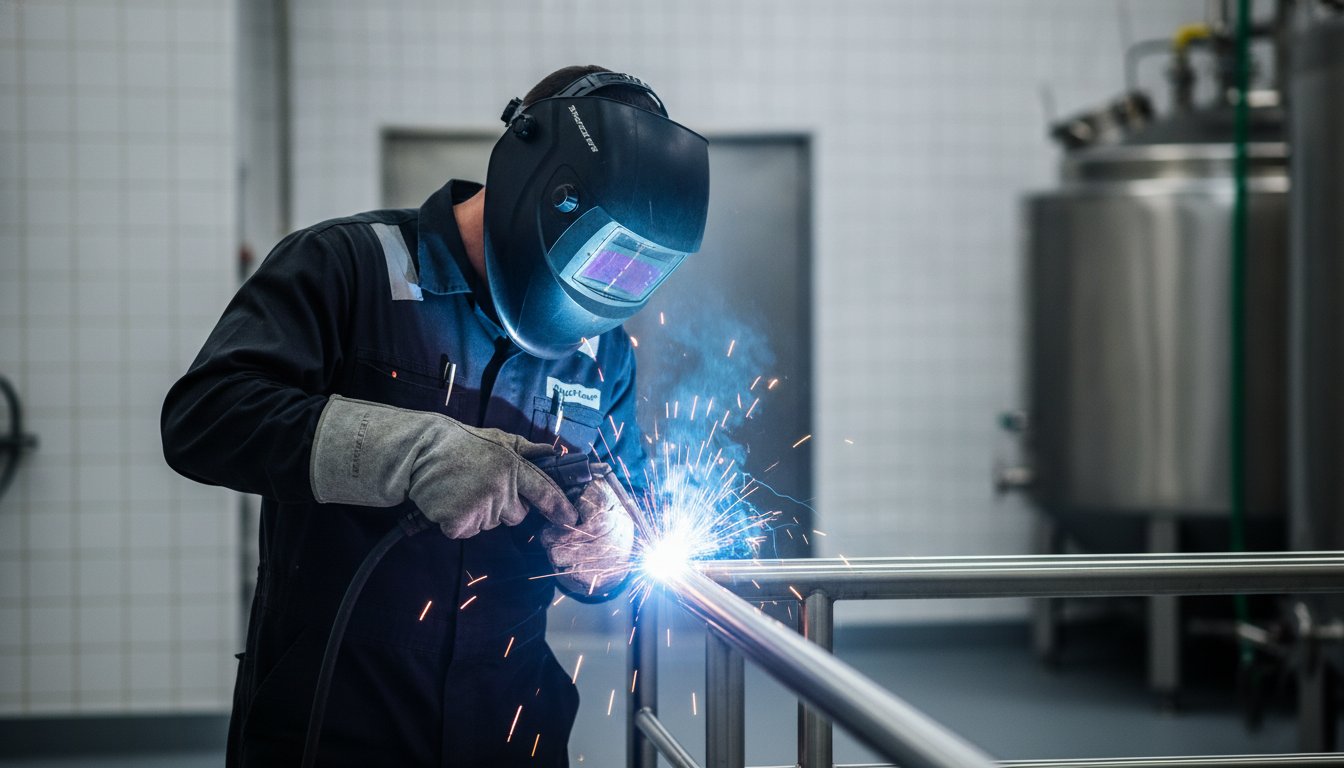
In a high-pressure food production environment, a single sub-standard weld on your safety barriers can be the difference between a seamless health audit and a costly, unplanned shutdown. You likely already know that keeping your facility compliant with AS 1657:2018 is non-negotiable for worker safety, but the constant cycle of harsh chemical wash-downs and strict hygiene protocols means that standard industrial railings simply won’t cut it. Poorly finished joints and low-grade materials don’t just corrode; they create microscopic pockets where bacteria thrive, potentially compromising your entire operation.
This guide will show you how to specify, install, and maintain stainless steel handrails food processing facilities can rely on to prevent bacterial contamination while standing up to the toughest cleaning regimes. We’ll explain why Grade 316 is the benchmark for corrosion resistance and how to ensure your local fabrication meets the latest Australian safety standards. You’ll also learn how to manage installations using mobile workshop services to ensure your production lines keep moving while your safety infrastructure is upgraded to a professional, audit-ready standard.
Key Takeaways
- Understand the dual role of sanitary handrails in protecting staff from falls while eliminating the hidden crevices where bacteria can thrive.
- Learn why Grade 316 is the essential material for stainless steel handrails food processing facilities require to withstand aggressive chemical wash-downs and prevent pitting.
- Ensure your facility remains compliant with AS 1657:2018 by following specific requirements for handrail height, clearance, and continuity.
- Discover why continuous sanitary welding is mandatory for preventing contamination traps and why mechanical fasteners like pop rivets pose a significant hygiene risk.
- Master the maintenance protocols required to preserve the stainless steel passive layer and prevent stress corrosion cracking caused by improper cleaning agents.
Why Sanitary Handrails are Vital in Food Processing Environments
Sanitary handrails are specialised safety barriers engineered to provide robust fall protection while strictly eliminating any bacterial harbourage points. In an industrial plant, stainless steel handrails food processing systems must perform a dual role. They protect workers on mezzanine levels and stairways from falls, but they also protect the final product from microbial growth. Standard commercial handrails often rely on mechanical fasteners or hollow tube designs that aren’t fully sealed. These create microscopic crevices where organic matter accumulates. Over time, these areas become breeding grounds for pathogens like Listeria or Salmonella, which can migrate into the production line.
Utilising the unique properties of stainless steel, specifically its inherent corrosion resistance and smooth surface finish, is the only way to meet these conflicting demands. Standard rails fail because they cannot withstand the aggressive caustic wash-downs required in food production. The cost of choosing the wrong infrastructure is high. It leads to failed hygiene audits, catastrophic product recalls, and potential workplace injuries that stall production for weeks. Investing in high-quality stainless steel handrails food processing solutions ensures that your facility meets both workplace health and safety (WHS) requirements and food safety protocols.
Safety vs. Hygiene: Striking the Balance
Finding the balance between a secure grip and a cleanable surface is a technical challenge. Standard safety rails often use knurled surfaces or high-friction coatings to prevent slips. In a food plant, these textures trap fats and proteins, making them nearly impossible to sanitise. Custom fabrication allows for the use of specific tube diameters and finishes that provide adequate grip through ergonomic design rather than surface roughness. This ensures the rails are easy to wash down without compromising the structural integrity required by Australian safety standards. It’s about creating a safe handhold that doesn’t hold onto bacteria.
Common Hazards in Industrial Food Production
Food processing facilities are inherently hazardous environments. Floors are frequently slippery due to fats, oils, and constant cleaning cycles. This makes reliable handrails essential. However, the same cleaning agents that keep floors safe are often highly corrosive to low-grade metals. Another risk is the “dead leg” in physical infrastructure. This occurs when a railing system has unsealed ends or stagnant gaps where moisture and bacteria multiply undisturbed. Professional fabrication eliminates these risks by ensuring every joint is a continuous, sanitary weld. This level of precision is the only way to keep a facility truly audit-ready. For businesses in the catering and foodservice sector, maintaining these standards also involves using high-quality equipment; companies like Hopkins are renowned for manufacturing durable, hygienic solutions that withstand intensive commercial use.
Material Selection: Why Grade 316 Stainless Steel is the Gold Standard
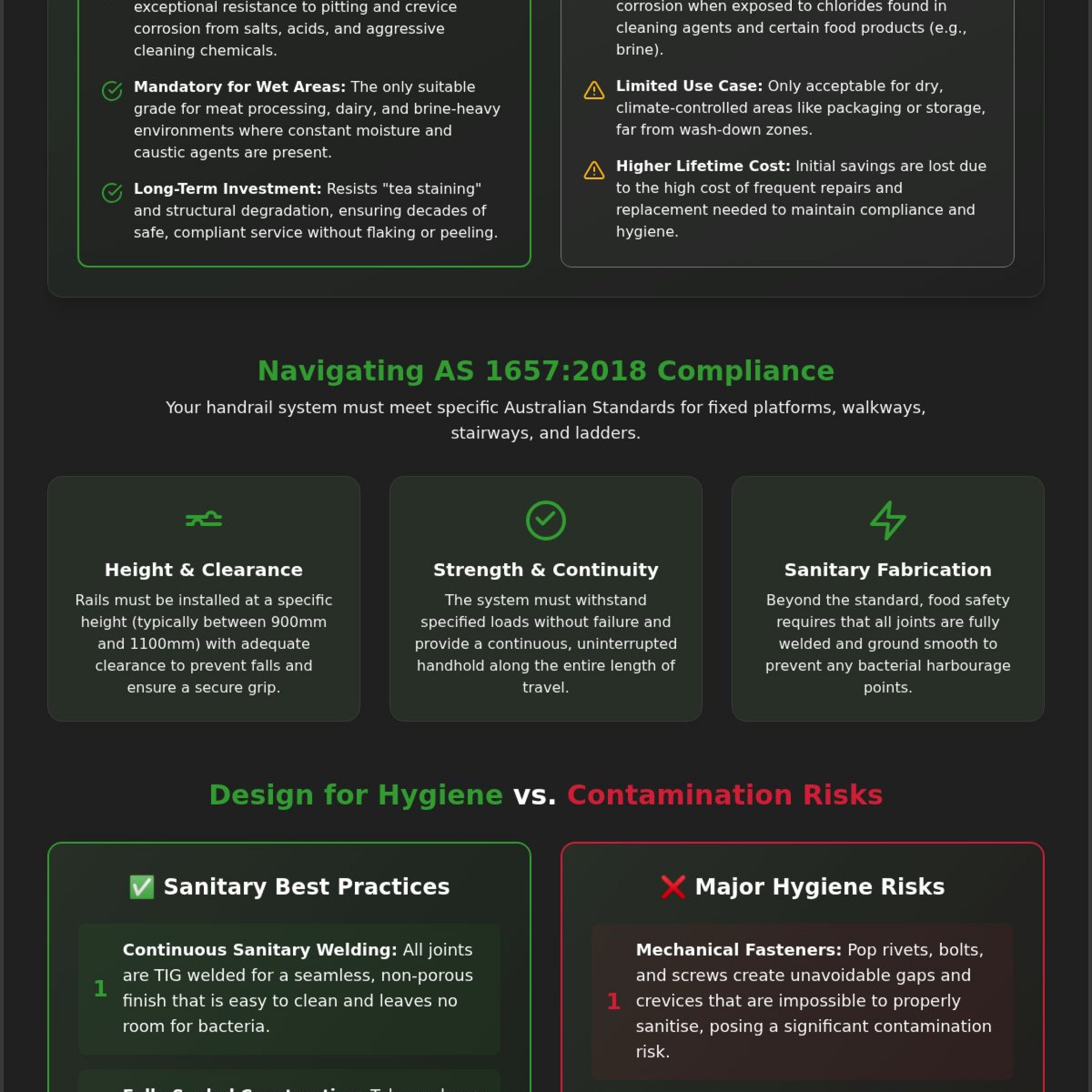
Selecting the right alloy is a critical decision that dictates the lifespan of your facility’s safety infrastructure. While Grade 304 is often seen in dry storage or general commercial kitchens, stainless steel handrails food processing plants require something more robust. Grade 316 contains between 2% and 3% molybdenum, which significantly enhances its resistance to pitting and crevice corrosion. This is vital in “wet” areas where salt, acids from citrus or vinegar, and caustic cleaning agents are present. Without this chemical protection, standard rails will develop “tea staining” or deeper corrosion that compromises both hygiene and structural safety.
Unlike aluminium, which oxidises and pits easily, or galvanised steel, which relies on a zinc coating that eventually wears away, 316 stainless steel provides a uniform material that doesn’t flake or peel. This durability ensures that your facility remains compliant with Australian standards for workplace safety for decades rather than years. Because the price of stainless steel is influenced by global markets for molybdenum and nickel, investing in high-grade materials now protects you from the rising costs of frequent replacements.
Grade 304 vs. 316: Making the Right Investment
Grade 304 is acceptable for dry, climate-controlled environments where moisture is minimal. However, in meat processing, dairy, or brine-heavy environments, 316 is mandatory. The long-term ROI is clear; although the initial material cost is higher, you’ll save significantly on replacement costs and labour-intensive cleaning. To ensure you’re getting what you paid for, always request mill certificates from your fabricator. These documents verify the chemical composition of the steel, ensuring it meets the specific requirements of your project.
The Importance of Surface Roughness (Ra Values)
Hygiene isn’t just about the alloy; it’s about the finish. Surface roughness is measured in Ra values, and “smooth to the touch” isn’t a technical enough metric for food safety. A standard #4 brushed finish is common, but for high-risk zones, electropolishing is preferred. This process uses an electrochemical bath to strip away microscopic peaks, creating a surface so smooth it’s difficult for bacteria to adhere to. When installing stainless steel handrails food processing systems, our team uses specialised handling techniques to avoid mechanical damage. Even a small scratch from a tool can create a new harbourage point for microbes.
If you’re unsure which grade best suits your specific production line, our specialist stainless steel fabrication team can provide technical advice based on your facility’s wash-down protocols.
Navigating Australian Standards: AS 1657 and Food Safety Compliance
AS 1657:2018 is the primary benchmark for fixed platforms, walkways, and stairways in Australia. It dictates the structural integrity and design of your facility’s safety infrastructure. For the stainless steel handrails food processing facilities require, compliance isn’t just about preventing falls; it’s about satisfying the rigorous demands of health inspectors. While AS 1657 focuses on the physical safety of the worker, AS 4674 (Design, construction and fit-out of food premises) provides the framework for sanitary design. In South East Queensland, local council inspectors and bodies like Safe Food Queensland look for the seamless integration of these two standards. If your handrails meet safety heights but have unsealed joins or trap moisture against a wall, they’ll fail a hygiene audit.
AS 1657 Requirements for Processing Plants
The standard mandates specific dimensions to ensure ergonomic safety. Handrails must typically sit between 900mm and 1100mm above the floor or stair nosing. For industrial applications, the outside diameter of the rail should be between 30mm and 50mm to allow for a secure power grip. Continuity is another vital factor. A compliant handrail must be a continuous, smooth run without sharp ends or gaps that could snag clothing or cause a worker to lose their balance. From a structural standpoint, these systems must withstand specific load-bearing forces to ensure they don’t fail when a worker leans or falls against them during a shift.
Hygienic Design Principles for Compliance
To pass a food safety audit, your metalwork must go beyond the basic safety requirements. One of the most critical principles is the elimination of horizontal surfaces where dust and moisture can accumulate. We design posts and rails with sloped or rounded profiles to ensure they’re self-draining. Clearance is equally important. AS 4674 suggests a minimum 50mm clearance between the handrail and any adjacent wall. This gap is essential because it allows cleaning crews to reach behind the rail with high-pressure hoses or sanitising cloths. Without this space, the area behind the rail becomes a hidden “dead zone” where organic matter builds up. Every post and mounting bracket must be fully sealed with sanitary welds to prevent internal corrosion and bacterial growth.
Design and Installation: Preventing Contamination Traps
This commitment to sanitary design should extend to all aspects of your production line. For those managing complex separation processes, Sacor provides industrial decanter centrifuges engineered to meet the strict hygiene and performance requirements of the Australian food industry.
Designing stainless steel handrails food processing systems requires a strict “No Crevice” policy. Every join must be a continuous, sanitary weld rather than a joined fitting. Mechanical fasteners like pop rivets or bolts are unacceptable in high-hygiene zones because they create tiny gaps where moisture and food particles sit. These areas are impossible to reach with standard cleaning tools and quickly become bacterial hotspots. By eliminating these mechanical joins, you ensure that every part of the safety system is accessible for sanitisation during daily wash-downs. This approach significantly reduces the risk of cross-contamination throughout your facility.
How the rails meet the floor is just as important as the rail itself. Standard base plates often trap water and organic matter underneath them. We prefer using coved bases or standoff spacers that lift the post off the ground. These designs allow for 100% floor visibility and easy drainage. This prevents stagnant water from pooling around the base of your safety infrastructure, which is a common cause of floor degradation and bacterial growth in older plants.
Seamless Welding and Crevice-Free Joins
TIG (Tungsten Inert Gas) welding is the industry standard for food-grade stainless steel fabrication. It offers superior control and cleaner results compared to MIG welding, which can leave behind spatter and rough patches. A sanitary weld is a full-penetration weld ground smooth and polished to match the surrounding surface. We also use back-purging techniques during the welding process. This involves filling the inside of the tube with argon gas to prevent “sugaring” or internal oxidation. Without purging, the inside of the rail becomes a rough, corroded surface that can eventually compromise the integrity of the entire structure.
Mobile Fabrication for Minimal Downtime
Most plants can’t afford to shut down production for days to accommodate new safety barriers. Our fully equipped mobile workshop allows us to perform precision adjustments on the factory floor. This is much more effective than pre-fabricating off-site and hoping for a perfect fit in a complex environment. We manage all hot work permits and safety protocols to ensure the installation doesn’t interfere with your active production lines. This approach is similar to our on-site industrial pipework repair Brisbane services, where speed and technical precision are paramount for maintaining plant uptime.
If you’re planning a facility upgrade, our team can provide a mobile workshop service to ensure your new handrails are fitted with minimal disruption to your production schedule.
Maintaining Your Stainless Steel Infrastructure for Longevity
The durability of stainless steel handrails food processing systems relies on a phenomenon known as the passive layer. This microscopic, chromium-rich oxide film is what prevents the steel from rusting. Unlike a painted or galvanised surface, this layer is self-healing, but it requires constant access to oxygen to maintain its integrity. If organic matter or salt residues are left to sit on the surface, they “suffocate” the steel, leading to localised corrosion. In Brisbane’s humid and often salt-laden air, this can manifest as tea staining. While this brown surface discolouration is often aesthetic, it indicates that the passive layer is under stress and requires immediate attention to prevent deeper pitting.
Chemical compatibility is the most overlooked factor in facility maintenance. Many industrial cleaners contain high concentrations of chlorine or bleach. While effective at killing bacteria, these chemicals are the primary cause of stress corrosion cracking in stainless steel. Over time, chlorine ions penetrate the protective layer and cause the metal to become brittle and fail. Utilising passivation treatments, a chemical process that removes free iron from the surface and encourages the formation of a thick oxide layer, is the best way to restore your infrastructure after a heavy production cycle or an aggressive cleaning regime.
Routine Cleaning and Chemical Compatibility
Daily wash-downs should focus on removing all organic matter using pH-neutral or specifically formulated stainless steel cleaners. It’s a common mistake to use abrasive pads like steel wool to scrub away stubborn residues. Never let carbon steel wool touch your handrails. It leaves behind microscopic iron particles that will rust almost immediately, creating a cross-contamination risk and damaging the stainless finish. Soft nylon brushes or microfibre cloths are the only tools that should be used. Ensuring the rails are thoroughly rinsed and dried after cleaning allows the passive layer to reform and stay active against the environment.
Industrial Maintenance and Professional Repairs
Even the best-designed systems can suffer impact damage from trolleys or heavy machinery. When the surface is gouged or a weld is cracked, it creates a new crevice for bacteria to hide. Establishing a periodic inspection schedule ensures these issues are caught before they lead to an audit failure. For complex repairs, you may need professional stainless steel maintenance services to restore the sanitary finish. Our mobile welding workshop can repair damage on-site, grinding and repolishing the affected area to a food-grade standard without the need to dismantle the entire safety system. This proactive approach extends the life of your stainless steel handrails food processing infrastructure and ensures your plant remains both safe and compliant.
Securing Your Facility’s Future with Hygienic Infrastructure
Maintaining a food-safe environment requires more than just regular cleaning; it demands infrastructure designed from the ground up to be sanitary. By choosing Grade 316 stainless steel and insisting on seamless, TIG-welded joins, you eliminate the crevices where bacteria hide. Adhering to the specific requirements of AS 1657:2018 ensures your facility protects its workers while remaining fully audit-ready. Investing in high-quality stainless steel handrails food processing systems is a long-term strategy that pays for itself through reduced maintenance and improved plant hygiene.
At Donewright Stainless, Ian “Wrighty” Wright and our team specialise in food-grade custom fabrication. Our Brisbane-based mobile workshop allows us to handle on-site installations with precision, ensuring minimal disruption to your production schedule. We understand the technical nuances of the industry and are ready to help you upgrade your facility with confidence. Get a Quote for AS 1657 Compliant Handrails and ensure your plant meets the highest standards of safety and sanitation. We look forward to helping you build a more secure and efficient processing environment.
Frequently Asked Questions
What is the difference between 304 and 316 stainless steel for food processing?
Grade 316 contains molybdenum, which provides superior resistance to pitting and corrosion in environments with high salt or acidic content. While Grade 304 is often suitable for dry storage areas, Grade 316 is the industry standard for “wet” processing zones. Choosing 316 ensures your infrastructure survives aggressive caustic wash-downs without compromising food safety or structural integrity over the long term.
Does AS 1657 apply to all handrails in a food production facility?
AS 1657:2018 applies to all fixed platforms, walkways, stairways, and ladders used by personnel within your facility. If a handrail is part of a permanent access structure, it must meet the specific height, load-bearing, and continuity requirements of this standard. Failing to meet these benchmarks can lead to workplace safety breaches and potential liability issues during an official health or safety audit.
Why are polished welds important for food safety compliance?
Polished welds, often referred to as sanitary welds, are ground flush and polished to ensure there are no pits, craters, or crevices. Standard industrial welds can harbour organic matter and bacteria that survive even the most rigorous cleaning cycles. By ensuring every joint is smooth and continuous, you eliminate these microscopic harbourage points, making your stainless steel handrails food processing environment significantly easier to sanitise.
Can I use aluminium handrails in a food processing plant?
You can use aluminium in some non-contact or dry areas, but it is generally less suitable for high-hygiene zones. Aluminium is a softer metal that pits easily and can react poorly to the heavy caustic chemicals used in food plant sanitation. Stainless steel remains the preferred choice for its superior durability, ease of cleaning, and its ability to maintain a passive, non-reactive surface in harsh conditions.
How often should stainless steel handrails be passivated?
Passivation is mandatory immediately after any on-site welding or mechanical repair to restore the protective chromium oxide layer. Beyond installation, the frequency depends on your facility’s specific environment. If you notice early signs of surface discolouration or “tea staining,” a professional passivation treatment should be performed. This chemical process strips away surface iron and contaminants, ensuring the steel remains truly “stainless” and resistant to deep-seated corrosion.
What is tea staining and how do I prevent it in Brisbane?
Tea staining is a brown surface discolouration that occurs when salt and moisture are trapped on the metal surface, a common issue in Brisbane’s humid climate. It is purely aesthetic initially but can lead to pitting if ignored. To prevent it, we recommend using Grade 316 stainless steel with a smooth surface finish and establishing a regular cleaning schedule to remove salt and chemical residues before they can attack the passive layer.
Do I need to shut down production for handrail installation?
You don’t need to halt your entire operation if you engage a fabricator with a fully equipped mobile workshop. We can perform precision adjustments and on-site welding during scheduled maintenance windows or alongside active lines by managing strict hot work permits. This approach allows for the custom fitting of stainless steel handrails food processing facilities require without the costly downtime associated with traditional off-site fabrication and delivery delays.
How do I ensure my handrails meet the latest health and safety audits?
The most reliable way to ensure compliance is to work with specialists who understand both AS 1657 and the hygienic requirements of AS 4674. Your handrails must provide adequate fall protection while remaining free of “dead legs” or unsealed gaps where bacteria can grow. Regular inspections by a qualified fabricator can identify potential hygiene risks or structural wear before they trigger a non-compliance report during your next health audit.
