
Brewery Tank Welding and Repair in Brisbane: A Practical Guide
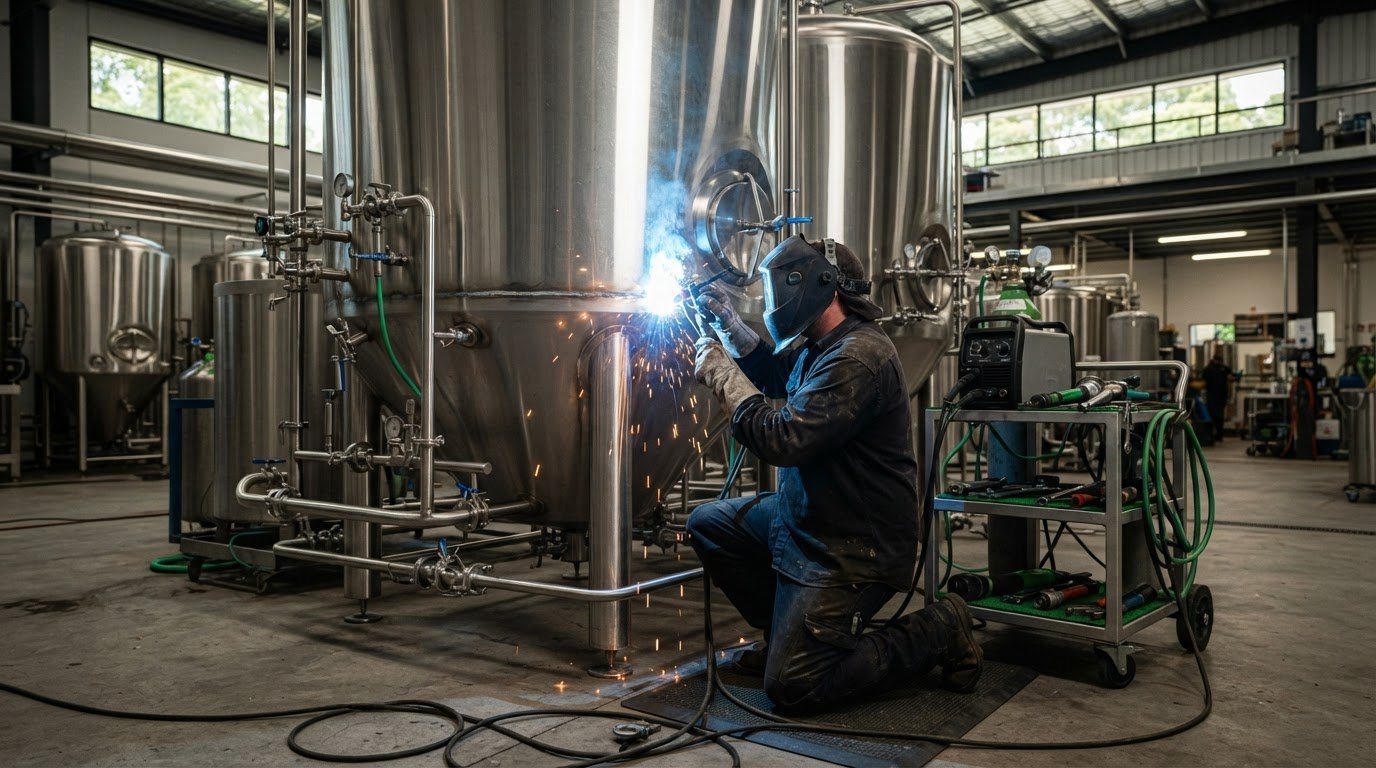
Can a leaking brewery tank be repaired on site without compromising its integrity or disrupting production for longer than necessary? A defect doesn’t automatically mean the tank needs replacing, but the right approach depends on the damage, tank construction and site conditions. Brewery tank welding and repair Brisbane projects need a careful assessment before work begins.
It’s reasonable to be cautious about repairs to product-contact surfaces. Material, wall thickness, previous repairs, pressure or vacuum duty and hygiene requirements all help shape a suitable repair plan. Access, production schedules and isolation arrangements matter too. Donewright Stainless provides mobile welding and industrial maintenance from Brisbane, using a fully equipped mobile workshop for on-site projects.
This guide explains what information helps assess a defect, how repair and replacement compare, and what to plan for tank integrity, hygiene and production continuity. It also covers how to coordinate the work before welding starts, so the repair strategy reflects the tank and site rather than guesswork.
Key Takeaways
- A leak, crack or corroded area is a reason to investigate, not enough on its own to decide whether a tank can be repaired.
- For brewery tank welding and repair Brisbane projects, tank material, wall thickness, operating duty and repair history help shape the assessment.
- Compare repair and replacement against the tank’s overall condition, the work required and production needs before deciding on a path forward.
- Prepare fault details and plan access, nearby equipment and coordination with the brewery maintenance lead before work begins.
- Donewright Stainless provides mobile welding and industrial maintenance for project-specific on-site work.
Brewery Tank Welding and Repair in Brisbane: What Damage Needs Attention?
A leak, visible crack, damaged weld or localised corrosion can raise an immediate question: can the tank be repaired, or is replacement needed? The visible symptom is a starting point, but it doesn’t show the full condition of the vessel. Tank material, wall thickness, age, previous repairs and operating duty all influence the assessment.
Brewery tank welding and repair means assessing and addressing damage to a metal vessel while accounting for its construction, operating conditions and product-contact requirements. An assessment distinguishes what an operator can observe from the cause and extent of the defect. This guide focuses on stainless steel brewery vessels, not polyethylene or other plastic tanks featured in some general tank-repair results. Plastic welding methods don’t establish whether a stainless steel tank is repairable.
Which brewery tank faults call for a welding assessment?
Look for changes such as a weeping seam, visible crack, dent from an impact, weld that appears separated or distorted, or corrosion near a joint or fitting. Record where the fault appears and whether it changes during operation. Photographs help document visible damage, but can’t confirm its depth, cause or extent.
A tradesperson can assess whether the damage is localised or part of a broader issue. Tank age, records of earlier repairs, material grade and wall thickness, and pressure or vacuum duty are relevant details. Don’t assume a small-looking fault is a straightforward repair before these factors are understood.
Why does brewery service change the repair brief?
Brewery tanks may hold product and undergo regular cleaning. That makes the internal surface and the area around a repair part of the plan, not an afterthought. Record the tank’s use, contents, cleaning routines and operating conditions, along with any product-contact requirements. These details help define the repair scope and agreed checks. A weld alone doesn’t prove that hygiene requirements have been met.
Welding processes vary, and the suitable approach depends on the tank and the job. The TIG welding process, also known as gas tungsten arc welding, is one process used on metals including stainless steel. It isn’t automatically suitable for every tank repair. Material, access and the required finish all need to inform the work plan.
How Brewery Tank Welding and Repair Is Assessed On Site
A sound repair plan starts with the tank and site, not just the visible fault. For brewery tank welding and repair Brisbane operators should expect the assessment to establish the vessel’s material, how it operates, available access and what the repair needs to address. These details help define a practical scope and coordinate the work with production.
What information helps scope a brewery tank repair?
Gather what’s available before the site visit. Tank drawings, identification details, material grade, dimensions and records of previous repairs can help build an accurate picture. Add the fault’s location and photographs, the tank’s contents and operating conditions, and any known pressure or vacuum duty.
Site details matter just as much. Note working space around the vessel, nearby equipment, access routes and relevant isolation arrangements. Explain how the fault affects production and identify timing or access constraints for the brewery maintenance lead to coordinate. Missing records don’t replace an assessment, but sharing available information can help focus it.
How mobile welding can fit brewery maintenance
A fully equipped mobile workshop supports on-site industrial work when access, isolation and repair scope make that approach suitable. The work plan should account for the tank’s position, space for equipment, nearby operations and management of the work area. On-site suitability depends on access, isolation and the repair scope.
The assessment then moves through a clear sequence:
- Gather tank details: review identification, drawings, material information and repair history where available.
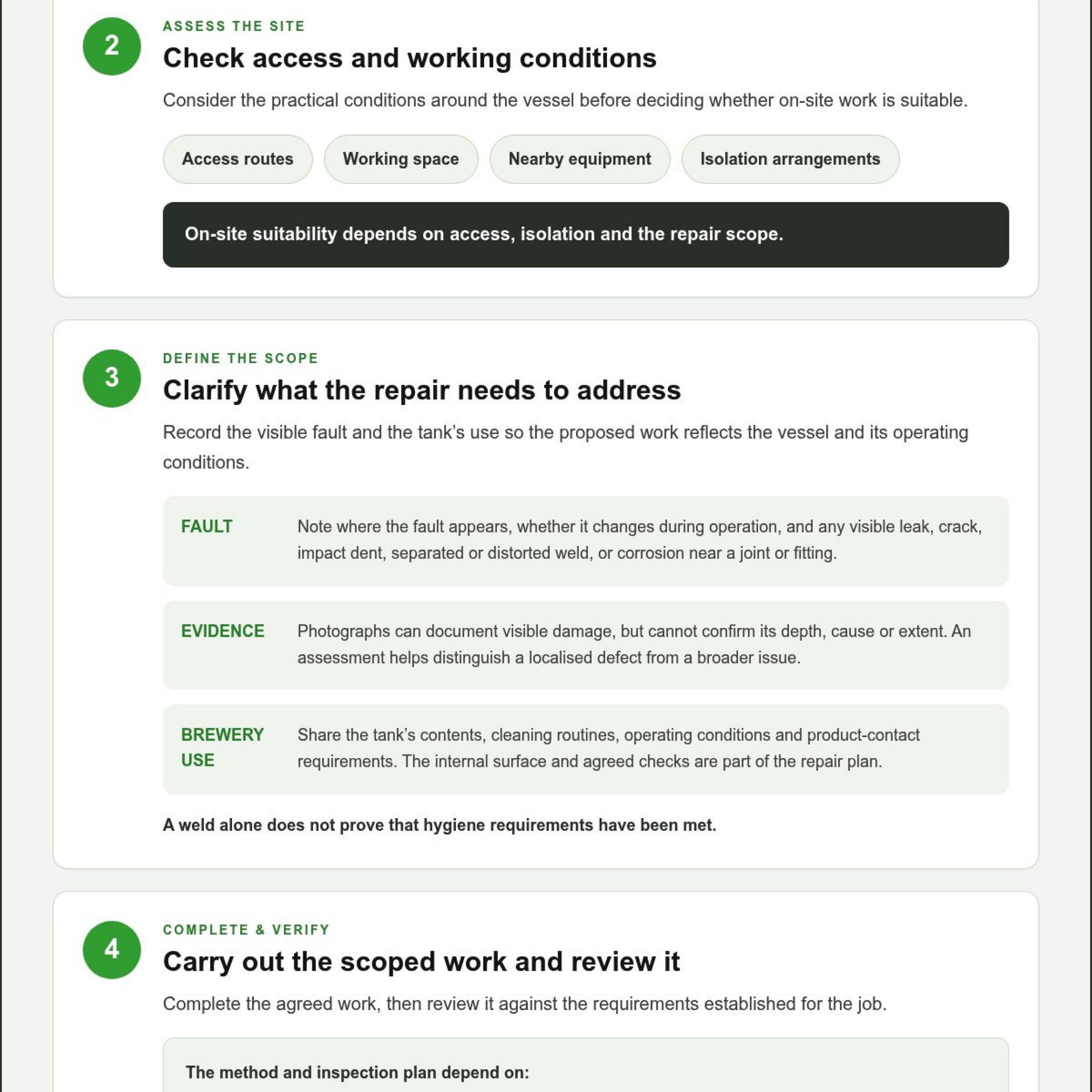
- Assess the site: consider access, working space, nearby equipment and isolation arrangements.
- Define the scope: establish the repair approach and agree which requirements or checks apply to the job.
- Complete and verify: carry out the scoped work, then review it against the agreed requirements. The method and inspection plan depend on the tank material, damage and operating conditions.
Coordinate timing with the brewery maintenance team rather than assuming a set duration. Agreeing access, work-area arrangements and production priorities in advance gives everyone a shared plan without promising a fixed timeframe or uninterrupted operations. WorkSafe Queensland’s guidance on welding safety can inform planning for hazards such as fumes, radiation and electrical risks.
For related site-based maintenance context, see on-site industrial pipework repair in Brisbane. Donewright Stainless provides mobile welding and industrial maintenance through its Brisbane mobile workshop services.
Repair or Replace a Brewery Tank? Compare the Practical Factors
A visible defect doesn’t automatically mean a brewery tank needs replacing, just as a weld repair isn’t suitable for every damaged vessel. Decide by weighing the tank’s assessed condition against its intended use and the work required. Comparing practical factors helps avoid judging by one visible fault or assuming either option is always preferable.
| Factor | Repair may be considered when… | Replacement may need consideration when… |
|---|---|---|
| Condition | Assessment identifies damage that appears localised and defines its extent. | Deterioration is widespread, or the overall condition is uncertain. |
| Repair scope | The proposed work can be clearly described and assessed against the tank’s requirements. | Damage or repeated failures point to broader work, or the scope remains unclear. |
| Tank duty | The vessel’s intended use and operating conditions can be considered in evaluating the repair. | The tank’s duty, construction or suitability for ongoing use raises unresolved questions. |
| Access | The work area and tank configuration allow the proposed repair to be carried out and checked as planned. | Access constraints make the repair scope impractical or affect how it can be assessed. |
| Operations | Repair planning can be coordinated with production and maintenance requirements. | Operational needs or the required work make replacement a more appropriate option to assess. |
When a targeted repair may be worth assessing
Localised damage, such as a discrete defect at a seam, calls for assessment, not an automatic recommendation to weld. Consider whether the damage can be addressed within a defined scope and whether that scope suits the vessel’s product-contact needs and operating conditions. The tank must be evaluated for its intended use after repair. A weld alone doesn’t establish suitability.
When wider damage or unknowns affect the decision
Extensive deterioration, repeated failures or an incomplete repair history can make the decision less straightforward. Pressure or vacuum duty also requires specific technical consideration based on the vessel’s construction and documented requirements. If the tank’s condition or intended use is unclear, don’t treat a limited repair as a complete answer. Broader custom stainless steel fabrication in Brisbane provides useful context for considering fabrication requirements alongside repair planning.
The repair-or-replace decision depends on assessed condition, intended duty and documented requirements. For brewery tank welding and repair Brisbane projects, comparing these factors gives a sounder basis for planning than guessing from a visible fault.
Prepare Your Brisbane Brewery Site for Tank Welding and Repair
Good site preparation gives the repair team a clearer picture of the job and helps the brewery coordinate work around its operations. Before arranging brewery tank welding and repair Brisbane, bring together the tank records, fault details and site constraints that will inform the work plan. The same preparation applies across the region, including the Gold Coast, Logan and Ipswich.
What should the maintenance team organise before site work?
Start with information that identifies the vessel and describes the fault. Gather available drawings, tank identification, material records, dimensions and previous repair documentation. Record where the damage is, when it was noticed and whether it affects operation or production. Include relevant operating details and note uncertainties rather than making assumptions about the tank’s construction or duty.
Then map out the work area. A concise checklist can help:
- Tank information: drawings, identification, material details and repair history, where available.
- Fault record: location, visible condition, photographs and known effect on production.
- Site access: entry route, clearances, working space and any limits on equipment movement.
- Site coordination: the brewery maintenance lead, relevant site contacts and nearby equipment or activities that may affect the work.
The brewery’s responsible personnel should direct site-specific isolation, cleaning and safety controls. They know the plant, its procedures and operational interfaces. Share those requirements during planning so the repair scope and site arrangements can be coordinated before work starts.
How to plan repair work around brewery operations
Discuss timing with the maintenance team in the context of production plans, access windows and the tank’s role in the process. A mobile workshop supports on-site industrial work when the repair scope and site conditions suit that approach. It doesn’t remove the need to plan equipment access, prepare the work area or account for nearby operations.
Before mobilisation, identify factors that could affect the job, such as restricted access routes, adjacent equipment, shared work areas or nearby scheduled activities. Agree how work will be coordinated with production, who will manage site controls and how changes to the agreed scope will be handled. This gives everyone a practical basis for planning without assuming a fixed turnaround or uninterrupted production.
Record the agreed repair scope and verification expectations before work begins. They should reflect the specific tank, proposed work and requirements identified by the brewery team, rather than relying on a generic checklist. Clear records also help the maintenance lead understand what was planned and completed.
For project-specific planning of brewery tank welding and repair in Brisbane, discuss your site requirements with Donewright Stainless.
Donewright Stainless for Brewery Tank Welding and Repair in Brisbane
Brewery tank welding and repair Brisbane projects call for more than a weld at the point of damage. The tank’s construction, the fault, operating conditions and brewery site requirements all shape the work. Donewright Stainless provides mobile welding and industrial maintenance for project-specific repair planning, supported by stainless steel fabrication capability and coordination around site operations.
A local mobile welding team for industrial maintenance
Donewright Stainless is based in Brisbane and serves Brisbane, the Gold Coast, Logan and Ipswich. Its fully equipped mobile workshop supports work at commercial and industrial sites, bringing equipment to the job where that is a practical approach. Suitability for a particular brewery tank repair depends on site access, isolation arrangements, working space and repair scope.
Planning starts with the tank and the conditions around it. Material details, damage location, previous repair information and the vessel’s operating duty help inform the assessment. The brewery’s maintenance lead can also outline production priorities, access requirements and site procedures. Together, these details provide a clearer basis for discussing the work, recognising that each tank and site has its own requirements.
What to include when requesting a brewery tank repair discussion
Useful details make an initial discussion more focused. Share what you know about the tank, describe the fault and explain how it affects operation. If available, include drawings or identification details, material and dimensions, repair history, and whether the vessel operates under pressure or vacuum. Photos can show the visible condition, but they don’t replace an assessment.
Include practical site information too: the tank’s location, access route, space around the vessel, nearby equipment, relevant site contacts and production constraints. The brewery’s responsible personnel should manage site-specific cleaning, isolation and safety arrangements. This information helps Donewright Stainless understand the project context and discuss a repair scope and coordination requirements tailored to the job.
If you’re planning brewery tank welding and repair in Brisbane or nearby, contact Donewright Stainless to discuss your tank, the damage and site requirements.
Plan Your Brewery Tank Repair with Confidence
A leak, crack or damaged weld is a reason to assess a tank, not a diagnosis of whether it can be repaired. The decision to repair or replace should reflect the vessel’s condition, intended duty and documented requirements. Clear information about the tank, fault and site access also helps shape practical work planning around brewery operations.
For brewery tank welding and repair Brisbane breweries can work with Donewright Stainless, a Brisbane-based team providing industrial maintenance, stainless steel fabrication and mobile welding. Its fully equipped mobile workshop supports on-site industrial projects. Service coverage includes Brisbane, the Gold Coast, Logan and Ipswich.
Share the tank details, damage location, operating conditions and site requirements to start a project-specific discussion. Discuss your brewery tank welding and repair requirements with Donewright Stainless and take the next step towards a well-planned assessment.
Frequently Asked Questions
Can a stainless steel brewery tank be welded while it is on site?
Yes, on-site welding may be suitable if the tank, repair scope and site conditions allow it. The assessment considers access to the damaged area, available working space, isolation arrangements and nearby equipment. Tank material, construction and operating duty also inform the proposed approach. A mobile workshop supports industrial work at a brewery, but on-site repair isn’t practical for every vessel or fault.
How do I know whether a brewery tank weld can be repaired?
You can’t determine repairability from the visible symptom alone. A leak, crack or damaged seam needs assessment in the context of the tank’s overall condition, material, wall thickness, operating duty and repair history. Provide photographs and available tank records to describe the issue, but treat them as background rather than a confirmed diagnosis. The assessment determines whether a defined repair scope is appropriate.
Does a repaired brewery tank need inspection or testing?
Inspection or testing requirements depend on the tank, its operating conditions, the repair scope and any applicable requirements for that vessel. Establish these for the specific job rather than assuming they are the same for every repair. Agree what verification is needed before work begins, including who is responsible and how results will be recorded. A completed weld alone doesn’t confirm the tank is suitable for service.
Can tank welding be scheduled to minimise brewery downtime?
Repair work can be planned around production requirements, but a particular downtime outcome can’t be assumed in advance. Share production constraints and preferred access windows with the brewery maintenance lead during planning. The team can then coordinate site access, isolation arrangements, work-area preparation and the proposed scope. The tank’s condition, site access and any additional work identified during assessment may affect scheduling.
What details should I provide when requesting brewery tank repair in Brisbane?
For brewery tank welding and repair Brisbane, share the tank’s identification or drawings, material details, dimensions and any previous repair records you have. Describe the fault’s location, when it appeared and how it affects operation. Include the tank’s contents and operating conditions, plus photographs if available. Site access, working space, nearby equipment, production constraints and the brewery maintenance contact also help clarify the project scope.
Is mobile welding suitable for every brewery tank repair?
No, mobile welding isn’t suitable for every repair. The decision depends on the damage, tank construction and duty, access to the work area, isolation arrangements and space for equipment. Donewright Stainless has a fully equipped mobile workshop for on-site industrial projects. Its Brisbane-area service coverage includes Brisbane, the Gold Coast, Logan and Ipswich.
Should I repair or replace a damaged brewery tank?
Base the decision on the tank’s assessed condition, intended duty and documented requirements. A localised defect may warrant a defined repair assessment, while extensive deterioration, repeated failures or an uncertain history can raise broader questions. Pressure or vacuum duty also needs specific technical consideration. Compare the proposed repair scope with the tank’s operational needs. Neither repair nor replacement is the right answer for every vessel.
