
TIG vs MIG Welding: Choose a Process for Your Materials
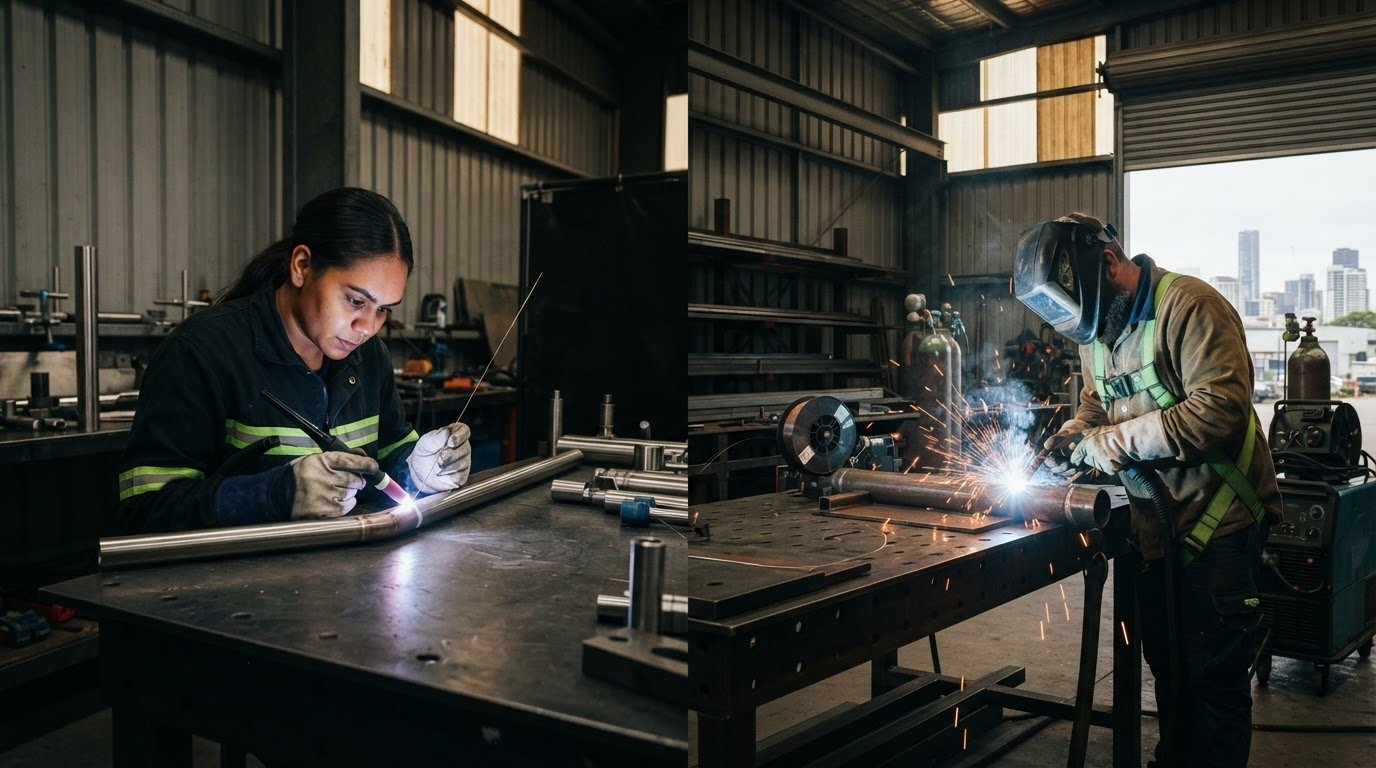
The faster process is not always the better fit. If you’re asking what TIG vs MIG welding means for your project, TIG generally suits thin materials and visible welds where precision and finish matter, while MIG is typically quicker to learn and better suited to thicker material and higher-volume work. Start by matching the process to the material and the result you need.
Both processes use shielding gas, so standard MIG and TIG are best suited to sheltered conditions with little wind. TIG gives the welder close control over the weld pool, while MIG feeds wire continuously, making it a more straightforward option for many jobs. This guide compares materials, ease of use, speed, outdoor limitations, shielding gas and weld appearance, then explains how to choose a process for your application.
Key Takeaways
- Match the process to your material and required finish: TIG favours precise work on thinner metals, while MIG is often suited to thicker sections.
- For faster, more straightforward welding, consider MIG; TIG demands more coordinated control and practice.
- Factor in the work environment: standard MIG and TIG both rely on shielding gas, which can be disrupted by wind.
- Choose shielding gas to suit the process and metal, as the right setup helps protect the weld pool.
- Before deciding, weigh material thickness, weld visibility, production pace and working conditions together.
Is TIG welding harder than MIG?
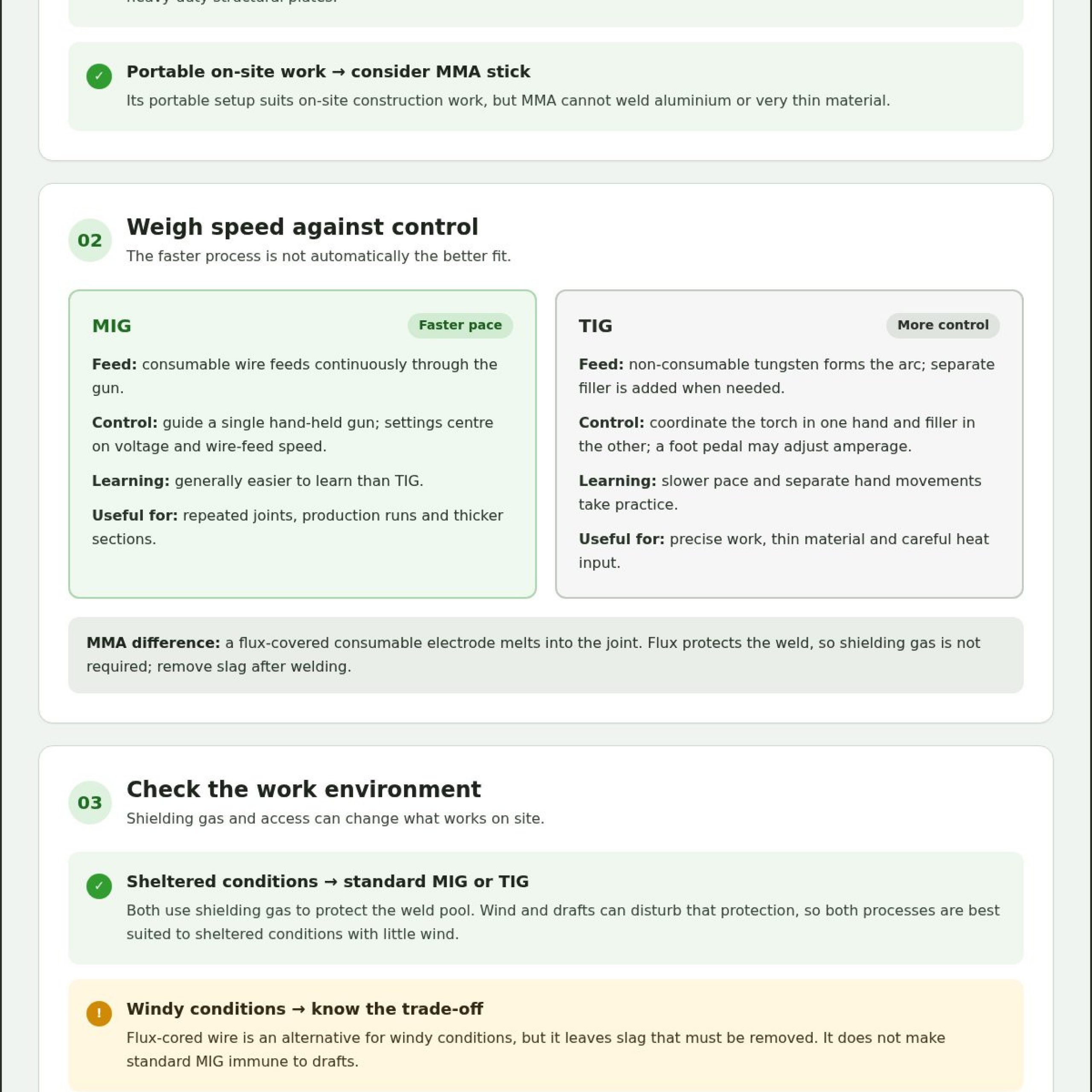
For most beginners, MIG is easier to learn because the machine feeds wire continuously and the operator guides a single hand-held gun. TIG requires more coordination: the welder controls the torch with one hand, adds separate filler with the other and may use a foot pedal to adjust amperage.
MIG means metal inert gas, while TIG means tungsten inert gas, according to the Australian Competition and Consumer Commission. In MIG welding, a consumable wire electrode feeds through the gun and melts into the joint. The machine uses voltage and wire-feed-speed settings, and shielding gas protects the weld pool. MIG suits a broad range of work, from 26-gauge sheet metal to heavy-duty structural plates, including automotive, construction and manufacturing applications.
TIG creates an arc between a non-consumable tungsten electrode and the workpiece. The welder adds separate filler metal when the joint needs it, while shielding gas protects the weld from atmospheric contaminants. TIG equipment includes a power source, torch, tungsten electrode, gas supply and, when used, a foot pedal. Its slower pace and separate hand movements take practice, but the process offers precise control. Clean metal surfaces matter before welding, and aluminium TIG work can use AC to help clean surface oxide.
MMA, or stick welding, works differently. An arc forms between the workpiece and a flux-covered electrode, which melts into the joint. The flux protects the weld, so MMA does not require shielding gas; the welder removes slag afterwards to expose the finished weld. Its portable setup suits on-site construction work, but MMA cannot weld aluminium or very thin material.
| Process | Electrode and filler | Typical strengths | Learning demands |
|---|---|---|---|
| MIG | Continuously fed consumable wire | Faster work; thicker metals | Generally easier to learn |
| TIG | Non-consumable tungsten; separate filler | Precise control; thin material | Two hands and fine coordination |
| MMA stick | Flux-covered consumable electrode | Portable on-site welding | Slag removal after welding |
In Australia, safety procedures and training should suit the welding task, equipment and workplace risk controls. Welding hazards include intense arc light, heat, fumes and electric shock. Use suitable eye and face protection, gloves, protective clothing and effective ventilation.
TIG and MIG machines and consumables vary in cost with machine capability, material, gas and wire or electrode requirements. MIG machines are typically less expensive than TIG machines; fabrication prices depend on the job and are provided after a quote request.
Choose MIG for a more straightforward process and faster work, TIG for controlled welding, or MMA for portable work suited to its material limits.
MIG welding ease of use, speed and outdoor limitations
MIG welding is generally faster than TIG because the machine feeds filler wire continuously into the joint. The welder guides the gun along the workpiece instead of pausing to add a separate filler rod. That steady feed can make MIG practical for production runs with repeated joints where speed matters.
For someone learning to weld, MIG is usually easier to pick up. Its controls centre on voltage and wire-feed speed, and the gun operates with one hand. MIG welding can be learned in a few weeks of training, although sound results still depend on choosing suitable settings and maintaining a steady travel speed. TIG calls for more coordination, with the welder controlling a torch and separate filler while managing heat. A tungsten electrode does not melt into the TIG weld, so the operator controls filler addition independently.
How fast is TIG welding compared with MIG welding? TIG is a slow welding process, while MIG’s continuous wire feed makes it faster for many joints. The actual pace also depends on access, metal thickness, joint preparation and the finish required.
That speed difference affects productivity, but it is not the only measure. MIG’s high deposition rate helps build up weld metal efficiently, making it useful for repeated joints and thicker sections. TIG’s slower pace can suit applications that need close control, such as a narrow weld on thin material. A fast weld that needs substantial correction can take longer overall than a controlled pass suited to the workpiece.
Precision also depends on the job. MIG’s continuous feed and gun make it easier to maintain a consistent bead along a long, accessible joint. TIG gives the welder finer control over heat and filler, which can matter around thin edges or visible surfaces. For example, a production bracket may favour MIG’s pace, while a thin stainless component may need TIG’s careful heat input.
Wind is a practical limit outdoors. Standard MIG uses shielding gas, and drafts can disturb its protection around the weld pool. TIG also uses shielding gas, so exposed, windy conditions can affect that process too. Flux-cored wire is an alternative for windy conditions, but it leaves slag that must be removed. It is a different wire process, not a way to make standard MIG immune to drafts.
For on-site work, assess shelter, joint access, material and finish before selecting a process. Where welding must happen at the job location, mobile welding can be a practical next step; the welding method still needs to suit the conditions and the metal.
How to choose the right process for your application?
A practical answer to “what is TIG vs MIG welding?” starts with the material, joint and finish. TIG and MIG differ in how they feed filler and control the weld, so compare those requirements before choosing a process.
MIG welding for fabrication
MIG suits fabrication where repeated joints, thicker material or steady production matter. Its continuous wire feed deposits filler efficiently, and the process is often used on mild steel and cast iron. For example, multiple similar brackets may benefit from MIG’s high deposition rate. Aluminium MIG welding can use a spool gun, while machine settings and joint access help determine the setup.
TIG welding for fabrication
TIG is an option for fabrication involving thin sheet, aluminium or visible welds. Its controlled arc and separate filler let the welder manage the weld pool closely, producing clean results without spatter on thinner aluminium. On stainless steel, TIG can form a narrow bead near critical areas. Its slower pace makes it less suited to jobs where rapid deposition is the priority.
Choosing a process by material
For stainless steel, consider TIG where a narrow, controlled bead matters. Mild steel and cast iron are often welded with MIG, which offers strong welds and high deposition rates. For thinner aluminium, TIG can produce clean welds without spatter; MIG aluminium work can use a spool gun. Material thickness and the required finish help determine which process fits.
Use this decision sequence before selecting a machine:
- Identify the metal. Distinguish stainless steel, mild steel, cast iron and aluminium, as the process choice can vary by material.
- Assess thickness. TIG can suit thin aluminium, while MIG is generally suited to thicker material.
- Define the finish. Consider TIG for a visible stainless steel weld or a narrow bead near critical areas.
- Set the production priority. Repeated mild-steel or cast-iron joints can favour MIG; delicate work can favour TIG.
Then match the process to access and the finished component’s requirements. The question “what is TIG vs MIG welding?” is best answered by considering the specific joint, rather than treating either method as a universal choice.
Shielding gas types and flow rates
Shielding gas protects the molten weld pool from atmospheric contamination during MIG and TIG welding. The gas choice depends on the process, base metal and joint conditions. A mismatch can affect arc behaviour and weld quality, so treat gas selection as part of the welding technique, not an afterthought.
TIG typically uses 100% argon, an inert gas suited to protecting the arc and weld pool. Its typical shielding-gas flow rate is 15 to 25 cubic feet per hour. Some TIG work uses argon blended with helium, hydrogen or nitrogen. The appropriate blend depends on the metal and the welding task, rather than a single setting for every job.
MIG commonly uses a shielding-gas blend, with the choice depending on the application. Typical MIG shielding-gas flow is 35 to 50 cubic feet per hour. MIG welding aluminium can use 100% pure argon, while pure CO2 can help reduce gas costs and increase weld penetration. These gases are not interchangeable without considering the metal and process.
Flow rate is the volume of gas delivered to protect the weld area. TIG’s typical range is lower than MIG’s, but the number alone does not determine protection. The torch or gun, access to the joint and surrounding drafts affect how effectively gas covers the weld pool. Wind can disturb shielding gas, which is why both processes are better suited to sheltered conditions with little air movement.
Use this sequence to narrow down a gas choice:
- Identify the process. TIG typically uses argon; MIG commonly uses an argon and CO2 blend.
- Match the gas to the metal. MIG aluminium can use pure argon, while TIG may use suitable argon blends.
- Set the process-specific flow range. Use the typical range for the process as a guide, then account for torch or gun access.
- Consider the work area. Drafts can disrupt shielding, so assess shelter before welding.
Gas also differs from consumable filler. MIG wire feeds continuously and becomes part of the weld; TIG filler is separate from its tungsten electrode. Shielding gas protects the weld area, while filler supplies metal to the joint. Keeping those roles separate helps explain why changing processes can require a different gas and consumable setup.
For example, a TIG job on aluminium starts with the metal and process, then the gas choice and flow range. A MIG job on aluminium has its own gas requirements, including pure argon. In each case, the gas, machine, consumable and technique need to work together; flow alone cannot correct a poor match.
Weld appearance and bead control
TIG and MIG leave different-looking welds because they control the arc and filler differently. TIG gives the welder close control over the weld pool and can create a neat, narrow bead. MIG feeds consumable wire continuously, supporting faster deposition but potentially leaving a more pronounced bead. Neither appearance alone proves a joint is strong.
With TIG, the welder controls the torch and adds a separate filler rod when needed. This gives precise control over heat and filler, helping produce the familiar “stacked dimes” appearance on visible welds. That finish can suit stainless steel components or artwork where the bead remains on display. TIG also suits thin materials, where careful control of the weld pool can help limit unwanted spatter.
A MIG weld forms as continuously fed wire melts into the joint. Its arc and travel speed influence bead width and penetration, while machine settings affect how the process behaves. For example, a long mild-steel joint in manufacturing may suit MIG’s steady wire feed. MIG can produce strong welds efficiently, but a fast pass does not automatically mean good fusion.
Penetration describes how deeply the weld metal fuses into the workpiece. A TIG welder can adjust torch movement and filler addition for a narrow bead, including on stainless steel near critical areas. MIG can deposit filler at a higher rate, which can suit thicker work. In either process, joint design, material preparation and settings influence the result.
Use appearance as one part of the assessment, not as a substitute for weld quality. A tidy bead may still have poor fusion, while a less decorative bead may form a sound joint. For a stainless steel join, consider whether it is visible, how much precision it needs and what the component must do. Then assess the weld against the job’s requirements.
- Visible finish: TIG can suit a stainless steel part where bead appearance matters.
- Long production joint: MIG’s continuous wire feed can help maintain pace across repeated work.
- Thin workpiece: TIG’s control over heat and filler can help manage the weld pool.
- Thicker material: MIG’s higher deposition rate can support efficient fabrication.
For both TIG and MIG, consistent travel and suitable settings help control bead shape. On a MIG joint, an uneven bead can signal changes in speed or arc control. With TIG, inconsistent filler addition can alter the bead pattern. The right process is the one suited to the material, joint and required finish, not simply the one that looks best in isolation.
If your project needs a considered finish on stainless steel, discuss stainless steel fabrication for the workpiece and application.
Donewright Stainless: Stainless steel handrails
Donewright Stainless fabricates stainless steel handrails and safety and protection systems for projects that need a durable, practical barrier. Once you have clarified your material and finish priorities, consider the finished item, its setting and how it will be used.
For a handrail project, Donewright Stainless provides stainless steel fabrication, including the design and installation of stainless steel handrails. Custom stainless benches are also available when a project calls for a fabricated component rather than a standard handrail. The right fabrication approach depends on the item’s requirements and its application.
For stainless steel handrails or related fabrication, contact Donewright Stainless to discuss your project.
Turn your material choice into a project plan
Turn your welding priorities into a clear brief. Identify the component, its working environment, the required finish and any access constraints. Those details help shape the fabrication approach and keep the finished item suited to its purpose. Knowing what TIG versus MIG welding means for your project is most valuable when it guides those decisions.
For stainless steel work, Donewright Stainless offers stainless steel fabrication, including stainless steel handrails, as well as safety handrails and protection systems. These services provide a practical path from considering materials and weld appearance to planning a finished handrail or protection system.
Share what the component needs to do and where it will be installed. Contact Donewright Stainless to discuss your stainless steel fabrication project and take the next step with a clear brief.
Frequently Asked Questions
Different materials: which method should you prefer?
Choose the process after identifying the metal, thickness and finish the component needs. For example, a repeated mild-steel fabrication job may favour MIG, while a thin aluminium part with a visible join may suit TIG. Cast iron is commonly welded using MIG. Stainless steel can be welded with either process, so the joint’s location and appearance help guide the choice.
Is MIG or TIG welding better for beginners?
MIG is generally the more approachable starting point for beginners because its wire feeds continuously and the operator guides one gun. A practical first exercise is to practise steady travel along a simple joint, then adjust the machine settings to improve the bead. TIG adds separate torch and filler control, asking beginners to coordinate more movements while managing the weld pool.
Is TIG better than MIG?
Neither process is universally better; each suits different project priorities. TIG can be a better fit for thin material, controlled heat input or a visible weld where bead appearance matters. MIG can suit thicker sections and repeated fabrication where deposition rate is important. For a component with both visible and structural joins, decide based on each joint’s demands rather than choosing one process for the whole project.
Should I learn MIG or TIG welding?
Start with MIG if your goal is learning a practical process for general fabrication or production work. Choose TIG if your intended projects involve thin metals, aluminium or precise visible joins. Consider the workpiece you want to make, too: a repeated bracket and a fine-detail stainless component call for different levels of control. Learning one process first does not prevent you from adding the other later.
Which is stronger: MIG or TIG welding?
Neither process automatically produces a stronger weld. Strength depends on whether the weld fuses properly with the base metal and suits the joint’s design and load. A correctly executed MIG weld can provide a strong joint, while TIG can also produce sound welds with controlled placement. For a real component, assess the joint requirements and the finished weld’s quality, not the process name alone.
Which welding process produces stronger or neater welds, TIG or MIG?
TIG is often chosen for a neater, more controlled bead, especially when the weld remains visible. Appearance alone does not establish strength. MIG’s continuous wire feed can produce strong welds efficiently, although its bead may look different. For example, a visible stainless panel may prioritise a refined finish, while a concealed production joint may place more emphasis on sound fusion and consistent fabrication.
What metals and material thicknesses are suitable for TIG versus MIG welding?
MIG is used across materials from 26-gauge sheet metal to heavy-duty structural plates, and commonly suits mild steel and cast iron. TIG suits thin sheet metals and aluminium, particularly where a clean weld matters. Stainless steel can suit either process depending on the joint and finish. Assess thickness alongside material: thin aluminium may favour TIG, while thicker work may favour MIG.
Which is easier to learn for beginners, TIG or MIG welding?
MIG is usually easier for beginners to learn because the machine feeds filler wire and the operator controls the gun with one hand. TIG demands coordinated torch and filler control, so beginners need to develop more simultaneous movements. If you’re deciding where to start, consider whether your first projects call for general fabrication or the fine control needed for thin, visible work.