
Pedestrian safety barriers in Ipswich for pathways and entries
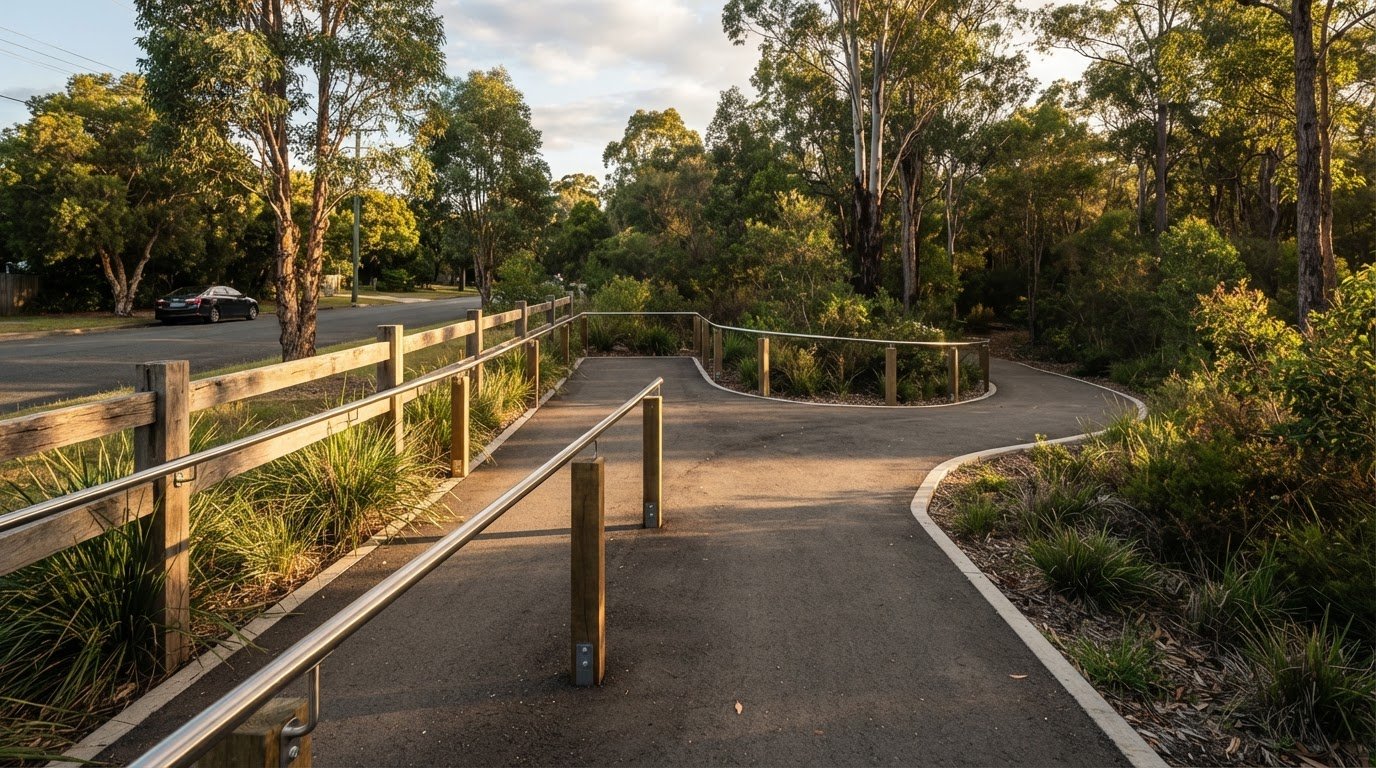
A safer pedestrian route depends on how people enter and move through it, not just on a barrier along its edge. Planning pedestrian safety barriers in Ipswich means considering pathway junctions alongside entry fencing. Ipswich’s parks standard drawing SP.83 covers pathway T-junctions, while SP.101 covers a two-rail timber pedestrian entry for natural areas or bushland; both are dated July 2013.
It’s easy to focus on the fence itself, but the layout around an entrance or junction also affects how pedestrians use the route. A barrier should suit its setting and work with the pathway, not simply mark a boundary.
This article explains how junctions and pedestrian entry fencing can support safer access, where these features may be useful, and what to consider when planning them in Ipswich. It also covers how custom-fabricated safety handrails and protection can fit a project that needs a durable, practical solution.
Key Takeaways
- Assess vehicle movements, sightlines and pedestrian routes together to identify where separation is most useful.
- Match the barrier type to its purpose: guiding pedestrians, restricting vehicle access or protecting a roadside edge are different tasks.
- Plan entries and junctions so barriers don’t obstruct clear, accessible movement along the path.
- Consider how handrails and protective metalwork can address site-specific access and safety needs.
Where are pedestrian safety barriers installed in Ipswich, and which locations are highest risk?
Pedestrian safety barriers are physical features that guide or separate people from hazards. In Ipswich, they can be considered beside busy roads, at pathway junctions, and around entrances to parks or bushland. The highest-priority locations are those where pedestrian routes meet vehicle movements, visibility is limited, or people need clear guidance.
Pine Street is a key example of a busy road corridor. An average of 16,675 vehicles use it each day. That traffic volume makes crossing points and nearby pedestrian routes important places to assess. Consider where people approach the road, whether they can see approaching traffic, and whether a barrier would guide them towards a safer crossing point.
A pathway T-junction is a place where one walking or cycling path meets another. Ipswich parks standard drawing SP.83 covers pathway T-junctions and is dated July 2013. At a junction, sightlines and movement paths matter: fencing or other barriers should guide users without obscuring the approach or creating an awkward route.
A pedestrian entry is a designated opening into a natural area or bushland. Ipswich parks standard drawing SP.101 covers a two-rail timber pedestrian entry and is dated July 2013. This type of entry can help define where people pass through, while the surrounding layout should make the intended route clear.
Roadside fencing is a physical boundary beside a road or access area. Ipswich roads standard drawing SR.33 covers tubular steel fencing, with and without chain wire, and is dated July 2020. Other options include log barrier fencing under SR.35 and locking rail fencing under SR.36, both dated July 2010. These drawings show different local fence types; the site’s purpose determines which is relevant.
For a practical site review, map the route first. Mark road crossings, junctions, entrances, driveways, and places where sightlines narrow. Identify where people and vehicles could meet, then consider whether guidance or separation would improve movement. This helps prioritise locations without treating every pathway edge as equally exposed.
What pedestrian barrier standards and Australian design rules apply in Queensland?
An Ipswich standard drawing shows a specified local infrastructure detail. Its identifier helps match a design to its intended use. These drawings cover pathways, fences, and access features, providing practical references for local projects. Their titles describe the elements shown, not one universal barrier solution. Start by identifying the site’s function, then compare the relevant drawings.
A pathway drawing depicts a pedestrian or shared path detail. Ipswich parks standard drawing SP.34 covers a concrete pedestrian and cycle pathway, dated July 2013. SP.35 covers a concrete pedestrian and cycle pathway with brick or paver banding, also dated July 2013. For road settings, SR.18 covers a standard kerb ramp, while SR.19 covers standard concrete strip pathways. Both are dated July 2013.
A fence drawing defines a particular boundary arrangement. SP.40 covers a timber fence 1800 mm high, dated July 2013. SP.42 covers a timber post-and-rail fence, also dated July 2013. Roads drawing SR.32 covers weld mesh fencing and a control fence, dated July 2010. SR.37 covers a four- and six-strand barbed wire fence, also dated July 2010. These examples serve different site functions.
A lockable rail is a barrier feature with an opening function. Ipswich parks standard drawing SP.85 covers a metal lockable slide rail option for parks and reserves, dated July 2013. This detail may be relevant where access needs to remain controlled. Its setting and purpose should guide its selection, rather than appearance alone.
Australian design rules apply to particular projects or assets. The listed Ipswich drawings provide local design details, but their titles alone do not establish every project requirement. Identify whether the site is a road, park, reserve, or pathway. Then match its use, access needs, and boundary purpose to the appropriate drawing. For example, a pathway detail and a fence detail address different elements, even when they meet at one location.
How do pedestrian barriers compare with guardrails, fencing, bollards and traffic calming?
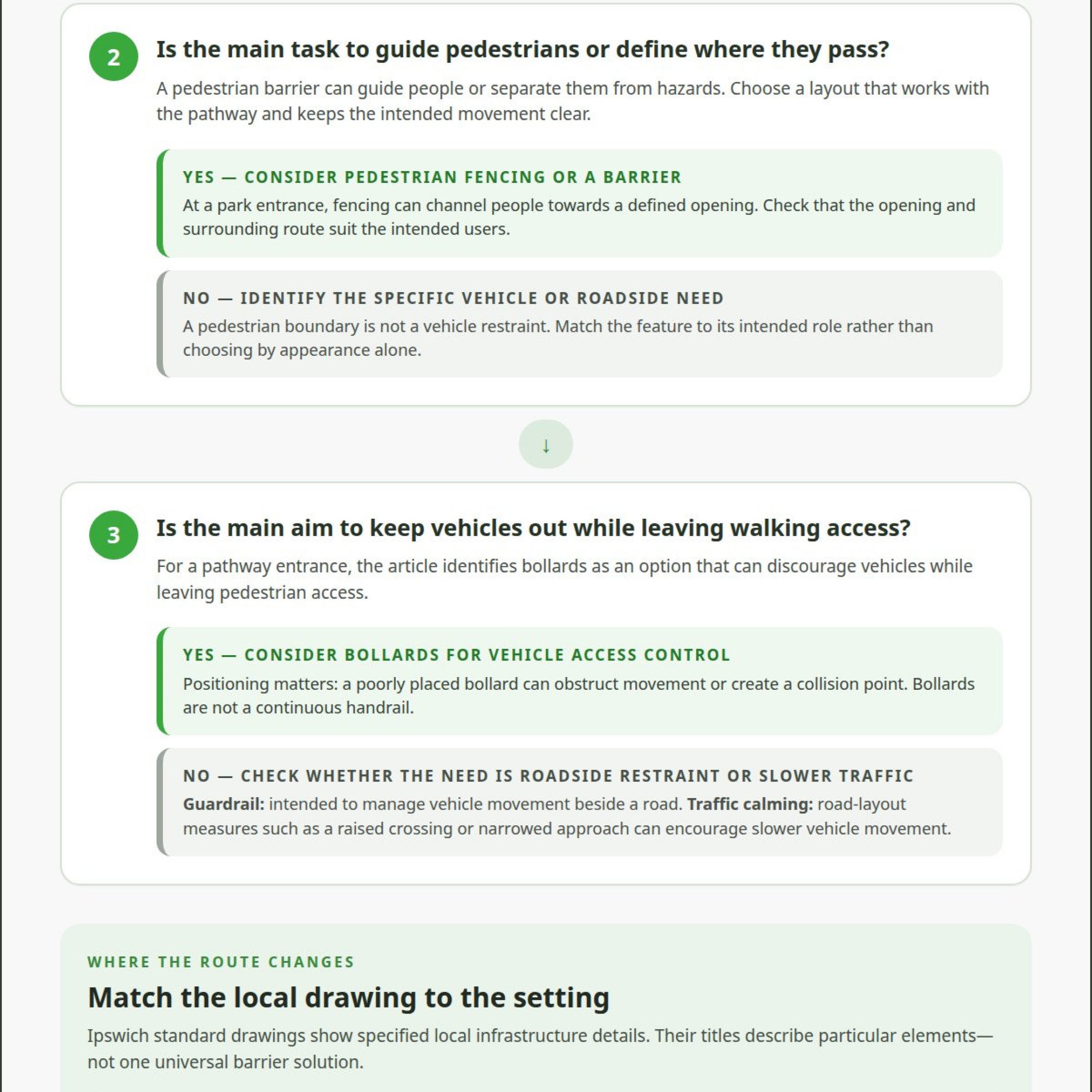
A pedestrian barrier guides people or separates them from hazards. The right pedestrian safety barriers in Ipswich depend on the route and its risks. Beside a driveway, a barrier can define a walking line. Its purpose is to guide pedestrian movement, not simply mark a property boundary. Consider the approach, crossing point, and exit together. Each should connect clearly without directing pedestrians into vehicle paths.
A guardrail is a roadside restraint intended to manage vehicle movement. Pedestrian fencing creates a boundary, not a vehicle restraint. Beside a road, identify the hazard first, then choose a system suited to that specific role. Do not treat a pedestrian boundary as a substitute for roadside protection.
Fencing creates a continuous or segmented boundary that guides access. At a park entrance, it can channel people towards a defined opening. Unlike bollards, fencing can create a longer separation line and discourage informal shortcuts. Check that the opening suits the intended users and route. For pedestrian safety barrier projects in Ipswich, choosing by function helps avoid unsuitable layouts.
A bollard is a short, fixed post used to control vehicle access. Near a pathway entrance, bollards can discourage vehicles while leaving walking access. Position them carefully: a poorly placed post can obstruct movement or create a collision point. Use bollards when vehicle exclusion is the main aim, not as a continuous handrail.
Traffic calming is a road-layout measure that encourages slower vehicle movement. A raised crossing or narrowed approach changes how drivers travel through a location. Unlike a barrier, it addresses vehicle behaviour through the road environment. At a crossing, traffic calming and pedestrian separation may complement each other, but they serve distinct purposes.
Choose by function, not appearance. First, decide whether the main task is guiding pedestrians, restricting vehicles, or addressing roadside exposure. Next, map openings and sightlines. Finally, check how the feature connects with the pathway and road layout. This comparison helps identify a suitable solution for each site.
That figure provides a project-specific cost reference, not a general price for pedestrian barriers or other street treatments.
What are the safety risks or accessibility issues associated with pedestrian barriers
A trip hazard is an obstacle that can catch someone’s foot or mobility aid. At a pathway entrance, projecting feet, uneven ground or loose fixings can create hazards. Inspect the full barrier line, including its base and connection points. Check again where paving changes, such as between concrete and grass.
A blocked route is a path narrowed or interrupted by an obstruction. At an Ipswich park entrance, a barrier should leave a clear, continuous route for people walking, using wheelchairs, or pushing prams. Check the approach, opening, and exit as one movement. A narrow opening or awkward turn can make access difficult, even if the path beyond is unobstructed.
A sightline is the area people can see along or across a route. At a T-junction, a fence panel or solid barrier near the corner can screen approaching path users. Review the view from each direction before positioning the barrier. Avoid creating a hidden approach, particularly where pedestrians and cyclists meet.
A pinch point is a short section where movement space becomes restricted. Bollards, gate posts, and fence returns can create one near a driveway or crossing. Walk the route from both directions and consider how people pass one another. Keep openings aligned with the natural path, rather than forcing users towards traffic or uneven ground.
A maintenance defect is damage or wear that affects how a barrier works. On a timber entrance, check for loose rails, splinters, and unstable posts. On a metal fence, inspect joints, sharp edges, and corrosion. Clear vegetation that blocks visibility or encroaches on the route. Record defects and arrange repairs before they worsen.
Accessible barrier design balances guidance with uninterrupted movement. A practical site review should test approach visibility, opening access, surface transitions and the condition of fixings. For a project requiring tailored pedestrian protection, discuss accessible barrier design as part of the site layout.
Donewright Stainless: Stainless steel handrails
Donewright Stainless fabricates stainless steel handrails and safety handrails and protection for pedestrian access projects. These options suit pathways or entrances that need a handhold or clear physical guidance. Custom stainless steel fabrication can create components tailored to the site layout, including its route, access points, and junctions.
Consider this work when pedestrian movement needs more than a boundary fence, or when existing metalwork needs attention as part of a wider project. A clear outline of the route and its intended use helps shape a practical approach to the handrail or protective feature.
For pedestrian access requirements, contact Donewright Stainless to discuss your project.
Make your next site review count
Before planning pedestrian safety barriers in Ipswich, turn site concerns into a clear project brief. Note where people enter, where their route changes, and what needs attention. Include photographs or a simple marked-up plan if available. This gives the project team a useful starting point for discussing the layout and intended function of each feature.
Also consider how the route may be used over time. Changes to an entrance, adjoining access, or pathway surface can affect how people move through the space. Keeping these connections in view helps make the design discussion practical, rather than treating each barrier as a standalone item.
Where stainless steel handrails or custom protective metalwork could suit the project, Donewright Stainless can discuss the fabrication requirements and site needs. A conversation can help clarify the next steps for your access project. Contact Donewright Stainless to discuss your requirements and move towards a well-considered solution.
Frequently Asked Questions
What types of pedestrian safety barriers are available in Ipswich, Queensland?
Ipswich’s standard drawings show timber, tubular steel, weld mesh, log and rail fencing, and lockable slide rails for parks and reserves. These are local design examples, not a single barrier type suited to every site. For a school-side path, park entrance, or roadside edge, compare the intended access, boundary, and visibility needs before choosing a design.