
Expert On-Site Aluminium Welding Brisbane: The Industrial Guide
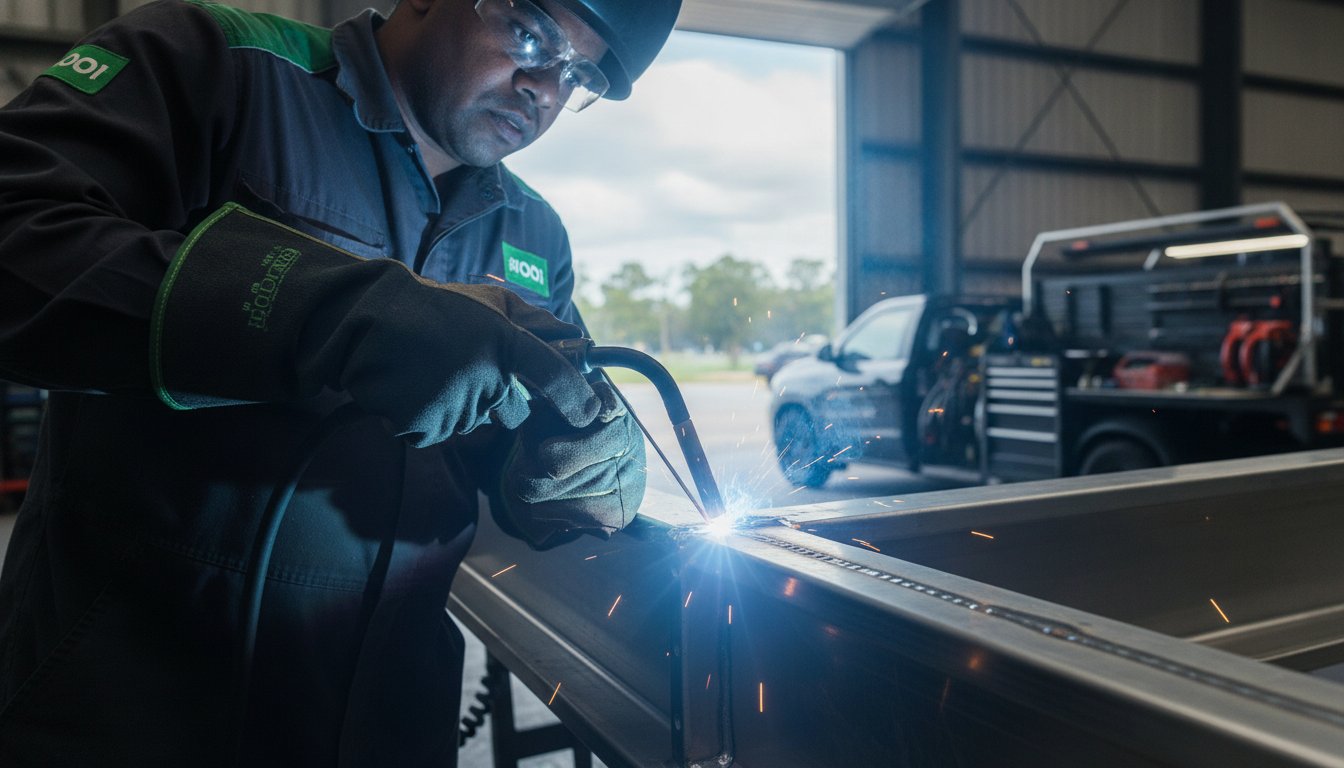
What if the very material you chose for its durability is being compromised by poor thermal management during a field repair? In the humid, salt-heavy environment of South East Queensland, aluminium is the logical choice for industrial structures, yet its sensitivity to heat makes on-site aluminium welding Brisbane a task only for those with specialised expertise. You’ve likely seen the results of inexperienced hands: warped components and weakened joints that fail to meet Australian Standards. It’s a frustrating scenario that often leads to more downtime and higher costs than the original repair was worth.
We understand that your priority is keeping operations running with as little disruption as possible. This guide will show you how to ensure your projects remain long-lasting and corrosion-resistant while meeting the strict requirements of AS/NZS 1665. We will cover the critical differences between MIG and TIG processes in a mobile setting and how a professional mobile workshop can deliver workshop-grade precision directly to your facility, saving you the logistical burden of transporting heavy equipment.
Key Takeaways
- Learn why aluminium’s natural oxide layer makes it the superior choice for resisting the high humidity and salt spray typical of South East Queensland.
- Understand the technical differences between TIG and MIG methods and why immediate cleaning of the oxide layer is critical for structural integrity.
- Discover how expert on-site aluminium welding Brisbane services eliminate the logistical burden of transporting oversized industrial components through congested city traffic.
- Gain insights into managing thermal expansion and preventing porosity to ensure your precision-engineered components meet strict Australian Standards.
- Evaluate the benefits of mobile workshop services that bring high-precision fabrication and maintenance directly to your facility.
Why Aluminium is the Material of Choice for Brisbane’s Industrial Sector
Aluminium fabrication is the specialised process of cutting, shaping, and joining specific alloys to create industrial-grade components. It isn’t a one-size-fits-all approach. Different alloys offer varied properties for specific environments, and in South East Queensland, this versatility makes it indispensable for local industry. Whether it’s for custom transport solutions or large-scale processing plants, the metal’s unique characteristics provide a level of performance that other materials struggle to match.
The “Brisbane Factor” is a primary reason for its popularity. Our local climate is notoriously harsh on industrial metals. High humidity and salt spray from Moreton Bay can accelerate corrosion in mild steel within days. Aluminium possesses a natural advantage: a thin, transparent layer of aluminium oxide that forms instantly when the metal is exposed to air. This layer acts as a protective shield. Understanding The Technical Art of Aluminium Welding is essential because disrupting this layer requires precise technique to maintain the metal’s integrity. When performing on-site aluminium welding Brisbane, technicians must manage this oxide layer carefully to prevent contamination and ensure a structural bond.
Beyond its resistance to the elements, manufacturers value the metal’s thermal and electrical conductivity. It dissipates heat quickly, which is a vital trait for processing plants operating under the intense Queensland sun. This efficiency helps maintain the longevity of components in high-stress manufacturing environments.
Corrosion Resistance in the South East Queensland Climate
When we compare aluminium to mild steel in high-moisture areas like Logan or the Gold Coast, the difference is stark. Steel often requires expensive hot-dip galvanising or constant repainting to survive the elements. Aluminium doesn’t. This inherent durability makes it the preferred choice for several key sectors:
- Water treatment facilities: Where constant moisture and chemical exposure are the norm.
- Food processing plants: Requiring strict hygiene, non-reactive surfaces, and frequent wash-downs.
- Coastal infrastructure: Exposed to salt-laden winds and varying tidal conditions.
Choosing on-site aluminium welding Brisbane ensures these structures are joined with the same level of protection as the base metal, maintaining the integrity of the entire installation without the need for secondary coatings.
Weight Advantages for Custom Industrial Components
The Technical Art of Aluminium Welding: TIG vs MIG Methods
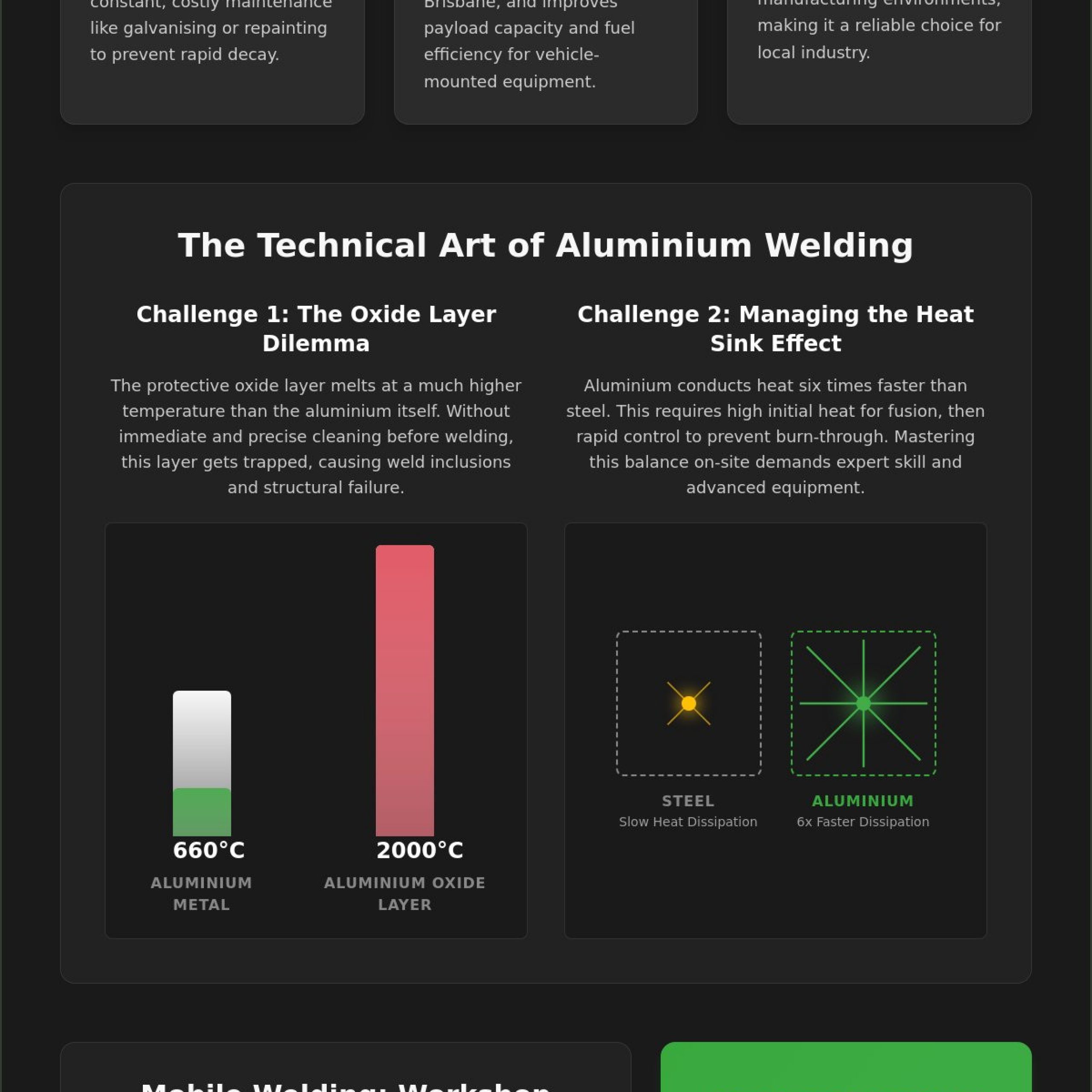
Aluminium’s physical characteristics make it a challenging material for the uninitiated. While steel is relatively forgiving, aluminium requires a deep understanding of the properties of industrial aluminium. The most significant hurdle is the oxide layer. This surface skin melts at approximately 2,000°C, while the aluminium underneath melts at only 660°C. If you don’t clean the surface immediately before striking the arc, you’ll likely trap oxides in the weld pool. This leads to inclusions and structural failure that can’t be fixed with a simple surface grind.
Then there’s the heat sink effect. Aluminium conducts heat six times faster than steel. This means the heat travels away from the weld zone rapidly, requiring a high initial heat input to ensure fusion, followed by a quick reduction in heat to avoid burn-through as the base metal saturates. Achieving this balance during on-site aluminium welding Brisbane requires a steady hand and high-end equipment capable of fine adjustments. We also carefully select filler alloys based on the application. For instance, 4043 is favoured for its silicon content to reduce cracking, while 5356 is the standard for high-strength structural joints where corrosion resistance is paramount.
TIG Welding: Precision for Detailed Fabrication
TIG (Tungsten Inert Gas) welding is the gold standard for precision. It’s the preferred method for thinner sections and projects where the finish is as important as the strength. By using an alternating current (AC), we can utilise the cleaning phase of the cycle to blast away surface oxides while the penetration phase does the joining. This makes it perfect for custom handrails, bespoke furniture, and intricate industrial pipework where a clean, stack-of-dimes aesthetic is required. Our mobile units are specifically configured for on-site aluminium welding Brisbane, ensuring workshop-quality results in the field.
MIG Welding: Efficiency for Heavy Structural Projects
For larger industrial structures, MIG (Metal Inert Gas) welding offers the necessary speed and efficiency. Modern pulse technology allows us to spray the metal into the joint without excessive heat, maintaining the temper of the alloy. Because aluminium wire is soft, we use specialised push-pull systems to prevent the wire from tangling or bird-nesting in the feeder. This level of efficiency is similar to what we provide for custom mild steel fabrication Brisbane, allowing us to complete heavy-duty structural projects on-site without unnecessary delays. If you’re unsure which method suits your specific project, the team at Donewright Stainless can provide a technical assessment of your requirements.
Navigating the Challenges of Custom Aluminium Fabrication
Aluminium’s high coefficient of thermal expansion is its most volatile trait. It expands nearly twice as much as steel when subjected to the same temperature increase. This characteristic makes on-site aluminium welding Brisbane particularly demanding. If a technician doesn’t account for this movement, the entire structure can warp or twist out of tolerance before the job is finished. Precision isn’t just about the weld bead; it’s about predicting how the metal will move as the temperature rises and falls.
Another major hurdle is porosity. Aluminium has a high solubility for hydrogen in its molten state, but very little when it solidifies. In the humid environment of South East Queensland, moisture in the air is a constant source of hydrogen. If the weld zone isn’t kept meticulously clean and dry, gas bubbles become trapped in the cooling metal. This leaves the weld porous and significantly compromises its structural capacity. Professional on-site services must use high-purity shielding gases and strict cleaning protocols to combat these local environmental factors.
Design considerations are equally vital. We must maintain specific minimum bend radii to avoid cracking in the heat-affected zone (HAZ). This area of the metal is softened by the welding heat, and aggressive bends can lead to immediate or delayed stress fractures. Once the fabrication is complete, various post-weld treatments can be applied. While aluminium is naturally corrosion-resistant, some Brisbane industrial projects require powder coating or anodising for extra durability or specific aesthetic requirements.
Preventing Distortion in Bespoke Designs
To combat warping, seasoned fabricators use specific sequences like back-stepping, where short welds are made in the opposite direction of the overall travel. We also use heat-sink blocks made of copper or brass to pull excess heat away from the HAZ. These methods are essential when allowing for shrinkage in complex projects, such as custom stainless steel benches Gold Coast and other multi-material industrial components. Precise jigging and heavy clamping aren’t just helpful; they’re mandatory to keep the metal in place as it cools.
Quality Assurance and Australian Standards
Reliability in industrial fabrication is built on adherence to AS/NZS 1665. This Australian Standard dictates the specific requirements for welding aluminium structures to ensure they can withstand their intended loads. For safety-critical items like industrial walkways, ladders, or overhead gantries, visual inspection is only the first step. Non-destructive testing (NDT), such as dye penetrant or ultrasonic testing, identifies internal flaws that aren’t visible to the naked eye. Because on-site aluminium welding Brisbane often involves structural repairs, certification is an essential assurance that your infrastructure is safe for your team and compliant with local regulations.
On-Site vs Workshop: Maximising Efficiency for Your Brisbane Project
Brisbane’s industrial landscape presents unique logistical hurdles that often dictate the fabrication method. Transporting oversized aluminium structures through the city’s congested arterial roads is more than just a nuisance; it’s a significant project cost and a risk to the material’s integrity. When a structure is several metres wide, the permits and pilot vehicles required for transport can quickly exceed the cost of the welding itself. This is why the choice between workshop and site-based work is a critical decision for any project manager.
Workshops provide a controlled environment where precision is the baseline. It’s the ideal setting for high-precision CNC machinery and complex initial fabrication where wind and humidity can be strictly managed. However, on-site aluminium welding Brisbane offers a level of flexibility that a workshop simply cannot match. It allows for real-time adjustments to suit existing site conditions, ensuring that every component fits perfectly without the need for costly “measure twice, transport twice” cycles. By eliminating transport fees, you can reallocate your budget toward higher-quality materials or more comprehensive maintenance.
A hybrid approach often yields the best results. By pre-fabricating complex components in the workshop and performing the final assembly and structural welding on-site, you get the best of both worlds: workshop precision and site-specific fitment. This methodical approach ensures that the bulk of the work is done in a controlled space while the critical final joins are tailored to the realities of your facility.
The Advantage of Mobile Welding in Brisbane
Minimising operational downtime is the primary driver for our mobile services. For industrial plants, the ability to repair aluminium pipework in situ means the difference between a minor pause and a multi-day shutdown. In high-stakes environments like the Port of Brisbane, the transport and marine sectors require immediate, reliable repairs to keep supply chains moving. Our mobile workshop units are designed to bring workshop-grade technology directly to your gate, ensuring that the weld quality on your site is identical to what we produce in our own facility.
Choosing the Right Approach for Your Timeline
If your facility is already at capacity, off-site fabrication keeps your operational area clear of trades and equipment until the final installation phase. Conversely, for maintenance shutdowns, combining new fabrication with on-site industrial pipework repair Brisbane creates a highly efficient workflow. Success depends on early planning for site access and power requirements. If you need to discuss the most efficient logistical path for your next project, contact the Donewright Stainless team to arrange a site assessment.
Precision Aluminium Solutions with Donewright Stainless
Donewright Stainless has become a trusted name within the South East Queensland industrial sector by prioritising technical precision and dependable service. Our team brings decades of hands-on experience to every job, supporting businesses across the Brisbane, Gold Coast, Logan, and Ipswich regions. We don’t simply provide a service; we offer a partnership rooted in a deep understanding of metalwork and industrial requirements. When you require on-site aluminium welding Brisbane, you’re looking for more than a technician; you’re looking for a specialist who can navigate the complexities of local climate and strict regulatory standards.
The ‘Wrighty’ difference is our commitment to combining personalised, approachable service with heavy-duty industrial capability. It’s a grounded philosophy that values long-term relationships over quick transactions. We take the time to understand your operational constraints and technical needs, ensuring our bespoke designs aren’t just theoretically sound but practically superior in a working environment. This approach allows us to transform complex technical requirements into a durable reality that stands up to the rigours of daily industrial use without the fuss often associated with large-scale projects.
Comprehensive Fabrication Capabilities
Our fabrication capabilities are as diverse as the industries we serve. We manufacture high-quality custom aluminium trolleys, specialised benches, and robust industrial safety protection systems designed for longevity. These aluminium solutions are often seamlessly integrated with our stainless steel handrails Brisbane and other safety offerings to create a cohesive, compliant site environment. While we are experts in the nuances of aluminium, our team is equally skilled in mild steel fabrication, providing the heavy-duty structural strength required for larger gantry systems or platform supports alongside our lighter aluminium components.
Partnering with Donewright for Your Next Project
Partnering with Donewright means choosing a methodical and transparent approach to project management. We believe that clear communication is the foundation of a successful build, and we keep you informed at every stage of the process. Our commitment to excellence ensures that every project meets or exceeds relevant Australian safety and fabrication standards, giving you peace of mind regarding compliance and liability. If you’re ready to improve your facility’s infrastructure, we invite you to contact us today for a technical consultation on your on-site aluminium welding Brisbane needs. Let us show you how our mobile workshop can deliver the precision your project demands directly to your door.
Securing Your Industrial Infrastructure for the Future
Choosing aluminium for South East Queensland projects provides long-term protection against harsh coastal conditions, but only when the fabrication is handled with technical precision. By opting for mobile services, you eliminate the logistical headaches of city transport while ensuring that every structural join meets rigorous Australian Standards like AS/NZS 1665. Securing reliable on-site aluminium welding Brisbane is the most effective way to maintain operational uptime without compromising on quality.
Donewright Stainless is a local Brisbane family-owned and operated business dedicated to providing workshop-grade results in the field. Our fully equipped mobile workshop is designed for high-stakes industrial projects, ensuring full compliance with AS 1657 and AS/NZS 1665 for every component we install. We take pride in our methodical approach and our ability to solve complex engineering challenges with quiet confidence. Contact the Donewright team for expert aluminium fabrication in Brisbane to discuss your specific technical requirements. We look forward to helping you build a more resilient industrial future.
Frequently Asked Questions
Is aluminium welding as strong as steel welding for industrial use?
Aluminium welds are highly reliable for industrial applications when the structure is engineered to account for the material’s properties. While aluminium has a lower tensile strength than steel, its superior strength-to-weight ratio often allows for more efficient designs. We use specific alloys and thicker sections to ensure the finished product meets the necessary load ratings and safety standards for heavy-duty use.
Can you weld aluminium to stainless steel for Brisbane industrial projects?
Direct fusion welding of these two metals isn’t possible because they have vastly different melting points and form brittle compounds when melted together. For Brisbane industrial projects, we typically join these materials using mechanical fasteners or specialised bimetallic transition inserts. These methods are essential to prevent galvanic corrosion, which is a significant risk in our humid, salt-heavy coastal environment.
What is the difference between 5000 and 6000 series aluminium for fabrication?
The 5000 series is alloyed with magnesium and offers exceptional corrosion resistance, making it the standard for marine and chemical processing environments. The 6000 series contains magnesium and silicon, which makes it heat-treatable and ideal for structural extrusions. We select the specific grade based on whether your project requires the extreme environmental durability of the 5000 range or the structural versatility of the 6000 range.
How do you prevent aluminium from warping during the on-site welding process?
We manage distortion during on-site aluminium welding Brisbane by using precise thermal control techniques. This includes the use of copper or brass heat sinks to dissipate energy and implementing back-stepping weld sequences to balance the heat input. Secure jigging and heavy clamping are also mandatory to keep the components aligned as the metal expands and contracts during the cooling phase.
Does Donewright Stainless offer mobile aluminium welding in the Gold Coast and Logan areas?
Yes, our mobile workshop services extend across the entire South East Queensland region, including the Gold Coast, Logan, and Ipswich. We bring fully equipped units directly to your facility to perform on-site aluminium welding Brisbane and surrounding areas. This mobile capability allows us to complete complex repairs and installations in situ, which significantly reduces your logistical costs and operational downtime.
How much does custom aluminium fabrication typically cost in Brisbane?
The cost of fabrication depends on several variables, including the specific alloy grade, the complexity of the bespoke design, and the total volume of materials required. Other factors include the welding method utilised and whether the project requires on-site assembly or workshop pre-fabrication. We provide technical assessments for each project to ensure our quotes accurately reflect the specific engineering and safety requirements of your facility.
What are the common signs of a poor aluminium weld to look out for during inspection?
Common defects include surface porosity, which looks like tiny pinholes, and “lack of fusion” where the weld hasn’t properly bonded with the base metal. You should also check for cracks in the weld crater or a heavily oxidised, “sooty” appearance, which suggests poor gas shielding or inadequate cleaning. A high-quality industrial weld should have a consistent, uniform ripple pattern and be completely free from undercut or excessive spatter.
Do I need to paint or powder coat aluminium after it has been fabricated?
Aluminium doesn’t require painting for protection because it naturally develops a resilient oxide layer that prevents deep corrosion. However, many industrial clients in Brisbane choose powder coating for additional chemical resistance or to match existing facility branding. If the structure is left in its raw state, it will remain structurally sound, though the surface will eventually take on a duller, matte finish as the protective layer matures.