
Stainless Steel for Sterile Environments: The Long-Term Benefits
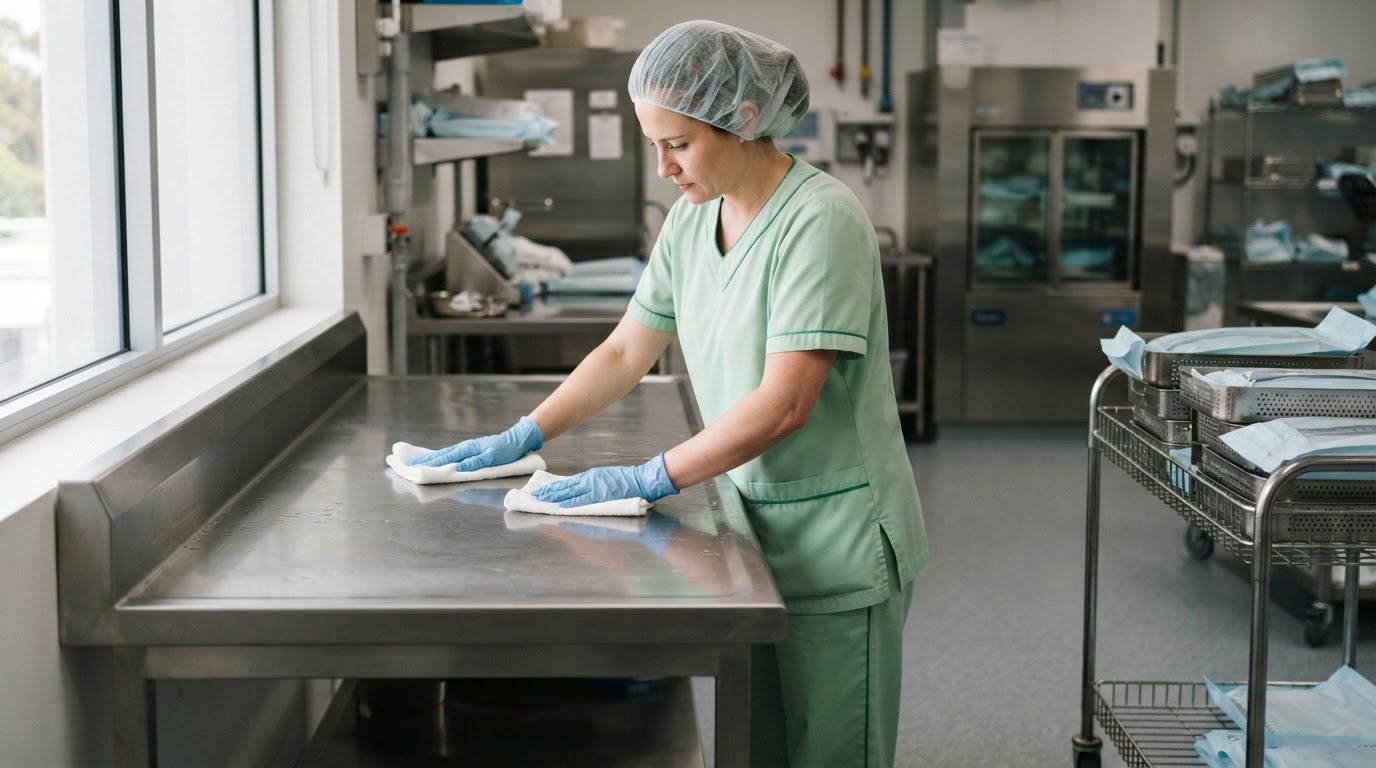
Yes, investing in higher-grade stainless steel can deliver better long-term value where equipment faces frequent cleaning, disinfectants and heat. For stainless steel in sterile environments, Type 316 is often preferred to 304 in demanding Central Sterile Services Departments because its molybdenum content improves resistance to chlorides and corrosion. That added durability may also reduce maintenance needs over time.
It’s worth weighing the initial material choice against how it will perform through repeated cleaning and sterilisation cycles. The right grade depends on exposure and the work the equipment must support, so a higher grade isn’t automatically needed for every application.
This article explains how 304 and 316 differ, why corrosion and disinfectant resistance matter, and what to consider when specifying benches and other equipment for a CSSD. You’ll also see how surface finish and routine care contribute to hygienic, long-lasting stainless steel.
Key Takeaways
- Match grade to exposure: 304 suits general applications, while 316 offers added corrosion resistance; 430 is better suited to settings with limited harsh-chemical exposure.
- Consider how disinfectants, chlorides and repeated heat cycles affect the equipment when weighing long-term value.
- In a CSSD, select hygienic surfaces and finishes that support cleaning, and consider how moisture and corrosion can affect equipment over time.
- For stainless handrails, safety protection or custom benches, Donewright Stainless provides fabrication suited to the needs of the space.
Are there long-term benefits to investing in higher-grade stainless steel?
Higher-grade stainless steel can offer better durability where equipment faces moisture, disinfectants and repeated cleaning cycles. Selecting stainless steel for sterile environments starts with matching the grade to chemical exposure, cleaning processes, fabrication and intended use.
Comparing 304, 316 and 430 grades
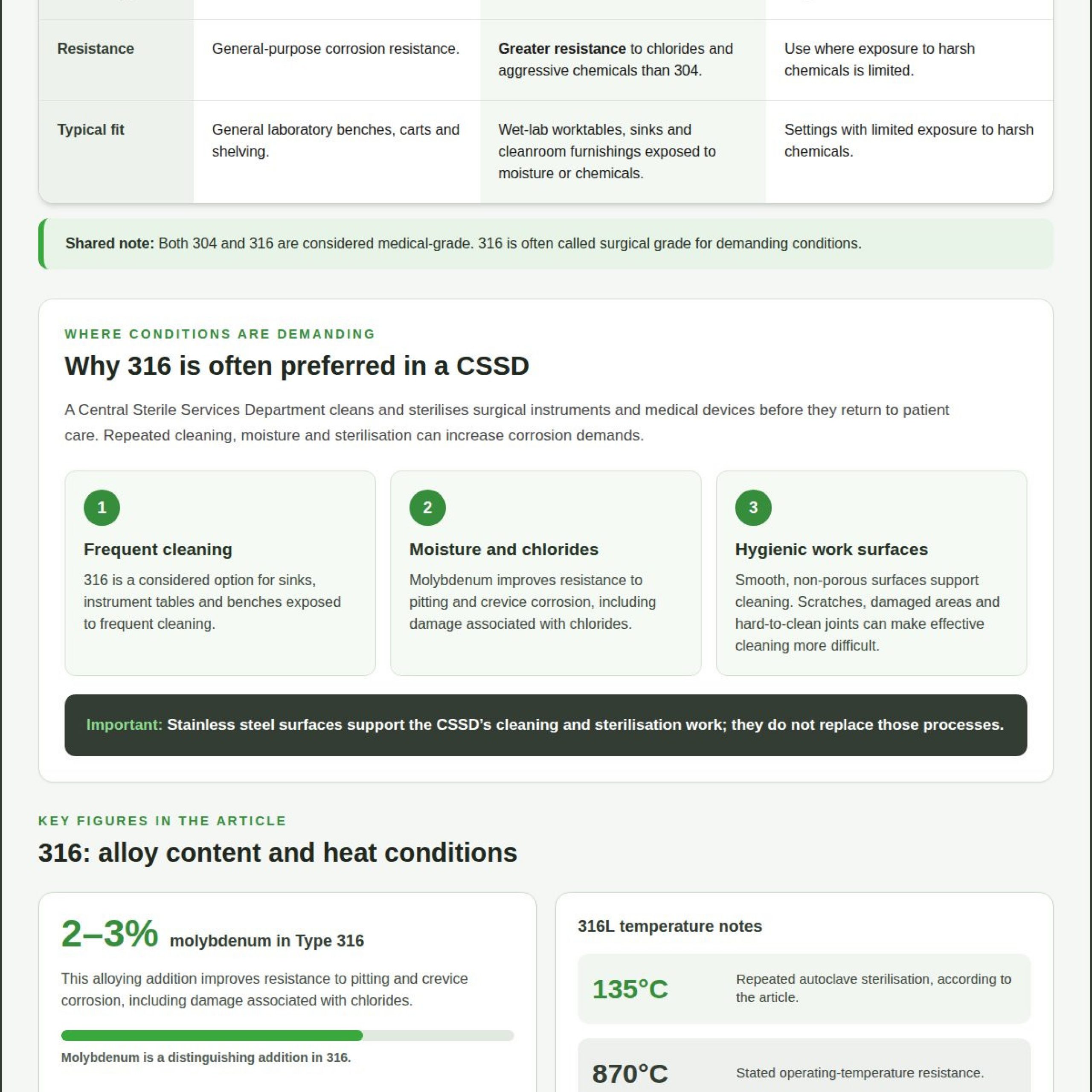
Grades 304 and 316 are austenitic stainless steels, while 430 is magnetic and has negligible nickel. Grade 304 contains 18% chromium and 8% nickel; 316 contains 16-18% chromium, 10-12% nickel and molybdenum. Grade 430 is used where exposure to harsh chemicals is limited.
Those differences affect corrosion resistance and service life. Molybdenum gives 316 greater resistance to chlorides and aggressive chemicals than 304. Both 304 and 316 are considered medical-grade; 316 is often called surgical grade for demanding conditions.
Grade choices for healthcare and laboratory settings
Grade selection for laboratory and morgue equipment depends on exposure, the work performed and budget. Grade 304 is commonly used for general laboratory benches, carts and shelving, where conditions are less demanding. Grade 316 suits laboratory sinks, wet-lab worktables and cleanroom furnishings exposed to moisture or chemicals.
Morgue tables and sinks often use grade 316 because bodily fluids create demanding exposure conditions. Healthcare scrub sinks face constant contact with water and disinfectants, making grade 430 unsuitable for this application. Matching the grade to the environment can help avoid premature equipment replacement.
Specifying and validating stainless steel
For stainless steel for sterile environments, specifications should identify the grade and intended application, rather than relying on a broad label such as medical-grade. ISO 5832-1 specifies processed stainless steels used in medical devices. It doesn’t make every stainless surface suitable for every cleanroom or manufacturing process.
Validation should account for cleaning agents, moisture, heat, fabrication and service cycles. The lower carbon content of 316L improves weldability by reducing corrosion risk at weld seams. Implant-grade 316LVM is vacuum melted to reduce impurities, but that designation relates to implant material, not general equipment. A use-specific specification supports informed purchasing and maintenance.
Resistance to disinfectants and high temperatures
Repeated cleaning exposes sterile-area equipment to chemicals, moisture and heat. Grade 316’s composition helps it resist corrosion where chloride exposure or concentrated chemicals challenge the surface.
Clean stainless steel with products suited to its grade and the facility’s disinfection process. Avoid abrasive chemicals and harsh products such as bleach, which can scratch the surface or damage its protective passive layer.
Type 316 contains 2-3% molybdenum. This alloying addition improves resistance to pitting and crevice corrosion, including damage associated with chlorides. In a laboratory or processing area, that ability matters where disinfectant residues or moisture can remain around joints and fittings. Compared with 304, 316 offers greater corrosion resistance in chloride-rich or chemically aggressive conditions.
Disinfectant compatibility depends on the chemical and how it is used. Concentration, contact time, rinsing and drying all affect the equipment’s exposure. A validated cleaning procedure should remove residues without abrading the steel or leaving moisture trapped in seams. Inspect joints and surfaces to catch staining before corrosion progresses.
Heat resistance also matters across repeated sterilisation cycles. Grade 316L withstands repeated autoclave sterilisation at temperatures up to 135°C, while its stated operating-temperature resistance reaches 870°C. These figures describe different conditions: the first concerns repeated autoclaving, and the second concerns operating temperature. They don’t mean every component or finish suits every process.
Steam autoclaving, ethylene oxide sterilisation, hydrogen peroxide plasma and dry heat are processes used with stainless steel containers. Choose equipment for its intended process, and preserve its surface with compatible cleaning. If corrosion in a steam steriliser goes unaddressed, it can contaminate equipment, contribute to failed loads and increase downtime.
For equipment that needs to suit a particular workspace, custom stainless benches can be fabricated around the practical requirements of the setting.
316 Stainless steel in Central Sterile Services Departments
A Central Sterile Services Department (CSSD) cleans and sterilises surgical instruments and medical devices before they return to patient care. Equipment in this workflow undergoes repeated cleaning, moisture exposure and sterilisation. Stainless steel for sterile environments is especially relevant when these conditions increase corrosion demands.
Type 316 is preferred over 304 for demanding CSSD equipment because it offers improved corrosion resistance. That makes it a considered option for sinks, instrument tables and benches exposed to frequent cleaning. Stainless steel surfaces also provide stable work areas for instruments and procedures, supporting the practical layout of the department.
A smooth, non-porous stainless steel surface helps prevent microbes and contaminants from penetrating the material and forming biofilms. It supports cleaning, but does not replace the CSSD’s cleaning and sterilisation processes. Surface condition matters too: scratches, damaged areas and hard-to-clean joints can make equipment more difficult to clean effectively.
Moisture can cause corrosion, commonly called rouge. It may form when water or moisture accumulates, including tap water, pure water, ultra-pure water or steam. In a CSSD, inspect joints and areas around sinks where moisture can remain. Unaddressed corrosion can affect equipment condition and structural integrity.
Grade 316 is relevant when equipment faces demanding cleaning and sterilisation conditions, particularly exposure to chlorides or aggressive chemicals. However, grade alone doesn’t determine performance. Fabrication, surface condition, moisture exposure and maintenance all influence how equipment holds up through operational cycles.
Specify stainless steel for sterile environments by recording the equipment’s task, exposure and cleaning conditions. This gives the material choice a practical basis: use 316 where corrosion demands justify it, and design accessible surfaces that support the CSSD workflow. Keeping moisture from accumulating and promptly addressing rouge can help preserve equipment condition and useful life.
What surface finish and roughness (Ra) are required for hygienic stainless steel equipment?
Hygienic stainless steel needs a cleanable surface, with a finish matched to the equipment’s use and cleaning process. Ra describes average surface roughness, but one Ra target cannot suit every application. Set an acceptance value in the equipment specification, alongside the required finish and intended cleaning conditions.
Surface texture matters because small flaws, cracks and burrs can harbour bacteria or contaminants. Electropolishing smooths stainless steel and removes small surface imperfections. It may be considered for pharmaceutical cleanrooms and high-risk surgical areas where a microscopically smooth finish is useful.
Ra alone does not describe every feature that affects cleaning. A surface may meet its specified roughness and still have a defect, damaged edge or hard-to-clean junction. Assess the whole surface, including welds, corners and transitions, where residue or moisture can collect.
Specify the finish according to the equipment’s location and function. For example, a cleanroom work surface may need different finishing considerations from a general-purpose bench. Record the grade, finish, Ra acceptance criteria and fabrication details together so inspection can compare the finished item with its intended application.
During validation, assess whether the surface can be cleaned using the facility’s established process. Examine visible defects and check the specified Ra with an appropriate measurement method. Keep records of inspection results and repairs, since reworking can alter the surface finish and measured roughness.
Electropolishing is an option, not a substitute for sound fabrication, suitable material selection or routine care. Abrasive chemicals can scratch stainless steel, while harsh products such as bleach can damage its protective passive layer. Cleaning methods should preserve the finish while removing contamination.
For equipment where finish and fabrication need to work together, discuss a stainless steel fabrication project tailored to the workspace.
Donewright Stainless: Stainless steel handrails
Donewright Stainless fabricates stainless steel handrails and safety protection for facilities that need durable, practical access solutions. For projects requiring purpose-made stainless components, the company also fabricates custom benches designed around the workspace and its use.
For healthcare and sterile-area projects, consider how each item fits the layout, cleaning routine and surrounding equipment. Handrails should support safe movement without obstructing access, while bench design should suit the tasks performed and allow practical cleaning. Match the material grade and finish to the exposure, as outlined above.
Choose Donewright Stainless for fabricated handrails, safety protection or a custom bench for your facility. Contact the team to discuss your project.
Make your next specification work for the space
Turn your material decision into a clear project brief. Record the equipment’s purpose, cleaning routine, chemical exposure and finish requirements, then use those details to guide design and fabrication. This connects stainless steel for sterile environments to how the room operates, rather than treating grade as an isolated choice.
Donewright Stainless supports practical facility projects with stainless steel fabrication, handrails and safety protection. These services address different needs, from access and safety features to fabricated components designed to fit a specific workspace. A defined scope gives the project a useful starting point.
For a considered next step, contact Donewright Stainless to discuss your project requirements. A well-planned specification can help your team make informed decisions and build equipment around the demands of the space.
Frequently Asked Questions
How does stainless steel contribute to infection control in medical and laboratory settings?
Stainless steel supports infection-control routines with surfaces that are straightforward to clean and resist contamination penetrating the material. In a laboratory, a smooth worktop can make spills easier to remove, while sound joints and edges reduce places where residue may collect. The material supports cleaning procedures, but does not replace them or sterilise instruments by itself.
What are the most common types of medical-grade stainless steel used in these environments?
Grades 304 and 316 are common medical-grade options, with 316L used where lower carbon content benefits welded components. Grade 304 suits general-use equipment, while 316 is selected for more demanding exposure. “Medical-grade” describes a material context, not one universal grade or a guarantee that every item suits every application. Specify the grade against the equipment’s task and environment.
Why is medical-grade stainless steel preferred in laboratories and morgues?
Its durability and cleanable surface make stainless steel useful for equipment exposed to frequent handling, moisture and cleaning. In laboratories, grade 304 is used for general benches and shelving, while 316 is used for wet-lab worktables and sinks. Morgue tables and sinks often use 316 because bodily fluids can create demanding exposure conditions.
Which stainless steel grades are suitable for sterile environments, such as 304, 316L, and 2205?
Grades 304 and 316L can suit different equipment needs, depending on chemical exposure, moisture and fabrication. Grade 304 is used for general applications; 316L’s lower carbon content helps reduce corrosion risk at weld seams. Grade 2205 is another grade to assess against the application, but the grade name alone doesn’t establish suitability. Consider the full operating and cleaning conditions.
How do 304 and 316L stainless steel compare for cleanrooms, pharmaceutical facilities, and hospitals?
Grade 304 suits general equipment where exposure is less aggressive, while 316L is useful when corrosion resistance at welded areas matters. For example, a cleanroom bench and a frequently washed sink may face different conditions, even within one facility. Compare the cleaning chemicals, moisture and fabrication details, then specify the grade and finish for each component’s actual use.
How resistant are stainless steel grades to bleach, chlorides, acids, and common sterilants?
Resistance varies by grade, chemical, concentration, exposure time and surface condition. Chlorides can promote pitting, while harsh bleach products can damage stainless steel’s protective surface layer. Stainless steel containers are used with steam, ethylene oxide, hydrogen peroxide plasma and dry heat. Don’t assume every grade tolerates every acid or disinfectant; align chemical use with the equipment’s cleaning procedure.