
Industrial Stainless Steel Fabrication: The Essential Guide for Australian Industry
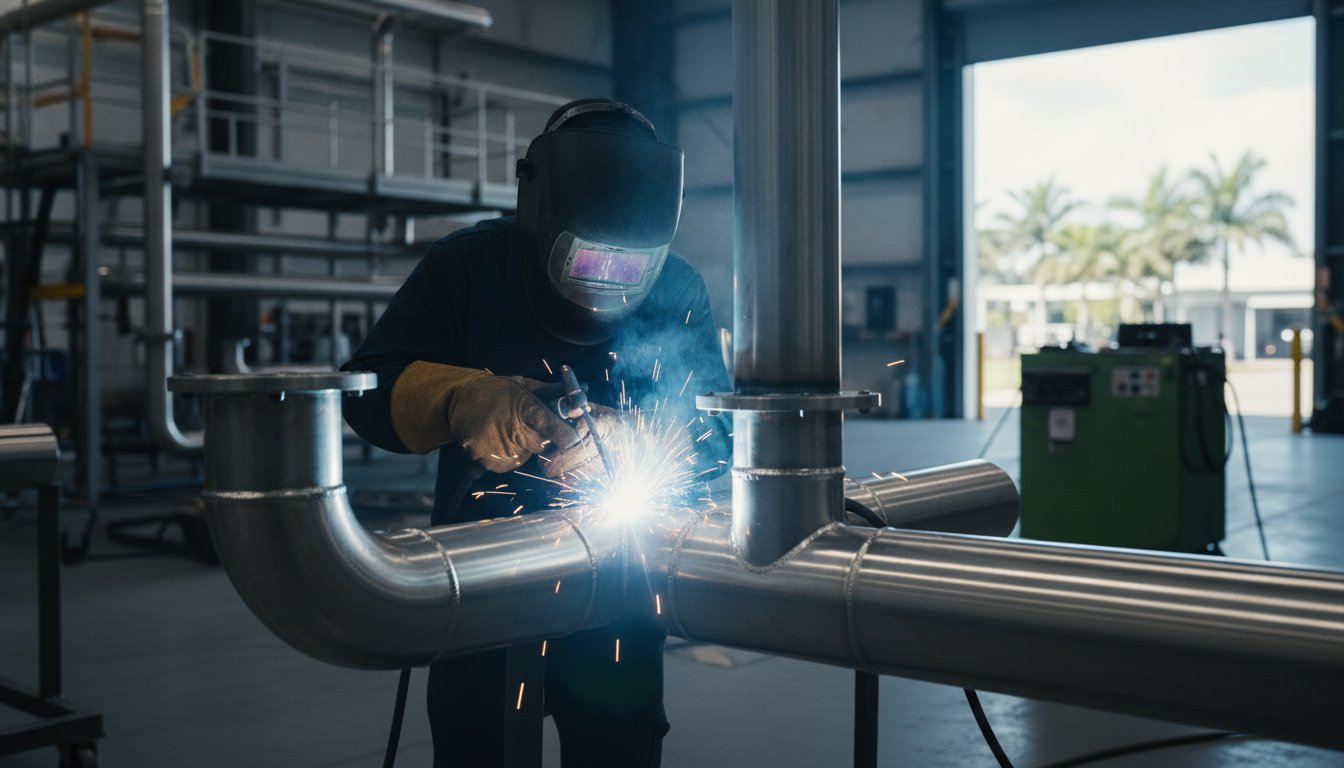
A single point of corrosion in a high-pressure pipework system isn’t just a maintenance headache; it’s a calculated risk to your facility’s safety and operational budget. When you’re managing a plant where downtime is measured in thousands of dollars per hour, you know that the integrity of your infrastructure depends entirely on the quality of your industrial stainless steel fabrication. It’s a common frustration for site managers who deal with the high costs of equipment failure and the strict compliance demands of the food and safety sectors.
We’ve designed this guide to help you master the technical requirements and material standards necessary to ensure your next project is built for longevity. You’ll learn how to identify the correct grade of steel for your specific environment, whether you’re dealing with coastal salt air or harsh chemical cleaning agents. We’ll also break down the fabrication process so you can vet contractors with confidence and ensure your assets remain 100% compliant with Australian safety regulations, including the critical AS/NZS 1554.6 standards for welding. By understanding these technical essentials, you can protect your investment and maintain a seamless, safe operation.
Key Takeaways
- Distinguish between general metalwork and specialised industrial stainless steel fabrication to ensure your equipment can withstand heavy-duty operational demands.
- Identify the specific chemical differences between 304 and 316 grades to select the right material for the corrosive environments found across the Gold Coast and Brisbane.
- Navigate the complexities of Australian Standards like AS 1657 to guarantee your platforms and walkways are fully compliant and safe for your workforce.
- Explore how on-site mobile welding and maintenance strategies can significantly reduce operational downtime while maintaining factory-quality precision.
- Learn the essential questions to ask when vetting a local fabricator to ensure they value precision and long-term asset integrity over quick, temporary fixes.
What is Industrial Stainless Steel Fabrication?
Industrial stainless steel fabrication is a specialised engineering discipline that transforms raw alloys into high-performance assets designed for the most demanding environments. Unlike light-duty sheet metal work, industrial-grade fabrication focuses on structural integrity, chemical resistance, and heavy-duty durability. This process is vital for maintaining hygiene in food production and preventing catastrophic failure in mining or chemical processing plants. To understand the foundation of these projects, it’s helpful to ask What is stainless steel? and how its specific properties, such as high chromium content, provide the necessary barrier against structural corrosion.
Standard solutions often fall short because they aren’t built for the specific stressors of a heavy-duty facility. In an industrial context, “good enough” is rarely sufficient. Whether it’s complex industrial pipework, custom safety handrails, or bespoke machinery components, every weld and joint must be executed with absolute precision. Without bespoke engineering tailored to a unique site layout, equipment often faces premature wear, leading to the high cost of corrosion-related equipment failure. Choosing industrial stainless steel fabrication means investing in a solution that accounts for the specific chemical, thermal, and mechanical loads of your operation.
The Role of Fabrication in Modern Industry
Industrial fabrication serves as the backbone for Australia’s primary sectors, including water treatment, food processing, and mining. The journey begins with detailed design blueprints, but the real value is added during the methodical transition to physical on-site installation. When a fabricator maintains high precision in the workshop, it translates directly to faster commissioning on-site. This disciplined approach ensures that new installations integrate seamlessly with existing infrastructure, reducing the risk of mid-project delays and operational downtime.
Standard vs. Custom Fabrication
The myth of “one size fits all” is quickly debunked on the factory floor. While mass-produced components might seem cost-effective initially, they often require extensive modification to meet safety standards or fit specific footprints. For example, installing stainless steel handrails Brisbane businesses rely on requires a bespoke approach to ensure 100% compliance with AS 1657. Customisation allows for a better fit around existing machinery and ensures that safety protection is actually effective. We believe that precision isn’t just about aesthetics; it’s about building for a lifetime of service in a way that standard parts simply cannot match.
Material Science: Choosing the Right Grade for Australian Conditions
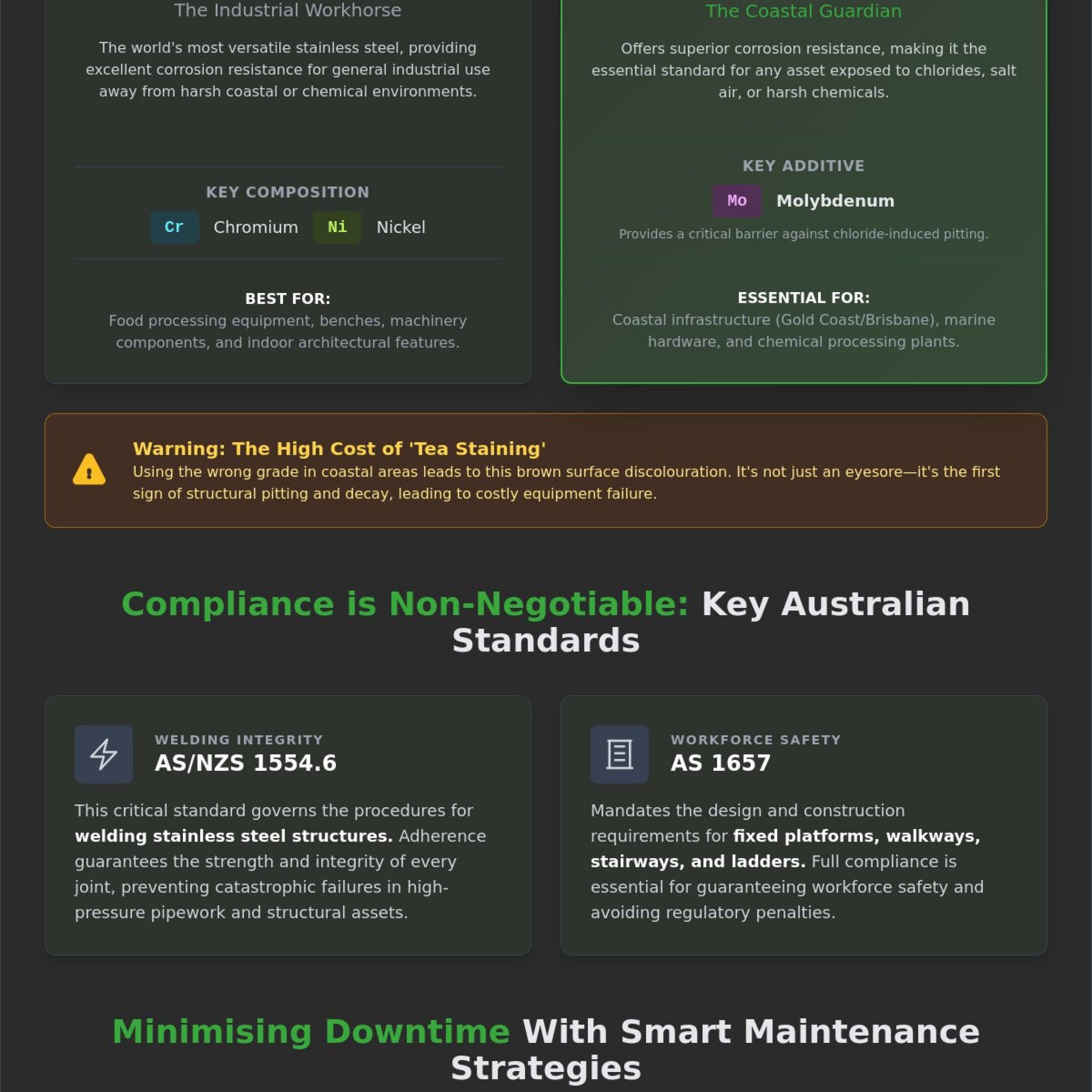
Australia’s climate is notoriously harsh on industrial infrastructure. In South East Queensland, the combination of high humidity and salt-laden air from the Pacific Ocean creates a highly corrosive environment that can degrade metal in months rather than years. Selecting the wrong material for industrial stainless steel fabrication often leads to “tea staining.” This brown surface discolouration is more than just an eyesore; it’s often the precursor to structural pitting and decay. The primary difference between common grades lies in their chemical makeup, specifically the presence of molybdenum in Grade 316. This element provides a critical barrier against chloride-induced pitting, making it the essential standard for any asset located near Brisbane ports or along the Gold Coast.
Proper finishing is just as important as the alloy itself. A smooth, polished surface reduces the areas where salt and contaminants can settle, further protecting the metal from the elements. While the science of alloys can be complex, the choice usually comes down to the specific environmental stressors your equipment will face. If you’re planning a new installation, discussing your material requirements with a specialist is the best way to ensure your investment survives the local conditions.
Grade 304: The Industrial Workhorse
Grade 304 is the most versatile and widely used stainless steel in the world. It contains high levels of chromium and nickel, which provide excellent corrosion resistance for controlled indoor environments. It’s the most cost-effective choice for internal components that aren’t exposed to salt air or aggressive washdown chemicals. For instance, custom stainless steel trolleys Brisbane facilities use for internal logistics are frequently fabricated from 304. However, it lacks the molybdenum required to survive in coastal zones. Using 304 where 316 is needed is a false economy that results in rapid aesthetic decay and eventual failure.
Grade 316: Maximum Corrosion Resistance
Grade 316 is the non-negotiable choice for chemical plants, water treatment facilities, and coastal infrastructure. The addition of 2% to 3% molybdenum significantly enhances its durability against chemical attack and salt spray. The long-term ROI of 316 is found in its longevity. In SEQ industrial zones, we’ve seen 316 assets outlast 304 counterparts by decades in identical conditions. Investing in the higher grade at the start of a project eliminates the need for premature replacements and reduces the frequency of maintenance cycles, keeping your plant operational for longer.
Compliance and Australian Standards in Fabrication
Adhering to Australian Standards is a non-negotiable requirement for any industrial facility. These regulations protect personnel and ensure that infrastructure can withstand the rigours of daily operations without failing. In the field of industrial stainless steel fabrication, compliance isn’t just about ticking a box; it’s about legal liability and operational safety. Relying on non-compliant imports often leads to costly rework when materials fail to meet local safety benchmarks. Using a local partner who understands the nuances of Australian law ensures that your assets are built to last and are fully insurable.
Structural integrity depends on the competency of the person behind the torch. For industrial pipework or structural supports, certified welders are essential to meet the quality requirements of AS/NZS 1554.6. They operate under strict guidelines to ensure every joint is penetration-perfect and free from defects that could lead to leaks or collapses. This level of oversight separates professional engineering from basic metalwork and provides a documented trail of quality assurance for your site records. It’s a disciplined approach that ensures the safety of your workforce and the longevity of your equipment.
AS 1657: Safety Rails and Walkways
AS 1657 is the primary standard governing the design and installation of fixed platforms, walkways, and ladders. It specifies exact requirements for handrail heights and the inclusion of kickplates to prevent objects from falling. When commissioning custom stainless steel fabrication Brisbane projects, your fabricator must account for specific site gradients and floor types. Failing a safety audit due to non-compliant railings can lead to immediate site closures and significant fines.
Food Grade Standards and Hygiene
In the food and beverage sector, AS 4674 sets the benchmark for hygienic design. A critical aspect of food grade stainless steel fabrication is the “crevice-free” weld. Bacteria thrive in microscopic gaps, so joints must be ground smooth and polished to specific Ra (surface roughness) values. Radius-edged benches and custom trolleys are mandatory because they eliminate sharp corners where organic matter could accumulate, ensuring your facility remains sanitary and compliant.
Mobile Welding and On-Site Maintenance Strategies
A fully equipped mobile workshop is much more than just a welder in the back of a ute. It’s a mobile engineering hub capable of performing TIG and MIG welding to the same rigorous standards as a stationary facility. This ensures that on-site modifications or repairs don’t compromise the structural integrity or hygienic properties of your assets. If your facility requires immediate support to keep operations running, you can book our mobile workshop services to ensure your repairs are handled by experienced professionals who understand site-specific safety protocols.
Minimising Downtime with Mobile Engineering
The primary benefit of mobile engineering is the drastic reduction in operational downtime. When dealing with industrial pipework Brisbane technicians can often perform repairs in situ, keeping the rest of the system online where possible. This approach bypasses the need for equipment re-labelling and lengthy reassembly phases. However, safety remains the priority. Mobile teams must strictly adhere to “hot work” permit requirements, ensuring that all sparks and heat are contained and that the environment is cleared of combustible materials before work begins.
Preventative Maintenance for Stainless Assets
Waiting for a component to fail is a costly strategy. Professional maintenance services focus on identifying early warning signs, such as stress corrosion cracking or weld decay, before they lead to a system-wide failure. Regular inspections are particularly vital for high-traffic safety protection systems and handrails that endure constant mechanical stress. This proactive approach isn’t limited to stainless steel; it also helps in extending the lifespan of mild steel fabrication Logan businesses use for structural supports and heavy-duty racking. By catching small issues early, you protect your long-term ROI and maintain a safer workplace for your team.
Selecting an Industrial Fabrication Partner in SEQ
The most effective partnerships are built on end-to-end service. This begins with a thorough understanding of your site layout, often utilising 3D scanning to ensure that new components fit perfectly within existing infrastructure. When one team manages the process from the initial design through to the final on-site installation, you eliminate the communication gaps that often occur when multiple contractors are involved. This integrated approach ensures that the finished asset is not only compliant with Australian Standards but is also optimised for easy maintenance and long-term service.
When you request a quote, look for a detailed breakdown that accounts for material traceability and specific compliance benchmarks. A professional estimate should be transparent about why certain grades or finishes are recommended for your specific location, whether you’re operating in the humid industrial zones of Ipswich or the salt-heavy air of the Gold Coast. If a fabricator cannot explain the “why” behind their technical choices, they likely don’t have the specialized knowledge required for high-stakes industrial work.
Questions to Ask Your Fabricator
- Do you have proven experience with AS 1657 and AS 4674 compliance? Your fabricator should be able to discuss these standards in a practical, on-site context.
- Can you provide ongoing on-site mobile welding and maintenance support? A workshop that disappears after delivery isn’t a long-term partner.
- What grade of stainless do you recommend for my specific SEQ location? They should account for local environmental stressors like salt spray or chemical washdowns.
The Donewright Difference
Wrighty and the Donewright team have built a reputation on a simple principle: precision is more valuable than haste. We understand that our clients in Brisbane, the Gold Coast, Logan, and Ipswich rely on their equipment to maintain tight production schedules. This is why we focus on bespoke stainless steel fabrication that solves complex engineering problems rather than offering “off-the-shelf” compromises. Our fully equipped mobile workshop ensures your project stays on track without fuss, bringing factory-quality standards directly to your plant floor whenever you need us.
Investing in Long-Term Asset Integrity
Mastering the technical nuances of industrial stainless steel fabrication ensures your facility remains safe, sanitary, and structurally sound for decades. By selecting the correct material grade for the South East Queensland climate and insisting on strict adherence to Australian Standards like AS 1657 and AS 4674, you protect your operation from the high costs of premature failure. Precision in every weld is the difference between a system that merely functions and one that excels under the pressure of daily industrial use.
Donewright Stainless brings decades of experience in industrial pipework and maintenance to every project. We specialise in providing dependable engineering solutions that meet the highest regulatory benchmarks. With our fully equipped mobile workshop, we provide comprehensive SEQ site support, bringing factory-quality precision directly to your plant floor to keep your operations moving without fuss. It’s a methodical approach designed to give you peace of mind and long-term reliability.
If you’re ready to secure the future of your infrastructure with high-quality engineering, contact Donewright Stainless for a custom fabrication quote today. We look forward to helping you build a project that stands the test of time.
Frequently Asked Questions
What is the difference between 304 and 316 stainless steel for industrial use?
The primary difference is the addition of molybdenum in Grade 316, which provides superior resistance to chloride-induced pitting and corrosion. Grade 304 is a versatile, cost-effective choice for indoor or non-corrosive environments. However, for any application near the coast or involving harsh chemicals, Grade 316 is the industry standard to ensure long-term structural integrity and prevent tea staining.
Does my industrial handrail need to comply with AS 1657?
Yes, any handrail installed on fixed platforms, walkways, stairways, or ladders in an Australian industrial setting must strictly comply with AS 1657. This standard governs everything from the height and diameter of the rail to its load-bearing capacity and the inclusion of kickplates. Ensuring your industrial stainless steel fabrication meets these requirements is essential for worker safety and passing mandatory site audits.
How much does industrial stainless steel fabrication cost in Brisbane?
The total investment for a project depends on several technical variables, including the selected material grade, the complexity of the engineering design, and the specific site access requirements. Material costs are often influenced by global market fluctuations, while labour costs reflect the level of precision and customisation required. We focus on providing detailed quotes that account for Australian Standards and the long-term durability of the finished asset.
Can you provide mobile welding services for on-site repairs in the Gold Coast?
Yes, we operate a fully equipped mobile workshop that provides specialised mobile welding and maintenance services across the Gold Coast and the wider SEQ region. This capability allows our engineers to bring factory-quality precision directly to your job site. By performing repairs and modifications in situ, we help you minimise industrial downtime and avoid the logistical headaches of transporting heavy equipment to a workshop.
What makes stainless steel “food grade” for commercial kitchens?
Stainless steel is considered food grade when it features a specific surface roughness (Ra value) and crevice-free welds that prevent bacterial accumulation. Under AS 4674, these surfaces must be smooth, non-absorbent, and resistant to aggressive cleaning chemicals. Our fabrication process ensures that joints are ground flush and polished, creating a sanitary environment that meets the strict hygiene requirements of commercial food processing.
Why is custom fabrication better than buying pre-made industrial components?
Custom fabrication allows for a bespoke fit that accounts for your facility’s unique footprint and existing machinery. Pre-made components often require extensive on-site modification to meet safety standards or fit correctly, which can lead to structural weaknesses. A custom solution ensures 100% compliance with Australian Standards from the outset, providing better longevity and a higher return on investment than “off-the-shelf” alternatives.
How do I prevent tea staining on my outdoor stainless steel fixtures?
Preventing tea staining involves selecting Grade 316 stainless steel and ensuring it has a high-quality, smooth surface finish. Rougher finishes trap salt and contaminants, which accelerates surface discolouration. Regular maintenance, such as washing the fixtures with fresh water to remove salt deposits, is also critical for assets located in coastal areas like the Gold Coast to maintain their appearance and prevent pitting.
What industries do you typically serve in South East Queensland?
We provide specialised engineering and maintenance services to a diverse range of sectors, including food and beverage processing, water treatment, mining, and maritime industries. Our team is experienced in handling the specific demands of these high-stakes environments, from installing safety handrails and protection to complex industrial pipework. We regularly support facilities across Brisbane, Logan, Ipswich, and the Gold Coast with reliable, compliant fabrication.