
Stainless Steel Handrails Gold Coast: The Ultimate Reference for Coastal Durability
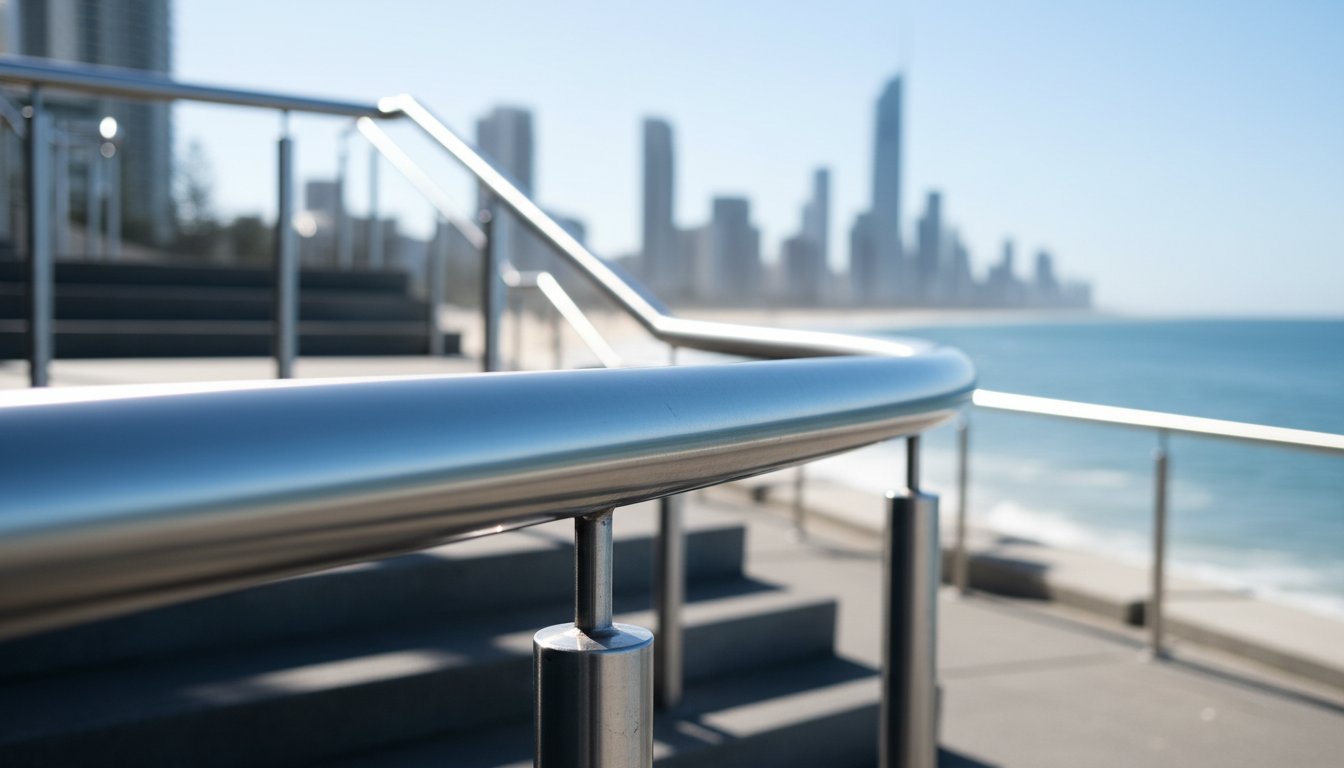
On the Gold Coast, the salt spray that defines our coastal lifestyle is a relentless force that quickly exposes the flaws in inferior metalwork. Choosing the wrong alloy doesn’t just lead to unsightly tea staining; it can compromise the structural integrity of your safety infrastructure. If you’re responsible for the installation of stainless steel handrails Gold Coast projects require for safety and durability, you already know that a railing is more than a convenience. It’s a critical asset that must withstand both the corrosive elements and rigorous daily use.
We understand the frustration of watching expensive infrastructure degrade under harsh conditions. This guide provides the technical clarity you need to specify handrails that offer genuine longevity and total regulatory compliance. You’ll learn how to navigate the specific requirements of AS 1657:2018 and the NCC 2022 Amendment 2 to ensure your site remains safe. We also examine why marine-grade 316 stainless steel is the non-negotiable standard for our region and how professional fabrication techniques can significantly reduce your long-term maintenance costs.
Key Takeaways
- Understand the critical chemical differences between Grade 316 and 304 stainless steel to prevent rapid corrosion and tea staining in coastal zones.
- Ensure your project meets current safety standards by mastering the handrail height and graspability requirements outlined in AS 1657:2018.
- Learn why custom-welded stainless steel handrails Gold Coast businesses install provide better durability than modular kits by removing crevices where salt and moisture collect.
- Identify the essential maintenance and post-fabrication treatments, such as passivation, required to maintain a pristine finish and structural integrity over time.
Why Stainless Steel is Essential for Gold Coast Environments
Stainless steel is fundamentally an iron alloy that incorporates a minimum of 10.5% chromium by mass. This specific concentration is the threshold required to create a passive layer of chromium oxide on the surface of the metal. While standard steels react with oxygen to form iron oxide, or rust, the unique stainless steel properties allow it to form a microscopically thin, non-porous film. This film effectively blocks oxygen and moisture from reaching the underlying iron. For those installing stainless steel handrails Gold Coast wide, this chemical barrier is the primary line of defence against a relentless coastal climate.
The economic argument for this material is based on lifecycle costs rather than initial outlay. Standard steel or timber often requires frequent repainting, staining, or complete replacement every few years due to rot and rust. Stainless steel represents a higher upfront investment, but it is designed to achieve a service life exceeding 25 years with zero replacement cycles. In a commercial or industrial setting, the avoidance of even one replacement cycle makes stainless steel the more financially responsible choice over the long term.
The Challenge of Coastal Corrosion
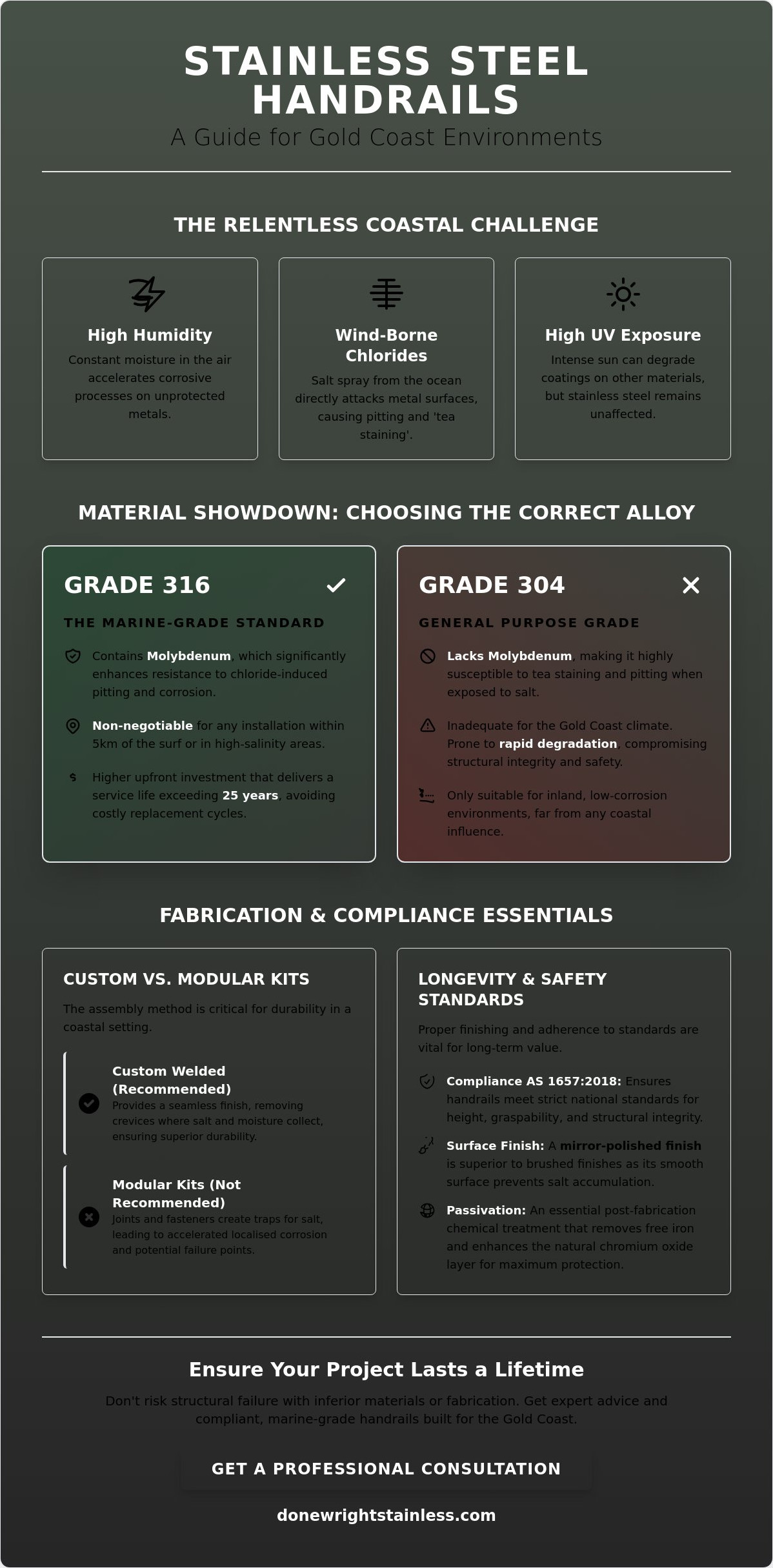
The Gold Coast’s combination of high humidity and wind-borne chlorides from the Pacific Ocean creates a highly aggressive environment. Salt-induced pitting occurs when chloride ions penetrate the passive layer, leading to localised cavities that can compromise structural integrity. In areas like Surfers Paradise, tea staining is a frequent sight. This brown surface discolouration is often mistaken for rust. It occurs when salt deposits are left to sit on the metal surface without being washed away. While initially cosmetic, persistent tea staining can lead to deeper corrosion if the material grade is not suited to the salt concentration in the air.
Aesthetic vs. Functional Longevity
Stainless steel provides a level of functional longevity that other materials cannot match. Unlike powder-coated aluminium, which can fail rapidly if the coating is chipped or scratched, stainless steel is effectively self-healing. If the surface is abraded, the chromium reacts with the atmosphere to reform the protective oxide layer almost instantly. This makes it ideal for high-traffic public areas where minor damage is inevitable. When selecting stainless steel handrails Gold Coast projects require for both safety and style, the material’s ability to maintain a sleek, professional appearance with basic cleaning is a significant advantage over high-maintenance alternatives.
Grade 316 vs. 304: Choosing the Right Material
Selecting the correct alloy is the most critical decision in the design phase. While many builders might consider Grade 304 for general use, it often proves inadequate for our local climate. Grade 304 is perfectly suitable for inland Brisbane or suburban areas far from the coast, but it lacks the chemical resilience required for the Gold Coast. The primary difference lies in the addition of molybdenum to Grade 316. This element significantly enhances the alloy’s resistance to chloride-induced pitting, which is the leading cause of tea staining and structural failure in marine environments.
Industry professionals often apply the 5km Rule when specifying materials. Any installation within five kilometres of the surf is considered a high-corrosion zone. In these areas, using anything less than marine-grade 316 is a risk that leads to rapid degradation. If you’re unsure which material suits your specific site, our team provides expert stainless steel fabrication advice to ensure your investment lasts for decades.
Grade 316: The Marine-Grade Standard
Grade 316 is the non-negotiable choice for any rail within sight of the ocean. The molybdenum content acts as a safeguard, preventing the localised pitting corrosion that salt spray triggers. This makes it the essential choice for surf clubs, beachfront walkways, and high-rise balcony balustrades. Without this chemical protection, the metal surface will eventually develop deep pits that trap moisture and accelerate decay. This eventually compromises the safety of the entire structure.
Surface Finishes and Salt Accumulation
The physical texture of the metal is just as important as the alloy itself. While a satin or brushed finish is often preferred for its modern aesthetic, the tiny grooves in the texture can trap salt and moisture. A mirror-polished finish is significantly more resistant to salt accumulation because its surface is virtually frictionless. For stainless steel handrails Gold Coast environments demand, the Roughness Average (Ra) value should ideally be less than 0.5 micrometres to ensure the surface remains easy to clean and resistant to tea staining. While a mirror finish might require more frequent wiping to remove fingerprints, it demands far less intensive maintenance to prevent permanent corrosion compared to coarser finishes.
Compliance and Safety: Meeting AS 1657 Standards
Compliance is the foundation of any professional installation. In Australia, the benchmark for safety in industrial and commercial environments is AS 1657:2018. This standard governs the design, construction, and installation of fixed platforms, walkways, stairways, and ladders. It ensures that every component, from the base plate to the top rail, functions as a cohesive safety system. When specifying stainless steel handrails Gold Coast projects require, adhering to these technical requirements is not optional; it’s a legal necessity to protect both users and asset owners.
The standard focuses heavily on the ergonomics of the rail. A compliant handrail must provide a continuous, smooth surface that allows a user’s hand to glide along the length without obstruction. This is vital during an emergency egress where a break in the rail could lead to a stumble or fall. Beyond the geometry, the structure must meet strict load-bearing specifications. The system must withstand significant lateral forces to ensure it doesn’t deflect or fail when a person leans or falls against it. Precision in stainless steel handrails Gold Coast fabrication ensures these safety margins are met every time.
Key Requirements of AS 1657
AS 1657:2018 specifies that the height of a handrail must sit between 900mm and 1100mm above the floor or the pitch line of a stairway. There’s also a critical “clearance” rule. A minimum of 50mm of clear space must exist between the rail and any adjacent wall or obstruction to allow for a firm, unobstructed grip. End-treatments are equally important. Rails must be terminated in a way that reduces the risk of injury or snagging clothing; this usually involves curving the rail back to the post or the wall.
Commercial vs. Residential Codes
Navigating the legal landscape requires an understanding of the difference between the National Construction Code (NCC) and industrial standards. While the NCC 2022 Amendment 2 covers general building requirements in Queensland, AS 1657 provides the granular detail needed for industrial sites and maintenance access. For those managing stainless steel handrails Brisbane wide, the overlap between these codes is where many non-compliant installations occur. Installing a system that fails to meet these specific standards can lead to failed inspections, increased insurance premiums, and significant liability in the event of an accident. We ensure every project we undertake is fully certified and built to exceed these minimum safety benchmarks.
Custom Fabrication vs. Modular Handrail Kits
When selecting stainless steel handrails Gold Coast property owners often face a choice between off-the-shelf modular kits and bespoke custom fabrication. While modular systems offer a perceived convenience, they possess a significant technical flaw in coastal environments. These kits rely on mechanical joiners, sleeves, and grub screws to connect components. This creates microscopic crevices at every junction. In our salt-heavy air, these gaps trap moisture and airborne chlorides, leading to accelerated crevice corrosion that begins from the inside out. This often results in structural failure long before the metal surface shows signs of wear.
Custom fabrication eliminates these vulnerabilities by using fully welded joints. A seamless, welded connection ensures there are no entry points for salt or moisture, effectively extending the lifespan of the installation by decades. Beyond durability, custom work allows for absolute precision on sloping sites or complex architectural layouts where “standard” sizes simply won’t fit. If your project requires a high level of technical skill and a perfect fit, our team provides expert stainless steel fabrication services tailored to your specific site requirements.
The Benefits of Fully Welded Construction
Fully welded construction provides a level of structural rigidity that modular systems cannot replicate. A welded rail functions as a single, monolithic unit; it doesn’t rattle or loosen over time due to thermal expansion or heavy use. This method allows us to seal every join completely, preventing the “tea staining” that typically plagues the connections of bolted systems. Furthermore, custom welding enables the handrail to follow unique architectural curves or complex industrial pipework layouts with a level of fluid continuity that modular components cannot achieve. For facilities where handrails run alongside process piping, coordinating this work with professional industrial pipework maintenance Brisbane and Gold Coast services ensures all stainless infrastructure is installed and maintained to the same exacting standard.
On-Site Measuring and Mobile Workshops
Achieving a compliant and aesthetic result requires precise manual measuring or 3D scanning before a single piece of metal is cut. This is especially critical on the Gold Coast, where terrain and existing structures often deviate from original blueprints. We utilise mobile workshop welding Brisbane and Gold Coast services to handle final adjustments during the installation phase. Having a fabricator on-site with mobile welding capabilities ensures that the handrail integrates perfectly with the existing environment. This approach reduces downtime and guarantees that the finished stainless steel handrails Gold Coast businesses rely on are both safe and visually seamless.
Installation and Maintenance for Long-Term Value
The final stage of any project determines whether the installation remains a “set and forget” asset or a constant maintenance burden. For stainless steel handrails Gold Coast projects, the work doesn’t end when the last weld has cooled. Professional fabrication must include rigorous post-fabrication cleaning to ensure the metal’s natural defences are fully active. Without these specific chemical treatments, even high-grade alloys can succumb to surface rust within months of being exposed to the salt air. Choosing an experienced partner ensures that these technical steps are never overlooked, protecting your investment from the day it’s installed.
Our team focuses on the precision of the finish to guarantee that the safety infrastructure we provide maintains its structural integrity and aesthetic appeal. We understand that a handrail in a high-traffic commercial zone requires a different maintenance approach than one in a private residential setting. By following a structured care routine and utilising our professional maintenance services, asset owners can effectively eliminate the need for costly replacement cycles.
Passivation: The Secret to Rust-Free Steel
Passivation is a critical chemical process that restores the protective chromium oxide layer after fabrication. During welding, high temperatures can cause “weld decay,” where chromium is depleted from the area surrounding the joint. If left untreated, these zones become highly susceptible to rust, regardless of the steel grade. Pickling paste is applied to welded areas to remove heat tint and surface contaminants, ensuring the chromium can react with oxygen to reform its protective barrier. This step is what separates a professional industrial installation from a low-cost alternative that will likely fail in a salty environment.
Professional Maintenance Tips
Maintenance requirements vary significantly depending on your proximity to the surf. For beachfront sites, a monthly rinse with fresh water is often necessary to prevent salt build-up. Interestingly, sheltered rails often rust faster than those exposed to the elements because they miss out on the natural “rain wash” effect that clears away corrosive deposits. When cleaning your stainless steel handrails Gold Coast, use warm water and a mild, non-abrasive detergent. You must avoid bleach, chloride-based cleaners, and steel wool, as these will permanently damage the passive layer and introduce carbon steel contaminants. If your hardware has begun to show signs of tea staining, we recommend calling in a specialist for a professional refresh to restore the surface through deep cleaning and re-passivation.
Securing Your Infrastructure for the Long Term
Coastal infrastructure requires more than just standard metalwork; it demands a technical understanding of how salt air interacts with different alloys. By prioritising Grade 316 marine-grade steel and adhering strictly to AS 1657 standards, you ensure your safety railings remain compliant and structurally sound for decades. Custom fabrication remains the most effective way to eliminate the hidden crevices that lead to premature failure in modular systems. When you specify stainless steel handrails Gold Coast projects require for high-exposure zones, you’re choosing a solution that balances safety with aesthetic longevity.
We bring a high level of technical precision to every project. Our mobile workshop welding Brisbane unit is fully equipped for on-site fabrication and welding, allowing us to manage complex installations with minimal disruption to your operations. As specialists in AS 1657 compliance, we handle the finer details of design and installation so you don’t have to worry about regulatory risks. We’re ready to provide the honest advice and high-quality workmanship your site deserves. Get a quote for custom, compliant stainless steel handrails on the Gold Coast today and secure your asset’s future.
Frequently Asked Questions
Is Grade 316 stainless steel necessary for all Gold Coast handrails?
Grade 316 is essential for any installation located within five kilometres of the coastline. While Grade 304 is durable in inland environments, it doesn’t contain the molybdenum required to resist chloride-induced pitting. On the Gold Coast, the salt concentration in the air is high enough to cause rapid degradation of inferior alloys. Choosing 316 ensures your handrails remain structurally sound and visually clear of deep corrosion for decades.
What is AS 1657 and why does it matter for my commercial property?
AS 1657:2018 is the Australian Standard governing the design and installation of fixed platforms, walkways, stairways, and ladders. It sets mandatory requirements for handrail height, load-bearing capacity, and graspability. Compliance with this standard is critical for commercial property owners to ensure user safety and meet legal obligations. We specialise in ensuring every installation meets these rigorous benchmarks to protect you from liability and provide safe access for all personnel.
How often should I clean my stainless steel handrails near the beach?
Beachfront installations generally require a fresh water rinse every month to prevent salt accumulation. Properties located further inland, beyond the immediate salt-spray zone, can typically move to a quarterly cleaning schedule. Regular maintenance involves a simple wash with warm water and a mild detergent. This routine prevents the build-up of corrosive chlorides that lead to tea staining, ensuring the longevity of stainless steel handrails Gold Coast projects in harsh environments.
Why is my “stainless” steel showing brown tea staining?
Tea staining is a surface discolouration caused by the accumulation of salt and environmental pollutants on the metal. It doesn’t necessarily indicate structural failure, but it shows that the protective oxide layer is being challenged. This often happens when the metal isn’t washed frequently enough or if a coarser surface finish was used. If left unmanaged, these deposits can eventually lead to deeper pitting; therefore, regular cleaning is the best preventative measure for coastal hardware.
Can I install stainless steel handrails myself using a kit?
While modular kits are available for DIY installation, they often lack the structural integrity and corrosion resistance of custom-welded systems. Kits rely on mechanical joins that create crevices where salt and moisture collect; this leads to internal rust. Achieving full compliance with AS 1657 and NCC requirements is also difficult without professional measurement and welding. We recommend custom fabrication to ensure a seamless, compliant, and durable result that fits your specific site perfectly.
What is the difference between a satin and a mirror finish for coastal rails?
A satin finish has a brushed texture that provides a modern, matte look, but the microscopic grooves can trap salt and moisture. A mirror finish is polished to a frictionless shine, making it significantly more resistant to salt accumulation and easier to wipe clean. In high-corrosion beachfront areas, we often recommend mirror-polished stainless steel handrails Gold Coast because the smoother surface provides a superior defence against tea staining and environmental decay.
How long does a custom stainless steel handrail installation typically take?
The timeline for a custom installation depends on the complexity and scale of the project. Generally, the process involves a few days for off-site fabrication followed by one to two days for on-site installation and final welding. We use mobile workshop services to streamline the process and ensure a precise fit. This approach minimises site downtime while ensuring that every joint is perfectly sealed and every bracket is securely anchored to the substrate.
What should I do if my handrails are already showing signs of rust?
If you notice surface rust or tea staining, you should immediately clean the area with a non-chloride based stainless steel cleaner and a soft cloth. Never use steel wool or harsh abrasives. These materials scratch the surface and introduce carbon steel contaminants that accelerate corrosion. If the staining is persistent or pitting has begun, it’s best to call for professional maintenance services. We can perform deep cleaning and re-passivation to restore the protective layer.