
Food Grade Stainless Steel Fabrication: The Ultimate Australian Industry Guide

A single microscopic pit in a weld can be the difference between a successful health audit and a costly facility shutdown. For Australian food producers, the stakes of equipment failure go far beyond simple repairs; they involve public health risks and the high cost of operational downtime. You likely already know that your choice of metalwork is the frontline of your food safety protocol. However, the technical path to achieving full compliance with food grade stainless steel fabrication standards often feels cluttered with conflicting advice and complex regulations.
We understand the pressure of maintaining a facility that is both productive and perfectly hygienic. This guide provides a clear roadmap to mastering the technical requirements and Australian standards essential for high-quality metalwork. We’ll clarify the 304 versus 316 grade debate, examine the current industry application of AS 4674, and explore how hygienic design principles can make your equipment easier to sanitise. By the end, you’ll have the practical knowledge to ensure your next project is a durable, long-term investment in your brand’s integrity without any unnecessary fuss.
Key Takeaways
- Understand the critical differences between 304 and 316 grades, including how molybdenum provides the superior corrosion resistance needed for acidic environments.
- Learn the no-niche design philosophy that eliminates bacterial traps through precise radius corners and smooth coving on all bespoke food contact surfaces.
- Master the technical requirements of AS 4674 to ensure your food grade stainless steel fabrication meets the strict Grade A standards required for Australian health compliance.
- Discover how custom solutions can reduce your operational downtime by being specifically engineered for your facility’s unique layout and processing needs.
- Identify the surface finish specifications that prevent microscopic pitting, making your equipment easier to clean and more durable over its entire lifespan.
What Defines Food Grade Stainless Steel Fabrication?
In the Australian food and beverage industry, the term “food grade” is often used loosely, yet it carries a precise technical definition. At its core, food grade stainless steel fabrication involves creating equipment from materials that are fundamentally non-toxic and highly resistant to corrosion. This ensures that the metal does not leach harmful chemicals or metallic flavours into the product. To be truly compliant, the finished surface must be entirely non-absorbent and free from microscopic pits or cracks where organic matter could accumulate. This level of precision is vital for maintaining a sterile environment and passing rigorous health audits.
Modern industrial systems rely heavily on Clean-in-Place (CIP) compatibility. This means the fabrication must allow for thorough cleaning without the need to dismantle complex machinery. Because food processing environments often involve exposure to acidic ingredients and aggressive chemical cleaning agents, the equipment must be robust enough to withstand these substances without degrading. Selecting high-quality Stainless steel is the first step in ensuring your facility remains safe, compliant, and efficient over the long term.
The Science of Sanitary Surfaces
The safety of a stainless steel surface is largely determined by its Roughness Average (Ra). In food-grade applications, the goal is a low Ra value, which indicates a smoother surface. This smoothness is critical because it prevents bacterial adhesion; microscopic organisms find it difficult to cling to a polished, uniform plane. The durability of this finish is maintained by a thin, invisible layer of chromium oxide. This “self-healing” passivation layer forms naturally when the metal is exposed to oxygen, providing a barrier against rust. Passivation is the chemical process of removing free iron from the surface and restoring this protective chromium oxide layer to ensure maximum corrosion resistance.
Why Mild Steel and Other Metals Fail
Choosing the wrong material can lead to catastrophic failures during a health inspection. Mild steel is unsuitable for food contact because it oxidises rapidly when exposed to moisture, leading to rust that directly contaminates food products. While aluminium is lightweight and has its uses, it is generally limited to specific non-contact applications due to its lower resistance to the harsh acids found in many foods. Porous materials or poorly finished metals are particularly dangerous because they can harbour pathogens like Listeria within tiny surface imperfections. Professional food grade stainless steel fabrication eliminates these risks by using non-porous materials that can be sanitised completely, protecting both your customers and your business reputation.
Selecting the Right Grade: 304 vs 316 Stainless Steel
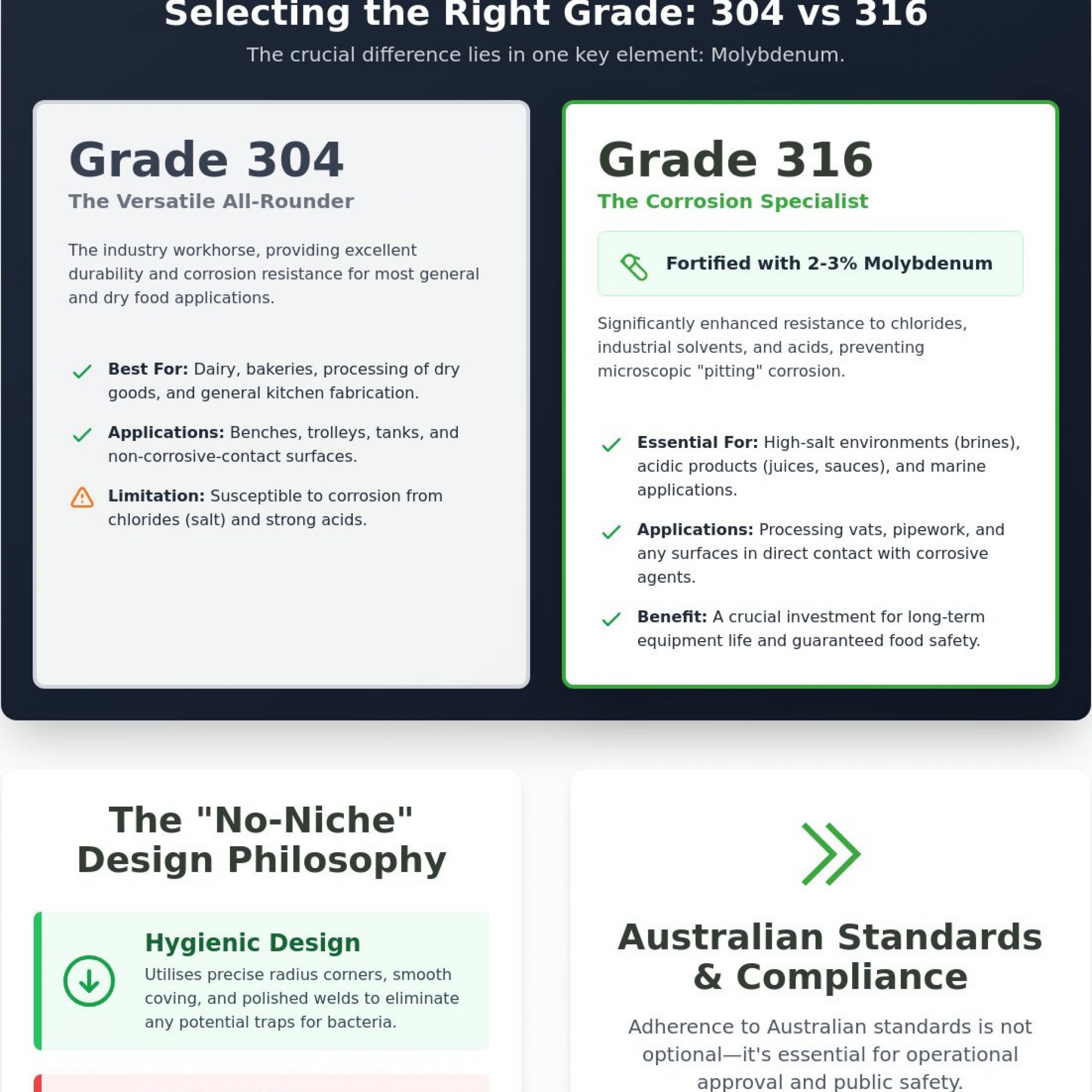
Choosing the correct alloy for food grade stainless steel fabrication is a decision that impacts the longevity of your equipment and the safety of your facility. While many grades of stainless steel exist, the Australian food industry relies almost exclusively on two: Grade 304 and Grade 316. The primary difference lies in their chemical composition. Grade 316 contains an addition of 2% to 3% molybdenum. This specific element significantly enhances the metal’s resistance to chlorides and industrial solvents, making it a specialist material for harsher environments.
From a cost-benefit perspective, Grade 304 is the industry standard for most dry food applications. It provides excellent durability and corrosion resistance at a lower price point than its 316 counterpart. However, the extra investment in Grade 316 becomes non-negotiable when your processes involve high salt concentrations, brines, or strong acids. Failing to specify the correct grade can lead to “pitting” corrosion, which creates microscopic traps for bacteria that no amount of cleaning can reach. Adhering to the guidelines set out in AS 4674-2004 ensures your material selection aligns with Australian regulatory expectations for food premises.
Grade 304: The Versatile All-Rounder
Grade 304 is the workhorse of the food industry. It is the most common material used for custom stainless benches and trolleys found in commercial kitchens and processing plants. This grade is perfectly suited for dairy, meat, and vegetable processing where moisture is present but salt levels remain moderate. Its main limitation is its vulnerability to high chloride environments. If your facility uses heavy brine or is regularly hosed down with high-strength chlorine sanitisers, 304 may eventually show signs of surface tea-staining or structural degradation.
Grade 316: The Acid and Brine Specialist
When the environment becomes aggressive, Grade 316 is the only reliable choice. It is essential for pickling lines, seafood processing, and any application involving high-salt products. In South East Queensland, coastal processing plants often prefer 316 even for non-contact surfaces to combat the corrosive effects of salt air. This grade is also the standard for industrial pipework handling hot liquids or chemical cleaning solutions. While the initial cost is higher, the reduction in maintenance and the prevention of premature equipment failure provide a much better return on investment. If you are unsure which grade your specific process requires, our team can provide a technical assessment of your environment to ensure your food grade stainless steel fabrication is fit for purpose.
Hygienic Design and Fabrication Techniques
While selecting the correct material is the foundation of food grade stainless steel fabrication, the design and assembly techniques determine the equipment’s long-term safety. A “no-niche” policy is the guiding principle here. This approach ensures that every single surface, joint, and support is accessible for cleaning and inspection. If a sanitising solution cannot reach a surface, bacteria will eventually find a home there. This is why radius corners, often called coving, are essential in benches and sinks. By replacing sharp 90-degree internal angles with smooth, curved transitions, we eliminate the tight spots where organic matter typically builds up.
The method of joining these components is equally critical. Tungsten Inert Gas (TIG) welding is the gold standard for hygienic work because it allows for high levels of precision and exceptionally smooth beads. For internal liquid handling, we use a process called back-purging. By filling the inside of a pipe with inert gas during the welding process, we prevent “sugaring” or oxidation on the internal weld face. This creates a mirror-smooth internal finish that is just as clean as the outside, ensuring no contaminants can snag on the pipe walls. Understanding these techniques is also covered in depth in our guide to industrial stainless steel fabrication for Australian industry, which explores how these same principles apply across a broader range of plant environments.
Eliminating “Bug Traps” in Fabrication
In the industry, we refer to crevices or rough welds as “bug traps.” These are microscopic or macroscopic gaps where bacteria can multiply, shielded from standard cleaning cycles. When performing on-site industrial pipework repair Brisbane, we prioritise slug-free welding to maintain a completely unobstructed flow. Mechanical fasteners like pop rivets or exposed bolt threads are strictly avoided in food-contact zones. These components create deep recesses that are impossible to sanitise effectively, making them a significant liability during a health audit.
The Role of Precision in Installation
A perfect piece of equipment can still fail if the installation is flawed. We often utilise 3D scanning technology to ensure new components fit perfectly within existing plant layouts, leaving no awkward gaps between machines. Floor mounts and leg stands must be fully sealed or “shrouded” to prevent liquid ingress underneath the equipment. For facilities with unique plant floorplans, bespoke stainless steel fabrication allows for tailored solutions that follow the specific contours of your workspace. This level of precision ensures that food grade stainless steel fabrication remains a functional asset rather than a maintenance headache.
Australian Standards and Compliance (AS 4674)
Compliance with Australian regulations is the final, non-negotiable step in any project involving food grade stainless steel fabrication. The primary framework governing these environments is AS 4674-2004, which covers the design, construction, and fit-out of food premises. While Standards Australia has technically withdrawn this document due to its age, it remains the industry’s active benchmark and the standard local council auditors use to evaluate your facility. Meeting these requirements ensures your equipment isn’t just functional, but legally fit for purpose.
A central component of this standard is the “Grade A” requirement for food contact surfaces. This classification mandates that any surface touching food must be smooth, impervious, non-toxic, and resistant to corrosion. During the fabrication process, we pay particular attention to drainage and waste management systems. Poorly designed drains can lead to stagnant water and bacterial growth, so ensuring a correct fall and seamless integration with the floor is vital for passing an audit.
Navigating Food Safety Standards
The standard provides specific instructions for wall-to-floor junctions and bench splashbacks to prevent the accumulation of debris. For example, splashbacks must be an integral part of the bench or be permanently sealed to the wall to eliminate gaps. Materials used must be non-toxic and non-tainting to ensure no chemical transfer occurs during food processing. AS 4674 is the primary benchmark for food premises in Australia.
Documentation and Traceability
For large-scale industrial plants, the physical metalwork is only half of the story. You also need a comprehensive paper trail to prove compliance. This includes Material Data Reports (MDRs), which certify the exact chemical composition of the stainless steel used. Weld maps and inspection reports are equally critical, providing a documented record of every joint and the technician who completed it. Professional fabricators organise this compliance paperwork meticulously to prove that every aspect of the food grade stainless steel fabrication meets the necessary safety thresholds. This preparation allows you to present a complete safety file to auditors without stress.
If you are preparing for a facility upgrade or a council inspection, our team can help you navigate these complex requirements through our Stainless Steel Fabrication services.
Partnering with a Specialist Fabricator in Brisbane
Choosing a local partner for food grade stainless steel fabrication offers distinct advantages that go beyond simple logistics. In South East Queensland, our unique climate presents specific challenges for metalwork longevity. High humidity levels and coastal salt air can accelerate surface tea-staining if the finishing process isn’t handled with local expertise. A Brisbane-based fabricator understands these environmental factors and selects the appropriate finishing techniques to ensure your equipment remains pristine. Working with a local specialist also means your project benefits from custom stainless steel fabrication Brisbane services that are tailored to the exact dimensions of your facility, rather than trying to force off-the-shelf components into a bespoke layout.
Operational efficiency in the food industry relies on minimising downtime. When equipment fails or requires an urgent modification to meet a new safety standard, waiting weeks for a factory-based repair isn’t an option. Mobile workshops equipped for food-grade standards allow for rapid response and on-site precision. This proximity ensures that repairs and maintenance are carried out by technicians who are familiar with the specific regulatory pressures of the Queensland food and beverage sector. Long-term maintenance programmes further extend the life of your assets, preventing the small pits or scratches mentioned earlier from becoming major contamination risks.
On-Site Mobile Welding and Maintenance
Performing food grade stainless steel fabrication on-site requires a disciplined “clean-room” approach to welding. Our mobile workshops are designed to carry specialised tools, including orbital welders and high-grade grinding equipment, which are dedicated solely to stainless steel to prevent cross-contamination from carbon steel particles. This mobile capability allows us to perform complex modifications or repairs directly on your production line without the risk and cost of removing heavy equipment from the site. We utilise HEPA-filtered extraction systems during on-site work to ensure the surrounding environment remains clear of debris, allowing your facility to maintain its hygiene standards even during active maintenance.
Custom Solutions for Queensland Industry
Every food production facility has its own set of logistical hurdles. We utilise 3D scanning technology to map existing plant floors, ensuring that new conveyors, hoppers, or custom sinks integrate seamlessly with your current infrastructure and drainage points. This digital precision eliminates the gaps and “bug traps” that often occur with manual measurements. Beyond processing equipment, we also specialise in the integration of safety handrails and protection barriers within production zones, ensuring they meet both occupational health and safety requirements and food-grade hygiene standards. For a reliable partner who understands the technical demands of your facility, you can get a quote from the Donewright team to discuss your next project.
Securing Your Facility’s Future Through Precision Fabrication
Achieving a compliant and efficient food processing environment requires more than just high-quality metal. It demands a deep understanding of metallurgy, Australian Standards, and the practical realities of daily sanitisation. By prioritising the correct material grade and eliminating bacterial traps through hygienic design, you protect your operation from the high costs of downtime and audit failures. Expertly executed food grade stainless steel fabrication is an investment that pays dividends in safety and equipment longevity.
With over 20 years of experience in Brisbane industrial fabrication, our team understands the local regulatory landscape. We specialise in AS 4674 compliant designs and operate a fully equipped mobile workshop for on-site food plant maintenance. This ensures your facility stays operational without compromise. We’re here to help you navigate the technical requirements and deliver results that stand up to the toughest inspections.
Discuss your food-grade project with Brisbane’s experts at Donewright Stainless
Frequently Asked Questions
What makes stainless steel “food grade” in Australia?
Stainless steel is considered food-grade when it’s manufactured to be non-toxic, non-absorbent, and resistant to the specific acids or chemicals used in food processing. The material must have a smooth surface finish that prevents microscopic food particles from becoming trapped. In the context of food grade stainless steel fabrication, this also means the design must allow for total sanitisation without any inaccessible crevices where bacteria could multiply.
Is 304 or 316 stainless steel better for a commercial kitchen?
Grade 304 is the standard choice for most commercial kitchens because it’s durable and cost-effective for handling dairy, meat, and vegetables. However, Grade 316 is better if your kitchen regularly handles high-salt products, brines, or heavy acids. The molybdenum in 316 provides the extra corrosion resistance needed to prevent pitting in these harsher environments, making it a smarter long-term investment for specialised processing.
What is AS 4674 and why does my fabricator need to know it?
AS 4674 is the Australian Standard for the design, construction, and fit-out of food premises. It provides the technical benchmarks for everything from splashback heights to the radius of coved corners on benches. Your fabricator must be familiar with this standard to ensure your facility is legally compliant. This knowledge prevents expensive rectifications after a council health inspector identifies non-compliant “bug traps” or poor drainage during an audit.
Can you weld food-grade stainless steel on-site?
Yes, on-site welding is a common requirement for facility upgrades and emergency repairs. Specialist fabricators use mobile workshops to bring precision TIG welding equipment directly to your plant. To maintain food safety, the work area is usually screened off to prevent cross-contamination from other metals. This allows for bespoke modifications to be made to food grade stainless steel fabrication without the need to dismantle and transport heavy machinery.
What is a “hygienic weld” and why is it important?
A hygienic weld is a joint that has been expertly fused and polished to be perfectly smooth and free from any pits, cracks, or “sugaring.” This is critical because even a tiny microscopic crevice can harbour pathogens like Listeria or E. coli. By ensuring the weld is as smooth as the surrounding plate, we make certain that standard cleaning cycles can reach and kill all bacteria on the surface.
How do I clean and maintain food-grade stainless steel fabrication?
Regular cleaning with warm water and a mild detergent is usually enough to maintain the protective surface. For tougher grime, use specialised stainless steel cleaners that don’t contain chlorides, as these can damage the metal. Always wipe in the direction of the grain to avoid scratching the finish. Routine maintenance ensures the chromium oxide layer remains intact, which is what keeps the equipment resistant to corrosion and bacteria.
Does food-grade stainless steel ever rust?
Stainless steel can rust if its protective “passive” layer is physically damaged or chemically compromised. This often appears as “tea-staining” in coastal environments or near high-chloride processing lines. If the metal is exposed to bleach or harsh abrasives like steel wool, the surface can oxidise. Professional passivation treatments can restore this protective layer, but the best defence is using the correct grade of steel from the start.
Why is TIG welding preferred for food-grade projects?
TIG welding is the preferred method because it offers the highest level of control and produces no weld spatter. This precision allows the fabricator to create exceptionally clean, low-profile beads that require less aggressive grinding to achieve a hygienic finish. Because it’s a cleaner process than MIG welding, it’s far better suited for the strict cleanliness requirements of the food and beverage industry.